Page of Swords Tarot Card Meaning: Reversed, Love, as Feelings, Yes or No

Draw a Classic Tarot spread →Free, no sign-up. Think of your question, then draw.
In one line: Sword raised, looking all around, wanting to know everything.
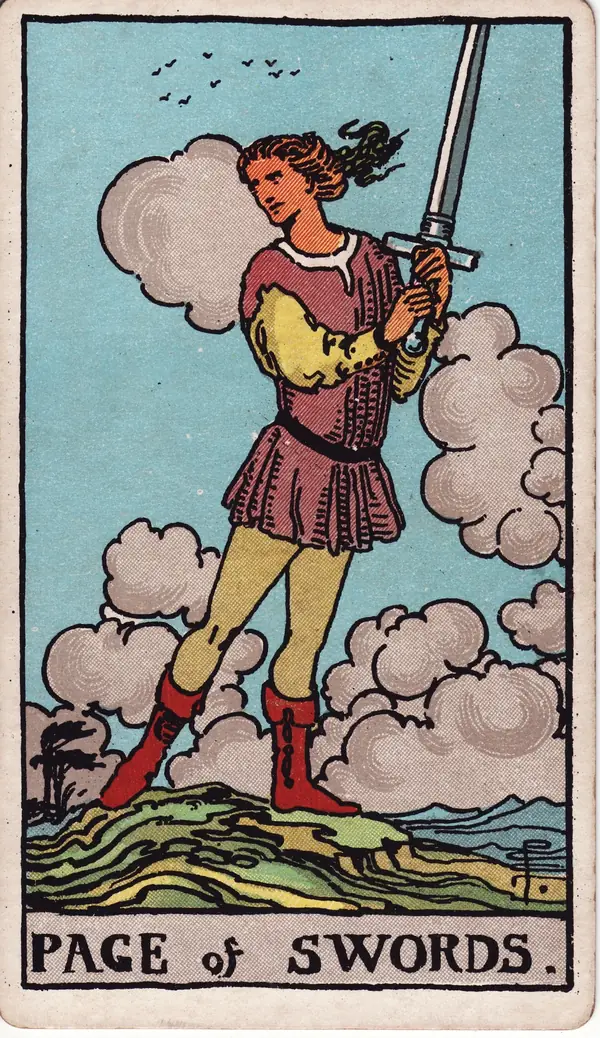
| Keywords | |
|---|---|
| Upright | curiosity, watchfulness, learning |
| Reversed | gossip, nosiness, talk without action |
| Type | Swords · air |
| Yes/no (our grading) | depends on the other cards |
Quick answers: yes/no · love · career
- Yes/No: Under our grading, Page of Swords depends on the other cards. Yes/no is the least reliable use of tarot—prefer “how should I approach this?”.
- Love: Testing the waters, lots of chat; reversed, prying or sharp words.
- Career: Good for study, research, writing; reversed, unreliable information.
*FateClear Editorial Team*
Want to draw a Classic Tarot spread? Draw cards.
In the Classic Tarot, the Page of Swords belongs to the Minor Arcana, to the Swords suit, and to the element of air. Court cards are usually counted as the eleventh through fourteenth cards of a suit, and the Page stands at the start of that arc—an apprentice rather than a master. On the Tree of Life, this card is often placed in Malkuth, the kingdom, the layer closest to ordinary life. That fits a figure who learns the rules of the world by walking into them, asking questions, and occasionally getting the answer wrong.
The image is easy to call to mind. A young person stands on uneven ground, holding a sword up beside the body with the tip toward the sky. The torso is angled, and the eyes travel past the blade to something farther off. Wind lifts the clothing, clouds move, and the footing is not level. There is no charge and no sheathed weapon. It reads as a patrol, a scan, a pause while waiting for a sound worth following. One line holds it together: sword raised, looking all around, wanting to know everything.
Upright, the card leans into curiosity, watchfulness, and learning. When it turns upside down, the same energy can scatter into gossip, nosiness, and talk without action. People often pull it in reverse and want a verdict on the spot. A kinder reading is that it shows where someone's cleverness is pointed, and whether their feet ever follow their questions.
Page of Swords Kabbalah and Tree of Life
In the Classic Tarot, court cards do not occupy the twenty-two paths. Their place comes from combining the rank element with the suit element on a sephira. The Page's rank element is earth, tied to Malkuth (the Kingdom), the tenth sephira, the layer of the physical world, the body, and results. Swords belong to Yetzirah, the world of formation, ruled by air. Together they form earth within air: the rank shows how this figure acts, while the suit shows what occupies their attention. Questions and judgments turn in the mind, but the hands still have to make those thoughts real.
Lower on the Tree of Life means closer to touchable life, and that placement matters. Even the sharpest idea has to survive a reality check. Malkuth is the last of the ten sephiroth, a closing of experience; the Page is the youngest rank, so this figure asks, watches, and tests before learning responsibility.
Fictional example: in a romantic connection, they may keep finding topics and want to know what you think—that is air. Real care looks earthy: they remember your schedule, check the route for you, and arrive on time. Air alone keeps the talk lively, but the relationship never quite lands.
At work, the same pattern appears: they gather material and raise questions, yet Malkuth asks for something deliverable—even one clear page of notes or a set of checked figures. In personal growth, they trade “I understand” for “I will try this for a week,” turning insight into a regular practice that involves the body and the calendar.
Astrologically, the card carries the earthier note of air. Court Pages are generally assigned no fixed zodiac sign, which fits the transitional feel of an idea that has formed before an identity has settled. Grounding does not make anyone duller; it gives intelligence somewhere useful to go.
Page of Swords Numerology
Court cards have no numbered pips, so numerology reads them through their position on the Tree of Life. The Page of Swords sits in Malkuth (the Kingdom), the tenth sephira, and 10 reduces to 1 (1 + 0 = 1). That gives two layers at once: 10 is the close of an experience, its results and accumulated material; 1 is the power to rise again and begin independently. In the Classic Tarot, the first major arcana card is The Magician, a natural link. The tools are already on the table; the question is whether there is will to use them.
This fits the card's meaning. The Page has collected news, questions, and scattered knowledge—the accumulation of 10—but has not shaped a method of their own. The Magician points to the missing move: decide what to do. If the Page is a student, the Magician is someone who can already put learning to use. The gap is not intelligence but willingness to own a choice. So the card often shows up as “I know a lot, but I have not started,” or “I just understood a little, and I want to try it now.” The shift from 10 to 1 also means the conclusion from last time can become the next starting point.
People with a Life Path number of 1 may recognize this card: independent, self-directed, ready to charge ahead, like an upright pole. Use it as a mirror, not a label. Ask what you could complete on your own next rather than pinning down a fixed identity. Court cards also carry age and maturity, so the number is only a supporting note; it cannot determine anyone's character or destiny.
Page of Swords and the Element of Air
In the Classic Tarot, Swords are the suit of air, centered on thought, speech, judgment, and the movement of information. Air makes people quick to react and good at seeing structure, but it also scatters attention. Wind has no fuel of its own. Fire pushes it faster, while water can blow emotion into loops of repeated thought. The Page adds earth: the body, a sense of reality, patience. Earth within air does not slow the wind; it asks the wind to land. Because this is the Page, the earth is still learning to settle, rather than already steady.
Elements cooperate and collide. Fire and air get along: enthusiasm drives action, and air helps fire find direction. Water and earth also work together, giving emotion a container and daily life some nourishment. Fire and water oppose each other, one burning outward and the other pulling inward. Around this card, many fire cards can turn curiosity into action, though the pace may become reckless. Many water cards send questions inward, producing more talk and heavier moods. Many earth cards can turn gathered information into concrete arrangements.
When air dominates a spread, it often points to overthinking, tangled news, and constant communication—the kind of day that will not slow down. When earth dominates, the theme shifts to practical life, money, the body, and follow-through. The Page of Swords sits between them as a reminder: stop adding questions, choose one thing you already know, and act on it. That might mean breaking a plan you have discussed into three steps, reducing saved material to one page, or setting a specific time to finish a conversation. Air supplies direction; earth gets you there.
What does Page of Swords mean upright?
Upright, this Page is the person who scans the room before sitting down. They have a real appetite for what is new, and their questions arrive faster than the answers. In conversation they pick up the second half of a sentence before you finish the first. At study, they find the main point and the right page quickly. At work, a fresh task gets their full attention, at least while it still feels like a puzzle. They are good at sorting complicated material into a few clear lines, and they often explain it better than someone who has known it for years.
The shadow is surface speed. Goals get chosen quickly and swapped just as quickly. Enthusiasm and focus tend to leave together, and the interesting middle of a project is where they disappear. They are not insincere. They are unfinished. The lesson this card keeps offering is simple: stay with one thing past the moment it stops being new, and let depth catch up with brightness.
Page of Swords reversed meaning
Reversed, the sword is still raised, but the direction wanders. There are plenty of ideas and very few landings. Promises are made brightly and then postponed, and accountability gets slippery—reasons come first, ownership comes later, if it comes at all. Goals blur. Today the plan is to learn a skill; tomorrow a different path looks more promising; by the weekend both have stalled at the first step. The person may be genuinely talented and still leave a trail of half-finished beginnings.
Words become the weak point. Something gets said too fast, too often, or with a little extra color added in the retelling. Hearsay turns into fact somewhere between one conversation and the next. A private remark becomes public material. Reversed, this card is not really about a lack of ability. It is about strength spent on talking and thinking instead of doing, and about a mind that treats every rumor as a research finding.
Page of Swords in love: single, in a relationship, reconciliation
In love, this Page brings conversation before commitment. The connection usually starts with a question, a shared link, a remark about something small you mentioned weeks ago. That can feel refreshing after heavier cards. It can also feel like standing near a window: you can see interest, but the door is not open yet. The sections below look at how the card behaves when it is upright, when it is reversed, and what it suggests for singles, couples, and people hoping to reconnect with an ex.
Page of Swords upright love
Upright love is curious and quick. The other person wants to know how you think, what you do on a normal Tuesday, which opinions you hold and why. They remember the odd detail you dropped into a conversation and bring it back later, which is flattering and slightly disarming. Messages may come in bursts: three in an hour, then silence for a day. The interest is real, but it lives in the head more than in a plan.
What to watch is follow-through. Someone can ask wonderful questions and still forget to confirm dinner. Enjoy the exchange, answer honestly, and notice whether their actions eventually match their curiosity. If they keep asking but never arrange anything concrete, you have learned something useful without having to guess.
Page of Swords reversed love
Reversed love is where signals stop matching. One day the messages are warm and constant; the next, they vanish, and the explanation is vague. The person may not be cruel. They may simply be confused, wanting closeness and fearing restriction in the same breath. But confusion passed on to you becomes your problem, and that is worth naming.
There is also a talking problem. Private matters may travel to friends, or a version of events may circulate that you barely recognize. If you are the one doing the retelling, pause before you turn a tender moment into a story. Reversed, this card asks for clearer words and fewer performances. Ask direct questions, and accept that a direct answer is more valuable than a beautiful one.
Page of Swords love for singles
For a single person, this card describes the urge to get out and meet people. You might strike up a conversation at a gathering, spend an evening comparing favorite films, or find yourself reading someone's profile with actual attention. The pleasure here is discovery: finding out that a person is funny, or stubborn, or unexpectedly knowledgeable about something obscure. That pleasure is worth having on its own.
The caution is mistaking a good conversation for a promise. This Page can chat late into the night and then wake up unsure. Give a new connection a few weeks. Watch whether curiosity turns into a second plan, a third message, a small act of reliability. Interest that never becomes effort is pleasant, but it is not a relationship.
Page of Swords in a relationship
In an established relationship, this card adds noise in the best and worst senses. The good version is a partner who shares what they read, asks about your day, and keeps the conversational door open. The tiring version is someone who makes plans on impulse and forgets to check the calendar you share. A weekend trip gets proposed on Thursday; by Friday they are absorbed in something else, and you are left holding the bag.
Say the practical thing early. If plans may change, ask them to tell you before they change. If a message matters, ask for it twice rather than assuming once was enough. This Page learns quickly when the lesson is concrete. Nagging rarely helps; clear agreements usually do.
Page of Swords and getting back with an ex
With an ex, this card often shows a test message: a quick hello, a link, a question about something only you would know. The person is genuinely curious about your life. They may also be checking whether their place in it still exists. That is not the same as being ready to rebuild anything. A knock on the door is not a moving truck.
Read the cards around it. Beside steady cards, the contact can grow into an honest conversation about what went wrong. Beside other restless cards, it may be a few messages and another disappearance. You are allowed to reply without handing over your whole position. Ask what they actually want, and notice whether they can answer without turning the question back on you.
Page of Swords as feelings: how they feel about you
When this card stands for feelings, the emphasis is on attention rather than devotion. Someone is watching, wondering, comparing what you say with what you do. They may feel more than they can express, but the first impulse is to gather information. That can look like interest from a distance, and it can feel both exciting and slightly exposed. The following sections separate the upright and reversed versions, then look at how someone sees you and what they may intend.
Page of Swords upright as feelings
Upright, they feel intrigued. You occupy a corner of their mind, and they return to things you said, turning them over. They may look up a topic you mentioned so the next conversation can go deeper. There is admiration for your mind, maybe a little competitive spark, and a wish to be found interesting in return. The feeling is alert rather than settled.
Do not expect a declaration yet. This is the stage of noticing, asking, and testing the air. If you want more, give them something to respond to: a clear invitation, a specific question, a plan with a time attached. Vague warmth can keep a Page circling for a long while. A concrete next step gives the feeling somewhere to land.
Page of Swords reversed as feelings
Reversed, their feelings are noisy and inconsistent. They may think about you constantly and still communicate poorly. They might ask friends about you instead of asking you. Defensiveness can appear when they feel seen too clearly, and they may retreat into jokes or analysis rather than say the plain thing. Mixed signals are not necessarily manipulation; sometimes they are the sound of someone arguing with themselves.
Your task is not to decode every shift. Ask one direct question and listen to the answer. If they can name what they feel and what they plan to do, the confusion may be temporary. If every question produces another riddle, believe the pattern rather than the poetry.
Page of Swords as how someone sees you
They see you as sharp, quick, and a little hard to pin down. You may come across as someone with opinions, someone who notices details, someone who will not accept a lazy answer. That can be attractive and mildly intimidating. They might also see you as guarded, because a fast mind can look like a closed door when it is really just a busy one.
If you want to be seen more warmly, let some softness show in ordinary ways: admit you do not know something, ask for help, share a small enthusiasm without dressing it up. The Page respects honesty. It responds well to a person who can be curious without needing to win every exchange.
Page of Swords as intentions
The intention here is usually to learn, ask, and test. They want more information before they commit to a direction. That can be healthy, especially after a painful history. It can also be a way of keeping one foot out the door. Look for specific intentions rather than general ones: not "I want to see where this goes," but "I would like to have dinner on Friday and talk about what we are doing."
If their intention is only to satisfy curiosity, no amount of reassurance will turn it into devotion. If their intention is to build something, the questions will start turning into arrangements. The difference shows up in calendars, not in compliments.
Page of Swords career and work (upright & reversed)
At work, this Page is the learner, the researcher, the person who asks the question everyone else was too polite to ask. That is an asset in roles that reward quick reading, clear writing, and fast response. It is a liability in roles that reward patience, follow-through, and discretion. The card does not promise a promotion or a windfall. It describes a style of working and the places where that style helps or hurts.
Page of Swords upright career
Upright, this is a good card for job hunting and for any task that begins with information. You find the right page, spot the relevant detail, and explain it without much fuss. Interviews tend to go well when you can give concrete examples instead of broad claims. Saying "here is a problem I solved and how I solved it" lands better than saying you are eager to learn. Research, writing, editing, coordination, customer questions, and troubleshooting all suit this energy.
On the job, new assignments get picked up quickly, especially when feedback is visible. The weak spot is the boring last ten percent. A report gets drafted and never proofread; a plan gets pitched and never scheduled. Build a small closing ritual—one final read, one calendar entry, one message to confirm—and the quality of your work will look much more consistent.
Page of Swords reversed career
Reversed, direction is the first thing to collapse. The days are busy, but the week has no shape. Plans are long and execution stops on the first line. Promises to colleagues slip, and the explanation arrives later than the work. Office talk becomes a hazard: repeating a rumor, commenting in a group chat, or forwarding a message without checking can create problems that are hard to undo.
Detail-heavy tasks deserve extra care. Emails go out with the wrong attachment; numbers get copied from an old version; a name is misspelled in a document that many people will see. Slow down before you hit send. If you are considering a new job, do not let frustration make the decision alone. Write three concrete criteria for what better looks like, then compare options against them.
Page of Swords for money and finances
With money, this Page is not a jackpot card. It is about information, judgment, and small daily choices. Air makes money move with news, and the Page reminds you that a message in your hand is not the same as a conclusion. Check before you act. That habit is worth more than any clever tip, and it protects you from decisions made in a moment of excitement or worry.
Upright, the strength is comparison. You read the terms, look at reviews, ask what a fee actually covers, and take time to understand a bill before paying it. That care saves real money on small things. The weakness is the abandoned system: a budget made beautifully on Sunday and ignored by Wednesday, a spending tracker that lasts four days. Pick one narrow target for the month—a subscription you no longer use, a weekly expense you can lower—and finish that instead of building an elaborate plan you will not maintain.
Reversed, money tends to follow mood and rumor. A message from a friend sparks an purchase; a discussion online makes a risky idea feel urgent; a sale creates a need that did not exist yesterday. There is also the avoidance problem: bills left unopened because opening them feels bad, and then a late fee arrives to make the bad feeling worse. Open the statement. Write down three months of spending. Separate what is necessary from what is automatic. None of this guarantees a result, and none of it replaces professional advice for a serious decision. It simply gives you a clearer floor to stand on.
Page of Swords for health
This card is linked with thinking, speech, and a nervous system that stays switched on. Its health message is not a diagnosis. It is a prompt about pressure and rhythm: when the mind keeps receiving and responding, the body eventually sends a signal that it needs a pause. Treat that signal as information, not as an inconvenience to push through.
Upright, energy is often decent and the mind is clear. You may feel ready to start a new routine, and that enthusiasm is useful. The risk is overestimating recovery. Coffee carries the afternoon, screens carry the evening, and the shoulders stay up near the ears without anyone noticing. Pay attention to sleep, breathing, eye strain, and tension in the neck and wrists. Put rest into the schedule before the schedule fills up. If something persists, see a doctor rather than asking a card to explain it. Questions about pregnancy belong with a medical professional; this page does not settle them.
Reversed, mental fatigue may show up before physical fatigue. Too much talk, too much scrolling, and a habit of answering messages in bed can keep the system humming when it should be winding down. Some people delay sleep to avoid the next day, then rely on stimulation to get through it. Try subtraction first: a fixed time to put the phone away, a short written list of tomorrow's tasks, a few minutes of quiet before sleep. If headaches, a racing pulse, or sleepless nights keep returning, get medical care. This is a reminder to rest and seek help when needed, not a treatment plan.
Page of Swords as advice
The advice of this card is about where to put your curiosity. Upright, the danger is cleverness that skims the surface. Reversed, the danger is a thought that never leaves the mouth or the notebook. Both versions point in the same direction: let the question become a step, and let the step have an ending.
Page of Swords upright as advice
Choose one subject and give it two weeks of small, daily attention. At the end, produce something you can show: a page of notes, a working draft, a tested recipe, a repaired shelf. When you hear a claim that makes you instantly angry or instantly excited, find the original source before you repeat it. Before speaking, take one breath and change "I heard" into "I checked." Be patient with people who learn more slowly than you do, and be patient with yourself when a question has no quick answer. Curiosity is a strength when it is aimed, and a distraction when it is everywhere at once.
Page of Swords reversed as advice
Write down what you want, then write down what you are willing to pay for it in time and effort. The lines that do not match are the ones to discuss, with yourself or with the other person. Say less and finish more. Shrink a promise until it is something you can actually complete, then complete it on the day you said you would. If you have been gathering information as a way to avoid deciding, set a deadline for the decision. If you have been repeating a story about someone else, stop and check whether it is yours to tell. A little restraint will do more for you now than another clever observation.
Page of Swords as a person
As a person, this card describes someone alert, verbal, and young in spirit even when they are not young in years. They ask questions, remember odd facts, and enjoy the moment a complicated thing becomes clear. They may be the first to share news, the one who notices a inconsistency in a story, the friend who sends three links about a topic you mentioned once. They are often good company and occasionally exhausting company.
They can also be restless. Quiet does not come naturally, and silence may feel like a problem to solve. Under pressure they may retreat into analysis or joke their way out of a sincere moment. They mean well more often than they appear to. Give them a direct request and a clear timeline, and they usually rise to it. Expect them to test ideas out loud; not every sentence is a firm position.
Page of Swords reversed as a person
Reversed, the same person becomes harder to trust with details. They may talk about people rather than to them, repeat what they have heard with extra seasoning, or promise more than they can deliver. The intelligence is still there, but it turns toward defending a story rather than finding out what is true. They might be easily bored, easily offended, and quick to explain why the fault lies elsewhere.
This does not make them a villain. It makes them someone who has not yet learned the cost of loose words. Keep your private information closer until they show they can hold it. Ask for specifics when they describe a plan. Notice whether they can apologize without adding a "but." People can grow out of this Page's reversals, but they grow by being held to ordinary standards, not by being rescued from them.
How to place it in a reading
Start with the position. In the past, this card often points to a period of learning, a question that started everything, or a message that changed your direction. In the present, it suggests scattered attention and a lot of incoming information. In the future, it warns that news will arrive before clarity does, and that you will need to ask, verify, and react quickly. In a position about another person, read it as their mental posture: watching, wondering, maybe not yet saying the whole thing.
Then look at the neighbors. Other Swords amplify reasoning and speech, which can be useful or sharp. Cups soften the card and turn questions into intimacy. Pentacles ground it, making plans more likely to become practical. Wands add speed and impatience. A major arcana card nearby raises the stakes: the matter is bigger than a passing curiosity. Reversed cards around it can show where the information gets distorted or where follow-through fails.
The traditional astrological note places this Page in the earthy part of air. Pages usually have no fixed zodiac sign, so the card is better read as a quality than as a person's birth chart. In the Tree of Life, its link with Malkuth is a reminder that ideas have to survive contact with daily life. A brilliant thought that never becomes a calendar entry, a budget line, or an honest sentence has not yet done its work. Ask what the next physical step would be, and the reading usually becomes clearer.
Our take
The Page's curiosity is valuable, and we would not want anyone to sand it down. The habit worth building is simpler: check your sources. When a claim arrives, ask who said it, what evidence sits behind it, and whether a reasonable person could see it differently. Apply that to news, to gossip, and to the stories you tell yourself about someone else's motives. You can ask boldly, learn quickly, and try new things without letting knowing replace doing. Keep those two guards in place—verify the information, finish the action—and this becomes a genuinely useful starting card.

FAQ
These are the questions readers ask most often when this card appears. The answers below are direct where the tradition allows a direct answer, but no card stands alone. Position, question, and neighboring cards still matter. If you are making a real decision, bring the practical facts into the reading as well, and do not ask one card to carry more weight than it can.
Is Page of Swords a yes or no card?
It depends on the other cards; alone, it is neutral and does not push a firm yes or no. The Page is an observer, not a verdict. Upright, it leans toward "gather more information and try a small step." Reversed, it leans toward "wait until the facts are clearer." In a yes-or-no spread, read the surrounding cards for direction, and treat this one as a note about how the answer will arrive: through a message, a question, or a piece of news.
What does Page of Swords reversed mean in a yes or no reading?
It still depends on the other cards, but reversed it usually favors waiting rather than acting. The reversed Page shows scattered information, mixed signals, or words that do not match behavior. That is rarely a clean green light. If the rest of the spread is steady, the answer may be "yes, but confirm the details first." If the rest is chaotic, treat it as a pause and ask a direct question before you commit.
What does Page of Swords mean if you have a secret crush?
It suggests mild curiosity about you, often from a distance, rather than a declared romantic interest. They may look at your posts, find a reason to talk, or ask a mutual friend about you. That attention is real, but curiosity is not the same as readiness. Give a little warmth back and watch whether questions turn into an invitation. If nothing concrete follows, enjoy the friendly exchange and keep your expectations steady.
What does Page of Swords mean for marriage?
It points to conversations and fact-checking, not a wedding announcement. This card cares about whether both people are saying the same thing clearly: plans for the ceremony, money, housing, and family expectations. It can also flag outside opinions being mistaken for a partner's view. If you are engaged, confirm details in writing and talk plainly. If you are not, the card invites an honest conversation rather than promising a proposal.
What does Page of Swords mean as an outcome?
The outcome is information: news, an answer, or a lesson that changes your next move. Expect the situation to resolve through communication rather than through a dramatic event. You may learn something that adjusts your plan, or receive a message that clarifies where you stand. The card does not guarantee the result you want. It does suggest that clarity is available if you are willing to ask and to hear an answer you did not script.
What timing does Page of Swords suggest?
Quickly and in fragments: news first, full clarity later. Think days or a few weeks, not a distant season. Pages are messengers, so this card often marks the early stage of a matter. Something arrives, you react, and the picture develops from there. Do not mistake the first message for the final answer. Give the situation a short window, then check again. If nothing has moved, ask directly rather than waiting on a silence.
Does Page of Swords mean pregnancy?
No. This card does not signal pregnancy, and tarot cannot confirm or rule it out. The Page is connected with questions, communication, and mental activity, not with matters of conception. If pregnancy is your actual question, use a reliable medical test and speak with a doctor. A reading can help you think about your feelings and your next conversation, but it is not a source of medical information.
What zodiac sign is Page of Swords?
Pages usually have no fixed zodiac sign. This one is often linked to the earthy part of air. That combination describes a mind that wants to be practical: ideas tested against reality, words checked against evidence. Some readers associate the card with Gemini or Libra because of the air element, but the tradition is not settled on a single sign. Treat the zodiac link as a flavor of the card's personality, not as a birth chart claim.
Is Page of Swords a good or bad card?
Neither. It is a neutral, mentally active card whose tone depends on how its curiosity is used. Used well, it brings learning, quick perception, and honest questions. Used poorly, it becomes gossip, nosiness, and promises without follow-through. Upright readings tend to feel fresher; reversed readings tend to feel scattered. Neither version is a punishment. Both are an invitation to aim the mind and let action catch up.
Related cards
- Knight of Swords: The same airy speed turned into a charge, showing what happens when the Page's questions become a fixed mission.
- Ace of Swords: The clear idea behind the Page's raised blade, useful when you need to cut through confusion rather than collect more facts.
- Queen of Swords: The Page's curiosity matured into discernment, with strong boundaries and a respect for honesty.
- King of Swords: Experience and judgment in the same suit, a reminder that knowledge becomes wisdom only after it is tested.
- The Fool: Another beginning card, but where the Fool leaps on instinct, the Page asks first and then decides.
- Page of Wands: A warmer, more impulsive beginning, useful to compare when you are deciding whether to think longer or simply start.