King of Swords Tarot Card Meaning: Reversed, Love, as Feelings, Yes or No

Draw a Classic Tarot spread →Free, no sign-up. Think of your question, then draw.
In one line: A judge on a high seat, speaking by reason.
| Keywords | |
|---|---|
| Upright | reason, authority, principles |
| Reversed | ruthlessness, abuse of power, sophistry |
| Type | Swords · air |
| Yes/no (our grading) | depends on the other cards |
Quick answers: yes/no · love · career
- Yes/No: Under our grading, King of Swords depends on the other cards. Yes/no is the least reliable use of tarot—prefer “how should I approach this?”.
- Love: A rational partner, more logic than feeling; reversed, cold and hard.
- Career: Professional authority, law, decision-making; reversed, high-handed.
*FateClear Editorial Team*
Want to draw a Classic Tarot spread? Draw cards.
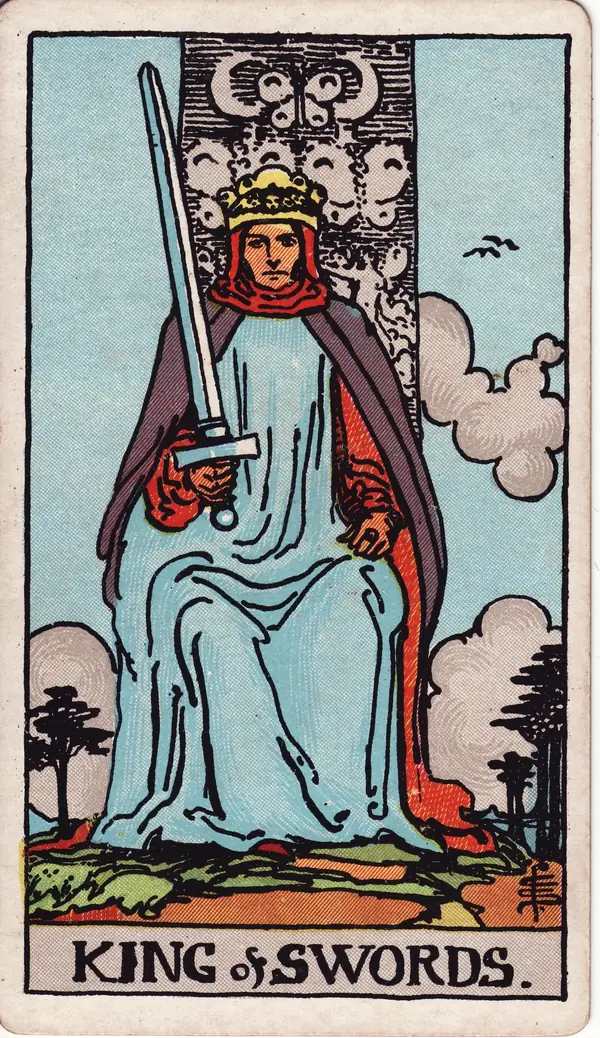
In the Classic Tarot, the King of Swords is a court card in the Swords suit, an air card. He sits on a high-backed stone seat, his crown level and his sword held upright. Clouds and birds move behind him, while trees and mountains rest in the distance. He does not look ready to charge. He looks like a judge who has heard both sides and is about to give a ruling.
The Swords suit governs thought, speech, judgment, and the way conflict is handled. As its king, this figure brings those themes to a mature, public, responsible level. His one-line meaning is simple: a judge on a high seat, speaking by reason. Reason, authority, and principles are his upright keywords, and his element is air. He can cut through confusion, but the cut can feel cold.
When the card turns upside down, the same rational system can lose its support. The judgment is still there, but the listening stops. Principles remain, yet they may be used as pressure. The difference between upright and reversed is rarely intelligence; it is whether the king still wants to hear the other person out.
King of Swords Kabbalah and Tree of Life
In the Classic Tarot, a court card on the Tree of Life is read in two layers: the rank supplies one element, and the suit supplies another element along with the world it belongs to. The King of Swords holds the rank of King, which corresponds to fire; Swords corresponds to air and to Yetzirah, the world of Formation. Put together, the card is fire of air—fire carried within the suit's air. Fire gives him the charge to begin, set a tone, and push things forward. Air shows what he values: ideas, language, information, and judgment. That gives the figure a concrete outline: he grabs the main point fast, then settles the situation with clear words.
Tradition often places this king in the second sphere, Chokhmah (Wisdom). That sphere stands for the first impulse to surface before an idea has taken shape, and it carries a masculine forward drive. It suits him: direction first, reassurance second.
Chokhmah comes directly after Kether (the Crown). It is creativity at its first spark, still unformed. Set here, his strength and blind spot arrive together. He is good at launching a thought, setting a tone, and gathering scattered information into one line. His blind spot is how quickly he mistakes the direction he sees for the only direction. Fire within air illuminates when it is steady; when it is rushed, it scorches. Astrology often puts the King of Swords near Gemini, which echoes his quick thinking, verbal strength, and habit of moving forward by trading information. It also warns that he can stay lodged in the mental layer. Traditions disagree on court-card and zodiac pairings, so treat this as a secondary color, not a rule.
None of this means much until it lands in ordinary life. In love, he cares whether things can be said plainly. He will bring up rules, boundaries, and plans. Fire wants a conclusion soon; air turns feelings into analysis. A partner can feel as if they are defending a thesis. At work, he is built for setting direction, breaking down problems, and handling outside communication. The more chaotic the information, the more useful he becomes. But when the team needs comfort, his fire can look too hurried. For self-growth, the card tells people with strong air and fire that they can hold a judgment without declaring the final outcome right away. Let the thought sit. Hear someone else's version. Then judgment can move from first reaction to genuine insight.
King of Swords Numerology
The King of Swords is a court card, so it has no pip number in the way the numbered cards do. Numerology cannot simply count “how many Swords” appear. A better method is to borrow its place on the Tree of Life, set the King in the second sphere, and enter through the number 2. Since 2 is already a single digit, it does not need to be reduced.
At its core, 2 is not about the surface choice between two options. It is about cooperation in a relationship: seeing another person, feeling the atmosphere, looking after each person's emotions, and reading people from small details. Its Major Arcana counterpart is the High Priestess. She does not win through noise. She wins through quiet, observation, and inner knowing. This forms a neat inside-outside pair with the King of Swords, who judges on the outside.
Place 2 beside the King of Swords and an overlooked side appears. On the surface he talks about rules. Underneath, he cares whether the other person feels understood and whether the room is out of balance. Number 2 makes him sensitive to the emotional temperature of a relationship, while the king's sword requires him to turn those impressions into a judgment. He may say, “Do it by the terms,” while he has already noticed the hesitation in your voice. The problem is that 2's sensitivity, if left unsaid, becomes guesswork; and the king's authority, if it overpowers 2's cooperation, becomes a one-sided conclusion.
For someone whose life-path number is 2, this card can serve as a mirror: you may truly be good at reading people, but watch how over-accommodating can leave you feeling wronged and how too much analysis can wear the other person out. Court cards are often read in numerology as stages of maturity. The king stands near the later end, meaning these traits have already formed and are more likely to become fixed. So this card is not giving you a final answer. It is a reminder that observation is a gift, and how you use it is still up to you.
King of Swords and the Element of Air
Swords belongs to air. Air is fast, light, and fluid. It turns experience into concepts, recasts feelings as reasons, and finds the gap in an argument. Air has no fuel of its own. Fire sets it in motion, water weighs it down, and earth gives it ground. That is why Swords cards often carry a “thinks a lot, talks fast, may not follow through” quality. Under stress, air can turn into sharp language that cuts others first and the speaker second. The king brings this air to maturity. He is no longer just clever; he is a stance that can own the consequences of a judgment.
A court card also asks you to combine the element of its rank with the element of its suit. The King corresponds to fire and Swords to air, so the result is fire within air. Fire provides initiative, courage, and the force to make a decision. Air provides information, language, and reasoning. The two cooperate: air gives fire direction, and fire gives air action. So this king does not stay in analysis. Halfway through a discussion, he puts a conclusion on the table. The mix has risks. If fire burns too hot, air whips it into a temper. If air scatters too much, fire may burn the wrong place. In this card, that looks like “fast judgment, hard tone, and only afterward the realization that he missed half a sentence.”
Elements also clash and support one another. Fire and air tend to feed each other; water and earth tend to steady each other; fire and water often run hot and cold and can struggle to meet. When a spread holds many Swords, it usually means the person is in a stretch of overthinking, too much incoming information, or frequent friction in speech. They need to turn ideas into steps they can actually take, not keep rehearsing the whole thing in their head. In a meeting where opinions are all over the place, he can pull the room into focus fast. But if someone there is hurting, dealing with the feeling first will do more good than another round of logic. In a relationship fight, fire within air can upgrade one complaint into a debate. Pause, repeat the other person's words back, and then state your own position. That is the mature use of this card.
What does King of Swords mean upright?
When the King of Swords appears upright, a situation has usually reached the point where someone must decide. A meeting has gone in circles, and he reduces the problem to three points, showing which has evidence and which is only frustration. A contract contains a vague clause, and he asks for it to be written plainly. A family disagreement is stuck, and he lays out time, cost, and responsibility instead of raising his voice. His authority comes from reason, not volume.
His reason, authority, and principles are reliable here. He stays calm under pressure, sees the cost of a choice one step ahead, and is not easily swayed by flattery. On the Tree of Life, this king is often placed near Chokhmah, the sphere of untempered wisdom. Insight arrives quickly, but without warmth it can become cold correctness.
King of Swords reversed meaning
Reversed, the king's intelligence does not disappear. What collapses is the support around it. Perhaps his advice was ignored, his decisions were overruled, or his competence was treated as a threat. He responds by closing the door: now he will not listen to anything. The outside looks harder, but the inside may be saying, "I need to be respected and understood."
This is where ruthlessness, abuse of power, and sophistry enter. Someone uses rules only when they favor him, calls control "for your own good," or turns up the volume to hide uncertainty. Sophistry is the clever argument that sounds fair while hiding a motive. The card is not a verdict that someone is evil. It asks what kind of support is missing and whether the person is willing to hear a real answer.
King of Swords in love: single, in a relationship, reconciliation
Love under this king starts with clarity, respect, and boundaries rather than constant closeness. You may be drawn to someone's judgment and then frustrated by how little he reveals. This card does not create romance for its own sake. It asks a practical question: can the two of you talk about what matters without turning the conversation into a cross-examination? The answer changes everything that follows.
King of Swords upright love
Upright, this is not the card of grand gestures. It is the card of a partner who remembers the appointment, reads the contract, and shows up when something difficult needs handling. He may say less than you want, but his word tends to mean something. Attraction begins in the mind: you respect how he thinks. The risk is that respect can feel like distance. Ask for warmth directly, and notice whether he can give it without treating the request as a flaw in the plan.
King of Swords reversed love
Reversed, love can become a case to be won. One person proves a point, the other goes quiet, and soon nobody remembers the original concern. You may hear cold logic, old mistakes brought back as evidence, or a flat "believe what you want." The stronger the case, the weaker the connection. Repair begins by stopping the debate and naming the feeling underneath it. If someone refuses to listen at all, that refusal is the real message, not the clever argument.
King of Swords love for singles
If you are single, this card often points to someone polished, articulate, and emotionally reserved. He may be visible at work, calm in a crisis, and interested in you without rushing to say so. He watches, tests the conversation, and decides whether you fit his idea of a serious partner. Do not try to outguess him. State your pace, your boundaries, and what you want. Then watch how he handles disagreement; that tells you more than his composure ever will.
King of Swords in a relationship
In a relationship, this king tends to appear when practical decisions pile up: budget, chores, family obligations, where to live, or how to divide the next few years. He is not unloving. He simply handles the logistics before he handles the feelings. Trouble starts when you want comfort and receive a solution. Hold the emotion first, then move to the plan. You can also say plainly, "I need you to listen before you judge." A good partner can learn that sentence.
King of Swords and getting back with an ex
Getting back with an ex under this king is less about missing each other and more about reviewing the old case. Can you name what broke? Is there a new agreement, or only a new mood? If one person lectures and the other silently endures, the reunion is just another negotiation. Look for an explanation of past harm, a change in behavior, and a willingness to set rules together. A polished speech is not the same as repair. Slow down before you sign the same contract again.
King of Swords as feelings: how they feel about you
Feelings questions ask what someone holds inside, but this king answers from the head first. The card often shows a person measuring, comparing, and searching for a reasonable account of the relationship. That does not mean he feels nothing. It means feeling sits behind judgment until he trusts that the connection makes sense. The useful question is not "Does he care?" but "Is he willing to leave the judge's seat and sit beside you?"
King of Swords upright as feelings
Upright, he likely respects you and finds your mind attractive. He may show care by helping with a problem, offering advice, or taking your plans seriously. He is guarded, though. He replies, but rarely spills. He notices your boundaries and expects you to notice his. This is not a game. He is checking whether the relationship can survive ordinary reality. If you make a specific request, he will probably take it seriously. If you only hint, he may retreat into reason.
King of Swords reversed as feelings
Reversed, he may feel unheard, unsupported, or quietly criticized. Instead of saying so, he becomes defensive. He answers "whatever" while keeping score, hears a challenge where you meant a question, or tries to control small details because the big picture feels shaky. He might also dismiss your friends, question your schedule, or decide things "for your own good." Do not call him a villain too quickly, but do not absorb the behavior either. Name the boundary and watch whether he takes responsibility.
King of Swords as how someone sees you
He sees you as capable, independent, and articulate, perhaps a little intimidating. You may come across as someone whose life looks organized, even when you do not feel that way. He might admire your standards and also wonder whether he can meet them. If he seems distant, it may be respect mixed with fear of rejection, not indifference. Warmth is not obvious in this card. A small, concrete sign of interest can do more than a clever exchange.
King of Swords as intentions
His intentions are usually honest but cautious. He wants a connection that can be discussed openly, and he may test compatibility through conversation before he offers more. Upright, he is not rushing you; he is deciding whether the two of you can build something stable. He may state his terms more plainly than you expect. Reversed, the intention can include a need to control or to win. Judge the behavior, not the speech. Consistency is the proof.
King of Swords career and work (upright & reversed)
At work, the King of Swords is a strong card for judgment, expression, and responsibility. He values structure, clear authority, and results that can be defended. This is a good time to explain your reasoning, put agreements in writing, and choose an environment where rules are visible. It is a harder card for workplaces that run on ambiguity, favoritism, or emotional pressure. The card does not promise promotion, but it rewards credible thinking.
King of Swords upright career
In an interview, you make a good impression when your answers have shape: background, trade-off, result. You do not need to be charming to everyone. Say what you can do, where your limits are, and how you handle conflict. The right role usually has clear reporting lines, fair evaluation, and room to make decisions. If you are already working, this card can point to a principled manager or to a moment when you must be the one who decides. When considering a move, read the contract carefully and ask who owns what.
King of Swords reversed career
Reversed at work, the usual story is a fight over authority. A manager changes direction without explanation, credit disappears, or blame travels downward. You may also be the one who has stopped listening after months of feeling unsupported. Do not make every meeting a battle. Put duties, instructions, and delivery standards in writing. Check the reality with a trusted colleague instead of carrying the whole story alone. If you lead a team, invite dissent before you decide. Authority is not silence; it is the ability to stay steady when someone disagrees.
King of Swords for money and finances
Money is not this king's main stage. He understands value and risk, but he is not built for indulgence or vague accounting. With this card, the theme is usually clarity: clear records, clear contracts, and clear answers about who owes what. It does not promise a windfall, and it should never be used as a reason to take a financial risk you cannot afford. A useful ritual is a quiet review of fixed costs, cash flow, unused subscriptions, and automatic renewals. Before a large purchase, write down the total cost, the exit terms, and the monthly effect. This will not make you rich, but it can keep confusion from making you poorer.
King of Swords for health
On health, this king is a prompt rather than a diagnosis. Air corresponds to breath, nerves, and thinking, and this figure tends to carry responsibility without complaint. The card often appears when the mind will not stop: the body is tired, but the internal meeting continues. Treat fatigue, tension, and poor sleep as signals, not as character tests. Build a wind-down period before bed, step away from work messages earlier, and take short movement breaks during the day. If symptoms persist or worsen, see a doctor. Pregnancy questions belong with a medical professional, not with a card.
King of Swords as advice
The King of Swords asks you to balance reason with human warmth. Upright, the danger is becoming too hard. Reversed, the danger is shutting everyone out because you were hurt. You can hold a principle without turning every conversation into a trial. You can ask to be understood without pretending you need nothing. The card is not asking you to become softer than you are; it is asking you to become clear without becoming cold.
King of Swords upright as advice
Upright, separate facts from feelings and wants. What actually happened? What did you add in your own mind? What do you truly want now? Decide by your principles, but leave room in how you say it. Let the other person finish before you deliver the verdict. If you have learned to sound hard in order to be taken seriously, try lowering the pressure and reducing control. Real authority is not fear. It is trust that survives disagreement.
King of Swords reversed as advice
Reversed, rebuild your support before you build another argument. Talk to someone trustworthy and check the facts. Are they truly rejecting you, or did you hear correction as rejection? If you are using stubbornness as armor, change the goal from "I must win" to "I must solve this." An apology is not a defeat. Changing your position is not the same as having no principles. Strength includes the ability to listen and still keep a boundary.
King of Swords as a person
As a person, the King of Swords is cool, articulate, and direct. He may be a manager, a professional, or simply the one in the family who reads the fine print. He does not waste words, and he can seem remote until you need someone to take charge. In the Hebrew alphabet, the king rank is often linked with Yod, the small seed-point from which a letter unfolds. That image fits him: one clear thought can organize a whole room. If this card points to you, ask whether you have forbidden yourself from being soft.
King of Swords reversed as a person
Reversed, this person can be sharp, dismissive, or controlling. Logic becomes a weapon, and every conversation turns into a chance to prove you wrong. Underneath, there may be a wound: someone who once felt ignored now refuses to be vulnerable again. That explanation does not excuse the behavior. Keep your boundaries, say what you will not accept, and do not try to win him over with better arguments. If this is you, notice how much distance your certainty has created, and repair the support you pushed away.
How to place it in a reading
In a spread, position matters as much as the card. In the past, it can show a decision you made by reason, perhaps at a personal cost. In the present, it asks for a fair hearing and a clear standard. In the future, it often points to a conversation where terms must be set. As an obstacle, the problem may be too much logic and too little empathy. As a person, it can describe someone cool, direct, and senior, or the role you are being asked to grow into. Nearby Cups call for empathy; Wands call for action; Pentacles ask for a workable plan. No single card is the whole verdict.
Our take
The King of Swords usually has the facts on his side. His logic tends to hold up. The real question is delivery: can the truth be said in a way people can hear? His clarity can cut through a mess, and his principles can hold under pressure. But a relationship is not a debate, and a workplace is not only a scoreboard. Be strict about the issue and generous with the person. If the card is reversed, look for missing support before you blame yourself.

FAQ
These are the questions readers ask most often about this card. Each answer starts with the short version and then explains the reasoning. A court card can describe a person, a mood, or a way of deciding, and its position in the spread changes how it speaks. Read the surrounding cards and the real situation alongside this page. No single definition can carry the whole reading.
Is King of Swords a yes or no card?
It depends on the other cards. On its own, this king does not cast a simple yes or no. When supportive cards surround it, the answer leans toward yes because the matter can be reasoned through and someone is willing to take responsibility. When conflict cards cluster around it, the answer may lean no, or at least "not yet," because the missing piece is agreement rather than effort. Upright, it favors a decision made with evidence. It still does not promise the outcome you want.
What does King of Swords reversed mean in a yes or no reading?
It still depends on the other cards; this card alone does not decide. Reversed does not automatically mean no. It may show incomplete information, a shaky position, or a person who will not listen. If the surrounding cards are steady, the situation can still move forward after a candid conversation. If they are tense, resolve the disagreement before you ask for a final answer. The reversal changes the quality of the judgment, not the whole verdict by itself.
What does King of Swords mean if you have a secret crush?
They are probably observing you and thinking before they act. He may be interested, but he wants to know whether the two of you make sense together before he shows much. That can look like mixed signals when it is really careful pacing. Do not try to force a confession through hints. Say what you feel and what you can handle, then watch his actions. If he is serious, he will respond with something more reliable than pretty words.
What does King of Swords mean for marriage?
It can support marriage, but only if expectations and rules are discussed openly. This king is not against long-term commitment. He is against vagueness. Before marriage, talk about money, chores, family boundaries, and the kind of life you both want. Upright, the couple can usually have that conversation without turning it into a fight. Reversed, watch for one person using logic to override the other or avoiding a key topic altogether. The real test is how he treats you when you disagree.
What does King of Swords mean as an outcome?
A reasoned decision, a firm boundary, or an honest conversation is likely. This is not a card of sudden luck or emotional reunion. As an outcome, it suggests that facts will matter, terms will be set, and someone will have to act like an adult. Prepare by writing down what happened, what you want, and what you will not accept. The final result depends on maturity and on the cards around it, but the tone is likely to be clear rather than sentimental.
What timing does King of Swords suggest?
There is no fixed timing; this court card often describes a person or stance. Court cards do not carry a dependable calendar date. This one may point to a meeting, a decision, or a person entering the situation, but it will not tell you "next Tuesday." Look at the surrounding cards for pacing, and look at real deadlines in your life. If you need an answer, ask for one. Waiting for a mystical date will only keep you in the same seat.
Does King of Swords mean pregnancy?
This card cannot answer pregnancy questions; only a medical test can. Nothing in the King of Swords gives a reliable yes or no about pregnancy. The card may reflect planning, responsibility, or pressure around the topic, but it is not a diagnostic tool. If pregnancy is possible, take a test and speak with a doctor. Do not let a tarot reading delay medical care or create false certainty in either direction.
What zodiac sign is King of Swords?
Gemini, with the neighboring sign sometimes suggested; court card correspondences vary. Traditional correspondences place the Swords court in the air signs, and this king is most often linked with Gemini. Some readers also mention the neighboring sign, which is why you may see more than one answer. Treat the zodiac link as a layer of color, not a fact that overrules the card. His real signature is air: thought, speech, analysis, and the need to make a fair judgment.
Is King of Swords a good or bad card?
Neither purely good nor bad; it is a card of tested judgment. Upright, it can bring clarity, boundaries, and the courage to take responsibility. Reversed, the same qualities can harden into coldness, control, or clever excuses. The card is not a blessing or a disaster on its own. What decides the tone is the maturity of the people involved and the company the card keeps in the spread.
Related cards
The King of Swords rarely stands alone. These cards often sharpen or soften his theme.
- Queen of Swords: She shares his clarity but reads people and details more closely, so together they can sound like a debate between principle and empathy.
- Knight of Swords: He moves faster and speaks more bluntly, pushing the king's decision into action before every detail is settled.
- Page of Swords: He is the young, curious version of this airy family, reminding you to ask questions and check the facts.
- Justice: She also weighs evidence and consequence, so the pair often points to contracts, fairness, and accountability.
- The Emperor: He represents structure and control, while the King of Swords represents reason and judgment; together they ask who holds authority and why.
- Ace of Swords: It offers a clean beginning, and with the king it suggests that a sharp insight can become a firm decision.