Queen of Swords Tarot Card Meaning: Reversed, Love, as Feelings, Yes or No

Draw a Classic Tarot spread →Free, no sign-up. Think of your question, then draw.
In one line: Seated with sword upright, seeing people clearly.
| Keywords | |
|---|---|
| Upright | clear-sighted, independent, measured words |
| Reversed | sharp-tongued, cold, overcritical |
| Type | Swords · air |
| Yes/no (our grading) | depends on the other cards |
Quick answers: yes/no · love · career
- Yes/No: Under our grading, Queen of Swords depends on the other cards. Yes/no is the least reliable use of tarot—prefer “how should I approach this?”.
- Love: Independent and rational, won't settle; reversed, too picky or cold.
- Career: Sharp judgment, good for audits and management; reversed, cutting remarks.
*FateClear Editorial Team*
Want to draw a Classic Tarot spread? Draw cards.
The Queen of Swords belongs to the Swords suit in the Classic Tarot. Swords are the air cards: thought, language, judgment, conflict, and decision. The queen brings an inward, caring quality to that air, so her clarity is not cold by design. She notices what others avoid, names it plainly, and then decides what to do. Her core meaning is clear sight joined to firm boundaries.
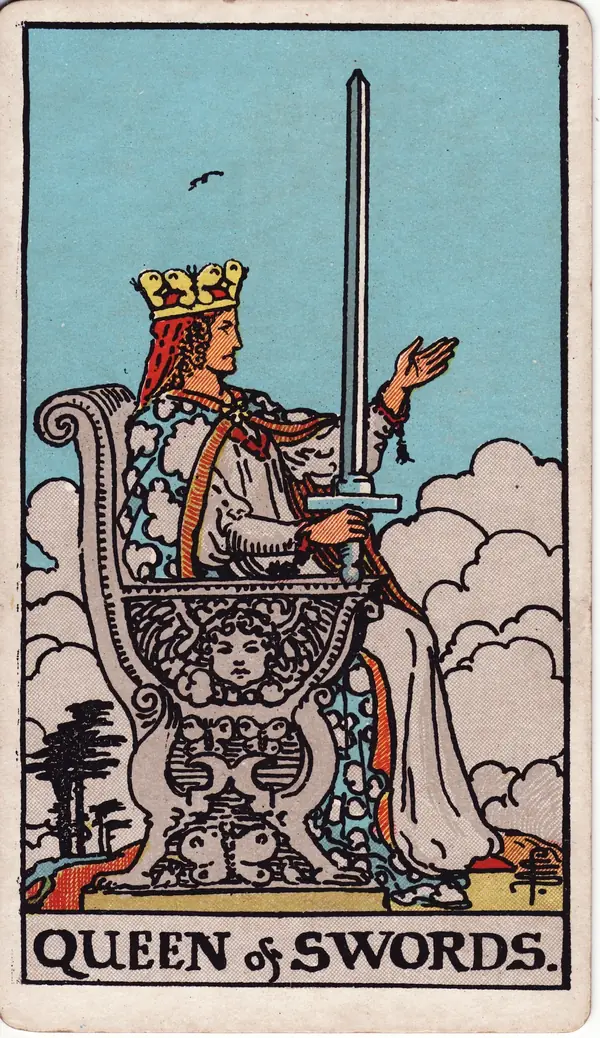
On the card, she sits upright with her sword held straight and her free hand extended. Her expression is the most serious among the queens. She looks like someone presiding over a room, pointing out the one detail everyone else missed. The blade is not there for display. It separates fact from wish, and it marks the line she will not allow anyone to cross.
When this card appears in reverse, her gift can turn brittle. The same mind that protects her may begin to criticize everyone, including herself. This guide looks at both sides of the card, then moves through love, feelings, work, money, health, advice, and the questions people ask most often. Context matters more than a single label.
Queen of Swords Symbolism: What Each Detail on the Card Means
In the familiar image of the Classic Tarot, she sits sideways on her throne, back straight, face drawn tight, gaze level. The profile pose suggests a habit of watching from the side and keeping a measuring distance while she observes. Her seriousness is not hostility; it is feeling kept under control. Upright, this is clarity that does not get pulled off course. Reversed, the same restraint can turn into keeping people far away, or scrutiny can slide into fault-finding.
The upright sword. She raises the blade vertically, edge toward the sky. Swords belong to air, the element of discernment, speech, and decision, and the straight posture implies principles that do not bend. Upright, she can cut a tangled problem into parts and separate fact from emotion. Reversed, the same blade may become a sharp tongue that wounds, or it can turn back on her as harsh self-criticism.
The extended hand. Her other hand opens outward, as if signaling stop or inviting the other person to explain. The gesture sets a boundary and leaves room for talk at the same time. Upright, she wants the rules stated plainly. Reversed, she may give only verdicts and refuse explanations, or let gestures and silence replace real conversation.
The crown and headdress. A crown rests on her head, edged with upward wing shapes. The crown says she has the authority to judge for herself; the wings suggest wind and the speed of thought. Upright, she takes responsibility for her choices. Reversed, authority can harden into “only I am right,” and she needs to check whether she has confused rank with truth.
The robe and cool colors. Cool blue, gray, and white dominate, cloud patterns fold through the fabric, and the crown carries a touch of gold. Blue belongs to reason and calm, gray-white pushes emotion back, and gold marks dignity and worth. Upright, these cool tones help her think in the middle of chaos. Reversed, too much cold makes her remote, as if every feeling has been switched off and only an untouchable shell remains.
The butterfly and winged faces on the throne. Butterfly patterns and the faces of winged infants often appear on the back of her seat. The butterfly stands for change and quick thinking; the infant faces suggest insight and protection. Together they turn air from something sharp into something that can recognize and renew. Upright, she distills judgment from experience. Reversed, change can stall into replaying old events, or she may pick at everyone else’s faults while refusing to revise her own view.
The sky and clouds behind her. Open sky spreads behind her, with clouds moving below and around her. Sky suggests clarity and height, while clouds suggest thought and uncertainty. Upright, she stands high enough to see far and can tell fact from imagination. Reversed, the clouds seem to press down, thoughts multiply, and guesses start to pass for conclusions.
The ground and her high seat. She sits above the ground, with cloud and stone beneath her rather than soft grass. Height gives her a wide view, and it also brings loneliness; the stone seat stresses stability and resistance to being moved. Upright, she holds her position under pressure. Reversed, watch for the chill of isolation, where independence becomes a pose of needing no one.
Queen of Swords Kabbalah and Tree of Life
In the Tree of Life correspondence, the Queen of Swords is a court card, so she does not take a path number from the major cards. Read her through three things instead: the element of her rank, the element of her suit, and the sephirah where she sits. The queen rank corresponds to water and is usually placed in Binah (Understanding), the third sephirah. Understanding here is not idle fantasy. It gathers raw impulse into shape and gives it limits and structure, so a person first grasps why something is happening before deciding how to answer.
Swords correspond to Yetzirah, the world of Formation, the air element, which governs language, information, discernment, and mental activity. Put the two together and you get what is often called water in air: water shows how she acts, by taking in, digesting, and then judging; air shows what she cares about, namely facts, statements, and boundaries.
This structure is useful at the table. In love, she is not without feeling. Her water side first senses the temperature of the bond, then her air side checks whether the other person’s words match their conduct. That is why she watches before she speaks, and why, once she speaks, she wants the rules made clear. At work, Binah helps her turn messy information into a structure, while air lets her explain that structure in plain language. Review, coordination, judgment, and any role that requires a firm stance fit her well. In personal growth, the boundary theme of the third sephirah reminds her that seeing the line between herself and others is not the same as pushing people away. Real understanding knows what to carry and what not to carry for someone else.
Reversed, the same map explains why she gets stuck: Understanding becomes overanalysis, boundaries become walls, and air becomes a loop of thoughts. The way back is to return to what Understanding actually means. Acknowledge the feeling first, then sort the facts, instead of crushing anxiety with an even harder conclusion. The usual astrological link places this court card near Libra, which emphasizes fairness, measure, and weighing things within a relationship. That fits the balance of Binah and the judgment of air. Traditions do not all agree on court-card astrology, so treat the link as an extra angle, not a rule.
Queen of Swords Numerology
Court cards have no pips, so numerology cannot read them straight from a number on the face the way it reads the Two of Swords or the Three of Swords. A common approach borrows the card’s place on the Tree of Life and works from the number 3. In life-path numerology, 3 is about creativity, inspiration, expansion, and social connection, and it matches the Empress among the major cards. The Empress here is not the Queen of Swords herself. It is the power of 3 to gestate an idea until it takes form: first inspiration, then expression, relationship, and creation bring it into the world.
Placed in the current of 3, the Queen of Swords did not get her edge from nowhere. She takes in a great deal of information, understands and organizes it, and only then forms a judgment. Her language and organizing skills often give her influence in a group. The expansive, sociable side of 3 is in tension with her solitude on the card: she can deal with people without necessarily letting them into her inner world. She is not a lone thinker; her ideas need an audience, even when she keeps that audience at arm’s length. Upright, the creativity of 3 shows as clear expression and a view of the whole picture. Reversed, expansion runs over: too many ideas, too many opinions, or insincere words spoken to keep up appearances.
For someone on a life path of 3, this card can serve as a mirror. You have a natural gift for expression and connection, but the queen reminds you that inspiration needs boundaries, relationships need sincerity, and cleverness should not be used to hide care. Court cards are also often read as stages of maturity, so this card is like an adult version of 3: someone who turns creativity into rules and learns to answer for what she says. This is not a verdict, only one thread for understanding yourself.
What does Queen of Swords mean upright?
Upright, Queen of Swords is the person who can stay calm while the room is chaotic. She listens, sorts the facts, and asks the question that ends a long, circular discussion. Her judgment is usually accurate because she is willing to look at what is inconvenient. She speaks with care, but she does not soften a truth until it becomes useless. Because her boundaries are visible, some people keep their distance; they may mistake precision for coldness.
Underneath, she feels deeply. She remembers old kindnesses and old wounds, and she can be lonely in the middle of a busy life. A sharp comment may hide a concern she does not know how to state directly. She needs respect more than flattery. When someone shows real competence and treats her as an equal, her guarded manner relaxes, and her dry humor appears.
Queen of Swords reversed meaning
Reversed, this queen does not become her opposite. Her clarity has simply been overused or knocked off balance. Perhaps her pride took a hard hit, and now she questions every decision she makes. She may insist that other people’s opinions do not matter while quietly reorganizing her life around them. The result is a strange mix of defiance and self-doubt.
Another version of the reversed card shuts feeling down altogether. She becomes stubborn, unwilling to hear another view, or so precise with her words that they land like small cuts. The sword that once drew a boundary now keeps everyone at a distance. The criticism may be aimed outward, but it often starts within. She needs to admit that she is hurt before she can lower the blade.
Queen of Swords in love: single, in a relationship, reconciliation
In love, the air of Swords meets the queen’s inward nature. She thinks quickly and feels slowly, or at least she expresses feeling slowly. She may understand a relationship in her head before her heart catches up. This does not make her less loving. It means she needs honesty, respect, and enough quiet to hear her own answer.
Queen of Swords upright love
Upright in love, she chooses with intention. She is not swept away by a grand gesture; she watches how someone behaves when they are tired, corrected, or asked to compromise. Once she commits, she is loyal and practical. She remembers the important date, notices the small stress, and plans for a shared future. Her tenderness often arrives as attention rather than poetry. To win her heart, skip the most expensive gift; something handmade, personal, or full of shared meaning tells her you were paying attention, and that moves her far more than a designer label.
Queen of Swords reversed love
Reversed in love, she may be guarding a wound she has not named. A casual remark can sound like disrespect, and she answers with distance or a perfectly aimed criticism. She may test a partner instead of asking for reassurance. The feelings are still there, but they are filtered through hurt pride. Until the hurt is spoken plainly, affection can feel like cross-examination.
Queen of Swords love for singles
For singles, this card describes clear standards and a strong reluctance to settle. She notices whether someone keeps small promises, speaks respectfully to service staff, and can disagree without becoming cruel. She may seem hard to approach because she is observing more than performing. If she says what she actually wants instead of waiting to be guessed, the right person has a fair chance.
Queen of Swords in a relationship
In a relationship, she is the partner who keeps the practical pieces moving. She tracks the schedule, spots the problem, and suggests a solution before anyone else has finished worrying. Her care can sound like management, especially during conflict. She improves the bond when she leads with “I felt hurt” before “Here is what you did wrong.” The second sentence can follow, but the first one opens the door.
Queen of Swords and getting back with an ex
Getting back with an ex depends less on nostalgia and more on respect. She remembers the good parts, sometimes more vividly than she admits. Yet her pride is strong, and a vague apology will not move her. She wants to know what the other person understood, what will change, and whether her boundaries will be honored this time. Clear accountability can reopen the door; repeated excuses close it.
Queen of Swords as feelings: how they feel about you
When this card describes feelings, look at behavior rather than declarations. The Queen of Swords rarely gushes. She may feel a great deal while appearing composed, and she may show interest by asking careful questions. Her mind is checking whether you are honest, whether you listen, and whether you treat her as an equal. Respect is the language her affection understands best.
Queen of Swords upright as feelings
Upright as feelings, there is genuine warmth beneath restraint. The person thinks about you seriously and may already be considering what a future together would require. They notice your competence and your character. They are less likely to say “I miss you” than to ask whether you got home safely or remember a problem you mentioned last week. The feeling is real; the delivery is measured.
Queen of Swords reversed as feelings
Reversed as feelings, the person is sensitive and defensive. They may care deeply but feel unsure whether that care will be respected. A small delay in your reply can become evidence that you are pulling away. They might answer coldly, then watch to see whether you stay. This is not indifference. It is a hurt pride trying to protect itself while waiting for a sign that you take them seriously.
Queen of Swords as how someone sees you
They see you as intelligent, self-possessed, and difficult to fool. You may come across as elegant in your boundaries, or slightly intimidating if they are unsure where they stand. They admire your honesty, even when it stings. They also wonder whether you need anyone at all. If you want them to approach, let a little ordinary warmth show; clarity does not have to become a closed gate.
Queen of Swords as intentions
Their intentions are serious but cautious. They want clear terms, truthful conversation, and a relationship that can survive real life. They are not interested in games, though they may test consistency before trusting. They intend to observe first and commit after the facts are in. If they ask a direct question, answer it directly. Evasion makes them withdraw faster than a difficult truth ever could.
Queen of Swords career and work (upright & reversed)
At work, this is one of the strongest queens in the deck. She can manage complexity, hold a standard, and make a decision without needing everyone to like her. She is suited to roles where evidence matters and where a calm voice must cut through noise. The reversed side shows what happens when evaluation becomes a weapon or when confidence collapses under scrutiny.
Queen of Swords upright career
Upright, she excels in judgment, review, planning, and management. She can run a project, edit a complicated document, audit a process, negotiate terms, or lead a team through a decision everyone has avoided. She thinks beyond the current week and sets goals three, five, even ten years out, then breaks them into plans she actually follows through on. People with this card in a career reading tend to rise at least into middle management, because they combine vision with a firm hand. She is not a people-pleaser, and that is an asset. She says no when no is needed. Her reputation grows because people trust her to be fair.
Queen of Swords reversed career
Reversed, workplace problems gather around evaluation and expression. She may have been criticized, overlooked, or second-guessed, and now she doubts her own read on the situation. She might overfocus on what a manager thinks, or swing the other way and become rigid, abrupt, or dismissive of advice. The remedy is to separate fact from feedback. Write down what happened, check it against evidence, and respond from clarity rather than wounded pride.
Queen of Swords for money and finances
With money, Queen of Swords favors reason over impulse. She compares value, reads the details, and asks what a purchase will cost over time. She is less impressed by a label than by durability and usefulness. This card is not a promise of wealth, and it does not point to a shortcut. It describes a steady approach: know the numbers, set a plan, and keep emotion from signing the check.
Reversed, money decisions can be driven by pride or self-doubt. She might spend to avoid feeling small, or refuse a sensible opportunity because she no longer trusts her own judgment. Watch for purchases made to prove a point. A cooling-off period helps. So does reviewing a decision with someone whose judgment is calm rather than flattering. Stability comes from honest arithmetic, not from winning an argument with a bank balance.
Queen of Swords for health
This card suggests a busy mind and a body that has been asked to wait. She may push through fatigue because the task is not finished, then wonder why she feels drained. Tension often shows up in the shoulders, jaw, eyes, or sleep. The helpful response is ordinary and consistent: protect rest, take breaks from information, move gently, and tell someone trustworthy that the week has been heavy.
Reversed, stress may be held more tightly. She could lie awake replaying a conversation or mask anxiety with a cold, efficient manner. This card cannot diagnose anything and should not be used instead of medical care. If low mood, worry, or sleeplessness persists, seek professional support. If your body sends a signal, have it checked by a doctor. Rest is not a reward for finishing everything; it is part of being able to continue.
Queen of Swords as advice
The card’s advice is not to become softer at any cost, and it is not to stay armored forever. It asks for a mature combination: clear thinking with enough warmth to keep the connection alive. Say the true thing, but choose a tone that can be heard. Set the boundary, but leave room for a question. The queen is most powerful when her honesty creates safety rather than fear.
Queen of Swords upright as advice
Upright as advice, trust your read and say what you need. If a situation has been vague, name the facts and the limit. If you care about someone, do not assume they know; put the care into words. You can be direct without being cruel. Replace “You always do this” with “When this happened, I felt alone.” Keep the boundary, but let the person see the human being who drew it.
Queen of Swords reversed as advice
Reversed as advice, step out of the courtroom in your head. Not every criticism deserves a permanent place in your self-image. Write down what was said, then mark which parts are evidence and which are someone else’s mood. Do not use coldness to test love or sarcasm to prove intelligence. Ask for respect directly. If a situation repeatedly makes you doubt your worth, leaving may be the clearest boundary you can set.
Queen of Swords as a person
As a person, she is sharp, independent, and quietly sensitive. She may be the colleague whose approval means something, the friend who tells you the truth, or the relative who remembers every promise. She has high standards because she asks a great deal of herself. She appreciates competence and dislikes being managed by someone who has not done the work. Under her composed surface is a strong need to be valued for who she is.
If this card points to a man, he may be thoughtful and cautious to the point of overthinking. He could weigh too many opinions and struggle to make the final call. That is not a flaw in his character so much as a mind that wants to be fair and fears being wrong. Either way, the queen asks for respect, not instruction. Advice lands better when it comes as an equal’s perspective.
Queen of Swords reversed as a person
Reversed as a person, she may be wounded and unwilling to show it. Her wit turns sharp, her standards turn punishing, and her independence becomes isolation. She might reject help before anyone can offer it. Do not mistake this for strength. The kindest response is steady respect without a power struggle. She may need time, but she also needs someone who will not reward the armor by treating the person inside it as invisible.
How to place it in a reading
Position changes the card’s role. In the past, she often points to a moment when someone saw a situation clearly and ended an illusion. In the present, she may describe the need to stay levelheaded while feelings run high. In the future, she suggests a decision, a boundary, or an honest conversation that brings relief. In an obstacle position, she can warn that reason has become a wall. In an advice position, she asks for truth with a human tone.
Neighboring cards adjust the reading. Cups soften her and bring feeling into the conversation. Wands speed up her judgment and add courage, though they can also add impatience. Pentacles turn her clarity toward budgets, schedules, and practical commitments. Another Sword card can sharpen the mind or sharpen the conflict. Read the card with its question and its neighbors, not as a slogan.
Our take
Before you reach for keywords, decide who she stands for in the spread. She may be you: the one who has already seen the situation and is ready to state the boundary. She may be the other person: someone whose thoughts stay behind reason and who watches before answering. She may also be a third party’s opinion, such as family, a coworker, a supervisor, or a reviewer, entering the matter with standards and judgment. These three readings differ sharply. If she is you, the question is whether and how to speak. If she is the other person, the question is what they are weighing right now. If she is a third party, the question is how an outside standard is shaping the decision.
Next, look at how many Swords appear in the whole spread. A heavy Swords presence means overthinking has taken over: plenty of information, plenty of assumptions, plenty of rehearsal, and very little that actually lands. The queen is then not a calm voice on her own; she is scrutiny magnified, and the more right she feels, the more tired she may become. When Swords are few and other suits dominate, her clarity works like an anchor, helping the querent recover judgment in the middle of emotion or action. Read her through that proportion before you read her alone.
Then follow her line of sight. Because she looks out from the side, her gaze often points to the theme of the neighboring card. Toward Cups, feeling is what she is weighing. Toward Wands, judgment is about to become action. Toward Pentacles, practical conditions and long-term arrangements are the focus. Toward another Sword, thinking, argument, or the urge to cut something off gets amplified. If her blade or extended hand aims at a card, that card is what she is drawing a line around or asking to explain itself. A card she faces carries more weight than one behind her.
If you use Past, Present, Future, her position changes the question directly. In the past, she says you once protected yourself with a clear judgment. In the present, she asks whether you have seen the truth and still not spoken. In the future, she suggests that terms must be stated next. Her astrological link is usually Libra, which speaks of fairness, measure, and relational weighing. In a spread, use it to ask: are both sides held to the same standard, and who is paying the cost of this judgment? That is more useful than reciting “calm and rational” from memory.
Queen of Swords in Different Positions: Past, Present, Advice, Obstacle
Past. In the past position, she often marks a moment when something became clear: a conversation where the truth was finally said, or a person who shaped you with standards and demands. The past position asks what formed the current situation, and she answers that reason once protected you, or that cold words once cut off a relationship. Upright, the experience left you with judgment. Reversed, it left wounded pride and unfinished sentences that still affect how you read people.
Present. The present position asks about your current stance. Her arrival suggests you have already seen the facts in outline but are still deciding whether to act. It can also show an effort to stay levelheaded and stop being dragged by emotion. Upright, that clarity is a resource; it is a good time to put boundaries and conditions on the table. Reversed, it signals imbalance now: either you are guarding too tightly, or rejection has made you doubt your own read. Check whether you are solving the problem or tending a wound.
Future. In the future position, she points to a stage that will call for a clear stance and a firm line. This does not have to mean separation; it may mean renegotiating the terms of a relationship or a collaboration. Upright, events move toward plain speech and agreed rules. Reversed, the benefits of a positive card are cut in half: delay, repeated testing, or seeing the truth and still not acting. The future is not fixed. The sooner the standard is stated, the less energy gets burned.
Advice. The advice position asks what to do. Her answer is not to stay cold, and it is not to shrink yourself into false softness. It is to express facts, feelings, and needs separately: first what happened, then how you felt, then what you want. Upright, the task is to establish clear rules; the tone can be gentle while the stance stays steady. Reversed, repair the imbalance first. Do not hand your judgment over to other people’s opinions, and do not use sarcasm to test whether someone cares. She is not asking you to win. She is asking you to stop being vague.
Obstacle. In the obstacle position, the problem is not that someone else is too clear-eyed. It is that this clarity is being used in the wrong place. Overanalysis, perfectionism, a cold tone, or a need to be right on every point can shut down a conversation that might otherwise work. Upright, the block may be standards set too high or defenses built too thick. Reversed, it may be stubbornness after a hurt, a cold war, or saying you do not care while waiting for the other person to bend first. Turn the sword from the person back to the problem, and movement becomes possible.
Outcome or clarifier. The outcome position asks what state things will settle into. Upright, matters tend to end with clear terms and visible boundaries. It may not be warm, but each person knows where they stand. Reversed, things can drag; the surface ends while the emotion has not, or pride costs someone a repair that was still possible. If she appears as a clarifier, she works more like a reminder: check who holds the standard and who is carrying the cost of the judgment. She is a positive card, so do not read the reversal as disaster. It means the benefits are halved and warmth and action still need to be added.
Queen of Swords Three-Card Example (Fictional Example)
Fictional example: The people and events below are invented; they exist only to show how a reading might work.
Question: Six months after a breakup, the ex has reached out again. The querent wants to know whether to answer and where the relationship would go if they do.
Spread: My state, the other person’s state, and the direction of the relationship, with one card for each.
Cards: Card one, “My state,” is the Queen of Swords upright. Card two, “The other person’s state,” is the Knight of Cups reversed. Card three, “Relationship direction,” is the Six of Swords upright.
My state: Queen of Swords upright. The querent has already seen the most damaging part of the relationship and knows she does not want to be led by ambiguity again. She still feels nostalgic and remembers the good scenes at night, but the upright queen lets her separate “Do I want this?” from “Is this worth it?” She can admit that she cares without melting the moment a familiar greeting arrives. What matters most to her now is whether the other person truly understood the original problem and whether this contact carries respect. The card also warns her that the calmer she looks on the outside, the more carefully she should check whether she is hiding a real need too deep.
The other person’s state: Knight of Cups reversed. The other person is not without feeling. The Knight of Cups carries an impulse to express affection and make a gesture; reversed, that impulse is unstable. He may be warm for a moment, say all the right things, and then pull back a few days later. He may also mistake nostalgia for love, or confuse “I am not doing well right now” with “I want to come back to you.” His actions and promises do not keep pace with his emotions, and that can leave the querent waiting all over again. The point is not whether he sent a message. The point is whether he can finish a thought and state his responsibility clearly.
Relationship direction: Six of Swords upright. The Six of Swords is not a guarantee of reconciliation. It is a passage from turbulence toward calmer water. The two may resume contact, but the subject may gradually shift from old grievances to practical arrangements. Or, after a few restrained conversations, each may set the relationship down in a quieter place. Upright, the direction is away from ongoing drain, not back into the old pull. If the querent chooses to answer, this contact is better used to close the loop and state the boundary than to confirm “we are starting again” on the spot.
Reading the three together. The spread has no major cards, which makes this feel like a specific relationship choice rather than a fate-level turn. Two Swords and one Cup put air above water: analysis, comparison, and review run the show. Feeling is present, but it sits in the back seat. In color terms, the cold blue-gray of Swords sets the key, while the Cup adds some warmth; the reversed Knight of Cups makes that warmth unreliable. The story is roughly this: the querent is clear, the other person is emotional but cannot produce steady action, and the relationship will slowly leave its most chaotic stage. The overall call is “you may answer, but do not rush to restore.” A reply is not a reconciliation. Put respect and facts on the table first, then see whether the other person can keep up.
Advice for the querent. Take a day or two and do not answer the moment the message arrives. Write down three sentences: whether I am willing to be in contact, what I want the other person to explain, and what I cannot accept. Keep the reply short, polite, and free of tests. A direct question works, such as “Is this contact meant to clear the air, or is it just a hello?” Then watch whether the other person’s actions match their words. If they only talk about missing you and dodge the original problem, treat the contact as closure. If they can be specific and stay consistent, consider slow contact. Do not use coldness to prove you do not care, and do not trade one soft moment for the old pattern.
Common Misreadings of Queen of Swords
Misreading one: she is cold and unfeeling. Her calm is a way of holding emotion back long enough to judge the situation, not proof that nothing is felt. The cloud patterns, her nostalgia, and her sharp tongue over a soft center all point to inner warmth. If you decide someone is heartless from this card alone, you may miss the warmth offered by a nearby Cup or a gentler card. Check what her sword is aimed at. Aimed at a problem, it is discernment. Aimed at a person, it is defense.
Misreading two: drawing her means a breakup or divorce. She makes boundaries, judgment, and communication the theme, but the result still depends on position and neighbors. Upright in an advice slot, she often says “say it plainly.” In an obstacle slot, she may say “too cold, too picky.” If cards of repair, commitment, or stability sit beside her, a serious conversation may actually make the relationship clearer.
Misreading three: reversed means she has become gentle. Reversal usually shows the upright energy in excess or out of balance. She may be cutting, stubborn, unable to hear another view, or shut down after a hurt. She does not automatically turn soft; the card warns that her clarity is losing its footing. Ask whether she is saying too much or saying nothing at all. Both versions need respect restored.
Misreading four: she only represents women. Court cards describe temperament and approach, not biological sex. A man who draws her may be the one who thinks too much, keeps high standards, and cares about respect without wanting to appear weak. A woman who draws her may be decisive and clear about boundaries. Look at whose life carries the air element and where the card sits, not at gender first.
Misreading five: she is blunt, so hurting people is fine. The Queen of Swords values truth, but truth does not mean leaving no room for anyone. Her maturity is not in saying the most final thing. It is in stating the facts, naming the boundary, and refusing to use language as a weapon. If cards of hurt, cold war, or separation sit nearby, examine how the message is delivered. “I am just honest” is not a way to skip the consequences.

FAQ
These are the questions that come up most often in readings. The card’s meaning still depends on the situation, the position, and the surrounding cards. A single card can set a tone, but it does not replace a careful look at the whole spread.
Is Queen of Swords a yes or no card?
She is not a flat yes or no by herself. In our grading, this card means “look at the surrounding cards.” Upright, she leans toward a clear, reasoned yes when the neighbors are stable and supportive. If the neighbors show conflict, delay, or separation, her clarity may express itself as a refusal. Reversed, she is harder to read as a simple yes because hurt pride or overthinking may be shaping the question. Context decides.
What does Queen of Swords reversed mean in a yes or no reading?
Reversed in a yes or no reading, the card leans away from a confident yes. The answer may be “not yet,” “not under these terms,” or “you already know the truth and are avoiding it.” If the surrounding cards show repair and honest communication, a difficult situation can still move forward. If they show coldness, repeated criticism, or exhaustion, the wiser answer may be no. Read the neighbors closely.
What does Queen of Swords mean if you have a secret crush?
With a secret crush, this card suggests observation rather than instant romance. The other person may be watching your character, your consistency, and the way you treat people. They are unlikely to rush toward a confession. If the card represents you, you may be analyzing every message instead of showing yourself plainly. Build trust through steady, respectful contact. Do not force a revelation before there is enough safety for one.
What does Queen of Swords mean for marriage?
For marriage, the card emphasizes communication, respect, and practical partnership. Upright, it supports a bond where two people can discuss money, family boundaries, and responsibilities without turning every disagreement into a contest. Reversed, watch for coldness, public embarrassment, or silent punishment. A strong marriage here is not built on constant romance alone. It is built on two people who can tell each other the truth and still behave kindly.
What does Queen of Swords mean as an outcome?
As an outcome, she points to a moment of clarity. A decision gets made, a boundary is stated, or a confusing situation is named for what it is. The result may feel cool at first because it requires honesty rather than comfort. It can also bring relief: the endless mental rehearsal ends. Expect a thoughtful resolution, not a sentimental one. Someone will likely choose the truth over the pleasing version of events.
What timing does Queen of Swords suggest?
The Queen of Swords ties timing to clarity rather than a calendar date: things move when the facts are clear or the honest conversation finally happens. It often points to a decision point rather than a calendar date. If you are waiting for movement, look for the moment when information arrives, a boundary is crossed, or a direct question can no longer be avoided. Use that moment rather than forcing an arbitrary deadline.
Does Queen of Swords mean pregnancy?
This card is not a pregnancy test and cannot confirm or rule out pregnancy. Nothing in the imagery or meaning gives a reliable answer to that question. If pregnancy is on your mind, treat the card as an invitation to seek clear information and speak with a doctor. A reading can help you explore your feelings, but it should never replace medical guidance or an actual test.
What zodiac sign is Queen of Swords?
The Queen of Swords is usually linked to the Libra end of the zodiac, the air sign of fairness, balance, and clear, even-handed judgment. Some readers also connect her with Aquarius, which highlights her independence and her ability to see a situation from a step back. Treat these links as useful lenses rather than fixed rules.
Is Queen of Swords a good or bad card?
She is neither purely good nor purely bad. When clear judgment, boundaries, and honest speech are needed, she is excellent. When her precision becomes criticism or her independence becomes isolation, the card shows a harder lesson. The sword can defend or divide. The difference lies in intention and tone. Ask whether the clarity in your situation is protecting something worthwhile or merely keeping intimacy away.
Related cards
- King of Swords: Shares her element but carries authority outward; together they help you tell fair judgment from control.
- Knight of Swords: Moves faster and turns her thinking into immediate action, with a risk of impatience.
- Page of Swords: Curiosity, questions, and fresh information; often news or learning when it appears beside her.
- Queen of Cups: The emotional warmth this queen sometimes needs to borrow; the two show head and heart side by side.
- Justice: Shares her concern with truth, fairness, and accountability.
- The Hermit: Solitude and reflection, a reminder to sort things out quietly before speaking.