Queen of Cups Tarot Card Meaning: Reversed, Love, as Feelings, Yes or No

Draw a Classic Tarot spread →Free, no sign-up. Think of your question, then draw.
In one line: Seated by the water, quietly holding her cup.
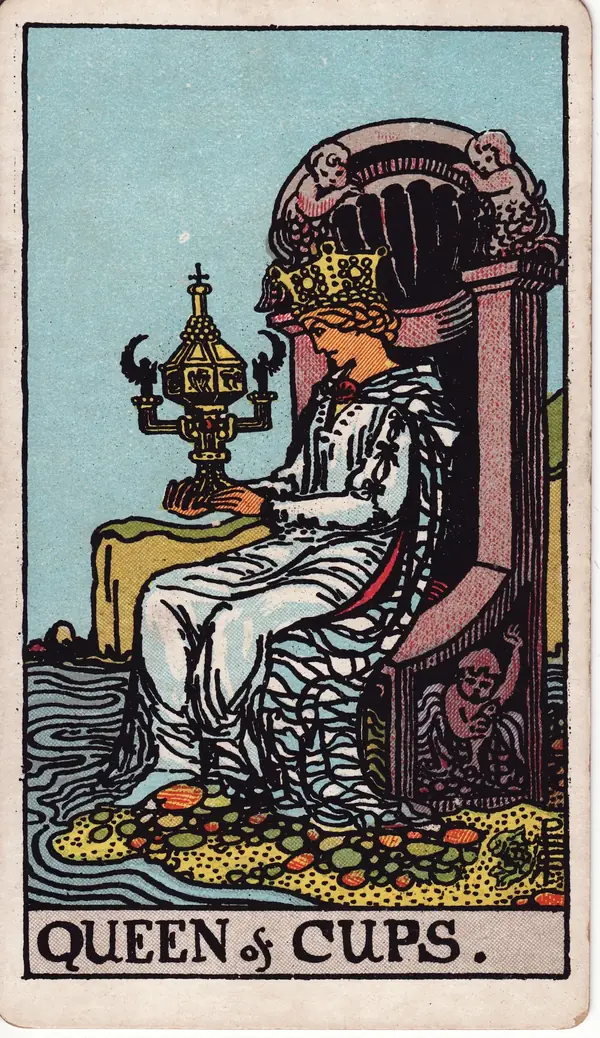
| Keywords | |
|---|---|
| Upright | empathy, gentleness, caring |
| Reversed | emotional drain, oversensitivity, people-pleasing |
| Type | Cups · water |
| Yes/no (our grading) | depends on the other cards |
Quick answers: yes/no · love · career
- Yes/No: Under our grading, Queen of Cups depends on the other cards. Yes/no is the least reliable use of tarot—prefer “how should I approach this?”.
- Love: Considerate and understanding; reversed, too sensitive or self-sacrificing.
- Career: Good for helping, counselling, care work; reversed, swamped by others' emotions.
*FateClear Editorial Team*
Want to draw a Classic Tarot spread? Draw cards.
The Queen of Cups sits at the edge of the sea, her throne resting on wet stone and her bare feet close to the shallows. In the Classic Tarot she is the thirteenth card in the suit of Cups, a court card of water. Both hands cradle a covered cup, and the sea behind her is calm but deep. Her one-line meaning is simple: Seated by the water, quietly holding her cup. She carries empathy, gentleness, and caring, yet her stillness is not passivity. She is listening.
Her power is receptivity. She notices what others feel before they say it, and she can sit with sadness without trying to chase it away. She is the friend who remembers that you hate loud restaurants, the coworker who sees you are overwhelmed before you announce it. But maturity is part of her image too. The cup has a lid for a reason. Not every feeling belongs to her, and not every person is entitled to the contents.
In the symbolism of the Tree of Life, she is often placed near Binah, the sphere of understanding, where received water is held and given shape. Thirteen, her number in the suit's older counting, suggests a passage from raw sensitivity into emotional adulthood. These are layers of meaning within the classic tarot tradition, not rules. When she appears upside down, the question becomes whether care has turned into self-erasure.
Queen of Cups Kabbalah and Tree of Life
In the Classic Tarot tradition, the Queen of Cups is often placed at the third sphere, Binah (Understanding). That sphere takes scattered impulse and gives it shape. Feeling is not denied or flattened; it gets a rim, a floor, a container. This is understanding that lets an emotion be known instead of merely spilled.
Her court rank carries water, and so does her suit. Cups also belong to Briah (Creation), which gives us Water of Water. The first water describes how she meets the world: through felt experience. The second describes where that experience goes: into relationships, memory, and emotional care. Gentleness is not just her manner. It is how she judges what is in front of her.
The structure is more useful than the labels. Rank tells you how she acts; suit tells you where she spends her energy. In love, she will not begin by out-arguing her partner. She listens for the hurt beneath the words. Without Binah's limit, listening becomes carrying the other person's burden. At work, she may be the natural mediator, the one who calms a client or trains a new hire because she feels the tension in the room. The shadow is just as concrete: a coworker's sigh turns into her responsibility, and she ends up doing work that was never hers. In her own growth, the card asks for a second move. A feeling has to be seen, then formed into a sentence she can say out loud. Water is useful only when it has a vessel. Without one, it floods the house.
Binah also suggests containment, gestation, and discernment. Her maturity is not endless softness. It is knowing when to catch and when to hand back. The usual astrological association places her near Cancer, and the fit is easy: outwardly considerate, inwardly protective of her own limits. Court card correspondences are not uniform, but read this way, the point holds. Feeling gets a place, and the place gets a boundary.
Queen of Cups Numerology
Court cards have no pip count, so the Queen of Cups' numerology is not about counting cups. Read her through her place on the Tree of Life. Binah is the third sphere, and three is built into her position. Three brings creativity, inspiration, and outward flow, along with a hint of social ease and romance. Among the Major Arcana, the number is often linked with the Empress. The Queen of Cups is thus a mature figure who carries that threefold energy into the emotional field. She has imagination and is willing to turn it into care.
The echo between the two cards is clear. The Empress speaks of abundance, gestation, and the slow work of letting things grow. The Queen of Cups gathers that abundance into relationship. She may set a comfortable table, remember who likes what, and help a nervous group settle. The difference is in the vessel. The Empress is soil; the Queen is a cup. Soil gives growth a place. The cup decides which feelings are worth holding.
Three without direction scatters. Feeling without a rim simply runs everywhere. With the cup's shape, inspiration becomes a considerate act: a note, a meal, a question asked at the right moment. For someone on a Life Path 3, this card can serve as a useful mirror. Ideas come easily and people come easily, but attention has to return to the few relationships that truly matter. That is a tendency, not a verdict. Court cards also suggest stages of maturity, so three should not become a fixed label. The energy is simple: radiate, then gather. Feel, then choose.
Queen of Cups and the Element of Water
Water in the Classic Tarot governs emotion, memory, relationships, and inner life. Its force is tidal: it comes close, soaks in, and slowly reshapes what it touches. It does not give orders. The Queen of Cups is a court card with water in her rank and water in her suit, making her Water of Water. She reads her own weather and picks up what others leave unsaid. But water takes the shape of its container. Without a boundary, her cup collects everyone else's spill.
Elemental pairings change the reading. Fire and air feed each other. Water and earth cooperate: earth gives the stream a bed, water softens the ground. Fire and water argue, one pushing ahead while the other stops to feel, and that argument can happen inside one person. Many Cups in a spread mean strong feeling and long thought, with action trailing behind. Pentacles ground her. Wands or Swords warn of friction between feeling and action, or feeling and reason.
For the Queen, much water is not automatically bad. In love, she helps someone lower their guard, then replays one cool remark all evening. At work, she listens, coordinates, and tends the team's mood. The trap is making "everyone happy" her private assignment. In self-care, she needs a regular outlet: a walk, a few notebook lines, a trusted conversation. The water must move. Pooled behind the ribs, it turns heavy.
The practical question is always the same: Is this feeling mine? Then she can decide whether to take it on. Water can feed a garden or swallow a road. A boundary is the shore.
Fictional example: A reader keeps soaking up a coworker's bad mood. Binah (Understanding) gives that feeling a container; her placement at three asks her to spend her warmth on bonds that go both ways; Water of Water reminds her that the storm in the room is not her climate.
What does Queen of Cups mean upright?
Upright, the Queen of Cups shows feeling that is available without being chaotic. You can name your own mood without turning it into everyone else's emergency. In a disagreement, you listen for the fear beneath the anger. You offer comfort without needing to fix everything. This is the empathy, gentleness, and caring side of the card, expressed as a steady presence rather than a performance.
Her maturity appears in discernment. She knows that holding space for someone is different from carrying their choices. She can say, "I hear you, and I cannot solve this for you." That sentence is not cold; it is honest. In daily life, this card might look like making tea for a friend, asking a quiet question, or apologizing without a speech. It may also look like protecting your own evening when you have nothing left to give.
Queen of Cups reversed meaning
Reversed does not make her cruel or false. It shows the water rising past the rim. The same sensitivity becomes emotional drain, oversensitivity, and people-pleasing. A short message gets reread for hidden criticism. You agree to plans you dread, then resent everyone involved. You become the reliable listener and wonder why no one notices you are drowning. Care turns into a role you cannot step out of.
Sometimes the reversal points to absorbing another person's weather until you cannot find your own. You may know their preferred comfort, their triggers, and their tone of voice, but not what you want for dinner. The first step is not to become hard. It is to admit, "I am affected." Then comes one boundary, small enough to keep: a later reply, a shorter visit, a clear no. The Queen is not broken; she is asking for a smaller cup and a fuller well.
Queen of Cups in love: single, in a relationship, reconciliation
Love readings bring out her need for emotional safety. The suit of Cups is about connection, but the Queen makes it specific: intimacy built on being heard, not performance. Upright, she leans toward tenderness and patience. Reversed, she can overgive and then quietly keep score. The card describes emotional weather, not a guarantee, so the neighboring cards still matter.
Queen of Cups upright love
Upright, affection shows up through attention. Your person remembers the small thing you mentioned last week, notices when you go quiet, and creates room for you to speak. Romance lives in rituals: a shared meal, a walk without phones, a hand on the back. If there is tension, this card favors a soft beginning. "I missed you today" opens more doors than a carefully built argument.
Her caution is worth hearing. Understanding someone is not the same as mind reading. Say what you need before resentment teaches you to withdraw. Warmth stays mutual when both people are allowed to be honest, including about the awkward parts. The Queen does not ask you to become a caretaker. She asks you to let care move in both directions.
Queen of Cups reversed love
Reversed, love can feel lopsided. One person keeps the emotional calendar, apologizes first, and tracks the other's moods. You say "I'm fine" while your face says otherwise, then feel abandoned when your partner believes you. Pleasing can look generous from the outside, but inside it breeds exhaustion and quiet resentment. Desire fades when you are always managing the room.
This is an invitation to speak plainly, not to become demanding. Try naming one need without a backstory: "I need twenty minutes of your attention tonight." Then watch what happens. A partner who can listen is worth building with. A partner who requires you to shrink is not made healthier by more patience. The card asks whether you are loving or performing, and whether the difference is visible to both of you.
Queen of Cups love for singles
For singles, this card is less about finding someone immediately and more about the kind of closeness you are ready for. You want to be known, not just chosen. That makes you attractive to people who value depth, but it can also draw those who want a rescuer. Watch the savior dynamic. Someone's sadness is not proof of compatibility.
You do not need to audition for love. Let interest build through consistency: who asks follow-up questions, who remembers, who can hear a boundary without turning it into a crisis. A quiet connection may develop slowly, and that pace is not a problem. Notice whether you are drawn to someone's potential or their actual presence. The Queen asks you to enjoy your own company while you wait for a match, not use it as a test.
Queen of Cups in a relationship
In an established relationship, this card often appears as domestic tenderness. Someone makes tea without being asked. The kitchen becomes the place where the real conversation happens. "How was your day?" is not small talk when it is asked with time behind it. This is a good moment to repair a cool patch with small gestures before analyzing the whole relationship.
Let care circulate. If you are always the one who remembers, schedules, and soothes, say so before you are bitter. If your partner is the one holding everything, ask what would actually help and then do it. The Queen thrives when tenderness has structure: a weekly check-in, a shared chore, an honest answer. She does not need a perfect romance, only one where both people can be soft without losing themselves.
Queen of Cups and getting back with an ex
With an ex, she offers a gentle signal, not a promise. There may still be real feeling, but feeling alone does not rebuild trust. A low-pressure message is more useful than a grand speech. Ask a simple question, listen to the reply, and notice whether the conversation has room for your experience as well as theirs. If it becomes a performance of who can care more, step back.
Look at the old pattern. Were you the one absorbing everything? Did they only return when they needed comfort? A reunion can be loving, but only if both people can name what went wrong without turning it into a trial. Closure can also be the kind choice. The Queen does not confuse nostalgia with readiness. She asks whether the water between you is fresh or simply familiar.
Queen of Cups as feelings: how they feel about you
When the card lands in the position for the other person's thoughts, it describes their inner weather rather than a script. They may feel tender, protective, and a little uncertain. The Queen rarely shouts her affection. She shows it sideways, through checking in, remembering, or sitting nearby without demanding conversation. That can be beautiful, and it can also leave you guessing.
Look at actions that repeat. A single thoughtful gesture is sweet; a pattern of thoughtful gestures is information. Reversed, their inner life may be flooded, and their care may come out as inconsistency or over-attachment. The card is a lens, not a transcript of their mind. Let it guide your questions, not replace them.
Queen of Cups upright as feelings
Upright, they likely feel a soft, genuine regard for you. They see you as someone safe to talk to, perhaps someone who understands without needing every detail spelled out. They may remember your preferences, notice your tired voice, and find reasons to be near you. Their affection is real, though it may be cautious. They might be waiting to see whether their sensitivity will be handled with care.
Do not mistake quiet for indifference. Ask directly and give them room to answer without an audience. At the same time, do not fill in the blanks for them. If they care, their behavior will become clearer over time. The Queen's warmth is a gift, but it is not a substitute for a clear "I want to see you." You are allowed to want both tenderness and follow-through.
Queen of Cups reversed as feelings
Reversed, their inner life may be messy. They could care deeply and still act inconsistently, because they are afraid of being too much or of losing control. They might overgive, then withdraw when they feel unseen. Sometimes they confuse pity with love, or lean on you as a emotional lifeline rather than a partner. Their feelings are not necessarily false; they are simply not settled.
Do not chase every mood. Watch for steady behavior: do they keep plans, tell the truth, and respect your no? You can be compassionate without becoming their container. If you are constantly decoding them, the relationship is asking too much of your attention. The card invites curiosity, not rescue. A person who wants to be close will eventually help you understand them.
Queen of Cups as how someone sees you
They may see you as gentle, perceptive, and a little mysterious. You seem like someone who listens, who notices the emotional temperature of a room, and who would not mock a vulnerable confession. That is a flattering view, and it can make you feel seen. It can also make them assume you are more certain or more patient than you actually are.
They might idealize your kindness, or they might worry that you are fragile. Both are projections. The card says your softness is visible; it does not say they understand everything beneath it. Let them meet the whole you, including your limits and your opinions. If they only value the version of you that never needs anything, that is useful information. Tenderness should not cost you your place in the relationship.
Queen of Cups as intentions
Their intentions tend to be caring rather than calculating. They want to nurture, understand, and make things emotionally easier. But the Queen can hesitate to make a bold move because she is waiting for the right feeling or the right moment. That may look like mixed signals when it is really caution. She wants closeness that feels safe, not closeness that has to be won.
If reversed, the intentions may be tangled: a wish for intimacy alongside a fear of responsibility. They may want to be needed more than they want to build something mutual. Judge by follow-through. Sincere care makes room for your no; it does not punish you for having a life. Ask what they are actually offering, not just what they feel. Clear intentions can survive an honest question.
Queen of Cups career and work (upright & reversed)
At work, her emotional intelligence is an asset. She reads the room, calms a tense meeting, and helps a client feel understood. These skills matter in roles that require trust, listening, or creative sensitivity. But the Queen is not a martyr. Career questions invite you to notice whether your workplace rewards care or quietly exploits it. Upright, the emphasis is on connection with clear roles. Reversed, the warning is about emotional labor that never appears on a job description.
Queen of Cups upright career
Upright, you may be the person colleagues come to when they need to think out loud. That can make you a natural fit for mediation, customer care, counseling, writing, design, teaching, or team coordination. It does not mean you must choose a "helping" title. Any job benefits from someone who can listen without rushing to judgment.
In an interview, your warmth can set you apart, but let it be backed by specifics. Talk about how you handled a difficult client or helped a team recover after a mistake. At work, make your emotional contribution visible without turning it into a permanent unpaid role. Say, "I can help with this part, and I need the deadline moved." Kindness plus clarity is the Queen at her best.
Queen of Cups reversed career
Reversed, work can drain you through unspoken emotional labor. You cover for a colleague's bad mood, absorb tension in meetings, and say yes to tasks that are not yours because you do not want to seem difficult. Over time, resentment builds and your focus slips. You may start to believe that being liked is part of the job. It is not, at least not at the cost of your health.
If you are job hunting, do not overpromise just to be chosen. Ask about management style and workload in plain language. In your current role, put boundaries in writing where possible: scope, hours, decision-making. Notice whether people listen the first time. A workplace that only values you when you are endlessly available is not a caring workplace. Care is not a substitute for fair pay or respect.
Queen of Cups for money and finances
Money is not her sharpest arena, but she has a clear lesson to offer. She cares about whether money creates safety, not whether it proves something. Upright, your finances are likely stable enough to see the whole picture. You may spend generously on people you love or on experiences that make life feel nourishing. That is not automatically a problem. Just keep a private reserve so generosity does not become self-neglect. If you share expenses, name the rules and check in regularly. None of this promises a windfall.
Reversed, watch for emotional spending and blurry boundaries. A hard day becomes an online purchase. You lend money because refusing feels rude, or you pay more than your share to keep the peace. Pause for one night before a large purchase, and write down what you are actually trying to feel. If debt is mounting, seek qualified financial guidance rather than making a rushed decision. The Queen asks for a gentle budget, not a fantasy of sudden wealth.
Queen of Cups for health
Health readings with this card focus on stress, sleep, routines, and the signals your body sends. Water sensitivity can show up as tight shoulders, an unsettled stomach, or a night of shallow sleep after a difficult conversation. These are prompts to pay attention, not a diagnosis. Upright, you are more likely to notice what you need and to accept help. Reversed, you may absorb other people's strain until your own rest disappears.
Keep the basics unglamorous: regular meals, water, movement you enjoy, and a bedtime that is not negotiable every night. Give feelings somewhere to go, whether through writing, prayer, music, or a trusted conversation. If a symptom persists or worries you, see a doctor. A card cannot diagnose an illness, and it should never replace medical care. The Queen's health advice is simple: let rest be real, not a reward you earn after everyone else is comfortable.
Queen of Cups as advice
Her advice is not "be nicer." It is "be honest about your capacity." Before you pour, check the cup. Upright, she asks you to let care flow without turning it into a performance. Reversed, she asks you to stop the leak. Both directions lead to the same place: tenderness needs a boundary to stay tender. Otherwise it becomes resentment wearing a pleasant face.
Queen of Cups upright as advice
Lead with listening. Ask what kind of support someone wants before you offer a solution. You do not have to solve every problem, and you do not have to feel everything at the same intensity. Protect a private outlet for your own emotions, whether that is a journal, a long shower, or a friend who does not need you to be strong. Say no once this week without writing a paragraph of explanation.
Choose one relationship where you can be equally honest. Tell someone what you appreciate about them, and then tell them one thing you need. The Queen's calm comes from knowing her own tide. She can be generous because she is not running on empty. Let that be the model: care that is chosen, not compulsive. You are allowed to be both kind and clear.
Queen of Cups reversed as advice
Practice return. When you notice yourself overexplaining a no, stop and let the sentence stand. Before you lend money or time, check whether you can afford the loss without resentment. Name one old grievance out loud instead of letting it leak into unrelated moments. Tell someone, "I cannot hold this today," and notice that the world does not end.
Step back from people who require you to manage their mood. Kindness without boundaries becomes a slow leak, and no relationship is improved by your quiet depletion. You are allowed to disappoint someone while remaining decent. Start with one small act of self-respect, then repeat it. The Queen reversed is not a lost cause; she is a person learning that her own needs count as real information.
Queen of Cups as a person
As a person, the Queen of Cups is often quiet, observant, and imaginative. She may have a rich inner life that few people see. She remembers birthdays, notices changes in your voice, and can make a room feel softer without saying much. She might be the friend who listens for hours, the parent who anticipates needs, or the artist whose work is full of unspoken feeling. Her sensitivity is a gift, but it needs a life of its own outside other people.
She is not necessarily shy or passive. Her calm can be a choice, a way of staying close to what is true. Still, she may struggle to ask for help because she is used to being the one who understands. If this is you, protect solitude without disappearing into it. Let someone else be the listener sometimes. A Queen who never lets her cup be filled will eventually mistake exhaustion for devotion.
Queen of Cups reversed as a person
Reversed, the same sensitivity appears under strain. She may be moody, indirect, or eager to please. She can use care to keep the peace, or use vulnerability to avoid responsibility. Her generosity may come with an unspoken bill: "After everything I did for you." That is not cruelty so much as an unmet need that has never been named.
This is not a permanent identity. Boundaries, honest conversation, and sometimes professional support can help her return to balance. If this is you, begin with one true sentence about what you want. If this is someone else, offer compassion and keep your distance from the rescue role. You cannot love someone into self-respect. The Queen reversed needs a mirror, not a manager.
How to place it in a reading
Placement changes her voice. In your own position, she describes your emotional state or the role you are playing. In the other person's position, read their thoughts and behavior, not your hopes. In the future, she suggests a season that asks for listening and emotional honesty. In the past, she may point to care that shaped you, or to a sensitivity you learned to hide. In an advice position, she asks you to check your capacity before you give.
The surrounding cards adjust the tone. Cups deepen the emotional current. Swords add analysis or conflict. Pentacles bring practical questions about time and money. Wands introduce urgency or desire. A gentle card nearby can make her care feel safe; a harsh card can show where tenderness is being suppressed. Ask, "Whose feelings am I reading, and what evidence supports that?" A reading is a conversation, not a verdict.
Our take
Our take is direct and kind: the Queen's kindness should include herself. Take care of yourself first. That is not selfishness; it is what makes lasting care possible. A depleted Queen cannot listen well, and a resentful one keeps score. Upright, let tenderness be mutual. Reversed, return what is not yours to carry. The card asks for warmth with a spine, and for a cup that is allowed to be filled.

FAQ
These are the questions readers ask most often about this card. Each answer begins with a short conclusion, then explains the reasoning. A card speaks through its position, the question, and the neighboring cards, so use these notes as a starting point rather than a final word. For medical or financial decisions, rely on a qualified professional and the facts in front of you.
Is Queen of Cups a yes or no card?
It depends on the other cards. On its own, the Queen of Cups is not a fixed yes. Upright, she often softens a reading and suggests that listening, patience, or emotional honesty will help. That can lean toward yes when the surrounding cards are supportive. If there is conflict or confusion nearby, her presence may mean "not yet" or "ask more questions." Reversed, she is even less of a clear answer. Treat her as a call to check the emotional facts.
What does Queen of Cups reversed mean in a yes or no reading?
It still depends on the other cards. Reversal alone does not turn her into a no. In a yes-or-no question, she warns that feelings are tangled. Someone may be overgiving, avoiding a direct answer, or reacting from old hurt. That does not automatically mean no, but it does mean the situation is not clean. Ask what needs to be said before a decision can be honest. If the other cards are steady, clarity may still come.
What does Queen of Cups mean if you have a secret crush?
There may be quiet warmth, but it is not a clear confession. This card often shows care expressed through small attentions rather than bold words. The person may notice you, remember details, or find reasons to talk, while still holding back. Do not turn every kindness into a declaration. Look for a pattern of consistent interest, and consider whether you feel safe being direct. Reversed, be careful not to mistake pity or dependence for attraction.
What does Queen of Cups mean for marriage?
Generally favorable, though it emphasizes emotional care more than a timeline or formal promise. For marriage questions, she points to the quality of daily companionship: listening, tenderness, and the ability to repair after a disagreement. She does not guarantee a proposal or a date. If you are married, the card asks whether both people still feel heard. If you are considering marriage, talk about feelings and expectations openly rather than relying on symbolism alone.
What does Queen of Cups mean as an outcome?
A gentle outcome shaped by listening, emotional honesty, and healthy boundaries. As an outcome, she suggests that the situation will be resolved through feeling rather than force. That can bring relief and closeness, but it may also require a difficult conversation. Reversed, the outcome may depend on whether someone stops overgiving or learns to ask for help. The card favors outcomes where care is mutual, not ones where one person quietly disappears.
What timing does Queen of Cups suggest?
No fixed timing; she often points to a slower emotional season rather than a sudden event. Water moves at its own pace. This card rarely indicates a dramatic deadline. Think in terms of emotional readiness: after a conversation, after a period of rest, or when trust has had time to rebuild. If you need a practical date, use real-world information rather than stretching the card for a number. Let the surrounding cards inform any timing.
Does Queen of Cups mean pregnancy?
It is not a pregnancy card, and it cannot confirm or rule out pregnancy. Some readers associate water and nurturing imagery with fertility, but that is a poetic link, not evidence. A tarot reading cannot detect a pregnancy or predict its outcome. If pregnancy is possible, take a reliable test and speak with a doctor. Do not delay medical care because a card felt reassuring or alarming. Your health deserves facts, not guesswork.
What zodiac sign is Queen of Cups?
Usually Cancer, sometimes a neighboring sign; court card correspondences vary by tradition. Cancer fits her water element, protective shell, and strong emotional memory. Some traditions assign court cards differently, so do not treat this as a birth chart fact. The link is best used as a resonance: tides, home, care, and the need for safety. If you are studying astrology alongside tarot, keep the two languages separate rather than forcing a perfect match.
Is Queen of Cups a good or bad card?
Mostly positive, but its goodness depends on boundaries and emotional balance. Upright, she brings empathy, gentleness, and caring into a situation. That is a real gift, especially when someone needs to be heard. Reversed, the same sensitivity can become emotional drain, oversensitivity, or people-pleasing. She is not a punishment. She is a request to care without abandoning yourself, and to receive care without guilt.
Related cards
- King of Cups: Beside the Queen of Cups, two mature water figures, suggesting emotional steadiness, mutual care, and the need for both people to hold their own center.
- Knight of Cups: Beside the Queen of Cups, romantic feeling meets an offer or invitation, reminding you that tenderness needs follow-through rather than endless waiting.
- Ten of Cups: Beside the Queen of Cups, a strong image of belonging and family warmth, often pointing toward shared routines and the feeling of coming home.
- Two of Cups: Beside the Queen of Cups, a one-to-one bond built on mutual recognition, helpful when you need to move from private feeling into an honest exchange.
- The Moon: Beside the Queen of Cups, deeper intuition and unspoken fear, a pairing that asks you to separate real care from imagination and old emotional habits.