Ten of Cups (10 of Cups) Meaning: Reversed, Love, as Feelings, Yes or No

Draw a Classic Tarot spread →Free, no sign-up. Think of your question, then draw.
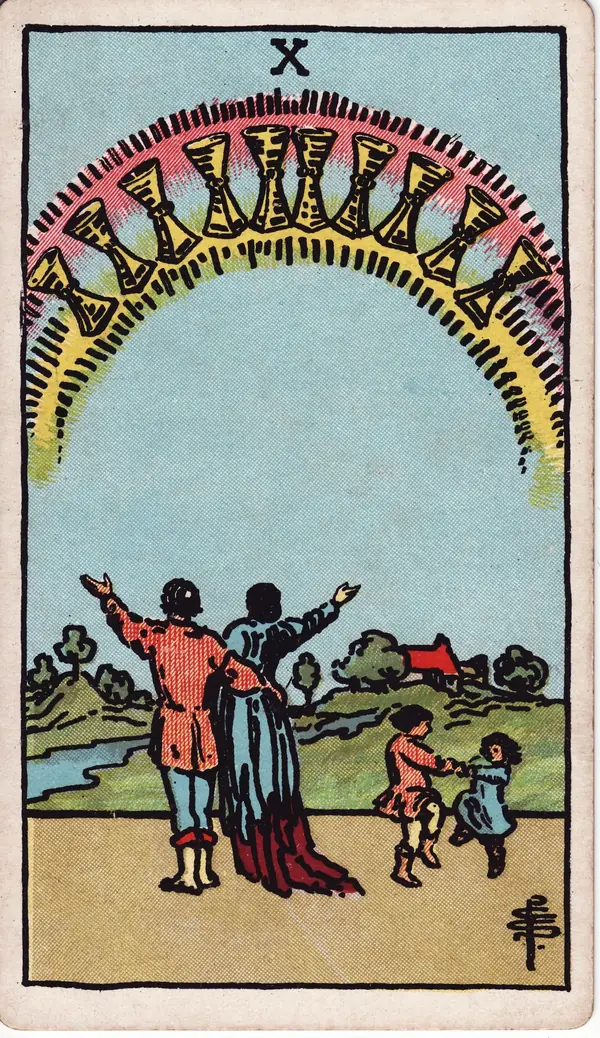
In one line: A family under a rainbow, arms open, life steady.
| Keywords | |
|---|---|
| Upright | family harmony, lasting happiness |
| Reversed | family conflict, idealizing |
| Type | Cups · water |
| Yes/no (our grading) | leans yes |
Quick answers: yes/no · love · career
- Yes/No: Under our grading, Ten of Cups leans yes. Yes/no is the least reliable use of tarot—prefer “how should I approach this?”.
- Love: A stable, lasting bond or starting a family; reversed, clashing values at home.
- Career: A team like family, work-life balance; reversed, harmony only on the surface.
*FateClear Editorial Team*
Want to draw a Classic Tarot spread? Draw cards.
The Ten of Cups sits at the end of the water suit in the Classic Tarot, where emotion, memory, and intimacy have been building card by card. Water gives the suit its fluid tone; the number ten brings that current to a point of completion. In the Tree of Life, the card is linked with Malkuth, the kingdom, the place where a hoped-for feeling finally lands in ordinary rooms and shared meals. It is also written 10 of Cups.
A family stands under a rainbow with their arms open, and ten cups arc across the sky like a roof. A house sits nearby, a river moves through the scene, and nobody in the picture seems to be performing for anyone. The one-line meaning we use is simple: a family under a rainbow, arms open, life steady. Its upright keywords are family harmony and lasting happiness.
Read upright, that steadiness is visible and easy to name. Turned upside down, or in reverse, the card can show family conflict or idealizing, a household that looks tidy from the street but feels tense inside. Reversed is not automatically bad news. It usually asks a more useful question: which parts of this good life are actually lived, and which parts are only staged?
Ten of Cups Kabbalah and Tree of Life
In the Classic Tarot, the Ten of Cups is a minor card, so it has no path on the Tree of Life and no Hebrew letter or path number of its own. Paths belong to the twenty-two major cards. Instead, two coordinates fix its place: the number ten sits in Malkuth (the Kingdom), the tenth sephirah, and the suit of Cups belongs to Briah, the world of Creation. Malkuth stands at the bottom of the middle pillar and signifies the physical world, the body, daily routine, and results. Briah corresponds to water and to the layer of emotion, feeling, and relational flow. Fire is will and action, water is emotion, air is thought, and earth is physical reality. The sephirah tells you the nature of what is happening; the world tells you the level. Together they describe emotion bearing fruit in real life. This is not a warm feeling kept inside the mind. It is a table where people eat, a home that holds them, and care among family members that has actually taken shape.
That structure is useful when you read the card. First, Malkuth asks you to test the result. In love, future talk means little unless someone is willing to meet the family, share chores, and plan a shared life. At work, a pleasant team atmosphere still has to show up as assigned duties and delivered results. Second, Briah says the quality of the outcome is emotional. It may not arrive as a promotion or a large sum. More often it feels like “I am accepted in this group.” Third, because Malkuth on the middle pillar receives what comes from the sephiroth above, the stability it describes is not dropped from the sky. It has passed through will, planning, and action, one layer at a time. In personal growth, the card asks whether inner security has become habits you can sustain, rather than something one person supplies. If you chase emotional harmony but avoid time, money, and responsibility, Malkuth gives a blunt reminder: the result has not truly landed.
The usual astrological correspondence is Mars in Pisces. Mars supplies drive and heat; Pisces supplies empathy and a tendency to dissolve boundaries. When the two combine, a person may give a great deal to loved ones or to a group, yet blur their own limits because they cannot bear to disappoint anyone. This echoes water in the Kingdom. For feeling to land, it needs warmth, but it also needs boundaries and practical arrangements.
Ten of Cups Numerology
The Ten of Cups is the tenth card, and numerology first reduces ten to 1 + 0 = 1. In the minor cards, the number shows how far a matter has traveled. Ten is the final result, the ending, or the point of fullness, so this card often brings a relationship, a project, or a way of living to the place where it has already taken shape. The completion it describes is not a cold finish. It is the emotional sense of having enough, of being full, of having somewhere to set things down. The reduced 1 adds a second thought: after fullness, you return to the starting point of “I.” Who starts the next round, and whether they are willing to keep tending the bond, will determine whether the satisfaction lasts. Ten cups form a circle, and the reduced 1 carries a simple reminder: after the cup is full, you still have to hold the first cup steady again.
The character of 1 is independent, self-directed, and willing to charge ahead. Picture a pole standing upright: establish your own footing before you move outward. It corresponds to the Magician among the major cards, which emphasizes will, expression, and the ability to turn an idea into something real. The contrast with the Ten of Cups is striking. The ten paints shared warmth; the one speaks of personal agency. They are not in conflict. A lasting relationship usually asks each person to have a center of their own and then choose closeness, instead of handing all of their security to the other person. The same applies at work. A team can give you belonging, but you still keep your own judgment and make your own contribution.
If your life path number is 1, the Ten of Cups can serve as a reference point. You may be used to carrying things alone and making your own decisions. The card invites you to consider whether receiving support can also be a form of strength, and whether dependence really has to mean losing autonomy. This is not a verdict, only a lens. If independence matters deeply to you, let the card remind you that fulfillment does not require giving up your opinions. It asks you to keep your own choices and your own pace inside a relationship.
Ten of Cups and the Element of Water
The Ten of Cups belongs to the numbered minor cards, so its element is simply the water of the Cups suit. No court-card rank element is layered on top. Water governs feeling, memory, empathy, and intimacy. It gives relationships their hold on us and makes people sensitive to atmosphere. Here water turns home into something concrete: people eat together, someone remembers your habits, and when you are sad you do not have to explain at length. Water can join many people into one group, but it dislikes rigid rules. The warmth of the Ten of Cups comes from people choosing to care for one another, not from a rule that requires it.
The elements cooperate and clash. Fire and air tend to feed each other, so an idea can push action forward. Water and earth work well together because feeling has a practical container; otherwise it never gets past feeling. Fire and water are more likely to collide. One side wants speed and momentum, while the other wants to slow down and feel. Handled badly, this becomes the tug of “you only care about getting things done, I only want your company.” The Ten of Cups leans toward water. Strong earth in a spread usually helps a family vision become a budget, a place to live, and a division of chores. Too much fire can mean someone substitutes action for listening. The Ten of Cups is not a court card, so there is no rank element to combine with the suit. Only court cards call for that double reading. The Knight of Cups, for example, carries passion and action into feeling, making expression more direct and possibly heating emotions faster than expected.
When water dominates a spread, emotion, relationships, and inner experience are the main line. A person may think and feel in great detail without taking immediate action. The Ten of Cups then stresses belonging and resonance. In love, it can mean a family welcomes you, or two people begin talking about a shared life. At work, teammates willingly cover for one another. In personal growth, it can mean allowing yourself to admit that you need company. There is also a risk: too much water can drown boundaries. If warmth turns into “keep the peace at any cost,” practical problems get shelved. Water needs a container, or happiness spills everywhere.
What does Ten of Cups mean upright?
Upright, the Ten of Cups describes family harmony and lasting happiness that has had time to take root. It rarely arrives as a shock. It looks more like a full table on a Sunday, friends who know which chair is theirs, or a partner who starts talking about next year without making it a grand announcement. Water adds empathy to the scene, so people notice when someone has gone quiet. The ten signals completion, not perfection. Arguments still happen; the difference is that everyone knows how to come back to the same table afterward. It can also point to good family news, a stable home, or the relief of finally being treated as an insider in a group.
Ten of Cups reversed meaning
Reversed, the card turns toward family conflict and idealizing. The rainbow is still in the picture, but someone stands a little apart from the group, smiling at the wrong moment. Perhaps an old family problem has surfaced again, or two people are keeping the peace by saying nothing. It can also describe the pressure to look happy because a holiday, a wedding, or a social media post demands it. This is not proof that a family is broken or a relationship is finished. It is a request to recalibrate. If the card describes the other person's thoughts, it may mean their family duties are already taking up the space a new relationship would need.
Ten of Cups in love: single, in a relationship, reconciliation
In love readings, the Ten of Cups sits at the domestic end of romance. The questions it raises are less about attraction and more about belonging: Who gets introduced to your people? Whose apartment starts feeling like home? What does an ordinary Tuesday look like together? The surrounding cards and the position in the spread matter a great deal here. A warm card in a difficult spread can describe a hope rather than a fact, and a reversed card beside a strong partnership card can simply mean a rough season at home.
Ten of Cups upright love
Upright in love, the card often marks the stage where a bond becomes public and practical. You meet each other's families, split a grocery list, or talk about holidays without hedging. The affection is shown through attendance: someone shows up to the boring appointment, remembers the food you avoid, and takes your side in a small dispute. That kind of care can feel so natural that it goes unthanked. Say the thanks out loud anyway. The card favors commitment, but it also asks you to keep treating each other like people rather than furniture.
Ten of Cups reversed love
Reversed in love, the gap between "we look fine" and "I am not fine" becomes the main event. A couple may keep the routine going while avoiding the one conversation that would change it. Family opinions can push into the middle of the relationship, or one person may carry all the emotional labor of keeping everyone comfortable. The card does not say leave. It says name the crack before it spreads. Choose a calm hour, describe specific events instead of character flaws, and listen for the part you would rather not hear.
Ten of Cups love for singles
For a single person, the card often brings family interest in your love life, sometimes more interest than you want. Introductions may come through relatives, friends, or familiar community gatherings rather than a dramatic chance meeting. The opportunity is real but quiet. You may be tempted to settle because everyone around you seems paired off. Resist that. First decide what kind of daily life you actually want, then notice who fits it. The right person should feel like an addition to your world, not a rescue from it.
Ten of Cups in a relationship
In an established relationship, this is one of the warmer cards for shared domestic life. It can mark meeting the parents, moving in together, buying things for a home, or a truce between two families that had been cool toward each other. The happiness is specific: someone saves you the last piece of something, the house feels quiet in a good way when you both are home. Still, closeness is not a substitute for clear agreements. Money, chores, boundaries with relatives, and plans for the future all deserve plain conversation.
Ten of Cups and getting back with an ex
With an ex, the card leans favorable when both people want stability and are willing to face what broke. There is often a family-like familiarity that makes reunion feel easy, and easy is exactly what to examine. Ask what has actually changed since the split. If the answer is only "we miss each other," you may be walking back into the same loop. If there is a new willingness to discuss money, family pressure, or whatever caused the distance, the card supports a careful second try.
Ten of Cups as feelings: how they feel about you
When the Ten of Cups appears in a feelings position, it describes an emotional climate rather than a single mood. The connection feels safe, familiar, and worth building around. It can also carry a domestic fantasy: picturing holidays, a shared kitchen, a future that looks calm. The card does not guarantee that the other person will say any of this out loud. It describes the direction of their thoughts, and the rest of the spread shows whether that direction has legs.
Ten of Cups upright as feelings
Upright, the other person likely feels at ease with you in a way that surprises them. You may be the person they want to bring to a family dinner or mention in a casual future plan. Their care often shows up in practical form: they remember your schedule, offer help before you ask, or make room for you in a crowded week. What they feel is less like fireworks and more like a place to land. Check whether the behavior matches the warmth. Consistent presence is the evidence; a pleasant speech is not.
Ten of Cups reversed as feelings
Reversed, their emotional stance is divided. Part of them wants the comfort of a familiar bond, while another part sees an obstacle: family expectations, an unfinished responsibility, or a fear of becoming ordinary. That split can produce mixed signals, warm one week and distant the next. It is tempting to fill in the blanks for them. Do not. Ask a direct question about what they want and what they are able to offer, then believe the answer they show you through action.
Ten of Cups as how someone sees you
The Ten of Cups often means someone sees you as steady, warm, and suited to a long life rather than a short chapter. They may picture you fitting into their family or their circle without much friction. That is a compliment, but it can also flatten you into a role. Being seen as "the dependable one" can make it harder to admit when you are tired or disagree. Let them see the whole person. A real home has room for a bad day, a differing opinion, and a closed door now and then.
Ten of Cups as intentions
As intentions, the card suggests a desire for something serious and domestic. The other person may be thinking about introduction to family, shared holidays, or a relationship that does not need to be hidden. That intention can be genuine and still be unfinished. If they talk about the future but rarely make time in the present, the intention is a wish, not a plan. Ask what step they are ready to take now. The answer will tell you more than any picture of a rainbow.
Ten of Cups career and work (upright & reversed)
At work, the Ten of Cups describes the office as a second household. People cover for each other, someone remembers birthdays, and the team has a shared sense of what "we" means. It is a pleasant card, but it is not a career strategy on its own. Comfort can support good work, and it can also keep someone in a role long after the learning has stopped. Read it as information about atmosphere first, then decide what it means for your next move.
Ten of Cups upright career
Upright, expect smoother relationships with colleagues, a team that has finally learned to work together, or a project that closes with everyone still speaking. Job seekers should pay attention to the human side of an offer: how the manager talks about people, whether colleagues seem to cover for one another, and whether the culture rewards honesty. For those already employed, the card favors collaboration and a settled season. Use that stability to build a skill or ask for a stretch assignment. Do not mistake a kind office for a place that will grow you forever.
Ten of Cups reversed career
Reversed, the workplace may feel less like a family and more like a clique with assigned seats. Blame moves around, emotional labor lands on the most agreeable person, and you can be in every meeting yet still feel like an outsider. First decide whether this is a short crunch or the actual culture. A hard month can be survived with boundaries and clear priorities. A hard year needs a different response: update your resume, ask careful questions about turnover and reporting lines, and keep a record of agreements. Leaving is easier when you have options.
Ten of Cups for money and finances
The Ten of Cups is not a windfall card. It talks about money in terms of household stability and shared resources: a budget that covers the rent, family members who can help in a pinch, a joint account that works because both people know what is in it. Upright, finances tend to feel supported rather than dramatic. You may put money toward a home, a family need, or an emergency fund. That is a good use of this energy. It is also a reminder to discuss money openly, because closeness can make people assume they agree when they do not.
Reversed, the card warns about family financial strain, hidden spending, or the cost of keeping up appearances. Someone may be paying for a lifestyle that looks better than it feels, or avoiding a conversation about debt because it would spoil the mood. Start with a plain audit: what comes in, what goes out, and which expenses exist mainly to protect an image. Then talk about who carries what. None of this is investment advice, and the card makes no promises about income. It only asks for honesty and a slower pace before any large decision.
Ten of Cups for health
Health readings connect this card to the emotional atmosphere at home. Upright, it favors routines that help the body settle: regular meals, a consistent bedtime, gentle movement, and rest that is not interrupted by guilt. When the household is calm, it is easier to sleep and easier to notice what your body needs. Use that window to schedule the checkup you have been postponing. Feeling well is not the same as needing no care.
Reversed, pay attention to how stress shows up physically: restless sleep, tight shoulders, changes in appetite, or a heaviness that arrives when you think about going home. These are signals, not diagnoses. The card does not say what condition you have, and it cannot replace a doctor. If symptoms persist or worsen, get medical care. If the strain is emotional, talking with a trusted person or a professional can help. Pregnancy is not something this card can confirm or rule out; only a medical test can do that.
Ten of Cups as advice
The advice of the Ten of Cups is not "find a perfect family." It is closer to "make the warmth you already have sustainable." That means noticing the people who show up, saying what you appreciate, and building small routines that hold a group together. Upright, the emphasis is on gratitude and consistency. Reversed, the emphasis is on naming the problem and renegotiating. In both cases, the card prefers a real conversation over a beautiful assumption.
Ten of Cups upright as advice
Start by naming what is good without turning it into a performance. Thank the person who remembers your coffee order, acknowledge the colleague who quietly fixes things, and answer the relative who checks in on you. Then create one small ritual: a weekly dinner, a walk with a friend, a monthly call with family. Rituals give belonging a place to live. Finally, ask for what you need in plain words. Testing someone's love through silence is a poor substitute for telling them the truth.
Ten of Cups reversed as advice
Find the exact place where the warmth stopped flowing. Is it a relative's expectation, a partner's avoidance, or your own habit of saying yes? Break the problem into topics that can be discussed: money, schedules, household duties, boundaries with family. Set a calm time and speak about specific events rather than broad accusations. At work, clarify responsibilities with the person who assigns them. If the environment is genuinely unhealthy, prepare an exit instead of enduring indefinitely. Give yourself a few days to see clearly before making a permanent decision.
Ten of Cups as a person
As a person, the Ten of Cups describes someone who values home, loyalty, and the quiet work of keeping a group together. This is often the friend who hosts, the relative who remembers everyone's dietary needs, the colleague who notices when a new person is left out. They are rarely the loudest voice in the room, but they are frequently the reason the room feels comfortable. Their care can look old-fashioned: a packed lunch, a ride to the airport, a place to stay during a hard week. They are not saints, though. They have opinions, limits, and days when they want to be taken care of too.
Ten of Cups reversed as a person
Reversed, the same caring nature can tip into people-pleasing. This person may keep the peace at their own expense, or chase an image of the perfect family while ignoring what is actually happening. Sometimes the reversal points to someone who controls through warmth: they give generously, then make it clear that the gift comes with expectations. It can also describe a person wounded by their family who still longs for closeness but does not trust it. With this person, watch the gap between the lovely words and the lived behavior.
How to place it in a reading
Position changes the card's meaning more than the card changes the position. In a past slot, the Ten of Cups can point to the family you grew up in or a relationship that already became a home. In the present, it describes the environment you are standing in now, including the people who make it feel safe. In a future slot, it leans toward stability, reconciliation, and belonging, though not necessarily on the timeline you want. In an advice slot, it returns you to daily practice: gratitude, shared meals, honest logistics.
Look at the cards around it as well. More water cards deepen the emotional and intimate theme; major cards give the situation more weight and a slower arc. Reversed, check the neighbors to see whether the pressure is coming from outside, such as a family member, or from inside, such as an idealized picture you are trying to live up to. The traditional astrological correspondence for this card is Mars in Pisces, a mix of steady effort and deep sensitivity. Action is present, but it follows feeling rather than force.
Our take
We read the Ten of Cups as long-term good, not a single stroke of luck. The image is genuinely lovely: arms open, a rainbow overhead, a household that has found its rhythm. It is easy to hear "you can relax now" in that picture. We would add a quieter note. This kind of life is built daily, through conversations, shared chores, repaired arguments, and ordinary kindness. It is not achieved once and then stored on a shelf.
So do not go slack when the card is upright, and do not despair when it is reversed. Ask what is real in the situation, what is only appearance, and whether the people involved are willing to work on the difference. That question is more useful than any promise of permanent sunshine.

FAQ
The Ten of Cups draws a warm picture, which makes people want a clear verdict. These questions come up often, especially around yes-or-no readings, marriage, and timing. Short answers are below, followed by the context that keeps them honest.
Is Ten of Cups a yes or no card?
Yes. The Ten of Cups leans yes, especially for questions about home, family, and long-term happiness. It is one of the more encouraging cards in the deck, but its yes is about a settled direction rather than an instant result. If you ask whether a relationship can become stable, the card supports that possibility. It does not remove the need for effort. A yes from this card often means "this is worth building," not "nothing can go wrong."
What does Ten of Cups reversed mean in a yes or no reading?
It still leans yes, but with conditions. Reversed, it asks you to clear up a real conflict before expecting a smooth result. The site's grading stays the same in reverse: this is not a hard no. It is a yes that depends on facing the family pressure, the avoided conversation, or the idealized picture that is distorting the situation. Treat the conditions as part of the answer. If they are never addressed, the practical outcome may feel much closer to no.
What does Ten of Cups mean if you have a secret crush?
It points to quiet, growing closeness rather than a sudden confession. Let the connection develop through ordinary, repeated contact. The card often shows up when you imagine a calm, domestic future with someone you have not yet dated. That picture can be sweet, but it is not evidence of their thoughts. Watch whether they make room for you in real life. Start with friendship and shared activities. A person who welcomes you into their routine is showing more than one who only enjoys private, flattering attention.
What does Ten of Cups mean for marriage?
Yes, it is a favorable card for marriage. It shows shared domestic hopes moving into focus. Upright, it often appears around meeting families, planning a home, or a relationship becoming publicly serious. Reversed, it does not cancel the possibility. It asks you to look at family opinions, money, and the division of responsibility before the celebration. A card cannot replace a conversation. If you have not discussed where you will live, how you will handle debt, and what each family expects, those topics matter more than a good omen.
What does Ten of Cups mean as an outcome?
As an outcome, it suggests stability, reconciliation, and belonging. The card describes a settled chapter rather than a single event. You may see a relationship become a household, a team finally cohere, or a family argument lose its grip. The tone is gentle and durable rather than spectacular. If the reading is about a specific deadline, remember that outcomes in tarot describe direction, not a guaranteed script. The choices made between now and then still shape the result.
What timing does Ten of Cups suggest?
It suggests gradual timing, not a fixed date. Think in weeks or a season rather than days. The card belongs to the tens, which mark the end of a cycle, so something has usually been building for a while. The visible result may arrive after a period of quiet consistency. Use the time well. Repair one relationship, stabilize your budget, or establish a routine. Those actions are the kind of groundwork this card tends to reward.
Does Ten of Cups mean pregnancy?
No. The Ten of Cups does not predict pregnancy. It can reflect family hopes, but it is not a medical answer. The card may appear when people are thinking about children, family gatherings, or a new addition to the household. That is a theme, not a test result. It cannot confirm or rule out pregnancy. If you have a health question, speak with a doctor and use a proper medical test. Tarot is not a substitute for either.
What zodiac sign is Ten of Cups?
Its traditional correspondence is Mars in Pisces. That pairing blends steady action with deep sensitivity. Pisces brings empathy, imagination, and a longing for emotional unity; Mars adds drive, though the drive can be indirect. In practice, this card often describes people who act on compassion and prefer to move with the mood of a group. This is a symbolic correspondence, not a rule about sun signs. A person of any sign can meet the Ten of Cups in a reading.
Is Ten of Cups a good or bad card?
It is generally a good card. It points to family harmony and lasting happiness, with room for real-life friction. Its goodness is domestic rather than dramatic. Think of a home where people can disagree and still share dinner, or a team that trusts each other under pressure. Reversed, it is still not a "bad" card in any simple sense. It is a warning that harmony needs honesty, and that a beautiful picture is not the same as a lived life.
Related cards
The Ten of Cups rarely stands alone. These cards help separate emotional satisfaction, practical stability, and shared vision.
- Nine of Cups: personal contentment and wishes fulfilled, which raises the question of whether the happiness is shared or private.
- Two of Cups: a direct bond between two people, which the Ten expands into family and daily life.
- Four of Wands: celebration, homecoming, and public joy, reinforcing the Ten's sense of belonging.
- Ten of Pentacles: material and family stability, adding the practical foundation the Cups card can overlook.
- The Lovers: choice and shared values, a reminder that warmth alone does not guarantee a matching direction.