The Lovers Tarot Card Meaning: Reversed, Love, as Feelings, Yes or No

Draw a Classic Tarot spread →Free, no sign-up. Think of your question, then draw.
In one line: Less about romance than about what you choose.
| Keywords | |
|---|---|
| Upright | choice, alignment, shared values |
| Reversed | indecision, value clash, imbalance |
| Type | Major Arcana 6 |
| Yes/no (our grading) | leans yes |
Quick answers: yes/no · love · career
- Yes/No: Under our grading, The Lovers leans yes. Yes/no is the least reliable use of tarot—prefer “how should I approach this?”.
- Love: Mutual attraction and shared values; reversed, divided attention or torn between two people.
- Career: A fork in the road—choose by your own priorities; reversed, partners pulling in different directions.
*FateClear Editorial Team*
Want to draw a Classic Tarot spread? Draw cards.
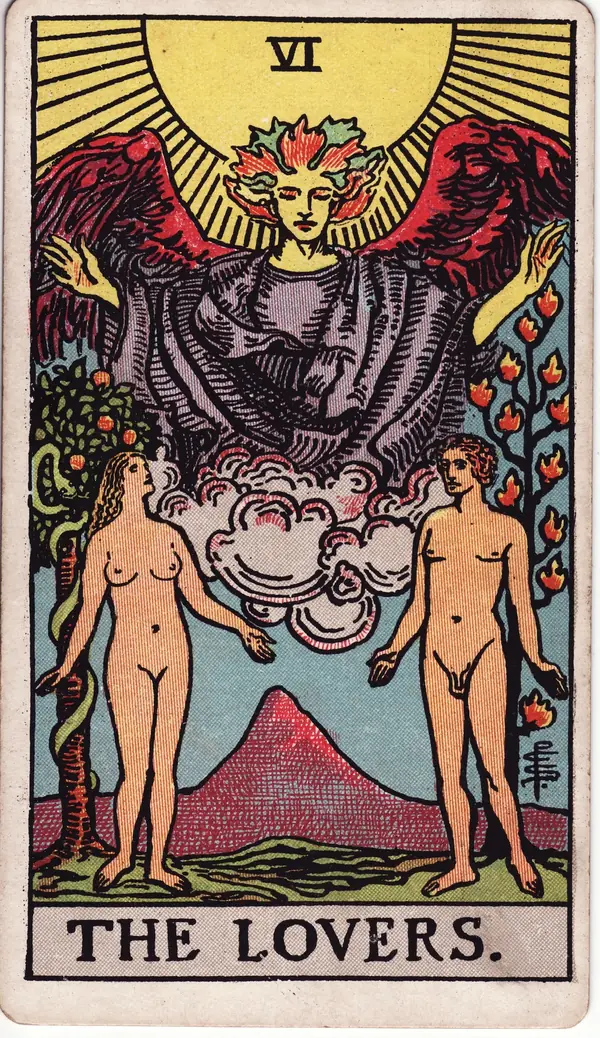
The Lovers is number 6 in the Major Arcana of the Classic Tarot, often linked with air and with the kind of communication that reveals what people really want. The traditional scene places two figures in a garden beneath a winged presence, with a fruit tree and a snake nearby. Purple accents in some versions draw the eye to the third figure, a reminder that a private bond always sits inside a wider world.
At its core, the card is less about romance than about what you choose. Attraction is part of the picture, but the deeper question is whether a person, job, or direction matches your values. Upright, it tends toward alignment, honest conversation, and a decision made with both eyes open. In reverse—or upside down in a spread—it shows the messier side: mixed signals, competing loyalties, and a choice postponed until it starts to cost you.
One-line meaning: less about romance than about what you choose. The sections below cover love, feelings, work, money, health, advice, and placement, with direct questions saved for the end.
The Lovers Symbolism: What Each Detail on the Card Means
Figure posture and gaze A man and a woman face each other. She tilts her head slightly toward the winged figure above, while he keeps his eyes on her. The lines of sight form a triangle: upward, across to the other, then back to the self. That shape says a relationship is not only two people drawn together—it also holds a higher principle and each person's own choice. Upright, the triangle means you can see your partner, see the relationship, and see where you stand all at once. Reversed, the gaze tends to slip out of alignment: one person stares only at the other, or listens only to outside voices, and hesitation, comparison, and disappointment grow louder.
Nudity Neither figure wears clothing; they stand in a garden. The nudity is not erotic—it is candor. Without titles, family background, or social masks, they meet as they actually are. Upright, it supports honesty and equality and suggests the relationship can begin from real needs. Reversed, it can turn into the unease of overexposure: one person fears being seen through, while the other uses intimacy to cross a boundary.
The winged figure and open arms Above the scene a winged figure spreads both arms outward, as if blessing and warning at once. It stands for the principle that rises above personal appetite—conscience, or a shared belief. Upright, it gives the choice a sense of direction: you ask not only whether you like something but whether it is decent and whether you would be willing to say it out loud. Reversed, that seat is easily taken by an outside authority—parents, friends, or public opinion making the call for you—or you talk yourself into something you already know is wrong.
The sun, clouds, and sky The sun hangs overhead, clouds gather around the figure, and the sky is bright. The sun means clarity, warmth, and bringing things into the open; the clouds mean transition and the parts not yet fully seen. Upright, it suggests important words can be said plainly and motives can be seen. Reversed, the sun can turn glaring and the clouds can turn into fog: one person overstates, the other stalls with vagueness, and the surface looks bright while the real problem stays hidden.
The distant mountain A mountain rises in the background, its outline quiet. It stands for real-world testing, endurance, and a stretch of road you have to walk together. Upright, it reminds you that a relationship does not run on butterflies alone; it also meets distance, family, and the rhythm of work. Reversed, the mountain easily becomes an ignored obstacle—or, flipped around, an excuse to do nothing, like always saying "once things settle down" without ever discussing how to walk the path.
Green ground and garden The figures stand on green land surrounded by what looks like a tended garden. Green carries growth, hope, and everyday nourishment; the garden says a relationship needs cultivating—it does not grow wild on its own. Upright, it supports slow tending and shared investment. Reversed, one person may keep watering while the other only enjoys the view; care turns into duty, and the relationship looks whole while it is actually off balance.
The fruit tree and the snake Behind the woman stands a tree bearing fruit, with a snake coiled in the trunk or branches. The fruit stands for knowledge and consequences you can choose; the snake stands for temptation, testing, and boundaries. Upright, it lets you see that temptation is still here, but you can choose not to hold the relationship together with secrecy. Reversed, temptation gets rationalized, and secrets, flirtation, or a third party damage trust. Reading this card, first ask whether you are hiding something.
The tree of flame Behind the man stands another tree, its leaves touched with flame or warm color. It stands for passion, vitality, and desire—energy that can be used or can run out of control. Upright, desire can drive commitment and give the relationship warmth and action. Reversed, the fire can burn too fast, turning into possessiveness, impulse, or a chase for the thrill of the moment. It faces the fruit tree: one side is boundary, the other heat, and the card asks you not to take only one.
The Lovers Kabbalah and Tree of Life
The Lovers corresponds to the 17th path on the Tree of Life, and its Hebrew letter is Zayin, whose shape originally means "sword." Here the sword is not for attack but for cutting and telling apart: it separates liking, fear, obligation, and expectation so you can see what you are really choosing. This path links the third sphere, Binah (Understanding), to the sixth, Tiphareth (Beauty). Understanding sits on the left pillar of Severity, gathering impulse into form and giving limit, structure, and judgment; Beauty sits on the central pillar and is the center of balance, harmony, and self. The path crosses the Abyss, so it speaks not of easy fondness but of a choice you still want to make after you have told things apart.
Direction also shapes the meaning. From Beauty back to Understanding is a turn inward and left, gathering feeling into form and boundary; from Understanding toward Beauty stretches out to the central pillar and downward, letting understanding enter concrete relationship and daily self. What both ends share: a relationship needs a shape, and the self needs to stand firm inside it.
In love, this card tests whether an attraction has boundaries. The liking is real, but are you willing to make it public, and do you respect each other's time? That is the work of Understanding. Can you stay whole inside the relationship? That is the work of Beauty. Reversed, boundary and longing usually pull against each other. At work, it helps you separate "this team gives me a sense of belonging" from "this job fits my long-term values"—the first leans toward Beauty, the second needs Understanding's judgment. In personal growth, when two directions appear, first cut through outside expectations like a sword, then ask which choice keeps your center steady. In astrology The Lovers is often tied to Gemini, and Gemini's duality and exchange echo this path's rhythm of "tell apart first, then unite."
The Lovers Numerology
The Lovers is number 6. In numerology, 6 does not reduce any further; it is already a highly complete single digit, themed around giving, care, the pursuit of perfection, and harmony, with its weight on relationships and family. Put 6 back into the Major Arcana sequence and The Lovers is that number's direct expression: a choice is not an abstract comparison but something that lands on "who am I willing to care for, who will I build a daily life with, which relationship am I responsible for." The number 6 is also often tied to family and long-term commitment, so The Lovers asks not about a passing spark but about whether you will place a person or a task inside your ordinary days.
Reduce 15, The Devil, to 1+5 and you return to 6, and the echo is worth studying: the same 6 is a clear-eyed union in The Lovers and can become dependence, possession, or the fear of leaving in The Devil. It is a reminder that when giving and caring lose their boundaries, they slide from love into bondage; and, the other way around, seeing the bondage can help you work out what you actually want to choose.
People whose life-path number is 6 are often described as valuing relationships, willing to care for others, and holding harmony to a high standard—close in temperament to The Lovers. Treat that only as a reference mirror, never a verdict. You can use the card to ask yourself: is my giving a choice, or is it fear of not being needed? At work and in personal growth, 6 also warns you not to make "everyone is satisfied" your only standard. Confirm your own order of values first, then decide whom to care for and what to take on, so giving does not turn into resentment.
What does The Lovers mean upright?
Upright, The Lovers asks you to name what matters and then act as if it does. You may be weighing two paths, two people, or two versions of your future. The card does not choose for you, and it does not treat neutrality as safe. Attraction, loyalty, and practical fit all belong in the conversation, but the deciding factor is usually shared values: honesty, family, ambition, faith, or the daily life you want to build. A friend may introduce someone, a colleague may recommend you, or a partnership may move from vague interest to a clear agreement. Keywords: choice, alignment, shared values.
The Lovers reversed meaning
Reversed, The Lovers turns a clean choice into a stalled one. You may know what you want in private and still let outside opinions, short-term comfort, or another attachment pull you elsewhere. The card points to indecision, a clash of values, and imbalance. Someone gives more; someone keeps a foot out the door; a plan stays vague because naming it would force a loss. This does not automatically mean betrayal. It more often means a decision has not been made honestly. A third presence may keep the bond from becoming clear. Ask where the imbalance is, and what an honest choice would require.
The Lovers in love: single, in a relationship, reconciliation
Love is where most people expect this card to shine, but its real subject is partnership as a decision. Romance may be present, yet the card asks whether two people are choosing each other in ways that show up in daily life: how they speak when they disagree, how they handle money and time, and whether they can be open about the relationship around friends and family.
The Lovers upright love
Upright in love, The Lovers favors clarity. A connection may deepen through a conversation that names what each person wants instead of hinting. Shared values matter more than matching tastes in music or restaurants. You may realize that a steady friend is attractive in ways you overlooked, or that an existing partner is willing to meet you halfway on a difficult subject. The card supports introductions, honest declarations, and agreements made in the open. It does not promise perfection. It asks both people to choose the relationship on purpose, then keep choosing it through ordinary days.
The Lovers reversed love
Reversed in love, affection can be real while the structure around it stays shaky. One person may compare you to an ex, measure you against a friend's relationship, or wait for a better option. Another may care deeply but avoid defining the relationship because freedom feels safer than commitment. You might feel the pull, then the distance, then wonder which version is true. Look at behavior over mood: who initiates, who explains, who disappears when plans become concrete. If the relationship is worth keeping, it needs a boundary and a straight conversation.
The Lovers love for singles
Single, The Lovers often points to a meeting through friends, work, a hobby group, or a community you already enjoy. The spark may begin as conversation rather than instant fireworks. Someone may introduce you to a person who shares your humor, your pace of life, or a value you rarely find in small talk. This is encouraging, not a guarantee that the first attractive person is your match. If two people interest you, notice what each one brings out in you. The one who makes honesty easier is usually the stronger choice. Stay open, but keep your standards awake.
The Lovers in a relationship
In a committed relationship, The Lovers usually surfaces around a shared decision: moving in, meeting families, dividing expenses, planning a trip, or deciding how much time to spend with each other's friends. The card says you can talk this through, but not if one person quietly makes the plan and the other is expected to agree. Set aside time when neither of you is rushed. Each person can name one priority and one concession. The goal is not to avoid disagreement; it is to make disagreement useful. Leave the conversation knowing what was decided and what needs another talk.
The Lovers and getting back with an ex
With an ex, the question is not whether you miss each other. It is whether the reason you separated has changed in practice. The Lovers can signal another conversation, especially if a mutual friend helps clear up a misunderstanding. It does not mean the past is erased. If the split came from a value clash about money, family, or commitment, look for evidence of a new approach, not just warmer words. If it came from poor timing or outside pressure, ask what would be different now. Reconciliation works when both people choose the repaired relationship, not just the comfort of the old one.
The Lovers as feelings: how they feel about you
Feelings questions need more care than a simple “Do they love me?” The Lovers describes how someone places you inside their life: as a possibility, a priority, a temptation, or a decision they keep postponing. One card cannot reveal a private thought with certainty. Use it as a lens for behavior. Notice whether their words, plans, and introductions match what they say they feel.
The Lovers upright as feelings
Upright, they likely feel a real pull toward you and a sense that you fit into their future. They may admire how you think, how you handle conflict, or how comfortable they feel around you. This is not always loud passion. It can feel like quiet recognition: “This person makes sense to me.” They may be weighing what choosing you would mean for their routines, family, or plans. If they are mature, the feeling turns into action: asking to see you, including you with friends, and making room in their schedule. If they are cautious, watch for consistency instead of demanding a speech.
The Lovers reversed as feelings
Reversed, their feelings are mixed or divided. They may be attracted to you and still hold back because another person, an ex, a friend's opinion, or a fear of losing freedom is in the way. You might experience them as warm one week and distant the next. That inconsistency is painful, but it is information. It often means they have not decided what they want, not that you failed to be lovable. Watch whether they can name the conflict and take a step toward resolving it. If they want access without making a choice, protect your clarity.
The Lovers as how someone sees you
As how someone sees you, The Lovers casts you as someone worth choosing. They may see you as attractive, easy to talk to, and a person they could build something real with. There is often a sense of equality here, as if you stand on the same ground rather than one chasing the other. They might also see you as a mirror for their own values, which can feel flattering and a little intense. Being seen as “the one who makes sense” is not the same as being understood. Let their curiosity about your inner life prove whether the picture is complete.
The Lovers as intentions
Intentions in The Lovers lean toward honest connection. They want to decide, or at least they want the situation to become clear enough to decide. That might look like asking a direct question, introducing you to people who matter, or proposing a plan that includes you. It does not necessarily mean a proposal or a lifelong promise. The card is about the direction of the choice. If their intentions are serious, their calendar and follow-through will show it. If they keep saying they need time but never name the decision, the intention is still forming—or still avoiding.
The Lovers career and work (upright & reversed)
At work, The Lovers is about fit, cooperation, and the people who connect you to an opportunity. It can describe a partnership, a referral, a team that needs to resolve a disagreement, or a choice between two roles. The card favors work that feels aligned with your values, not just impressive on paper. It also warns that relationships at work carry weight: who trusts whom, who advocates for you, and who benefits when you say yes.
The Lovers upright career
Upright, work opportunities often arrive through people rather than cold applications. A former colleague may recommend you, a friend may connect you with a team, or a client may return with a bigger project. In an existing job, this is a good time to negotiate a partnership, clarify a shared goal, or mediate between two departments. If you are choosing between offers, compare the daily reality: the manager, the team's communication style, and whether the role lets you use what you value. The card supports agreements, but put important terms in writing. Good chemistry is useful; a clear contract is better.
The Lovers reversed career
Reversed, the trouble is usually structural rather than personal. Roles may be vague, information may be withheld, or two leaders may give you conflicting instructions. You might be caught between colleagues who want your loyalty and a manager who wants your silence. The card also warns about opportunities that look polished but feel evasive: a title without authority, a partnership without clear shares, or a referral from someone with an agenda. Slow down and ask specific questions. Get responsibilities, pay, decision rights, and exit terms in writing. Protect your reputation and keep a record of what you were asked to do.
The Lovers for money and finances
The Lovers is not a wealth card, and it should not be used to predict a windfall. Its financial message is about shared resources and values. You may be deciding how to split expenses, whether to lend money to a friend, or how to structure a partnership. Upright, it favors transparency: clear budgets, written agreements, and conversations about risk before money moves. Reversed, it warns about imbalance and vague promises—someone pays more, someone avoids the paperwork, or a friend becomes defensive when asked for details. Do not let affection replace a contract. Keep large amounts documented, decline guarantees you cannot afford, and choose decisions that let you sleep at night.
The Lovers for health
When The Lovers appears in a health context, look first at decision fatigue. Going back and forth between options can keep the body in a low-grade tense state: sleep becomes uneven, appetite changes, shoulders tighten, and attention scatters. The card does not diagnose anything and cannot tell you whether a treatment will work. It can remind you to reduce the number of decisions you are carrying at once. Choose one manageable change, keep regular meals and a steady bedtime, and tell someone you trust how you are doing. If symptoms persist, worsen, or worry you, see a doctor. Pregnancy questions belong with a medical professional, not a card.
The Lovers as advice
The card's advice is blunt: stop pretending that indecision is neutral. Every delayed choice is also a choice, and it usually costs time, trust, or peace of mind. Upright, the card asks you to move toward what is honest. Reversed, it asks you to remove the confusion that keeps you circling. In both cases, name your values, gather the facts you actually need, and then act before the moment passes.
The Lovers upright as advice
Write down the three things you care about most in this situation. Then ask whether each option supports them or merely looks good from a distance. If the answer is unclear, have the conversation you have been avoiding: ask where the relationship is going, request the terms of the job, or tell a friend what you need. Let people help you, but do not hand them the final decision. The Lovers favors a choice you can explain without flinching. Once you make it, stop re-litigating every alternative. Put your attention into making the chosen path real.
The Lovers reversed as advice
Stop trying to keep every option open. That strategy feels safe, but it often leaves you exhausted and unreliable. Identify the outside voice making the choice harder: a friend's judgment, a parent's expectation, an ex who still texts, or your own fear of disappointing people. Set one boundary around it this week. Do not make a permanent decision at the peak of emotion, and do not use silence to force someone else's hand. If someone has repeatedly lied or crossed a boundary, you do not owe them access while you “figure it out.” Clarity can be a form of self-respect.
The Lovers as a person
As a person, The Lovers suggests someone communicative, relational, and interested in finding common ground. They tend to be easy to talk to and may have a wide circle of friends. They care about fairness and often notice when a group is not treating someone well. The shadow side is that they can become so focused on keeping the peace that they avoid a necessary choice. They may ask everyone's opinion, compare options endlessly, or stay in a situation because leaving would disappoint people. Their charm is real, but their reliability depends on whether they can commit after the conversation ends.
The Lovers reversed as a person
Reversed as a person, this card can describe someone charming but hard to pin down. They may say what sounds good in the moment, then change direction when a friend or family member disapproves. They might keep several options warm because choosing one feels like losing something. This does not make them cruel. It makes them unreliable until they do their own work. If you are dealing with this person, pay attention to what they do when no one is watching and when a decision becomes inconvenient. Apologies are not the same as change. Let consistent behavior, not potential, earn your trust.
How to place it in a reading
Position changes the card's tone. In the present or situation position, The Lovers often shows a choice that is already active, whether or not you have admitted it. In the other person's position, it points to how seriously they are weighing the connection. In the future, it suggests a decision or partnership will come to a head. In the advice position, it asks you to return to your values and speak plainly. Look at the neighbors too. The Two of Cups can soften the card toward mutual affection; the Two of Swords can sharpen the indecision; the Devil can add obsession or a third presence; the Chariot can speed up the consequences of a choice. As a Major Arcana card, it describes something structural, not a passing mood.
Our take
Choice spreads suit The Lovers best. Take the two-option spread: one side stands for Option A, the other for Option B, and the key to the decision sits in the middle or below. When The Lovers lands in an option position, it does not announce that the path will succeed; it says the path fits your order of values better—there you can be more yourself and are more willing to carry the consequences. If it lands in the key position, it shifts the question from "which option has better conditions" to "what do I actually care about." Answer the second one first, and only then does comparing make sense.
The same card reads differently in different option positions. Upright in A, A tends to have room for candor, fit, and negotiation; reversed in A, the pull may be strong but the boundaries blurred, or you may be suppressing your real needs to accommodate someone. Reversed is not a death sentence—it asks you to list where the imbalance is: time, money, family expectations, or a third party's opinion.
Keep The Lovers distinct from The Devil and the Two of Cups. The Two of Cups looks like two people who have already seen each other, a smaller and more concrete bond; The Lovers puts "choice and values" on stage and may involve a third presence, a collaboration, or a life direction. The Devil's pull is heavier and stickier, often with desire, control, and fear of loss; when The Lovers draws close, upright usually means you still hold the right to choose, and only reversed do you need to watch whether desire or social obligation has tied you down.
Astrologically The Lovers is often matched with Gemini, which in a spread can be a reminder to lay out the information from both options and compare communication styles, room to learn, and daily rhythm—but do not treat "we talk easily" as a commitment. The sign is only support; still combine it with the position and the neighboring cards.
The Lovers in Different Positions: Past, Present, Advice, Obstacle
Past The past position asks what has already happened and what it left behind. When The Lovers lands here, it usually points to a decision you once made about a relationship or a value: you chose a path, a person, or traded one opportunity for another. Upright, that decision was largely honest and still gives you direction today. Reversed, the past may leave an unfinished choice—say, you once buried your own wishes to keep someone else satisfied, so now a similar situation finds you wavering again. It speaks not only of an old love but of an old order of values.
Present The present position asks about your current state. With The Lovers here, you are standing at a crossing that calls for a statement: should the relationship move forward, should the collaboration continue, should something be made public. Upright, you already know what you care about more; what is missing is saying it plainly. Reversed, there is plenty of information but your heart will not settle, and you are easily pulled by comparison, outside opinion, or another option. This position does not rush you into a decision, but it asks you to admit that you are choosing.
Future The future position asks about the trend. When The Lovers falls here, a relationship or partnership is often pushed into the open and needs a formal response from you; it can also mean you meet a new situation that forces a choice. Upright leans toward both sides being willing to talk and the relationship heading toward clarity; reversed may mean delay, back-and-forth, or outward progress while unspoken terms remain inside. A future card is not a guarantee—it is more like a road sign lit up ahead of time.
Advice The advice position asks how to respond. With The Lovers here, the answer is not to keep collecting options but to return to your order of values: what can I not give up, and what can I concede. Upright, the card asks you to speak honestly, move things forward, and turn commitment into concrete arrangements. Reversed, it asks you to stop people-pleasing and stalling, set your boundaries, and only then decide whether to continue. If upright is "choose what you believe in," reversed is "first see clearly why you are afraid to choose."
Obstacle The obstacle position asks what is stuck. When The Lovers lands here, what blocks you is usually not a lack of a partner or a lack of chances but a clash of values and scattered attention: you want stability yet cannot let go of freedom, you care about your partner yet cannot drop your friends' judgment. Upright, this obstacle can loosen through one honest conversation. Reversed, it may be idealization, an old relationship, or a third party's opinion pulling at you. Seeing the obstacle clearly does not mean solving it at once, but it stops you from pinning all the blame on the outside.
Outcome or hint The outcome position asks where things go if you keep on this course. Upright, The Lovers leans toward an answer both sides must confirm: there is a chance of reaching agreement, and the relationship or partnership gets recognized, but only if someone speaks first. Reversed, the upside of a positive card is halved, and the result may be "yes, with conditions": things are not necessarily bad, only stretched out, or agreed on the surface while reservations remain underneath. It hints that you should fill in the terms still unsettled and not mistake a temporary balance for the final answer.
The Lovers Three-Card Example (Fictional Example)
Fictional example: The people and events below are invented and are used only to show how a reading works.
Question: The querent has two job offers. One is at a large company with established systems and stable pay; the other is a newly assembled team moving at high speed. They want to know which to choose.
Spread: A two-option spread with the positions "Option A," "Option B," and "Key to the decision." The three cards, in order: 1) "Option A: the stable big company" — Knight of Pentacles (upright); 2) "Option B: the fast new team" — Knight of Wands (upright); 3) "Key to the decision" — The Lovers (upright).
Option A: Knight of Pentacles (upright) The Knight of Pentacles in position A says this path's baseline is steady, slow, and cumulative. The big company's process, training, and security really can give the querent a solid foundation; it is not a card that excites at first glance, yet it says that if they are willing to go step by step, skill and resources will build up over time. In an option position, it answers "is this path worth walking": yes, but the price is a slower rhythm and slow short-term wins. If the querent cares most about security and long-term grounding, this card is a point in favor.
Option B: Knight of Wands (upright) The Knight of Wands in position B feels like setting off fast and learning by doing. The new team may give the querent more room to contribute, quicker feedback, and more need to push for things themselves; it will keep them busy, even a little burned. Upright means the momentum of this path is real, not an empty promise, but the Knight of Wands also warns: heat arrives fast and drains just as fast. In an option position, it answers "does this path have energy": yes, but they need to confirm the work boundaries, the reporting lines, and the actual resources, and not be drawn in only by "fast" and "new."
Key to the decision: The Lovers (upright) The Lovers in the key position pushes the standard from "which side has better conditions" to "which side looks more like the person I want to become." Upright, it does not choose A or B for the querent; it says the decision should line up with long-term values and be something they can own openly and honestly. It may point to team atmosphere and whether the people they would work with are worth trusting, and to whether the querent truly wants steady accumulation or rapid growth. A Major Arcana card in the key position means this choice will shape the structure of their life, so they should not look only at salary or title.
Reading the three together Both options are Knights, so neither side is stalled; they are two speeds. The Knight of Pentacles is earth's slow and solid, the Knight of Wands is fire's fast and hot. Fire brings the start, earth receives the results, and the two do not actually clash—what clashes is the querent's need right now. Only one Major Arcana card appears, and it sits exactly in the key position, meaning the real work is a value judgment, not a shortage of outside chances. In overall tone, the Wands' orange-red is the loudest, the Pentacles' earthy color holds the temperature down, and The Lovers' brightness seems to ask: what are you willing to be responsible for? No Cups card means emotion is not the main basis; no Swords card means there is no need to overbuild a pros-and-cons table.
Advice for the querent First write down the three things they care about most—say, speed of growth, stability of life, and whether the people they would work with are trustworthy—then verify each with both sides: A's room to grow and actual duties, B's security, hours, and direct supervisor. If two of the three can only be met on one side, choose the side truer to long-term values. If they still cannot decide, give themselves a deadline: after one final round of questions, stop comparing over and over. Once they choose, put their attention into shaping the path they took rather than looking back to prove the other was better.
Common Misreadings of The Lovers
Misreading one: drawing The Lovers means romance is coming. The Lovers can speak about love, but its core is choice and alignment with values. It can also show up for a work partnership, a friend's introduction, or a life-direction decision. Staring only at romance means missing what the card really asks: what do you care about? In a spread, read the question type and the position first, then decide whether to read it as love.
Misreading two: reversed means cheating or a breakup. Reversed is usually the upright energy in excess or the situation currently off balance: hesitation, comparison, blurred boundaries, unequal giving. The third party may be a friend, a family member, or a shared project, and does not necessarily mean betrayal. The way to avoid this misread is to look at neighboring cards and the actual evidence, not to convict a relationship on the strength of one reversed card.
Misreading three: upright means you are destined to be together. Upright gives opportunity and support, not a guaranteed result. It says the two sides have room to reach agreement, but you still need to confirm whether the other person is single, whether they are willing to make it public, and whether they will carry real responsibility. If the spread has no follow-up action card, keep "fondness" and "commitment" separate even more.
Misreading four: The Lovers is only about feelings, not reality. This card does the opposite—it pulls out your order of values, and money, time, family plans, and boundaries all belong to it. Talk only about sparks and not about arrangements, and the problems remain after the heat fades. When reading, ask: are the two people's lifestyle and tolerance for risk close enough?
Misreading five: if a third party appears, they must be the villain. A third party is sometimes the person who introduces you, sometimes a mediator, sometimes family or friends who object. What matters is the role they play in the relationship: do they help both sides communicate, or do they blur the boundary further? See the role clearly, then decide whether to set a limit.
Misreading six: upright is always "yes" and reversed is always "no." This site's grading is that both lean yes, with reversed carrying conditions or delay. Reversed is not a denial; it is a reminder to fix the imbalance first. Reading reversed as a flat no makes you miss things you could still talk through.

FAQ
These are the questions readers ask most often about The Lovers. Each answer begins with the short version, then explains the nuance. A tarot card can help you organize a situation, but it cannot replace a conversation, a doctor's advice, or a careful look at someone's behavior. Where the card leans yes, that leaning still depends on real-world choices.
Is The Lovers a yes or no card?
The Lovers can be read as a yes-or-no card, and this site's grading leans yes. The yes is conditional, not automatic. Upright, it suggests a choice supported by honest communication and shared values. That usually points toward moving ahead, provided both people or parties are willing to act. Reversed, it still leans yes, but something needs to be clarified or balanced first. Treat the leaning as a direction, then check the facts.
What does The Lovers reversed mean in a yes or no reading?
It still leans yes, though the path is less direct. Expect conditions, delay, or a need to resolve a conflict first. The reversed card is not a flat no. It often describes a situation where the answer could become yes after a difficult conversation or a boundary is set. If you are asking whether someone will choose you, watch whether they make that choice visible. If they keep avoiding the subject, the delay itself is your answer for now.
What does The Lovers mean if you have a secret crush?
It suggests genuine potential, but not a guarantee. Watch for consistent interest rather than treating one card as a confession. With a secret crush, The Lovers often reflects your own process of choosing: you are deciding whether this person is worth the risk. It can also point to a connection that grows through a mutual friend or shared activity. Upright, look for small signs of follow-through. Reversed, the signs may be mixed, so let real interactions set the pace.
What does The Lovers mean for marriage?
It leans toward a serious discussion of commitment, but it does not promise a wedding. In a marriage question, the upright card often points to the next practical step: meeting families, discussing money, or talking about where you want to live. That is a good sign if both people are willing to engage. Reversed, the card may show hesitation, outside opinions, or an unresolved old attachment. The commitment needs a clearer foundation before it becomes a public promise.
What does The Lovers mean as an outcome?
As an outcome, it points to a decision that matters and usually leans positive if your values and actions line up. The card rarely describes a passive result. It suggests that the outcome will be shaped by a choice you or someone else finally makes. Upright, that choice is more likely to be honest and mutually beneficial. Reversed, the outcome may arrive after a delay. Either way, the card cares less about a fixed verdict than whether the decision reflects what you truly value.
What timing does The Lovers suggest?
There is no fixed date. The card often points to a decision point near a conversation you have been avoiding. Timing with The Lovers tends to be event-driven rather than calendar-driven. A talk, an introduction, or an ultimatum can move things faster than waiting for a sign. Upright, the opportunity may come together over a few weeks once both people are honest. Reversed, delays stretch longer because the real issue is unresolved. If you need a timeline, decide what you need to know and by when you will ask.
Does The Lovers mean pregnancy?
No. The card cannot answer pregnancy questions. For anything involving conception or pregnancy, speak with a doctor. The Lovers may symbolize partnership, choice, or the beginning of a new chapter, but it is not a medical test. If you are trying to conceive, pregnant, or worried about symptoms, rely on medical guidance rather than card meanings. The same caution applies to any health question that requires a diagnosis or treatment decision.
What zodiac sign is The Lovers?
Gemini is the zodiac sign most often linked with The Lovers. This association comes from the card's airy, communicative quality and its theme of holding two possibilities at once. Gemini is often described as curious, verbal, and adaptable, which fits a card about conversation and choice. Some readers connect it to the idea of twins, since the image contains two central figures. Use the correspondence as flavor, not a rule about who someone is.
Is The Lovers a good or bad card?
It is generally a good card, though its value depends on whether the choice matches your values. Upright, The Lovers is usually welcome in a reading. It suggests honesty, connection, and a decision that can move life forward. Reversed, it is not a disaster card. It flags confusion, imbalance, or competing loyalties that need attention. A difficult card can still lead to a good outcome if it helps you stop avoiding a necessary conversation. The card becomes “bad” mainly when it justifies ignoring evidence or staying in a situation that keeps hurting you.
Related cards
To place this card back in the full deck, see all 78 cards.
- The Two of Cups: Offers a warmer, more direct picture of mutual affection, while The Lovers adds the weight of a values-based choice.
- The Two of Swords: Shares the image of two options but leans toward avoidance, whereas The Lovers asks you to face the real decision.
- The Devil: Can involve intense attraction or a third presence, but it points to entanglement and imbalance rather than clear agreement.
- The Chariot: Is another decision card, though it emphasizes momentum and willpower more than shared values.
- The Star: Brings hope and healing after a difficult choice, while The Lovers focuses on the choice itself.
- The Fool: often appears before a values choice as a lighter first step; The Fool asks whether you will move, The Lovers asks what you choose once you have.
- The Tower: names a sudden break in a bond or structure; beside The Lovers it asks whether you are choosing, or whether something is collapsing before you can.