The Fool Tarot Card Meaning: Reversed, Love, as Feelings, Yes or No

Draw a Classic Tarot spread →Free, no sign-up. Think of your question, then draw.
In one line: Someone setting out with little baggage and plenty of nerve.
| Keywords | |
|---|---|
| Upright | fresh start, traveling light, trusting instinct |
| Reversed | recklessness, dodging responsibility, blind spots |
| Type | Major Arcana 0 |
| Yes/no (our grading) | leans yes |
Quick answers: yes/no · love · career
- Yes/No: Under our grading, The Fool leans yes. Yes/no is the least reliable use of tarot—prefer “how should I approach this?”.
- Love: You may fall for someone before checking the details; reversed, slow down and look past the first rush.
- Career: Good for trying a new direction on a small scale; reversed, your plan is too loose—write the worst case down first.
*FateClear Editorial Team*
Want to draw a Classic Tarot spread? Draw cards.
In the Classic Tarot, The Fool is Major Arcana 0, set before the numbered sequence like a breath taken before the first word. Its traditional element is air, and its number suggests a state rather than a rank: the moment before experience hardens into certainty. The card does not hand you a plan. It hands you a door and asks whether you are willing to walk through it.
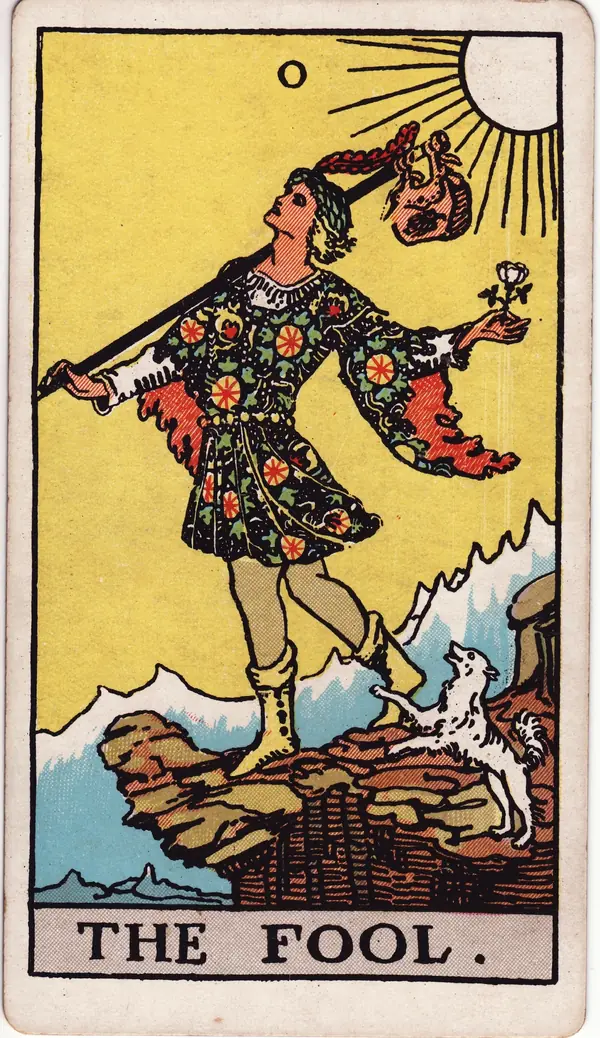
The familiar image shows a traveler at the edge of a cliff, a small bundle over one shoulder, face lifted toward the sky. A little dog dances at the traveler's heels, and the sun burns bright in the distance. The bundle is light, the step is confident, and the drop is real. That mixture matters. The Fool is not a promise that the ground will rise to meet you; it is a portrait of moving before every answer is in.
Its one-line core is simple: someone setting out with little baggage and plenty of nerve. Upright, the card favors openness, instinct, and a first attempt. In reverse, the same impulse can harden into recklessness or quiet avoidance. Same traveler, same cliff, different relationship to risk. Reading The Fool well means holding both the freedom and the drop in view.
The Fool Symbolism: What Each Detail on the Card Means
Posture and expression: The young figure leans forward, one foot reaching past the cliff edge while the other stays behind. The head is lifted and the face relaxed. Because the movement is unfinished, the weight has already shifted outward even though the foot has not landed. Intention has outrun certainty. Upright, read this as openness, a willingness to try, and comfort with being a beginner. Reversed, the same lean without awareness becomes stepping forward without looking.
Bundle and staff: A staff carries a small cloth bundle slung behind the shoulder; it is too light to hold everything. The staff supports walking, while the bundle gathers old experience. Together they suggest traveling light—and taking only the parts of yourself you are willing to sort through. Upright, the card supports leaving excess behind. Reversed, it can point to poor preparation, or to using “pack light” as an excuse not to be responsible.
White rose: One hand holds a white rose. White suggests purity, calm, and restraint; the flower is passion not yet worn down by reality, a sign of original intent and clean motives. Upright, it asks you to check why you are leaving. Reversed, the rose may be only a pose: the person says “whatever happens” while never having counted the cost.
Clothing colors and pattern: The coat mixes red, yellow, and green in an irregular pattern. Red is passion, yellow sits near the balance of feeling and reason, and green is hope and growth. Placed together, the colors suggest potential that has not settled into one form. Upright, the card encourages experience without rushing to define yourself. Reversed, it can show scattered attention, with emotions, thoughts, and actions each going a separate way.
Hat and feather: A soft hat carries a feather at the side. Feathers belong to air: light, drifting, tied to thought, freedom, and a nature not weighed down. Upright, this makes the figure flexible and willing to enter a new setting. Reversed, it suggests changing your mind with every breeze—going today and undoing it tomorrow. If a spread is already heavy with air, look for someone or something that can bring the idea to ground.
Small dog: The little dog follows, jumps, or turns back, as if barking and keeping company at once. Animals often stand for instinct, body signals, and loyal companionship. The dog may also be the only part of the self that sees the danger. Upright, it is a friendly warning and a companion. Reversed, it is an alarm being ignored: other people keep warning, and the traveler treats their warnings as a buzzkill.
Cliff edge: The figure stands at the edge of high ground, with no finished road ahead. The cliff stands for the unknown, risk, and a threshold; it also marks the outer edge of an old life. Upright, the card shows someone who sees the drop and still chooses to move. Reversed, the drop is underestimated, or the person keeps testing the edge without deciding. The tone depends on whether neighboring cards provide any ground.
Distant snowy mountains: Snow-covered peaks rise in the background, their lines cold and severe. The mountain is a distant goal, a challenge that takes time to climb, and the “higher place” held in the mind. Upright, light travel still has a direction. Reversed, the distance may be romanticized: the person sees the view but has not counted the route, the expense, or the stamina required.
White sun: A bright sun hangs in the sky, pale white or light yellow. It stands for clarity, vitality, and guidance, while the white tone adds purity and calm. Upright, it is a small light inside—the route is unclear, but the reason for leaving is known. Reversed, the light has not vanished; it is covered by overoptimism, and “it should be fine” is being used as judgment.
Sky and palette: The sky is usually bright yellow, closer to early morning than noon. Yellow links feeling and reason, and its warmth makes a person willing to move outward without becoming feverish. The overall warmth creates tension with the cliff: brightness that still contains risk. Upright, the card supports hope and action. Reversed, the warmth is out of balance and turns into agitation, causing details to be missed.
Terrain and road: The traveler stands on high ground with no paved route ahead, only open air beyond the cliff. This terrain says the question is not “which ready-made path should I choose?” but “am I willing to begin where there is no map?” Upright, the card is about making your own way and allowing uncertainty. Reversed, it is forcing a path where none exists, or mistaking “no limits” for “no consequences.”
Card number 0: The Fool is numbered 0 and placed before the Major Arcana. Zero resembles a circle and a blank page: from nothing to infinity, both a starting point and an ending point. It sits outside normal order and stands for possibility not yet defined. Upright, stay open and learn from zero. Reversed, the wheels may spin—anything can be imagined, and nothing is ever committed.
The Fool Kabbalah and Tree of Life
In the Classic Tarot tradition, The Fool corresponds to the eleventh path, and its Hebrew letter is Aleph, whose original pictograph means “ox,” the English word commonly used for it. The ox is not a comment on intelligence. It stands for carrying, pulling, and breaking ground: strength harnessed to a plow, slowly turning fallow land into soil that can be farmed. The letter gives The Fool endurance to bear weight, not just lightness. The path links Kether (the Crown), the first emanation and pure source of all energy on the central pillar, with Chokmah (Wisdom), the first impulse and masculine drive on the right-hand Pillar of Mercy.
The path runs from the first emanation to the second, turning “everything is still possible” into “one direction has begun to move.” A traditional saying holds that energy expands to the right, contracts to the left, and only downward can extend and land. The Fool’s path is closer to an outward expansion from the source; it has not truly descended. So it carries both pure drive and suspension: the thought has left, but reality has not caught up. Upright, it is a newly lit sense of direction. Reversed, the light circles overhead while the person refuses to find a foothold.
In love, imagine someone who feels attracted, has already decided to move closer, but the two have not established steady communication. This path says the impulse is real, yet it is still at the source and has not been tested by reality. The other person’s thoughts may not have moved past curiosity. Upright, send one natural greeting rather than arranging a grand date at once. Reversed, do not mistake a flutter of attraction for a relationship that already exists.
At work, it often matches a project idea that has just appeared. The Crown supplies the vision, Wisdom supplies the first push, but the path has not passed through the lower emanations, so process, budget, and ownership are still missing. Upright, build the smallest possible sample. Reversed, do not quit first and explain later, or invest before there is a plan. In self-growth, it is the decision to stop letting an old identity define you. Upright, allow a new version to appear. Reversed, change the label without touching the old habits.
The card’s common astrological correspondence is air, and modern readings often add Uranus. Both emphasize sudden ideas, broken convention, and freedom from restraint, which fits the structure between the Crown and Wisdom: first the spark, then the search for a shape. Treat this as background. The Fool’s freedom is not blankness; a push from the source runs behind it. The hard part is letting that push pass through contraction and grounding instead of scattering in midair.
The Fool Numerology
The Fool’s number is 0. In numerology, zero means from nothing to infinity: the starting point of every number and the endpoint they look back toward. It is not reduced, so no other card is reduced from it; zero is the card’s numerical identity. The Fool is not the first card in the sequence but the blank page before it begins. Everything is still unnamed and therefore unlimited. It contrasts with 1: one has no shape yet, the other has begun to act. It links end to beginning with 21, a reminder that completion can return to the start.
In life-path numerology, zero has no independent personality number. It is more like the undertone behind all numbers. It makes 10 look like an amplified 1 and gives 20 a sense of unfinished possibility. There is no fixed “zero person,” but combinations that include 0 often carry that undertone. Such a combination may use The Fool’s “I can always restart” as comfort, but it must ask whether the person will take responsibility for the choice. Upright, the undertone is openness and trust. Reversed, it can become procrastination, with “I am still exploring” used as a reason never to land.
Zero also echoes the card’s meaning in the space between empty and full. Empty, it can hold something new; without a fixed shape, it is not bound by old experience. But emptiness can also make a person forget that there is a cost. Upright, use that emptiness to welcome possibility. Reversed, ask whether the blank has been left so long that it has turned into avoidance.
Put zero back into the Major Arcana and its relation to 1 resembles “the idea” and “the action.” Number 1 puts the tools on the table; zero is still deciding whether to sit down. With 21, it is a call and response between “setting out” and “coming full circle.” Completion is not the final stop; it is a sorting of the baggage before the next departure. For long-term questions, ask whether you lack a new beginning or a proper ending to the old stage.
Placing 0 back into the full journey of the Major Arcana adds another layer. Starting from The Fool at 0, the path runs through The Magician's "act" at 1 and The High Priestess's "observe" at 2, all the way to The World's "complete" at 21. The Fool is the only card that can stand anywhere on that road: it sits at the start, yet it is also the traveler walking between every other Major card. So when The Fool appears, ask first: which stretch of the journey am I standing at the edge of? If the same spread also holds high-numbered Majors such as Judgement or The World, an old cycle is usually closing while a new one gathers. If the nearby Majors are numbered 1 to 5, the new stage has only just begun, and learning by trial and error is the theme for now.
What does The Fool mean upright?
The Fool upright points to a fresh start you can actually make. Maybe an invitation arrives, a new interest takes hold, or a routine finally feels too small. The card supports traveling light: a first step taken with modest resources, such as a conversation, a trial session, a short trip, or a rough draft. It asks for curiosity more than certainty. You do not need to know the whole route. You do need to notice what is in front of you, pack lightly, and let experience correct the plan. Trusting instinct works best when your eyes stay open.
The Fool reversed meaning
The Fool reversed describes the same departure with the brakes cut. Enthusiasm may be real, but details are skipped, consequences are waved away, and other people's warnings are treated as nagging. This is the card of recklessness and dodging responsibility: quitting before checking the numbers, promising more than can be delivered, or calling carelessness freedom. Blind spots grow when speed feels exciting. The card does not announce disaster. It asks you to look for the missing step: the call not made, the cost not counted, the limit not set. A short pause can turn a risky leap into a workable start.
The Fool in love: single, in a relationship, reconciliation
Love readings often bring The Fool when a connection is new, undefined, or ready for a change of scenery. The card is less interested in labels than in willingness: Are you open? Are they? Is there room to explore without pressure? It can describe a sweet, playful beginning, but it can also expose a person who enjoys the spark and avoids the follow-through. Whether you are single, in a relationship, or considering reconciliation, read the surrounding cards for tone, then look at behavior over time.
The Fool upright love
The Fool upright in love has a light, experimental quality. Two people may meet through travel, a community event, a party, or a shared enthusiasm, and the connection grows through spontaneous conversation rather than heavy expectation. There is affection here, but not necessarily a roadmap. If you are dating, enjoy the discovery while staying honest about what you want. If you are committed, the card may invite a shared adventure or a break from routine. Keep the playfulness, and keep your promises.
The Fool reversed love
The Fool reversed in love can feel exciting and unstable at once. One person may chase the thrill but disappear when a real conversation is needed. Another may confuse intensity with intimacy, making grand gestures without following through. You might hear lovely words and see inconsistent actions. The card asks you to slow the story down and check the facts: Are plans kept? Are boundaries respected? Does freedom run only one way? Affection is not the same as reliability, and a charming beginning does not excuse carelessness.
The Fool love for singles
For a single person, The Fool upright encourages a wider field of view. You may be ready to talk to someone outside your usual type, visit a place you have never been, or accept an invitation that feels slightly outside your comfort zone. The point is not to force a relationship; it is to let curiosity return. Say yes to a low-stakes plan, stay present, and notice how you feel around the other person. Adventure can open the heart, but basic discernment should travel with you.
The Fool in a relationship
In an established relationship, The Fool often asks for fresh air. A weekend away, a new hobby together, or an unscripted evening can remind two people why they chose each other. Yet the card also draws a line between shared freedom and private escape. If one partner keeps saying "later" about money, family, or future plans, the lightness may be covering avoidance. Talk about the practical pieces: time, budget, responsibilities, and boundaries. Novelty is healthy when both people know where home is.
The Fool and getting back with an ex
The Fool and getting back with an ex suggests a restart, not a rewind. A first message might be light: a hello, a memory, a question about how life has changed. That can be appropriate if both people are genuinely curious and willing to meet as they are now. It is not a reason to skip the old problems. If the breakup involved impulsiveness, silence, or broken promises, those patterns need names and new behavior. Reconnection can begin casually, but it cannot survive on nostalgia alone.
The Fool as feelings: how they feel about you
When The Fool appears in a feelings position, it usually speaks to openness, curiosity, and a desire to see what might happen. It is rarely a sign of a settled, long-term plan. The person may feel drawn toward you because the connection feels unforced, or they may be keeping one foot near the exit. Use their behavior as the tiebreaker: Does their interest show up consistently, or only when the mood strikes? The card offers a direction, not a verdict.
The Fool upright as feelings
The Fool upright as feelings suggests that you occupy a bright, uncomplicated place in their thoughts. They may find you easy to talk to, refreshing, or different from what they expected. There is a wish to explore, to spend time, to see where things go. What is missing is definition; they may not have imagined a future yet. That does not make the interest false. It means the connection is still in its opening pages. If you want clarity, ask for it gently rather than trying to read a promise into enthusiasm.
The Fool reversed as feelings
The Fool reversed as feelings often carries a split: attraction on one side, hesitation on the other. They may enjoy your company and still resist any step that feels binding. Sometimes this comes from genuine uncertainty; sometimes it is a habit of slipping away when things get real. Watch for mixed signals, last-minute changes, or declarations that are never followed by action. You can hold compassion for their confusion without volunteering to manage it. Their thoughts are theirs to sort out; your boundaries remain yours.
The Fool as how someone sees you
The Fool as how someone sees you casts you as the free spirit in their story. They may see you as open, fun, and a little unpredictable, someone who brings movement into a stale routine. That can be flattering, but it can also mean they have put you in a category: the exciting one, the casual one, the person who never needs anything serious. If that picture does not match who you are, say so. Let them meet the whole person, not just the traveler with the light bag.
The Fool as intentions
The Fool as intentions points toward exploration. They probably want to talk, meet, or try something new with you, and they may genuinely mean it. What the card does not promise is a detailed plan. Their intention might be to enjoy the connection as it comes rather than to define it. That is workable if you want the same thing. If you are looking for commitment, ask what they are actually offering. Judge the answer by consistency, not by the warmth of the moment.
The Fool career and work (upright & reversed)
In work readings, The Fool is the card of the beginner's door: a new role, a transfer, a side project, a change of direction, or a task you have never handled before. It favors curiosity and a willingness to learn in public. It does not favor skipping preparation. The best use of this card is to make a small, reversible move—ask for a trial assignment, shadow someone, test an idea with a limited audience, or learn a tool through a short training session. Let the results inform the next step.
The Fool upright career
The Fool upright in career supports fresh starts and calculated experiments. You may be offered a role that stretches you, or you may finally decide to explore a field that has been tugging at your attention. The card encourages you to apply, ask, and try, even if your resume is not perfect. In an existing job, volunteer for the unfamiliar project and learn as you go. Keep a beginner's humility, though. Check the brief, confirm the deadline, and ask for feedback early. Courage works best when it is paired with basic diligence.
The Fool reversed career
The Fool reversed in career warns against motion for its own sake. This is the moment to look closely at the offer with missing details, the resignation letter written in frustration, or the plan that assumes everything will work out. Ambition is not the problem; unexamined risk is. Before you leap, ask what the first ninety days look like, who pays for what, and how long you can manage without income. Seek advice from people who know the field. You can still choose the bold path, but choose it with your eyes open.
The Fool for money and finances
With money, The Fool is not a lottery ticket. It favors small experiments, learning purchases, and modest risks that will not damage your daily life. Upright, you may spend on a trip, a tool, or a class that expands your experience; keep the amount within a range you can lose without hardship. Reversed, the card warns about optimism that ignores fees, contracts, or exit terms. Separate essential money from money you can afford to risk. Read the fine print, ask what could go wrong, and avoid any decision you cannot explain calmly. No card can promise a return, and this one certainly does not.
The Fool for health
The Fool in health is a reminder about pace. New energy can be wonderful, but it can also tempt you to ignore sleep, skip meals, or jump into intense activity after a long pause. Build rest into the plan and pay attention to the body's early signals. This card does not diagnose illness and does not indicate that any condition will improve or worsen. If something hurts, persists, or worries you, see a doctor. If you are pregnant or managing a health condition, ask a clinician before changing your routine. The card supports sensible movement, not medical guesswork.
The Fool as advice
Advice from The Fool is about the size of the next step. The card rarely asks for a total life overhaul. It asks you to leave the familiar spot and learn from contact with the world. That might mean sending one message, booking one session, or trying one afternoon of the thing you keep postponing. It also asks you to be honest about what you are carrying. Travel light, but do not pretend the cliff is not there. Courage and attention belong in the same bag.
The Fool upright as advice
If you have been waiting to feel completely ready, The Fool upright says begin smaller than your fantasy. Choose an action you can complete this week and reverse if needed: a query, a draft, a visit, a trial run. Tell one trustworthy person what you are attempting so you have a witness, not a manager. After the step, pause and look at what happened. Did it interest you? What did it cost? What did you learn? Let the next move come from evidence as well as instinct. Openness is a practice, not a single leap.
The Fool reversed as advice
The Fool reversed advises a deliberate pause. Before you make an irreversible choice, write down what you are gaining, what you are risking, and what you would do if the worst plausible outcome happened. Ask someone with relevant experience to poke holes in the plan. That is not weakness; it is how enthusiasm becomes durable. If you cannot answer the basic questions, wait. You do not have to abandon the idea. You only have to stop treating urgency as proof. Keep the spark, add the map, and decide when your feet are under you.
The Fool as a person
The Fool as a person often describes someone open, curious, and hard to fence in. They may be the friend who suggests a last-minute trip, the coworker who asks the naive question everyone else was afraid to ask, or the partner who needs room to breathe. Their gift is movement; their challenge is follow-through. They can be delightful company and frustrating when promises go missing. Read them by their patterns, not by their potential. A free spirit is not automatically unavailable, but freedom means little if it never includes responsibility.
The Fool reversed as a person
The Fool reversed as a person can show up as charm without accountability. This is someone who may leave plans vague, change direction without warning, or turn a serious conversation into a joke. They might not be malicious; they may simply be uncomfortable with limits. Still, you are allowed to notice the cost. Do they respect your time? Do they repair mistakes? Do they stay when the fun stops? The card invites compassion for their restlessness and honesty about its impact. You can care about someone and still decline a front-row seat to their chaos.
How to place it in a reading
In a spread, The Fool often lands in a position about beginnings: the present moment, the next step, the unknown, or the advice. Its tone depends heavily on its neighbors. Beside steady cards such as the Emperor or the Four of Pentacles, it reads as a supported risk, a leap with a net. Beside turbulent cards such as the Tower or the Five of Swords, it warns that impulsiveness may multiply the confusion. It can also suggest that the question itself needs a new angle. Instead of asking, "How do I control this?" try, "What would I attempt if I were new here?"
Our take
When The Fool appears in a spread, do not rush to recite keywords. First look at whether the cards on either side are “ground” or “cliff.” Beside Pentacles cards or Emperor-type cards, it is like a cushion placed below the cliff: the experiment is possible because money, time, or experience can catch the fall. Beside Swords cards or The Tower, it is closer to standing on loose ground. Check the risk, the contract, your stamina, and the worst outcome. The Fool does not judge safety; the neighboring cards tell it whether there are conditions for landing.
In a past-present-future spread, The Fool is often a starting point, but not necessarily the first card. In the second position, it means the matter has already had a period of preparation and is only now truly restarting. In the third, earlier cards may be paving the way—or delaying—until this moment, when the person is finally willing to step. In the future, the point is not to guarantee a new chapter but to show that the next stage will unfold in an unfamiliar, open way. In the past, look at what that departure left unfinished.
Its astrological correspondence is air, with Uranus often added in modern readings, so in a spread it can signal sudden information, a change of rules, or an unplanned turn. If enough earth sits nearby, the sudden event can become a prepared experiment. If the spread is all air and fire, watch for ideas that grow larger while nobody books the ticket, calculates the cost, or confirms the time. Its position shows at which stage the matter is restarting.
If The Fool lands in the center, it is often the turning point of the whole spread. The other cards describe reality; this one asks, “Should we try a different way of moving?” Do not ask only whether it is good or bad. Look at which two cards it connects. Linked to resources, change has a fulcrum. Linked to conflict, change needs guardrails first. Read this way, The Fool does not dissolve into a vague “whatever happens.”
The Fool in Different Positions: Past, Present, Advice, Obstacle
Past: The past position asks what shaped the current situation. The Fool here often points to a beginning that never fully ended. Perhaps the person took a step on intuition, or left an old track because they did not want to be arranged. That step was not necessarily wrong; it carried a beginner’s innocence, and the follow-through never caught up. Reversed in the past, it may be an impulsive exit that left a mess, or courage worn down by reality, so that every plan now begins with failure. Ask what that departure taught you, not only whether it succeeded.
Present: The present position asks what the current state is. The Fool here says the person is standing on a threshold: the old life is still behind them, the new one has not formed, and excitement mixes with a sense of suspension. Upright, they are willing to admit they do not know and still try. Reversed, the same energy is off balance. They may want to cut everything away at once, or fear making a mistake and keep testing without deciding. Reversed here is often upright energy overdone or a temporary loss of balance, not a simple opposite. The task is not to force a final answer but to tell whether they are approaching out of curiosity or avoiding something they must face.
Future: The future position asks how things will develop. The Fool here usually points to a new phase, an attempt the person has never made, or rules being rewritten. It does not promise smooth sailing; it says the theme will be learning and adaptation. Reversed in the future, the new chapter may be delayed, or the opening may be underprepared, so more information is needed before launch. It can also mean “it looks like a start, but the person is still in place.” For a short-term question, it is a thought drawing near. For a long-term question, do not mistake the beginning for the result.
Advice: The advice position asks what to do now. The Fool’s direction is to keep the heart of departure but make the first step small and recoverable. Upright, ask, try, and experience before you feel completely ready. Reversed, slow down first and check the cost, the way back, and the specific warnings other people are giving. Reversed here is not a call to give up; it turns the upright “dare” into “dare after looking.” If you have been too cautious, it pushes you forward. If you have been too impulsive, it taps the brake.
Obstacle: The obstacle position asks what is in the way. When The Fool lands here, the obstacle is often not a lack of opportunity but a misunderstanding of “starting.” Someone treats novelty as direction, or wants only the ease of stepping and none of the tedious follow-through. The environment may also refuse to allow unlimited trial and error. Reversed in this position often shows two extremes: rushing ahead and creating avoidable chaos, or being so cautious that every possibility becomes a daydream. Once you see which one is happening, you know whether to add a plan, a boundary, or courage.
Outcome (or clarifier): The outcome position asks where the matter will go. The Fool gives an open result: not a final verdict of success or failure, but “entering a new phase.” Upright, the result may be a worthwhile attempt that restores a sense of direction even without immediate success. Reversed, it is more likely to be an unstable start, a delayed decision, or a benefit cut in half—things can begin, but they need more repair. When an essentially positive card is reversed, the good is often reduced. It can also serve as a clarifier: the ending is not fixed, and you can still choose to set out again in a more mature way.
The Fool Three-Card Example (Fictional Example)
Fictional example: The people and events below are fictional and are used only to demonstrate how to read the cards.
The querent is thirty and works a stable office job. Lately he keeps thinking about resigning, taking a year off, learning to dive, and visiting several places he has always wanted to see. The real question is whether he should take this step. On the surface it is “go or stay.” Deeper down, it is whether he is willing to trade a year for a chance to meet himself again, and whether he can bear the uncertainty after his income stops.
The spread is Development, Obstacle, Advice. The first card, in Development, is The Fool upright. The second, in Obstacle, is the Four of Pentacles upright. The third, in Advice, is the Three of Wands upright. This spread does not make the decision for him. It separates where the matter is heading, what is blocking it, and how to respond.
Card 1, Development: The Fool (upright). Development asks for the direction of events. The Fool upright shows that the urge to resign, learn diving, and travel is not a passing whim. A real need for renewal lies behind it: he wants to raise his head above a life that has been arranged for him and feel his own curiosity about the world again. The card supports “beginning,” but not “handing in your notice tomorrow.” It says the direction has life in it. The next task is to turn it into concrete steps rather than leaving it in imagination.
Card 2, Obstacle: Four of Pentacles (upright). The Four of Pentacles shows a figure clutching coins, emphasizing guarding, control, and fear of loss. In the obstacle position, it does not mean he is greedy. It means “security” is what blocks him: the mortgage, savings, family expectations, and the question of whether he can find a job with similar pay when he returns. These concerns are real and reasonable. The card suggests that the issue is not “do I dare?” but “do I have a bottom line that would let me loosen my grip?”
Card 3, Advice: Three of Wands (upright). The Three of Wands often shows a person standing on high ground and looking into the distance, staff at hand, like someone waiting for a ship or planning the next move. Its advice is not to jump at once. First widen the view: calculate a year of living expenses, research the stages and costs of diving instruction, arrange a short trial, and talk through the division of responsibilities with a partner or family. Break the “long journey” into small, testable plans, then decide whether to extend it to a full year.
Together the three cards tell a clear story. The Fool in Development is air, and it says the wind in his mind is real. The Four of Pentacles in Obstacle is earth, and it says money and security are holding him back. The Three of Wands in Advice is fire, and it says the way out is to turn the vision into a plan, not to choose between “quit on impulse” and “keep enduring.” Only one card comes from the Major Arcana, so the core drive comes from a life-stage transition. What actually determines whether he can go the distance is the practical arrangement shown by the two minor cards.
In tone, The Fool’s sky is bright and warm, the Four of Pentacles is contained and cool, and the Three of Wands carries an open warmth. The alternation of warm and cool says this is not a matter of pure enthusiasm or pure caution. The two need to connect. The small number of Major Arcana cards also suggests that fate is not pushing him along; the initiative lies more in everyday choices.
The specific advice for the querent is this: do not resign yet. Use three to six months as a dry run. Calculate basic annual expenses and set aside emergency money. Take a short block of diving instruction to confirm that he truly enjoys it. Ask the employer about unpaid leave, a longer unpaid break, or remote work. Split the travel into short segments and take one or two first. Set a review date, then decide whether to leave formally. This preserves The Fool’s sense of departure without letting the Four of Pentacles’ fear grow without limit.
What changes if the same spread turns reversed: Suppose The Fool had appeared reversed in the development position. The center of the story shifts. Reversed, the urge to leave is pushing too hard; recent exhaustion may be driving it, so the wish to escape outweighs the wish to set out. In that version, the Four of Pentacles stops being only an obstacle and becomes a needed brake, reminding him to protect his baseline first. The Three of Wands' advice also changes from "plan the trip" to "get clear on where you actually want to go and what you want to learn." The contrast shows that upright and reversed do not just flip good and bad; they change the direction of the whole story. Upright says "prepare, then go." Reversed says "first tell leaving apart from running away."
Common Misreadings of The Fool
Misconception 1: The Fool means stupid and irresponsible. The figure is a beginner, not a fool. He is willing to take one step while information is incomplete, and that openness has value. The real shadow is recklessness. If you read the whole card as “bad,” you miss its support for trying and starting over. In a spread, look at both neighbors and orientation: with ground beneath him, this is courage; without support, it is time to name the risk.
Misconception 2: Drawing The Fool means you must resign, travel, or confess at once. The card describes a stance toward the unknown, not a checklist of actions. It may only be asking you to learn in a different way, take on a small project, or meet a new circle of people. Treating a grand gesture as the only answer can create unnecessary losses. Ask instead: what is the smallest, most recoverable first step for this person?
Misconception 3: Reversed means total failure and the thing must not be done. Reversed is more often upright energy taken too far or balance lost in the moment, not a simple opposite. The Fool reversed may be too impulsive, or it may be hesitating so long that it refuses to land. When an essentially positive card reverses, the good is often cut in half. The right response is to slow down, verify information, and add a way back—not to close the door forever.
Misconception 4: The Fool belongs only to young, single, or self-employed people. A beginner’s mindset has no necessary link to age, marital status, or type of work. A person with a family may need to learn again or change the rhythm of life. Someone in a stable job may be preparing a new beginning. The difference is that the person with more real-world obligations has to design a steadier first step.
Misconception 5: The more spontaneous The Fool is, the better; plans destroy inspiration. The cliff in the image shows that freedom and seeing where you stand are not in conflict. True light travel means knowing what can be left behind and what must be carried. Refusing to count the cost is not free-spiritedness; it hands the risk to your future self. If Pentacles or Emperor-type cards appear, treat them as ground. If Swords or Tower-type cards appear, check the details more carefully.

FAQ
The Fool raises practical questions about timing, commitment, and risk, so the short answers below focus on what the card actually supports. Classic Tarot readings are interpretive, not fixed predictions, and a single card should be weighed with the rest of the spread and with real-world information. Use these responses as starting points for reflection, especially when a decision involves money, health, work, or another person's choices.
Is The Fool a yes or no card?
Yes. The Fool leans yes, especially when it appears upright. Upright, it supports a first attempt, an application, a conversation, or a modest adventure. The answer is not a guarantee of success; it is an invitation to begin and learn. Reversed, the same overall grade remains a cautious yes, but the risk needs attention. For irreversible decisions, gather the missing facts before you act. The card rarely argues for staying completely still.
What does The Fool reversed mean in a yes or no reading?
It weakens the yes to a conditional answer, not a firm no. The reversed card still belongs to a beginning, but it warns that someone is skipping a step. You may be rushing, avoiding a responsibility, or missing a warning sign. Treat the answer as yes only after you close the obvious gaps. If the question involves signing, traveling, or quitting, wait until you understand the downside. A pause can preserve the opportunity rather than destroy it.
What does The Fool mean if you have a secret crush?
It points to curiosity and a possible opening, not a confession. Your crush may see you as easy to talk to, fun, or pleasantly unexpected. That can create room for natural contact, but it does not prove they are ready for romance. Start with ordinary conversation and watch whether they make time for you. If they are consistent, you can deepen the connection. If they only appear when they need entertainment, keep your secret and your standards.
What does The Fool mean for marriage?
It suggests a new chapter or a fresh approach, not a guarantee of lasting commitment. If you are dating, the card asks for more shared experience before big promises. If you are already married, it may call for play, travel, or an honest reset. It can also expose a partner who enjoys the idea of freedom but avoids the work of partnership. Talk about practical expectations, not just the mood of the moment. Marriage needs adventure and reliability in the same house.
What does The Fool mean as an outcome?
A new beginning with an open result; expect learning more than certainty. The outcome may be a move, a first attempt, a change of direction, or a relationship that starts without a clear label. The card says the situation is still forming. Do not treat the outcome as a promise that everything will be easy. Look at the surrounding cards for support or friction. Your choices between now and then still shape what this beginning becomes.
What timing does The Fool suggest?
Timing is open and often tied to your first step rather than a fixed date. The Fool rarely points to a distant season. It behaves more like a door that opens when someone finally acts. You might see movement soon after a conversation, an application, or a decision to try. Avoid forcing a deadline onto another person's process. If you are waiting for a sign, the card suggests that a small experiment will give you better information than more guessing.
Does The Fool mean pregnancy?
It does not confirm or rule out pregnancy. No card can establish whether you are pregnant, and this one should never be used as a substitute for a test or medical advice. The Fool may symbolize a new chapter or a childlike fresh start in a reading, but that is symbolic language. If pregnancy is possible, take a test and speak with a doctor. If you are trying to conceive or have concerns, rely on medical guidance rather than card interpretation.
What zodiac sign is The Fool?
Air is its traditional element, often linked with Uranus in modern correspondence. Some readers associate The Fool with the air signs—Gemini, Libra, and Aquarius—because the card emphasizes curiosity, movement, and ideas. In modern lists, Uranus is frequently named as its planetary link, which adds a taste of independence and sudden change. These associations are interpretive lenses, not rules. Use them to enrich a reading, but let the card's position and your question guide the final meaning.
Is The Fool a good or bad card?
Neither purely good nor bad; it is a card of open beginnings. Upright, it tends to support courage, curiosity, and fresh experience. Reversed, the same energy can become recklessness or avoidance. The difference is usually not the card itself but the amount of awareness brought to it. Ask whether you are being open or merely careless. A good beginning includes both enthusiasm and a willingness to look at the ground beneath your feet.
Related cards
Several cards pair naturally with The Fool, and each one changes the flavor of a beginning. Some add resources, some add stillness, some add choice, disruption, or completion. Read them as a conversation rather than a checklist. The question you asked will decide which voice matters most, and the card's position will show where that voice belongs. The Fool is never read in isolation when it sits in a spread; its meaning shifts with every neighbor.
To place this card back in the full deck, see all 78 cards.
- The Magician: another card of starting, but it emphasizes skill, resources, and deliberate action rather than pure openness.
- The High Priestess: turns the Fool's outward curiosity inward, suggesting that you wait, listen, and observe before acting.
- The Lovers: brings choice and commitment into the picture, asking what you value once the first spark has passed.
- The Tower: exposes the cost of a blind leap, so together they warn that sudden change may remove structures you were counting on.
- The World: closes a cycle, and beside The Fool it reminds you that every departure eventually asks for follow-through and completion.
- Death: closes a chapter, while The Fool opens one; together they ask what you are leaving so the new step can be clean.
- The Star: offers quieter hope after a leap, useful when The Fool’s openness needs a steadier light to walk toward.