The Star Tarot Card Meaning: Reversed, Love, as Feelings, Yes or No

Draw a Classic Tarot spread →Free, no sign-up. Think of your question, then draw.
In one line: The night sky after a storm—faint light, clear direction.
| Keywords | |
|---|---|
| Upright | hope, healing, long-term goals |
| Reversed | disappointment, low confidence, vague goals |
| Type | Major Arcana 17 |
| Yes/no (our grading) | leans yes |
Quick answers: yes/no · love · career
- Yes/No: Under our grading, The Star leans yes. Yes/no is the least reliable use of tarot—prefer “how should I approach this?”.
- Love: A relationship mending, or hope for the future; reversed, disappointment or fear of hoping.
- Career: Good for long-range goals, brand and reputation; reversed, don't quit over one setback.
*FateClear Editorial Team*
Want to draw a Classic Tarot spread? Draw cards.
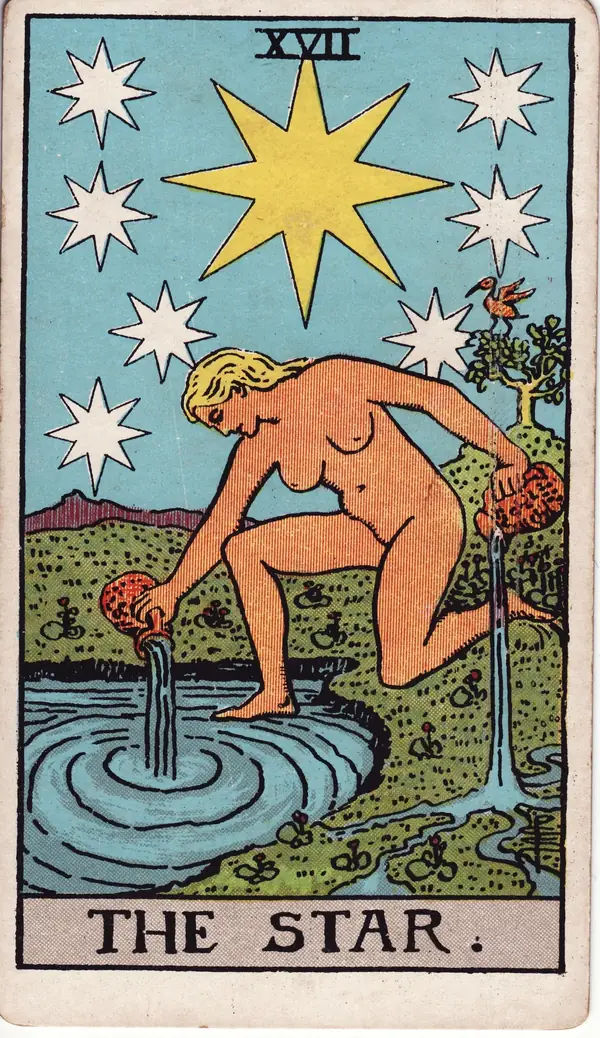
In the Classic Tarot, The Star is Major Arcana 17, a card associated with the element of air. It follows the kind of upheaval that clears a landscape. A figure kneels beside a pool, pouring water from two vessels—one onto the water, one onto the earth. Above, one large star shines among seven smaller ones. The scene is quiet. The light reveals the terrain without erasing every shadow.
At its center, The Star means hope, healing, and long-term goals. Our one-line meaning is “The night sky after a storm—faint light, clear direction.” You may not have reached comfortable ground, but you can see which way to walk. The card does not promise results on your schedule. It promises that direction can return before certainty does.
The Star often appears after depletion: a demanding job, a disappointment, a season of caring for everyone else. It also shows up when a goal deserves a slow build. In reverse—or upside down in a spread—it seldom turns hostile. It asks whether fatigue, doubt, or vague aims have clouded a light that is still there.
The Star Symbolism: What Each Detail on the Card Means
In the Classic Tarot's familiar scene, the Star does not rely on drama. Its details are all about learning to see again.
A figure at the water's edge A naked figure kneels beside a pool, one leg near the land, the other foot touching the water. The body is low and steady, the face free of strong emotion. Ground and sensation share one posture: nothing is fled, nothing is flooded. Upright, this favors healing that comes back to ordinary life—getting up, eating, seeing people. Reversed, it warns that you may claim to be letting go while still kneeling in an old mood. Boundaries soften, and a thoughtless remark can unsettle you for hours.
Two jugs One jug in each hand: one pours into the pool, the other onto the earth. The water circulates rather than accumulates. Feeling returns to its source, and daily life gets watered. Upright, giving and receiving stay in motion, and a wish can become a practical act. Reversed, both jugs seem to tip the same way—too much output, too little refill, then plain tiredness. Ask yourself: Am I feeding my life, or spending myself to maintain a good-looking surface?
The bare body No clothing, no color to hide behind. The nudity is not provocative; it is the end of pretense. Rank, role, and composure are set aside, leaving the actual self. Pale skin against the night makes the figure look quiet and exposed. Upright, this favors candor, acceptance, and love that does not require a performance. Reversed, it can turn into raw sensitivity: a neutral comment lands as rejection, so you withdraw or work harder to prove your worth.
Deep blue sky and stars A broad dark-blue field brings coolness, distance, and reflection. One large star shines among seven smaller ones, often eight-pointed and golden. The gold is like a lamp in the night—a direction you can follow without being dazzled. Upright, the large and small stars suggest hope in stages: first the bearing, then a series of small approaches. Reversed, the stars are still there, but clouds or emotion obscure them. That is not proof the road is gone. Blue lets you step back for the whole picture; gold marks one point within it worth nearing.
Pool and land The pool mirrors the starlight; the land beside it takes the second stream. Blue water suggests feeling, the unconscious, and imagination. Brown soil suggests the body, practical reality, and routine. Both receive water at once, and that is the card's balance. Upright, inner life and outer arrangements answer each other: rest when rest is due, and face what needs facing. Reversed, water may overflow or the ground may crack. Emotion swamps practicality, or busyness leaves no room to feel. The question is: Have you tended only one side?
Tree and bird A tree rises at one side, a bird settled on a branch. The brown trunk suggests roots; green leaves suggest peace and hope. Roots go down into soil while branches reach toward sky—slow growth, measured in time. The bird stays rather than flies, like an observer or a quiet message. Upright, this says patience can accumulate into results; relationships and work may improve through long attention. Reversed, it warns of watching without moving, waiting too long, or treating a distant hope as permission to ignore the present.
The eight-pointed star and its rhythm The main star is often eight-pointed, ringed by seven smaller stars. Eight suggests cycles, order, and return to the start. Yet this is not a sealed circle. It is a reminder to adjust your heading again and again. Upright, that rhythm favors steady practice and regular review. Reversed, the beat collapses: three days of force, two days of silence. Within the whole card, starlight is a tempo, not a one-time miracle.
The Star Kabbalah and Tree of Life
On the Tree of Life, the Star sits on the fifteenth path, joining Chokmah (Wisdom) and Tiphareth (Beauty). Chokmah stands on the right pillar, the Pillar of Mercy. It represents first impulse, masculine drive, and creative force before it has a shape—lightning that arrives before language. Tiphareth stands at the center, the place of balance, harmony, and self, where inspiration is gathered into a self you can actually carry. The path's Hebrew letter is Heh, whose early sense is "window." A window does not make light; it lets you see what is outside and lets you be seen. With the Star on this path, hope is not something to own. It is a change of view.
Direction matters. If the current runs from Chokmah to Tiphareth, it contracts from right to left: raw impulse enters the center and learns form, responsibility, and ground. If it runs from Tiphareth back toward Chokmah, it expands from left to right: the self you already have reconnects with a larger inspiration. A vertical descent carries the ideal into daily life instead of leaving it as a vision. Some traditions exchange the letters of the Emperor and the Star, giving Tzaddi to the Star and Heh to the Emperor. Both readings can work; neither has to cancel the other.
This structure clarifies several situations. In love, the spark of Chokmah resembles early attraction, while Tiphareth asks whether that attraction can enter a stable self and ordinary shared life. If it stays only a spark, the Star becomes idealization; if it can be brought into routine, the card's upright repair is real. At work, inspiration that remains "I want to do something big" turns into delay. Shrink it into a deliverable skill or piece of work, and you follow the path's direction. In personal growth, the window says hope is not an escape outside the glass. It is a different way of seeing, followed by a return to your own place. The usual astrological link to Aquarius echoes this move from private impulse to a wider human view: ideals must land on actual people, or they become cold slogans.
The Star Numerology
The Star is number 17. Reduce 17 to a single digit: 1 + 7 = 8, the number of Strength. The character of 8 cares about patterns, results, and resources. It knows how to manage, and it can summon endurance for a long goal. Its risk is turning everything into a measurable score and forgetting why it began. The Star reduces from 17 to 8 as if to say: no hope, however large, survives for long without order, patience, and resource management.
The link between Strength and the Star is not intensity. It is quiet persistence. Strength is often read as taming instinct with gentleness; the Star holds a direction with unobtrusive light. Neither depends on one burst. Both rely on a steady inner stance. When the Star appears, ask: Have I made my wish sustainable? Passion without rhythm will show up as delay and depletion, which is the lesson of 8. A plan without warmth sends you back to the Star's question: why did I want this in the first place?
People with a life-path number of 8 are often described as sensitive to results, resources, and order. They tend to think like managers and may load themselves with the demand to succeed. The Star can serve as a counterweight. When the schedule is too full, it asks you to leave room for breath and trust. When you only daydream, the 8 asks you to write down the steps. This is one lens for self-understanding, not a verdict about anyone. The point is not to rank people by a number, but to notice how you handle pressure and completion.
What does The Star mean upright?
When The Star stands upright, its keywords are hope, healing, and long-term goals. The hope is practical, not sugary. You may have left a high-pressure role or come through a stretch of disappointment. Life has not transformed overnight, but your sleep improves and you begin making plans again. That return of capacity is the card’s real gift.
The Star also describes a clear internal compass. You know what kind of person you are trying to become and which effort deserves years rather than days. It might be a steady savings plan, a health routine you can keep, or a relationship where you no longer perform to be accepted. Do not mistake slow progress for the wrong path.
The Star reversed meaning
Reversed, the keywords are disappointment, low confidence, and vague goals. The path has not vanished; your view of it has blurred. Perhaps you gave a lot and received little response. Perhaps you kept tending other people’s needs until you could not name your own. The danger is turning “I was not seen” into “I am not enough,” then working harder to earn a sign of worth.
Reversed, The Star can also point to a goal that sounds inspiring but has no shape. You may want a calmer life or better work, yet have no idea what the first ordinary step would be. That vagueness makes every effort feel pointless. Before making a dramatic decision from discouragement, write down what is actually unclear: the schedule, the boundary, the conversation, the number.
The Star in love: single, in a relationship, reconciliation
Love under The Star is rarely a sudden blaze. It is the warmth that returns after trust has been tested or energy has been low. The card favors honesty, patience, and closeness where two people can be quiet without performing. It asks you to notice what is visible in behavior, not only what you hope is happening beneath the surface. That is where the reading becomes useful.
The Star upright love
Upright in love, The Star describes a bond that grows through calm attention. You become more willing to state a need plainly and to give the other person room to answer. Affection may not arrive in grand speeches; it shows up in reliable messages, small repairs, and the sense that you do not have to manage the other person’s mood to keep the peace. If you are in a steady phase, do not confuse peace with indifference. Some intimacy is built while sitting side by side, doing ordinary things. Let your efforts be visible instead of silently keeping score.
The Star reversed love
Reversed in love, The Star often points to an imbalance between giving and receiving. One person remembers, plans, and softens after conflict while the other accepts it as the baseline. You may say it is fine, then feel a sting when no one asks whether you are tired. The other person may sense pressure without understanding why, and withdraw. The more you give, the less room there is for an honest exchange. This is not automatically an ending. Name the specific task, hurt, or hope. If the response is consistent avoidance, believe that pattern too.
The Star love for singles
For a single person, The Star upright is less about immediate partnership than recovery. You are becoming reacquainted with your own preferences after disappointment or self-doubt. People who once seemed exciting because they were unpredictable may lose their shine. You start to value steadiness, respectful communication, and someone who does not punish you for having a life. Connection is more likely to grow in low-pressure settings: a shared interest group, a class you attend for pleasure, or a recurring volunteer shift. Do not audition for love. Build a life that feels good enough that another person is an addition rather than a rescue.
The Star in a relationship
In an established relationship, The Star upright often brings a season of practical planning. You may discuss where to live, how to share expenses, or how to make room for rest. These conversations can sound unromantic, yet they are a form of devotion. The card supports a bond where both people can say, “This is what I need this month,” without turning the request into a verdict on the relationship. Watch for default roles. One person remembers every appointment; the other assumes it happens by itself. Make requests concrete and small: “Could you handle dinner on Tuesdays?” works better than a general complaint.
The Star and getting back with an ex
With an ex, The Star upright leans toward calm reconnection rather than dramatic reunion. The pace is slow, and the lesson is clarity. A conversation that avoids relitigating every old fight can reveal whether both people have changed the pattern that broke the bond. Nostalgia alone is not evidence. Look for consistent contact, honest acknowledgment of the past, and a willingness to name what would be different. You do not need to reopen the door all at once. A brief, respectful exchange can show whether the other person responds with maturity. If charm returns without accountability, let the light stay a memory.
The Star as feelings: how they feel about you
When The Star appears in a feelings position, the question is not simply “Do they like me?” It is “What place do I hold in their inner life?” The card tends to describe warmth with distance, admiration with caution, and hope that has not yet become a plan. Read it with the surrounding cards and, most importantly, with actual behavior. The gap between atmosphere and action is where the useful answer lives.
The Star upright as feelings
Upright as feelings, The Star suggests genuine goodwill. The other person likely experiences you as soothing, honest, and easy to be around. They may admire qualities they feel they lack: steadiness, generosity, quiet courage. There is often an element of idealization here, not in a sinister way, but in the sense that they see your best side clearly and have not yet integrated your ordinary imperfections. Expression may still be slow. They could believe there is time, or worry that rushing would spoil something delicate. Offer a warm opening, then observe whether they move toward you. Hope matters only when it eventually acquires legs.
The Star reversed as feelings
Reversed as feelings, The Star can show affection tangled with doubt. The other person may feel that you are good for them but not know how to meet you halfway. Perhaps they are ashamed of their inconsistency, or they sense that your generosity comes with unspoken expectations. Rather than say that, they retreat into vague friendliness. You may read the distance as rejection and try harder. The card does not prove dislike. It suggests that their feeling is not yet supported by capacity or courage. Pay attention to whether they can tolerate a direct conversation. If every honest question is met with deflection, the limit is their participation.
The Star as how someone sees you
As how someone sees you, The Star often paints a flattering but slightly distant portrait. They may see you as calm, principled, creative, or unusually kind. You might seem like someone with a clear inner world, someone who does not need constant reassurance. That can be attractive, and it can also make you harder to approach. They may assume you are fine alone and not think to offer support. There is a risk they are responding to an image rather than the whole person. Let them encounter a real preference now and then. The right person will find your humanity more interesting than a flawless silhouette.
The Star as intentions
Upright, The Star’s intentions are usually sincere but unhurried. The other person may want connection or a long-term possibility, yet they are not in a rush to define it. They might prefer to build trust through repeated small contacts. That can be healthy, but it can also become a comfortable place to hide from commitment. The card asks you to distinguish patience from avoidance. Reversed, intentions may be muddled. They could enjoy your company and still lack a plan. Look for specificity: What are they asking for? What are they offering? What happens when you set a boundary? A good intention that never becomes a decision is still a message.
The Star career and work (upright & reversed)
In work, The Star is a card of direction and endurance. It favors roles and projects that reward patience, care, and a sense of purpose. It is not usually a fast-promotion card. More often, it describes the long middle of a build: the part where the work is unglamorous, results are invisible, and you have to trust the trajectory you chose.
The Star upright career
Upright, The Star supports steady progress. If you are job hunting, the process may be slower than you want, but the opportunities that develop are more likely to fit your values. A role with a clear mission or room to grow may matter more than a quick title. If you are employed, patient behind-the-scenes work can begin to receive recognition, especially work that requires care with details or people. Do not rely on being discovered. Share your progress in plain language, keep a record of what you completed, and ask for the resources you need. If you want to change fields, build the bridge before you burn the old one.
The Star reversed career
Reversed, The Star at work points to three common strains: effort without return, goals without definition, and confidence drained by an environment that rarely acknowledges you. You may be busy all day and still unable to say what you are building. Or you may take on the invisible labor that keeps a team functioning, only to watch someone else present the results. This is not a signal to quit impulsively. It is a signal to audit. Which tasks add to your skills, and which merely consume energy? What could you clarify in one focused conversation? If reasonable requests are repeatedly ignored, prepare an exit plan while you still have energy. Leave on purpose, not in exhaustion.
The Star for money and finances
The Star is not a windfall card. In money matters, it describes stabilization, careful habits, and a horizon longer than one pay cycle. You may be recovering from a tight season and beginning to see breathing room. The card favors knowing your real numbers: what comes in, what goes out, what you owe, and what you can set aside without punishing yourself.
Upright, the emphasis is gradual repair: small automatic transfers, a written budget, a sustainable debt plan, and income that does not depend on constant risk. It does not promise wealth. Reversed, it can reflect disappointment or soothing anxiety with spending. Look at the figures without judgment, pause urgent decisions, and seek regulated professional guidance for debt or contracts. The card offers perspective, not a guarantee.
The Star for health
The Star in health is about rhythm, recovery, and listening sooner. It often appears when your body has been sending signals you have been overriding: shallow sleep, changed appetite, tension that never quite leaves, or a mood that stays flat. The card does not diagnose anything. It asks whether your daily pattern is sustainable.
Upright, it leans toward restoration. You may be rebuilding routines after a demanding period: regular sleep, meals at consistent times, short walks, fewer nights of pushing past exhaustion. Progress can feel unimpressive day to day, yet direction matters. Reversed, the caution is cumulative fatigue. You might sleep enough hours and still wake unrefreshed, or skip meals and rely on caffeine. Do not treat “I can still function” as proof that nothing needs attention. Return to basics and see a doctor about persistent symptoms or lasting low mood. Pregnancy concerns belong with a medical professional; this card does not settle them.
The Star as advice
The Star’s advice is rarely “try harder.” It is closer to “get clear, then take the next small step.” Hope can be fragile after disappointment. The card does not ask you to manufacture optimism. It asks you to create enough order and rest that your sense of direction can return without being forced. That is a gentler assignment than it sounds, and often a more effective one.
The Star upright as advice
Upright, The Star advises you to name the long-range goal and reduce it to something this week can hold. If you want a healthier life, choose one bedtime and one meal to stabilize first. If you want a different career, identify one conversation or one skill module. The point is not to prove ambition in a single burst. It is to create evidence that you can keep showing up. Practice asking directly, too. Silent generosity may feel noble, but it often leaves you resentful and leaves others uninformed. Protect rest as part of the plan, not as a reward you earn after everything else.
The Star reversed as advice
Reversed, The Star advises you to stop using overgiving as proof of worth. List the last few situations that left you feeling small or unappreciated. For each, ask: Did I choose this freely, or was I afraid of what would happen if I said no? That question is not about blame. It is about finding where a boundary could have changed the pattern. Put the unsaid words on paper before you try to speak them. Choose one honest conversation and keep it specific. If the other person consistently refuses to engage, distance is information, not failure. Restore sleep and ordinary routines before redesigning your whole life.
The Star as a person
As a person, The Star describes someone gentle, principled, and a little self-contained. They may not be the loudest presence in a room, but people remember how they made them feel: calmer, more hopeful, less alone. They often have a strong inner sense of what matters and are willing to work quietly toward it. Because they seem capable, others assume they do not need help. They are good at offering care and less practiced at receiving it. Under stress, they may become remote rather than confrontational, pouring energy into a project or someone else’s crisis. Their lesson is to let themselves be known before they are depleted.
The Star reversed as a person
Reversed as a person, The Star can describe someone whose hope has worn thin. They may still be kind, but there is a guarded quality to it, as if they are conserving what little energy remains. They might overcommit to feel needed, then quietly resent the people they are helping. Or they may present a polished calm while feeling lost underneath. This person is not necessarily dishonest. More often, they are disappointed and unsure how to ask for what they want. With them, vague reassurance will not help. Clear, specific communication will. If this is you, begin by telling the truth in one safe relationship. You only have to stop pretending that exhaustion is devotion.
How to place it in a reading
In a spread, start with position. In the past, The Star can show a belief or a person who helped you survive a difficult chapter. In the present, it often marks a turning point in recovery or a moment when priorities are being reorganized. In the future, it suggests that direction will become clearer, though the timeline is unlikely to be quick. In an obstacle position, it may warn against passive hope or idealizing someone instead of observing them.
In an advice position, bring the message down to earth: what is the next concrete action? If it describes another person, keep your interpretation modest. The card shows an atmosphere, not a transcript of their thoughts. Its element is air, so themes of communication, ideals, perspective, and distance belong here. The Star rarely dominates a spread with drama. It works more like background light, changing how the other cards are seen.
Our take
Placed on a timeline, the Star is easily misread as "good news is coming." It is closer to a lamp during repair. If the Tower or Three of Swords has just appeared—breakage and sharp pain—the Star later in the spread usually means the most intense part has passed. What follows is slow cleanup and the return of trust. A reunion, promotion, or new partner may not arrive at once. Sleeping again, eating a meal, and wanting to see people are the card doing its work. Timing is measured in capacity, not in a date.
If the Star comes first, the reading flips: the vision has arrived, but action has not caught up. You may see clearly what kind of life you want while your practical arrangements stay where they were. Do not mistake being moved for making progress. Check the cards that follow for earth, action cards, or specific commitments. If they are all air and fire, the idea is bright and the grounding is early. A calendar entry or a first phone call tells you more than another inspiring image.
When it sits beside the Moon, ask whether fog is blocking hope. The Moon nearby often means you are filling gaps in information with imagination; the Star's light remains, bent by emotion. You may be guessing at another person's motives instead of asking. Beside the Sun, clouds clear, and hope can be stated and carried out. In a past-present-future spread, the Star can set the tone for the present, while the future position shows whether the lamp keeps burning or needs another card to supply power. Its astrological link is Aquarius, which offers a useful question: Does this matter involve a group, friends, a long-range ideal, or the need for some distance to see it clearly? Do not treat a zodiac sign as an order. It is one more angle.
The Star in Different Positions: Past, Present, Advice, Obstacle
Past The past position asks, "What shaped the person you are now?" With the Star here, you once survived a hard stretch on a modest belief—perhaps self-encouragement after an exam, or an imagined future during a relationship. It was not necessarily a visible success. It was a low note saying things could still improve. Reversed, that old hope may have become the source of disappointment: you placed too much expectation on one person or one result, and you are still filling the hole. The position changes the meaning because the past does not ask whether hope exists now; it asks how hope affected you then.
Present The present position describes the actual state of things. The Star here often means you are warming back up after depletion. Direction has returned, but the pace is slow. You may be clearing your room, reestablishing a routine, or willing to discuss the next step—all upright signs. Reversed is a lamp under cloud: not a lack of ability, but confidence, sleep, or boundaries leaking away. The useful question is not "When will this get better?" but "What is still draining me?" In the present, the card shifts from future outcome to current recovery.
Future The future position asks what comes next. The Star ahead often means the direction grows clearer while the process stretches out. A quiet preparation period may come before a concrete opportunity. Reversed is not disaster; it is closer to half the benefit. Hope remains, but disappointment, a vague goal, or overgiving needs attention first. Otherwise "let's wait and see" can slide into stagnation. The future position magnifies a trend, not a promise. Use it to set a pace, not to start celebrating early.
Advice In the advice position, the Star tells you to hold the long direction, break the large wish into one step that this week can hold, and say your needs out loud. Reversed, the advice becomes "stop adding more." Quit trading excessive effort for reassurance. Restore sleep, daily routine, and boundaries before deciding whether to keep investing. Here the card turns description into action: upright, it stresses steady approach; reversed, it stresses stopping the drain and repairing first.
Obstacle As an obstacle, the Star is rarely a catastrophe. It usually points to one of two distortions: hope without action, or idealizing the other person and the future. Reversed, the block leans toward sensitivity and imbalance. A neutral sentence gets replayed in your head, and every act of giving is tallied against the response until resentment builds. Once you see this, "wait for the light" can become "look at what is covering the light." A gentle card in the obstacle position can even make gentleness an excuse to avoid conflict.
Outcome or clarifier The outcome position asks where the current path leads. The Star there leans toward slow improvement: a relationship steadies, your mood recovers, a plan takes shape. It is rarely immediate. Reversed, discount the result: not a total failure, but fewer benefits and more conditions. If the Star appears as a clarifier, it asks one question: Does this hope have matching action and rest? An outcome gives direction; a clarifier gives you a checkpoint for the present.
The Star Three-Card Example (Fictional Example)
Fictional example: The following people and events are invented and are used only to demonstrate a reading.
Question: A woman using the alias "A Cheng" broke up a year ago and wants to start dating again. She asks where her love life is heading. She does not want to repeat the depletion of her last relationship, and she is not sure she is truly ready.
Spread: Past, Present, Future.
Past: Three of Swords (upright). This card in the past does not mean she still cries every day. It points to the clean sting left by the breakup: words were spoken, trust broke, and she needed a long time to admit the relationship was over. Upright, the wound is candid. She has not painted it over with "it was really fine." It explains why she wants to begin again and still flinches when someone comes close. She is not unwilling to love; she remembers being pierced.
Present: The Star (upright). In the present position, the Star shows recovery, though not readiness to rush into a relationship. She can eat alone, take a weekend walk, and talk with friends about how she is doing. Hope has returned, but it is quiet and dim. Its element is air, and it carries Major Arcana weight. Her main task now is to sort out her inner direction, not to grab someone so she can prove she is healed.
Future: Two of Cups (upright). Two of Cups in the future suggests a connection of mutual recognition, where both people are willing to exchange. It does not have to mean a life partner arriving immediately. More likely, it shows a chance for an equal, comfortable meeting: the other person is willing to respond, and she can state her needs instead of caretaking or guessing. Water appears here, so affection begins to flow again—provided she does not project the old wound onto someone new.
Read together, the story is clear: from the sharp pain of Three of Swords, through the quiet repair of the Star, toward the mutual response of Two of Cups. Only one card is from the Major Arcana, which suggests the central work is inner orientation, not a perfect stranger dropping into her life. Two cards are air, so her thoughts, communication, and judgment still lead. She may rehearse the same conversation in her head many times. Water arrives last, meaning feeling is returning but needs time. The palette moves from gray and cold in the past, to deep blue and gold in the present, to the first warm tones in the future. The overall movement is cold to warm, not an instant clearing.
The reading is mostly positive, but the pace is slow. She does not need to force herself into a relationship, and a new person should not be used to cover an old wound. A steadier approach: keep the routine that is helping her recover, continue seeing friends and doing things she enjoys; meet people in low-pressure settings and watch whether their response is consistent; say her needs early in a date and notice whether the other person asks about her experience. If the old wound gets triggered, she does not have to blame herself. She can slow down one step. The Star gives direction, Two of Cups gives possibility, and the stretch between them is still hers to walk.
Common Misreadings of The Star
Misreading 1: The Star means the wish comes true now It is not a wishing card. It is a card of direction and repair. The Star more often says, "This road is worth taking," not "the result is already here." Look for later action cards, real commitments, or scheduling in the spread. On its own, read it as a slow yes, not a reason to celebrate early. The timing still matters.
Misreading 2: Reversed means all hope is gone Reversed, the Star usually shows obscured light, half the benefit, or a present imbalance. It is not a final verdict. It may point to disappointment, sensitivity, or overgiving, or simply remind you to restore sleep and boundaries. Use the surrounding cards and real-world feedback. One reversed card does not cancel the whole matter. Context matters more than a single symbol.
Misreading 3: The Star is only about romance It also speaks to work direction, steady learning, health rhythms, and self-worth. Reading it only as love narrows the card too much. First check what the spread asks, then see which area of life the Star occupies. A career question and a dating question deserve different details, even when the same card appears. That is how the answer becomes truly specific.
Misreading 4: If you draw the Star, they must like you The Star can mean goodwill, observation, idealization, or simple comfort with you that has not become urgency. Check the other person's position, orientation, and actual behavior. Attraction is not the same as intention. Do not use one card as a substitute for conversation, and do not turn silence into proof of deep devotion. A card describes atmosphere, not a decision.
Misreading 5: The Star tells you to wait passively Waiting becomes an obstacle when it is an excuse to avoid action. The Star supports patience, not endless delay. Hope needs a body, or it stays a mood. After the reading, turn it into one thing you can do this week: send a clear message, finish a small plan, or state a boundary plainly. Patience without a next step is just delay in softer clothing.
Misreading 6: The Star has no shadow Its shadow is idealization, overgiving, and using "let it unfold naturally" to dodge reality. Reversed, these tendencies can grow. The card's light is real, but it can also make you squint past what is inconvenient. Seeing the shadow is not pessimism. It keeps hope from turning into another disappointment. A mature reading includes both the light and the habits that block it.

FAQ
Is The Star a yes or no card?
Yes, it leans yes, but as a slow, qualified yes rather than an instant green light. The Star says the direction is viable, not that the outcome will arrive immediately. For questions about healing, education, long-term love, or a goal that needs patience, the affirmative tone is strongest. If you are asking whether to force a quick result, the card would rather you wait and prepare. Think of it as permission to continue, not a guarantee of speed. The surrounding cards will show whether the path is supported in practice.
What does The Star reversed mean in a yes or no reading?
It is still a soft yes, though conditions need attention first. Reversed, The Star points to disappointment, low confidence, or a goal that has become vague. The answer is not a hard no, but progress depends on naming what is unclear and restoring your energy. If you are asking whether to abandon something meaningful, the card advises against deciding from temporary discouragement. Ask what would make the next step concrete. Once the fog lifts, the underlying direction may still be sound.
What does The Star mean if you have a secret crush?
It suggests warm interest, but the expression may be slow or guarded. The other person may notice you, enjoy your company, and still keep a careful distance. They could be idealizing you a little, which makes a direct approach feel riskier. Watch for small consistent actions rather than relying on atmosphere or hope. You can offer a clear, low-pressure opening and see whether they meet you. If you are always the one guessing and waiting, let their behavior answer for them.
What does The Star mean for marriage?
Usually it is a hopeful sign for long-term commitment, provided practical matters are discussed. Upright, the card supports shared vision, patience, and the willingness to repair. It does not mean a relationship is automatically ready for a lifelong promise. Money, household responsibilities, family boundaries, and expectations need honest conversation. Reversed, the warning is accumulated disappointment or unbalanced giving. Treat the card as encouragement to build the foundation, not as a substitute for clear agreements. Legal or financial questions deserve appropriate professional advice.
What does The Star mean as an outcome?
It points to a gradual, hopeful outcome shaped by patience and steady effort. The result is rarely instant or dramatic. More often, it looks like a situation that stabilizes, a direction that becomes clear, or a person who recovers enough to choose again. Reversed, the outcome may arrive after a period of doubt, or it may depend on addressing a vague goal first. Read the surrounding cards for the practical shape of the result. The Star supplies the tone: quiet improvement rather than a sudden triumph.
What timing does The Star suggest?
It suggests slow timing, with no fixed deadline attached. This card is not known for immediate results. It describes a process that unfolds over time, depending on the question. The point is not to calculate an exact date but to notice whether the direction is becoming clearer and whether your actions are consistent. If you need a decision by a certain date, make that date practical rather than symbolic. The Star favors preparation, not waiting passively for the sky to rearrange itself.
Does The Star mean pregnancy?
The Star does not confirm or rule out pregnancy. Use a medical test and professional advice. In a reading, this card can symbolize hope, a new chapter, creativity, or care for the body. It is not a diagnostic tool, and a hopeful symbol should never replace medical evidence. If you are trying to conceive or worried about symptoms, speak with a qualified clinician. Pregnancy is a medical matter with many variables. Let the card offer emotional perspective, not certainty about your body.
What zodiac sign is The Star?
Aquarius is the common traditional correspondence. The Star is linked with air and with Aquarius in many traditional systems. That association colors the card with independence, humanitarian concern, future-minded ideas, and a certain emotional distance. It can also point to group belonging or a cause larger than one person. Some readers also explore a connection with Cancer because of the card’s themes of care and nourishment. You do not have to choose one. Use the association as a lens, not a rule about an individual’s character.
Is The Star a good or bad card?
It is generally good, though it offers hope and healing rather than easy instant results. Upright, it usually brings a gentle turning point: steadier emotions, clearer goals, or a relationship that can breathe again. Reversed, it is not a curse. It tends to show obscured hope, low confidence, or disappointment that needs care rather than dramatic action. Judge it by the question and position. For long-term matters, The Star is encouraging. For a demand to know exactly when something will happen, it is a reminder that good things can be real and still unfold slowly.
Related cards
To place this card back in the full deck, see all 78 cards.
- Temperance: Both cards value balance and patient adjustment, though Temperance focuses more on blending daily opposites.
- Judgment: Both speak of renewal, but Judgment emphasizes a decision made after honest review.
- The Moon: Both explore inner life, with The Moon in mist and The Star in clearer night air.
- Queen of Wands: Both can describe generous care, reminding you to give without burning yourself down.
- Ace of Swords: Both support clarity, and this card can turn The Star’s broad direction into a specific plan.
- The Fool: Both encourage trust in the road ahead, though The Fool is lighter and more spontaneous.
- The Lovers: both carry ideals and closeness; The Lovers tests whether a choice is honest, The Star slows into healing and longer hope.
- Death: often clears the ground before The Star; Death ends the chapter, The Star lights a small lamp on the empty lot.
- The Tower: frequently precedes The Star’s repair; The Tower breaks the old frame, The Star teaches a slower rebuild instead of pretending nothing happened.