Temperance Tarot Card Meaning: Reversed, Love, as Feelings, Yes or No

Draw a Classic Tarot spread →Free, no sign-up. Think of your question, then draw.
In one line: Pouring water between two cups to find the right mix.
| Keywords | |
|---|---|
| Upright | balance, moderation, blending |
| Reversed | imbalance, excess, rushing |
| Type | Major Arcana 14 |
| Yes/no (our grading) | leans yes |
Quick answers: yes/no · love · career
- Yes/No: Under our grading, Temperance leans yes. Yes/no is the least reliable use of tarot—prefer “how should I approach this?”.
- Love: Calm companionship that improves with adjustment; reversed, one gives too much or the rhythm is off.
- Career: Good for coordinating many parties and gradual tuning; reversed, one side is overdoing it.
*FateClear Editorial Team*
Want to draw a Classic Tarot spread? Draw cards.
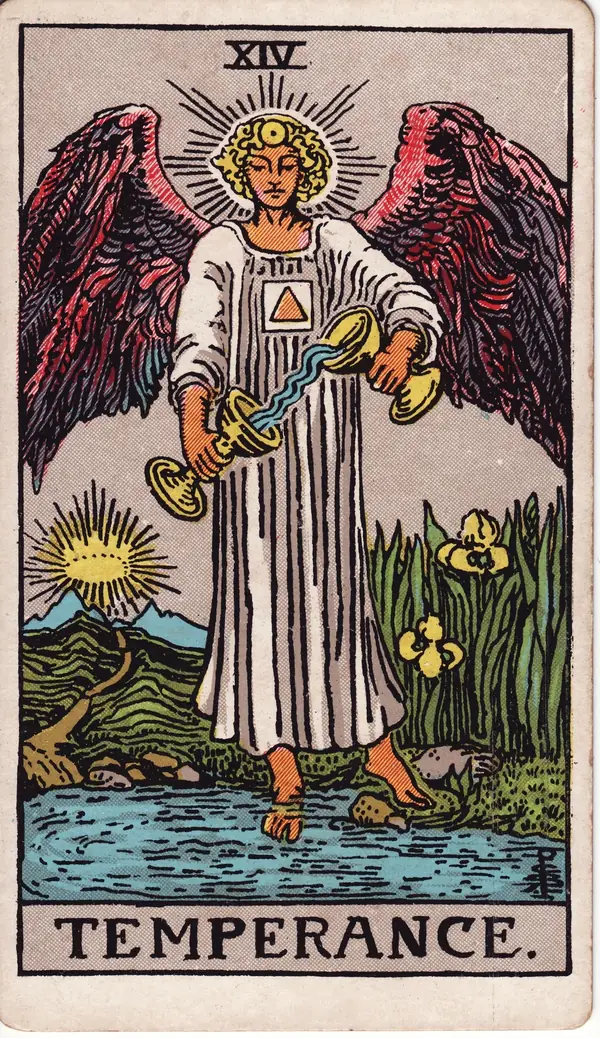
Temperance stands at number fourteen in the Major Arcana, between Death and the Devil, yet its message is quieter than either neighbor. A winged figure rests one foot in a pool and the other on land, pouring water between two cups. A path lifts toward a distant sun. The scene is calm, but it is not passive; every detail is about deliberate adjustment.
In the Classic Tarot, Temperance belongs to fire, though the flame is steady rather than wild. In the Tree of Life, it is often placed on the twenty-fifth path, Samekh, joining Beauty and Foundation. That image works as practical advice: inner harmony needs a foundation in ordinary routines. The number fourteen suggests movement that has passed a midpoint and now needs integration.
The card's one-line meaning is simple: pouring water between two cups to find the right mix. When it lands in reverse, the question becomes what has spilled, what is rushed, and what proportion needs correcting. Temperance is less a promise of good luck than an invitation to notice the recipe of your life.
Temperance Symbolism: What Each Detail on the Card Means
The winged figure: In the familiar Classic Tarot image, a winged figure stands at the center, calm, eyes moving between two cups. The wings place the figure in both sky and earth, a reminder that a person can stay slightly above emotional weather without leaving the ground. Upright, that height keeps impulse from taking the wheel. Reversed, the same detachment can become avoidance: cool words on the surface, no willingness to touch the real problem.
One foot in water, one on land: One foot rests in the pool, the other on land. Water carries feeling, memory, and the unconscious; land carries reality, action, and consequence. The pose does not choose between them; it lets both stand. Upright, it supports feeling what you feel, then making a decision that works in the world. Reversed, balance fails: either the person sinks into emotion and stops moving, or pushes ahead and buries feeling out of sight.
Two cups and moving water: The figure holds a cup in each hand and pours a thin, steady stream from one to the other. This is not one-way giving, nor emptying yourself in a single gesture; it is repeated calibration. Upright, the card speaks of reciprocity in love, resource sharing at work, and leaving room for yourself. Reversed, water rushes and spills, or one cup stays empty for a long time: giving and receiving no longer match.
The white robe: The figure wears a simple white robe, its lines clean and free of ornament. White here is not coldness. It suggests clarity, restraint, and the wish to sort confusion into order. Upright, it makes harmony principled rather than a vague wish to keep the peace. Reversed, white can become camouflage: the person sounds reasonable while carrying resentment or anger they will not admit.
The red wings: Red touches the wings and contrasts with the white robe. Red stands for passion, vitality, and the urge to act, so the card’s calm is not lifeless. The fire has simply been placed where it can keep burning. Upright, this supports a warmth that is gentle but real. Reversed, the fire may have been held down too long and leaks out as impatience, sarcasm, or a sudden flare.
The path and the sun: Behind the figure, the ground opens into a small path that runs toward the sun on the horizon. The sun suggests hope, clarity, and life; the path says arrival takes time. Upright, the direction is there, but it must be walked step by step. Reversed, someone may turn their back on that light and stare only at the nearby mess, or look for a shortcut and throw off their pace.
The pool, shore plants, and irises: A pool lies at the figure’s feet, with irises growing at its edge. The flowers do not bloom in the middle of the water or on dry ground; they grow where water meets soil, a sign that life appears at the border between two states. Upright, the card encourages small islands of order where emotion and practical life meet. Reversed, it asks you not to ignore signals at that border, such as poor sleep, changed appetite, or impatience with things you once enjoyed.
Distant mountains and pale sky: Low mountains rise in the background under a pale, soft sky. The mountains suggest long-term aims and a steady scale; the light sky keeps the scene open instead of stuffed with one mood. Upright, the card helps put a current argument back into a longer stretch of time. Reversed, the mountains can feel like pressure and the sky seems lower; the person sees only today’s setback and forgets where they meant to go.
The square and triangle on the chest: A square with a triangle inside appears on the figure’s chest. The square often points to matter, boundaries, and the physical world; the triangle to spirit, direction, and upward force. Layered together, they say inner belief has to fit inside daily structure. Upright, this supports turning values into habits. Reversed, words and behavior split: someone talks about balance while their schedule keeps running on empty.
Temperance Kabbalah and Tree of Life
On the Tree of Life, Temperance corresponds to the twenty-fifth path, ruled by the Hebrew letter Samekh, whose shape can be read as “pillar” or “support.” The path links Tiphareth (Beauty), the sixth sphere, with Yesod (Foundation), the ninth. Both sit on the central pillar, and the path runs straight down it. Beauty concerns centered harmony and a sense of self within the whole; Foundation concerns the unconscious, imagination, and the everyday base of life. Joined, they do not describe a flight to a higher realm. They ask inner balance to have something sturdy beneath it.
The word “support” matters. Beauty without Foundation leaves reconciliation as a mood; Foundation without a center turns daily life into mechanical repetition. The downward direction also stresses extension and grounding: insight from above must enter sleep, conversation, money, and scheduling before it stands. In love, agreeing to “communicate better” is not enough; a standing time to talk and a way to reconnect after a fight are the support. At work, values have to become process and priority, not private perfectionism. In self-growth, “I want calm” becomes a plan for sleep, food, and asking for help.
The common astrological link is Sagittarius. Its long view and search for meaning echo the larger harmony seen on this path, while the downward line warns against staying in vision alone. Sagittarius supplies direction; Samekh demands a pillar. Together they keep Temperance from becoming a slogan. If someone talks only about ideals and refuses concrete steps, the card sends the question back to daily life.
Temperance Numerology
Temperance is numbered 14, which reduces to 1 + 4 = 5, the number of The Hierophant among the Major Arcana. Five carries curiosity, a love of travel, and an outward spread of energy, along with a tendency to scatter when too many choices compete. Fourteen first holds the starting point of 1 and the frame of 4, then returns to the flow of 5: a center is established, then carried into a larger world. That fits the image of pouring water back and forth and finding a ratio inside change.
Read beside The Hierophant, Temperance gains a practical echo. The Hierophant speaks of tradition, norms, and a shared order; Temperance asks how to bring different ingredients to a temperature people can take in. One provides the container, the other adjusts the contents. Rules without blending turn rigid; blending without shared rules turns into everyone talking past everyone else. So when Temperance appears, ask: Am I drawing on experience that came before me, or forcing a standard that does not fit? Am I integrating, or just trying to keep everyone pleased?
People with a life path number of 5 are often described as close in temperament to The Hierophant: curious, willing to move, meet people, and trade ideas, but prone to opening too many windows at once. Temperance is a gentle reference for them, not a verdict. It suggests putting exploration into a sustainable rhythm and leaving time to digest, rather than filling every gap with novelty.
What does Temperance mean upright?
Upright, Temperance carries balance, moderation, and blending. This is not the bland middle of never choosing; it is the active work of finding a ratio that holds. Think of a sauce that needs salt, a conversation that needs a softer tone, or a week that needs one fewer commitment. The card asks you to taste, adjust, and taste again.
It also has a self-contained quality. You may be warm in company while keeping some feelings private. That distance is not coldness; it is discernment about what belongs to you and what belongs to the room. Upright, this steady inner temperature helps you avoid being pulled into every mood around you.
Temperance reversed meaning
Reversed, Temperance points to imbalance, excess, and rushing. The water pours too fast and leaves the cup; the schedule fills until rest disappears. You may tell yourself you are being calm while suppressing anger, or insist you are flexible while quietly keeping score. The outer performance of balance can hide a very uneven interior.
The reversed card often exposes a coping habit rather than a catastrophe. Maybe you say yes to one more favor, skip lunch again, or push a conversation toward a decision before it is ready. The invitation is not shame. It is to ask where the mix has gone wrong and who can give you honest feedback.
Temperance in love: single, in a relationship, reconciliation
In love, Temperance is less about sparks than about rhythm. It asks whether two people can share a life without one person shrinking or the other taking over. The card often appears when a relationship needs negotiation, patience, or a kinder pace, not a dramatic declaration. It can describe deep affection and physical attraction, but it wants those things to sit inside a life that actually works.
Temperance upright love
Upright in a love reading, Temperance favors a connection that grows through ordinary time. You notice compatibility in small things: how you share a meal, handle a delay, or disagree without turning it into a contest. Attraction is present, but it is not asked to carry the whole relationship.
This card often describes a partner who is caring without being clingy, or a mood in which you can be honest without flooding the other person. The risk is complacency. Peace is valuable, yet it still needs attention, curiosity, and actual conversation.
Temperance reversed love
Reversed in love, the card usually shows mismatched effort. One person plans, explains, and repairs; the other drifts or reacts. There may be generosity on the surface and resentment underneath. Sometimes the imbalance is internal: you want closeness and independence at the same time but keep switching abruptly between them.
It can also point to intensity that burns through the relationship's practical needs. Long talks replace sleep, jealousy replaces questions, or a small disagreement becomes proof that everything is wrong. The useful move is to name the actual imbalance instead of debating who loves whom more.
Temperance love for singles
For a single person, upright Temperance often describes a life that already has shape. You have routines, friendships, and standards, and you are not desperate to fill an empty chair. That is healthy, but it can make you overlook someone who does not arrive with fireworks.
Pay attention to the quiet presence instead of the loud spark. It may be the friend who remembers your appointment without being reminded, the person who asks a follow-up question because they were actually listening, or a date that feels easy rather than impressive. These are small signs that someone can share ordinary life, not just a dramatic evening. Reversed, the card warns against two opposite mistakes: saying yes to anyone because loneliness feels unbearable, or rejecting everyone before they have a chance to disappoint you. Both come from fear, and both skip the slower work of learning what kind of company actually suits you.
Temperance in a relationship
In an established relationship, Temperance asks for a fair division of labor and feeling. Who tracks birthdays, plans meals, notices when the house is low on supplies, initiates repair after an argument? If one person carries most of that invisible work, the relationship may look fine from outside while one partner is exhausted.
Talk about money, intimacy, family obligations, and personal time as shared questions, not accusations. The goal is not a perfect fifty-fifty split every day; it is a pattern both people can live with. Reversed, the card warns that a big decision may be used to avoid a smaller, more honest conversation.
Temperance and getting back with an ex
With an ex, Temperance offers possibility, not a guarantee. It suggests that reconciliation can only work if the old pattern changes. If one person chased and the other withdrew, can they now speak without the chase? If silence was the problem, can both tolerate an awkward conversation?
Start with a low-pressure exchange and watch for reciprocity. Does the other person ask about your life, respect a boundary, and follow through on a small plan? If you are doing all the adjusting, the card's balance is missing. Slow is fine; one-sided effort is not.
Temperance as feelings: how they feel about you
When Temperance appears in a feelings position, it rarely describes a loud rush of emotion. It describes someone who feels something real and is trying to hold it carefully. Their care may look like consistency, thoughtful questions, or a strange amount of restraint. Read it as a temperature, not a verdict. The question is whether that temperature is comfortable for both of you.
Temperance upright as feelings
Upright as feelings, Temperance suggests affection mixed with caution. They may enjoy your company, find you easy to talk to, and feel a quiet pull toward more. Yet they are also protecting their own rhythm, perhaps because they have been overwhelmed before or because they want to choose clearly rather than impulsively.
Their feeling is often expressed through steadiness: replying when they say they will, remembering details, making room in a busy week. It may not feel dramatic. If you need constant intensity to feel loved, you could mistake this for indifference, so check the actions before assuming the worst.
Temperance reversed as feelings
Reversed as feelings, Temperance can show confusion rather than lack of care. They may feel drawn to you and also crowded by the situation, or they may be dealing with competing demands that leave little emotional room. Their behavior can swing between warmth and distance, which is exhausting to read.
There is also a chance they are idealizing the connection while avoiding its practical parts. They imagine a beautiful future but do not ask about your schedule, your needs, or your boundaries. Look for whether their feeling turns into reliable behavior, not just meaningful glances.
Temperance as how someone sees you
Temperance as how someone sees you often paints a flattering but slightly distant picture. They may see you as composed, fair, and good at calming a room. You seem like someone who does not need to be managed, which can feel refreshing. They might also wonder what is underneath the calm.
At times they see you as more reserved than you feel. If you have been protecting yourself, they may read that as self-sufficiency. A direct sentence about what you want can correct the picture. The card asks for a little more visibility, not a complete confession.
Temperance as intentions
As intentions, Temperance is sincere but gradual. They want to build something that does not collapse under pressure, so they may move slowly, test compatibility, and avoid promises they cannot keep. This is not necessarily avoidance. It can be a mature attempt to prevent another messy ending.
Still, intention must become action. Watch for whether they make time, introduce you to their world at a reasonable pace, and discuss the future without vague promises. If patience is always your job and clarity never arrives, the card's balance has tipped. Ask for specifics kindly and see what happens.
Temperance career and work (upright & reversed)
At work, Temperance is the colleague who can hold two competing needs in mind. It favors negotiation, resourcefulness, and sustainable effort over heroic all-nighters. The card often appears during a transition, a team conflict, or a period when you need to combine different skills instead of choosing one identity. Its advice is practical: make the load visible, then redistribute it before people are running on empty.
Temperance upright career
Upright, it points to work that improves through thoughtful adjustment. You might mediate between departments, revise a process, or find a job search rhythm that includes rest. Your strength is seeing how pieces fit, not merely pushing harder.
If you are job hunting, tailor a few applications well rather than scattering dozens. If you are employed, negotiate scope and deadlines before resentment builds. If you are changing fields, combine old skills with new training instead of treating your past as wasted. The card favors steady progress and honest conversations about capacity.
Temperance reversed career
Reversed, work becomes a place of overflow. You take on extra tasks to seem helpful, then miss the deadline that actually mattered. Or you polish one project endlessly while the team waits. A rushed launch, an unclear contract, or a boss who rewards availability over judgment can all fit this card.
Before making a dramatic move, list your real obligations and the hours they require. Cut or renegotiate one commitment. Ask for written priorities if verbal requests keep shifting. If you are starting a business, test demand on a small scale and protect your cash buffer. The card does not forbid ambition; it asks you to stop spending energy without a plan.
Temperance for money and finances
Money readings with Temperance focus on proportion, not sudden wealth. The card asks you to look at what comes in, what goes out, and what you are saving for. A budget does not have to be punitive; it can be a way of making sure the things you value are actually funded.
Upright, it favors steady habits: checking accounts, canceling duplicate subscriptions, building an emergency fund, and giving large purchases a waiting period. Reversed, it warns about excess or panic. You might spend to soothe a bad day, take on another payment plan, or chase an opportunity because you are afraid of missing out. Slow down and read the terms. If debt, taxes, or legal issues feel unmanageable, bring in a qualified professional. Temperance promises no jackpot; it offers a saner relationship with money.
Temperance for health
Temperance speaks to rhythm: sleep and wakefulness, effort and rest, talking and listening to your body. It does not diagnose anything, and it cannot tell you whether a symptom is serious. It can prompt an honest look at how long you have been running on caffeine, stress, and postponed rest.
Upright, the card supports routines you can keep: a consistent bedtime, meals that do not require heroics, movement you actually enjoy, and boundaries around work messages. Reversed, it flags extremes such as skipped meals, binge eating, overtraining, or days that collapse into nights. Notice the signals without turning them into a medical verdict. If discomfort continues, see a doctor. Pregnancy, medication, and chronic conditions deserve professional guidance, not a card's conclusion.
Temperance as advice
Temperance rarely tells you to do nothing. It tells you to stop treating every choice as all-or-nothing. The useful question is not “What is the perfect answer?” but “What is the right proportion for this week, this person, this decision?” That shift makes the card practical. It can be applied to time, money, affection, and attention, especially when you are tired of sweeping swings.
Temperance upright as advice
Upright, make one adjustment instead of a dramatic overhaul. Reduce a commitment, ask a direct question, or build a buffer into your day. If a relationship matters, show up consistently rather than trying to win one big conversation. If work is heavy, clarify priorities before agreeing to more.
Also keep some privacy. Balance does not require explaining every feeling to everyone. Choose one trustworthy person, say what is true, and let their perspective widen yours. Then act at a pace you can sustain. The card trusts gradual repair more than a spectacular reset.
Temperance reversed as advice
Reversed, stop before you add another demand. Ask three plain questions: What am I actually short of? Where am I overcompensating? Who has earned the right to advise me? Write the answers down so you are not only reasoning in circles.
Then subtract. Drop one promise, delay one spending decision, restore one basic routine. If a job or relationship keeps consuming you without change, set a time limit and a boundary. Reach out to a neutral person or a qualified professional if the stakes are high. Rebalancing is not failure; it is maintenance.
Temperance as a person
Temperance as a person looks like the friend who pours the tea before asking what happened. They are usually good at holding space, noticing tension, and finding a middle option. They may enjoy travel, philosophy, or long conversations about how to live well, but they do not need to dominate the room.
They can seem serene and slightly elusive. Their calm is often a practice, not a personality trait. They need solitude to recharge and may dislike being rushed into emotional displays. In a close relationship, they show love through reliability and thoughtful attention rather than constant intensity.
Temperance reversed as a person
Reversed as a person can describe someone who gives too much and then resents it, or someone who insists everything is fine while controlling the details. They may be scattered, overbooked, and quick to promise more than they can deliver. Their unpredictability can leave others anxious.
It can also describe a person who swings between extreme discipline and collapse. They work intensely, then disappear. They offer generosity, then withdraw. This is not a permanent identity. Under stress, many people lose proportion. The helpful response is clear boundaries and direct communication, not a campaign to fix them.
How to place it in a reading
In a spread, Temperance works as a steadying influence. In the past, it can describe a period of learning how to blend two parts of life, perhaps after a move, a breakup, or a job change. In the present, it asks what is being mixed right now: work and rest, independence and intimacy, ambition and patience. In the future, it usually suggests gradual improvement rather than a sudden event.
Position matters. Near a problem card, Temperance says there is still room to negotiate. Near an outcome card, it says the result depends on whether the proportions are realiztic. With the High Priestess, compare private reflection with public warmth. With the Devil, look at where excess or attachment has taken over. With the Star, the theme is repair after strain. These pairings are prompts, not fixed scripts.
The fire element is steady here rather than explosive. On the Tree of Life, the path of Samekh connects Beauty and Foundation, a reminder that harmony has to reach daily life. Use those symbols to deepen the reading, never to overrule what the person in front of you actually says.
Our take
When Temperance lands in a spread, look first at the cards on either side. It rarely stands alone; it works like a joint between two currents. If an impulsive card sits on the left and a hesitant card on the right, Temperance asks how people moving at different speeds can still travel together. If a practical card is on one side and an idealistic card on the other, it looks for the part that can be grounded first. Temperance by itself yields the empty answer “find balance.” Set between two clearly different cards, it shows whether the adjustment involves time, money, communication, or boundaries.
In a relationship spread, the “between us” position suits it especially well. That position is not about either person’s character; it describes the field they create together. Temperance there usually means there is still room to negotiate, but both people have to maintain the pace. If a fast Swords or Wands card sits nearby, the conversation may need to cover how often you meet or how quickly you reply. If a slower Cups or Pentacles card is nearby, check whether emotion and practical resources are being seen. The contrast with The Devil is useful too: both can appear in tangled relationships. The Devil leans toward fixation, repetition, and staying despite the drain; Temperance asks whether the closeness restores both people or merely flattens the conflict for now. The first is healthy balance; the second is a short ceasefire after mutual exhaustion.
In common spreads, past-present-future can show how Temperance carries old experience into the present. Situation-obstacle-advice works well with Temperance in the advice seat, where it says to adjust the ratio before arguing about the result. In a two-choice spread, Temperance near one option does not promise that option is luckier; it suggests that path has more room for integration. Its astrological link is Sagittarius, which can be used to check perspective: if the question is stuffed with immediate emotion, Temperance may ask you to lengthen the timeline; if the person is overly optimistic and always thinking about the next stop, it can appear in the obstacle position to say, deal with the ground under your feet. Sagittarius gives direction, Temperance gives the scale. Used together, they are more specific than “let it be.”
Temperance in Different Positions: Past, Present, Advice, Obstacle
The same Temperance card answers different questions depending on where it falls. Position decides what to ask; the card decides which way the answer leans. So do not simply recite “balance.” Look at what that position is missing. Reversed often means the upright energy is excessive or the present situation is out of proportion, not a simple opposite. A mostly positive card in reverse often means the benefit is halved.
Past: The past position asks what shaped the present. Temperance here often describes a period when someone survived by compromise, patience, or coordination: yielding space again and again in a relationship, or catching demands from several directions at work. It explains why things look steady now while the person feels worn out underneath. Reversed, the past may hold a stretch of poor proportion, such as long accommodation, overextension, or silence when terms should have been discussed. Reading it is not about reopening old wounds; it is about seeing where today’s caution came from.
Present: The present position asks what is happening now. Temperance here usually marks an integration period: emotions are not settled, but the person is willing to count the ratio; nothing is decided, yet a window for negotiation has opened. Upright, resources are still sufficient, and the key is not to solve everything at once. Reversed, imbalance is already visible: the calendar is too full, one person is always accommodating, or rest has been pushed to the edge. This position asks you to fix the biggest leak first.
Future: The future position asks where the current approach leads. Temperance ahead often points to gradual easing, blending, and stability, but it comes with conditions: both people must keep adjusting, or the situation will not hold. Passive waiting does not create balance. Reversed in the future suggests more ups and downs, half the benefit, and the old problem of proportion returning. Use it to set a checkpoint, not to announce an ending in advance.
Advice: The advice position asks what to do now. Temperance here is concrete: remove one overcommitment, supply one neglected need, and redistribute time, money, or emotional energy. Upright, it favors negotiation over force and steady small actions over one grand statement. Reversed, it asks you to stop the loss first and stop treating “just hold on a little longer” as a plan. It does not predict; it points to something you can actually do.
Obstacle: The obstacle position asks what is blocking progress. Temperance here is not a bad card; its strength has been overused. Someone avoids telling the truth for the sake of harmony, delays a decision while waiting for a better moment, or loses their own position while trying to satisfy everyone. Reversed makes the drain easier to see: the surface looks balanced, but neither person is content. Ask: Have I turned adjustment into delay, and understanding into a fear of asking?
Outcome or clarifier: An outcome position asks what may take shape. Temperance there leans toward a gentle, revisable result: not necessarily a dramatic happy ending, but a workable arrangement both people can accept. Reversed, it may be only a temporary balance, with the old issue still waiting and less benefit than expected. As a clarifier, it acts like a reminder: do not stare only at winning or losing; ask whether this ratio can last. In either direction, read the surrounding cards to see whether the adjustment actually happened.
Temperance Three-Card Example (Fictional Example)
Fictional example: The people and events below are invented and serve only to demonstrate a reading.
The querent and their partner live in different cities. One keeps early hours and a packed schedule; the other only comes alive at night. Messages often sit for hours before a reply. They are not short on affection, but they have little shared waking time, and planned calls are frequently interrupted by work. The querent wants to know how to make the relationship work and whether the current rhythm will wear them both down.
The spread uses three cards: “You,” “the other person,” and “between you.” The first card, in the “You” position, is the Knight of Swords upright. The second, in the other person’s position, is the Queen of Cups upright. The third, in the “between you” position, is Temperance upright. This layout separates each person’s present state from the relationship field; it does not pass character judgments on either one.
Card 1, “You”: Knight of Swords upright. This card shows how badly the querent wants the problem settled: they want call rules and visit frequency decided soon, perhaps even every disagreement talked through in one sitting. The Knight of Swords has drive, along with the sharp edge that speed brings. “We need to communicate” can come out as “Why can you never manage this?” Upright, the urgency is not malicious; it comes from caring. But if the relationship becomes a checklist, the other person will feel questioned rather than understood.
Card 2, “the other person”: Queen of Cups upright. The other person is emotionally perceptive. They notice the querent’s effort and remember small acts of care. The Queen of Cups meets a relationship through feeling and does not quickly produce a tidy plan under pressure. When questioned repeatedly, they may go quiet or say “I’m fine” while withdrawing what they actually need. Upright, the affection is still there, but they need some quiet to turn emotion into words they can say out loud.
Card 3, “between you”: Temperance upright. The relationship itself is not without room. The real question is whether the two of them can define a rhythm both can bear. Temperance here does not ask the querent to slow down alone, nor does it ask the other person to force compliance. It rebalances meetings, calls, and separate lives: which hours are reserved for each other, which messages can wait, and how soon to reconnect after a conflict. It moves the focus from “Who loves whom more?” to “Can this arrangement run for the long term?”
Taken together, only one Major Arcana card appears, which suggests the central theme is the way they live together rather than some outside force. The elements are air, water, and fire: the Knight of Swords brings speed and thought, the Queen of Cups brings feeling and containment, and Temperance warms both sides. Air can run cold and water can bend too softly; without Temperance, one pushes while the other retreats. The card’s fire gives that speed a human temperature. The overall reading leans positive, but not in the sense of “do nothing and it will fix itself.” It says the method has to change for the relationship to settle.
The advice for the querent is to turn interrogation into agreement. Offer a short, specific plan: two set calls each week, one theme per call; say important things in a voice message instead of letting text escalate; when the other person is busy, ask when they can reply rather than sending message after message. Protect some time when you are not waiting on a response. After a few weeks, see whether both people keep the agreement. If only the querent is arranging the schedule and absorbing the disappointment, the ratio needs to be renegotiated, not used as a reason to keep enduring.
Common Misreadings of Temperance
Misreading one: Temperance is cold and unfeeling. The calm image is easy to mistake for indifference. In fact, the card puts feeling into a container that can last. The warmth is still there; it simply does not rely on dramatic display. When Cups cards or The Lovers appear in the spread, check whether the actions are steady rather than asking only whether they are intense enough.
Misreading two: Reversed means a breakup or certain failure. Reversed usually points to excessive energy or a current imbalance, not a death sentence. It often describes haste, fatigue, or poor communication, with the benefit cut in half. Read the surrounding cards: repair cards mean there is still room to adjust; a cluster of long-term drain cards calls for a serious evaluation.
Misreading three: Temperance means endless yielding and peacekeeping. Adjustment is not self-erasure. Real Temperance asks: How much can I give? Where is my limit? Is the other person adjusting too? If one person keeps retreating while the surface stays calm, that is suppression, not balance. When power is clearly tilted, read “endure” as “we need to negotiate terms.”
Misreading four: Draw Temperance, do nothing, and it will improve. This card often arrives when active calibration is needed: drop one commitment, schedule one conversation, rework the budget. Waiting without action only postpones the problem. End the reading with one small, executable step rather than “go with the flow.”
Misreading five: Temperance is only about emotions, not money or time. The figure is pouring water, and water is a resource. In real life, that may mean work hours, savings, time spent together, or task priority. When many Pentacles appear, ground Temperance in accounts and schedules. “Relax your mindset” alone misses the place that actually needs adjusting.

FAQ
Is Temperance a yes or no card?
Temperance leans yes. It favors a measured approach rather than an instant result. Our yes-or-no scale places it on the positive side, but the emphasis is on process. A question about whether something is possible usually gets a soft yes, provided you are willing to adjust as you go. If you are asking whether a plan will work exactly as imagined, the answer is less certain. The card supports the direction, not every detail. Give it time and watch for signs that the balance is holding.
What does Temperance reversed mean in a yes or no reading?
Reversed Temperance still leans yes, but timing and execution need care. The reversed card does not flip our grading. It suggests that the goal is still reachable, yet rushing, overcommitment, or unclear communication could make the path messier. A yes may arrive later than you want. Treat the reversal as a request to check the mix. Are you asking too much too soon? Is the other person actually available? Once the proportion is corrected, revisit the question. The answer may become clearer.
What does Temperance mean if you have a secret crush?
It usually means quiet interest and slow observation, not a hidden grand passion. They may find you easy to be around and enjoy your company, but they are not rushing to reveal much. Their caution could come from temperament, past experience, or simply not knowing you well yet. Look for small consistencies: do they remember details, make time, or ask questions that go beyond politeness? If yes, there may be room to build. If you are always initiating, step back and let the rhythm show you more.
What does Temperance mean for marriage?
It suggests a marriage built through negotiation and steady adjustment rather than dramatic proof. Temperance is a practical card for partnership. It asks how two people will handle money, family, chores, rest, and intimacy without one person carrying the whole load. Shared rituals and honest repairs matter more than a perfect image. If you are considering marriage, discuss the unglamorous details before the celebration. If you are already married, the card points to rebalancing rather than predicting divorce or bliss. It describes a direction, not a fixed fate.
What does Temperance mean as an outcome?
As an outcome, it points to a workable compromise and a gradual return to balance. The result is unlikely to be a sudden triumph. More often it is a situation that becomes livable because someone adjusts the pace, the terms, or the expectations. That can feel underwhelming if you wanted fireworks, but it tends to last longer. The card also asks something of you. The outcome is not guaranteed if you keep repeating the same extreme. Make the practical change, and the likely result shifts with it.
What timing does Temperance suggest?
It suggests gradual timing: soon enough to matter, slow enough to do properly. Temperance is not a stopwatch card, and it rarely rewards demands for an immediate answer. The pace tends to follow the adjustment itself. Once the practical conditions improve, movement becomes more visible. Watch for small signs of progress rather than a single dramatic turn. A returned message, a calmer conversation, or a schedule that finally has breathing room can all be part of the timing. Let the process unfold without handing over your boundaries.
Does Temperance mean pregnancy?
Temperance cannot confirm or rule out pregnancy; only a medical test can do that. Tarot is not a diagnostic tool, and this card does not carry a reliable pregnancy answer. If you are wondering about pregnancy, take a test and speak with a health care professional. Do not base a decision on a card. Emotionally, Temperance may invite you to slow down and consider what you actually want, but that reflection is not a result. Pregnancy questions deserve medical facts and personal support, not guesswork from a reading.
What zodiac sign is Temperance?
Temperance is commonly associated with Sagittarius. In classic correspondence, the card is linked to Sagittarius and to the fire element. Sagittarius contributes the long view: the desire to understand, travel, and find meaning, while Temperance adds restraint and proportion. This does not mean every Sagittarius is balanced, or that the card is a horoscope prediction. It is a traditional symbol that can enrich a reading. The lived situation, the other cards, and the person's choices still matter most.
Is Temperance a good or bad card?
Temperance is generally a good card, though its gift is balance rather than sudden luck. Most readers treat it as constructive. It can reduce chaos, improve communication, and help you build something sustainable. It is especially welcome when life has felt extreme or exhausting. It is not always comfortable. The card may ask you to give up a dramatic role, wait longer, or admit that your effort is misplaced. That kind of good is quieter than a windfall. Judge it by whether the result is healthier, not by whether it is exciting.
Related cards
- The High Priestess: Both cards value inner knowledge, though the High Priestess turns inward while Temperance stays warm and social.
- The Star: A shared tone of recovery and calm, with the Star leaning toward hope and Temperance toward daily practice.
- The Chariot: Drive and restraint meet here; the Chariot pushes forward while Temperance asks whether the pace can be sustained.
- The Devil: A useful contrast, since the Devil shows attachment and excess where Temperance seeks proportion.
- The Magician: The Magician starts things and gathers resources; Temperance shows how to combine them without burning out.
- Judgment: Judgment brings a clear decision or awakening, while Temperance describes the adjustment that makes the decision livable.