Quick answer: Lenormand is a 36-card fortune deck. Each card shows a scene from everyday life, and readers usually skip reversals, linking neighboring cards into a sentence instead. That makes its answers feel more concrete than tarot's.
What Is Lenormand, and How Is It Different from Tarot?
Lenormand is a 36-card fortune deck. It does not focus on archetypes or inner exploration. Instead, it turns everyday people, actions, and things into a clear message. The biggest differences from tarot are a fixed deck size, upright-only readings, and a strong reliance on reading cards in pairs.
A tarot deck usually has 78 cards, and each card carries several layers of meaning. It is good for exploring how a situation came about and what someone is feeling. Lenormand works more like building a sentence: one card is a word, two cards make a phrase, and three cards make a full statement. If you want a different angle, you can try the spread ideas in Classic Tarot or the image-based approach of Plum Blossom I Ching.
- Deck size: Lenormand always has 36 cards.
- Direction: cards are read upright, so the meanings stay stable.
- Method: read each card first, then the cards next to it.
- Tone: concrete events, people, and outcomes, with less abstract symbolism.
How Do You Read a Single Card?
Start with the main scene on the card, then put it back into your question. Do not just memorize a list of keywords. The Rider means news and movement, the Heart means love and caring, and the Ring means a promise or a bond. The same word shifts tone depending on the question.
With one card, describe what is happening in the picture. Then ask yourself: who or what step does this match in my question? Finish with a sense of timing or mood. One card is good for a quick check on direction, but it has limits. For an important question, add more cards and read them together.
How Do You Read Three Cards Together?
Three cards are not three separate answers. They form one sentence. The middle card is the main point, and the cards on either side describe it and add causes and effects. Read the middle first, treat the sides like adjectives or context, then say the whole thing as one natural sentence.
Suppose you ask, "Where is this relationship going?" and draw Rider, Heart, Ring. The Heart in the middle is the core: love and caring are the focus. The Rider on the left brings news, contact, or action. The Ring on the right points to a promise, commitment, or a defined relationship. Put together: a message or a reach-out renews the feeling between the two people, and they move toward a clearer commitment.
If the two side cards clash, do not pick one and ignore the other. Read it as a process: what comes first, what affects it, and how it settles on the middle theme. You can also use past, present, and future positions, but positions are only a support. The link between neighbors still matters most.
How Do You Read Five Cards?
Think of five cards as a central theme plus four sides. Read the middle card first, then the two cards beside it, and finally the two outer cards for background. This keeps the main line clear and still catches the turns.
One simple order: the two left cards show where the matter comes from and what drives it, the middle card is the current core, and the two right cards show where it is heading and how it lands. You can also read all five as one long sentence. Watch for repeated themes and people cards, and for echoes between cards. The more a theme repeats, the more it deserves attention.
How Can You Ask Better Questions?
The more specific the question and the clearer the time frame, the more useful the cards' reply. "What should I do?" is usually too broad. "What is still missing from my job-change prep in the next three months?" is much easier to read.
- Ask about one thing at a time. Do not mix love, work, and money in one spread.
- Add a time frame, such as "the next three months."
- Use open questions, not ones that only take a yes or no.
- Ask about what you can act on, rather than asking the cards to guarantee an outcome.
Should You Worry About Cards Like the Coffin or the Cross?
No. Do not treat them as bad omens. The Coffin often points to an ending, a pause, or space that needs to be cleared. The Cross often points to duty, a burden, or a lesson you cannot avoid. They describe a state and a process, not a verdict.
When you draw one of these cards, look at its neighbors: does the ending get lighter, or does the burden get more concrete? Then put it back into your question and find the one step you can adjust. With health, marriage, or money, a single card cannot decide the outcome. The cards only offer a new angle for thought. Real decisions still belong with real information and expert advice.
All 36 Lenormand cards
| # | Card | Name | Keywords | Meaning |
|---|---|---|---|---|
| 1 | 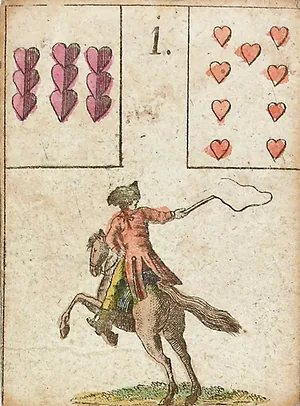 | Rider 9♥ | message, visit, new progress | News arrives, someone visits, or things move forward; it gives nearby cards a quick pace and a fresh feel. |
| 2 | 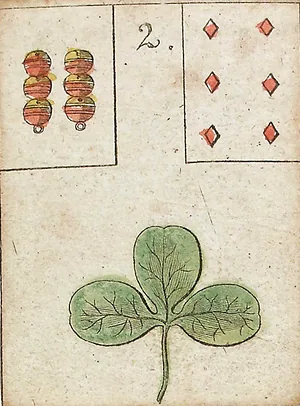 | Clover 6♦ | small luck, opportunity, ease | Small luck and short-lived chances, a reminder not to take things too seriously; it adds a little good fortune and a turn for the better to nearby cards. |
| 3 | 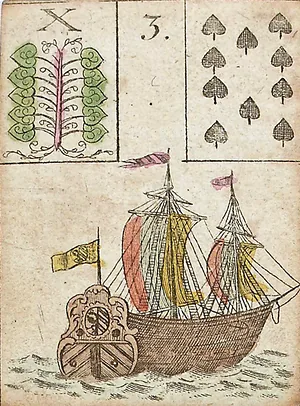 | Ship 10♠ | travel, distance, exploration | Travel, distance, and looking outward; nearby cards often point to far places, change, or missing someone. |
| 4 | 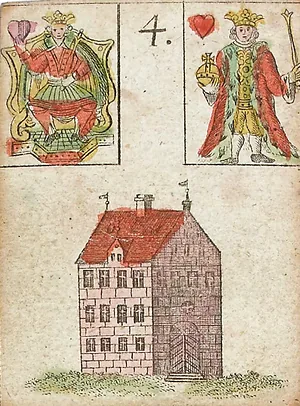 | House K♥ | home, stability, family | Home, stability, and roots; it gives nearby cards a sense of family and safety. |
| 5 | 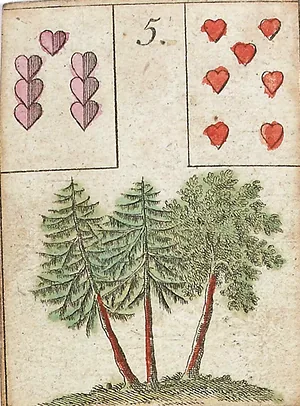 | Tree 7♥ | health, growth, lasting | Slow growth and roots, also linked to health; one card cannot settle a health question, but nearby cards bring a sense of lasting and taking it slow. |
| 6 | 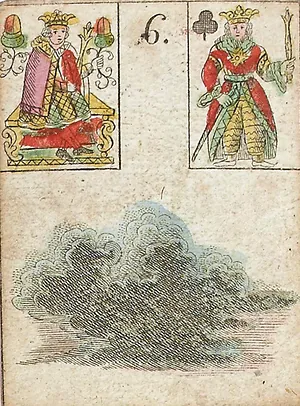 | Clouds K♣ | confusion, doubt, unclear | Confusion and not seeing clearly, though it may clear up soon; it casts a layer of uncertainty over nearby cards. |
| 7 | 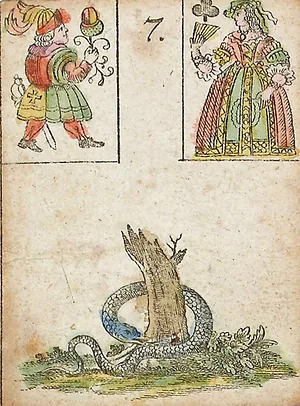 | Snake Q♣ | detour, temptation, complexity | A detour, complexity, or someone playing games; it makes nearby cards winding and calls for more care. |
| 8 | 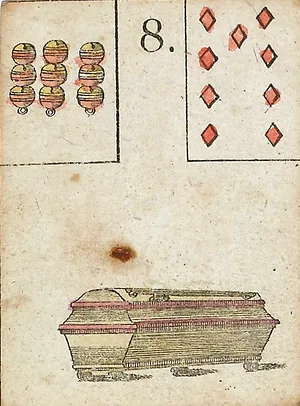 | Coffin 9♦ | ending, standstill, letting go | An ending or a standstill, and also clearing the way to start again; nearby cards carry a sense of closing and pausing. |
| 9 | 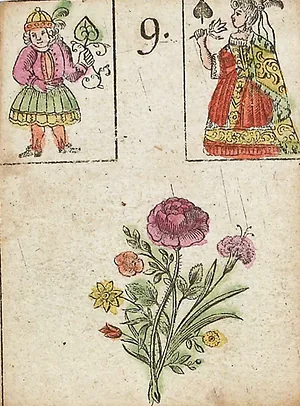 | Bouquet Q♠ | joy, gifts, beauty | Joy, gifts, and good spirits; it makes nearby cards look brighter and more welcome. |
| 10 | 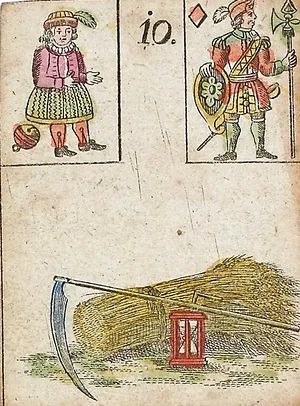 | Scythe J♦ | sudden, cut, decision | A sudden cut or a firm decision, and it comes fast; nearby cards get a clean, decisive edge. |
| 11 | 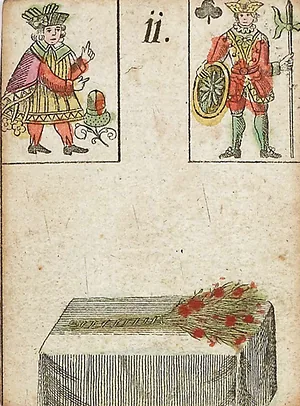 | Whip J♣ | quarrel, repetition, exercise | Arguments, repetition, and push and pull, and it can also mean exercise; nearby cards become more intense and more repetitive. |
| 12 | 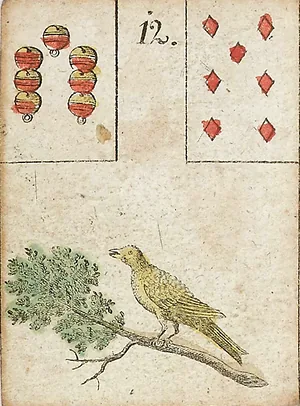 | Birds 7♦ | talk, news, busy | Talking, news, and busy exchanges; it adds conversation and back-and-forth to nearby cards. |
| 13 | 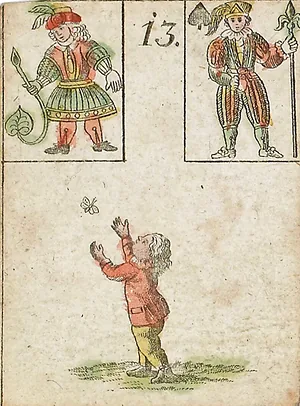 | Child J♠ | beginning, something new, simplicity | A new start, simplicity, and small things; it makes nearby cards feel younger, like a first step. |
| 14 | 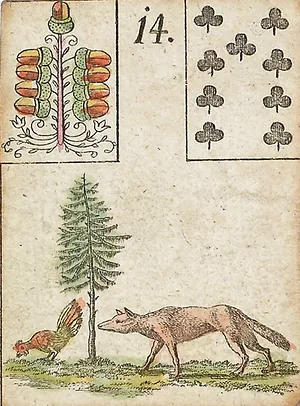 | Fox 9♣ | caution, strategy, work | Caution, strategy, and watching closely, plus a need to guard against small schemes; nearby cards gain a layer that calls for attention. |
| 15 | 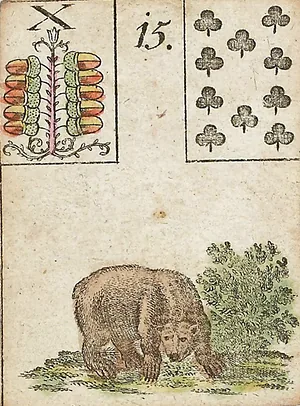 | Bear 10♣ | strength, authority, resources | Strength, authority, and resources, with protection too; nearby cards carry more weight. |
| 16 | 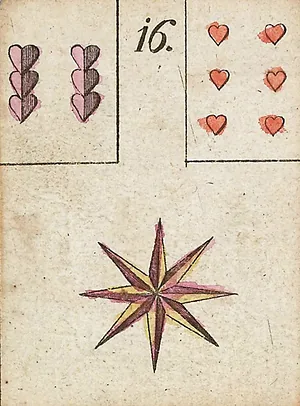 | Stars 6♥ | hope, inspiration, guidance | Hope, inspiration, and direction; it gives nearby cards an idealistic tint and a clear goal. |
| 17 | 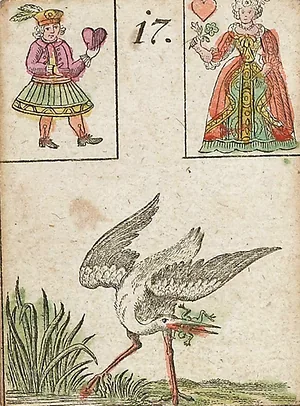 | Stork Q♥ | change, move, new stage | Change and moving, often into a new stage; nearby cards take on a sense of shifting and renewal. |
| 18 | 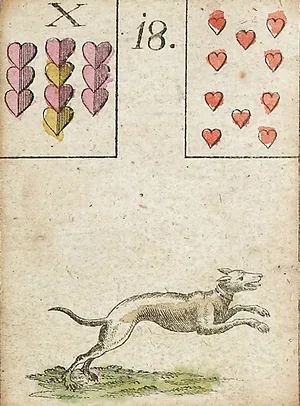 | Dog 10♥ | friends, loyalty, trust | Friends, loyalty, and trust; it adds companionship and reliability to nearby cards. |
| 19 | 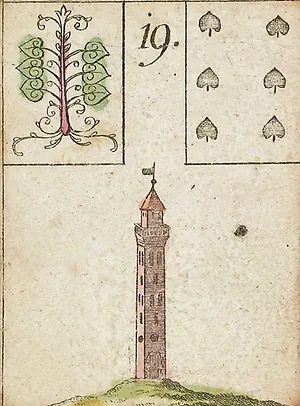 | Tower 6♠ | boundaries, institutions, solitude | Boundaries, institutions, or solitude, about distance and rules; nearby cards seem more formal or more distant. |
| 20 | 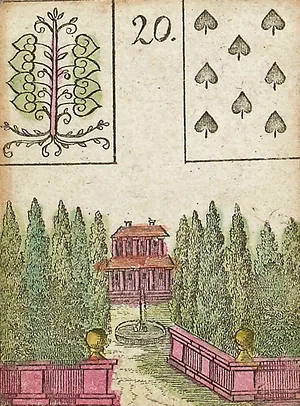 | Garden 8♠ | socializing, crowds, public | Socializing, crowds, and public settings; it makes nearby cards more outgoing and easier to see. |
| 21 | 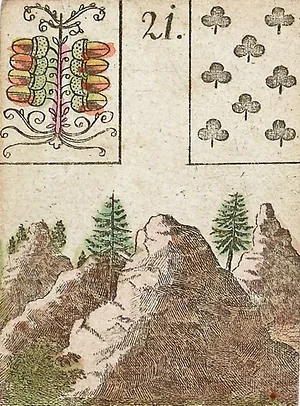 | Mountain 8♣ | obstacle, delay, coldness | Obstacles, delays, and coldness that need to be moved aside slowly; nearby cards seem stuck and have to wait. |
| 22 | 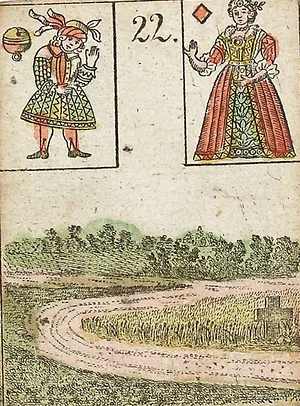 | Crossroads Q♦ | choice, fork, decision | A fork in the road and choices, meaning more than one path; nearby cards carry a sense of deciding and branching. |
| 23 | 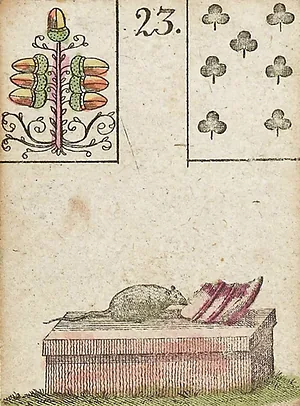 | Mice 7♣ | drain, anxiety, loss | A little at a time being used up, anxiety, or things going missing; it brings wear and unease to nearby cards. |
| 24 | 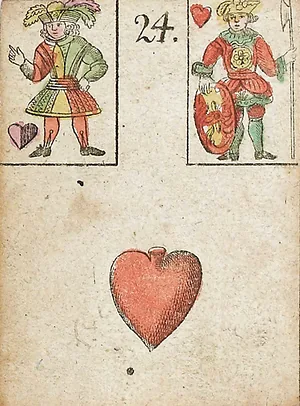 | Heart J♥ | love, feeling, sincerity | Love, sincerity, and warmth; it tints nearby cards with tenderness and care. |
| 25 | 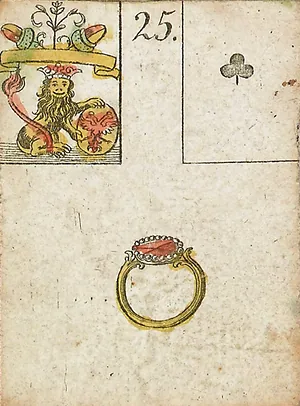 | Ring A♣ | promise, contract, cycle | Promises, contracts, and cycles; one card cannot settle a marriage, but nearby cards make the agreement clearer. |
| 26 | 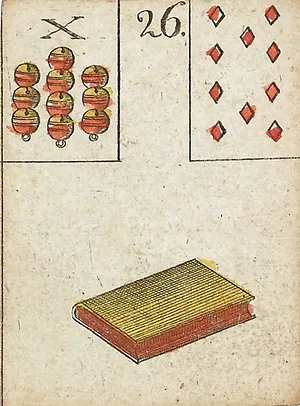 | Book 10♦ | secrets, knowledge, learning | Secrets, knowledge, and things not yet revealed; nearby cards seem not fully explained. |
| 27 | 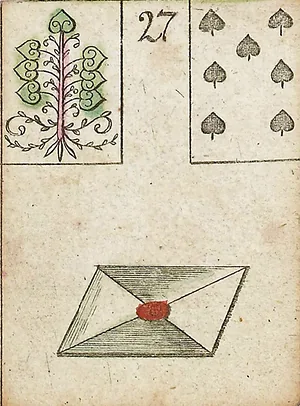 | Letter 7♠ | news, documents, communication | News, documents, and written communication; it adds clear information to nearby cards. |
| 28 | 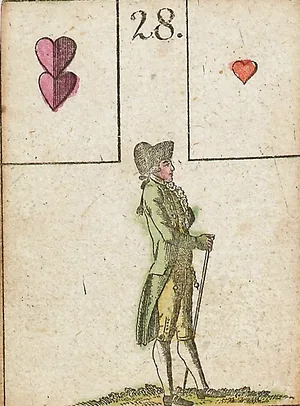 | Man A♥ | man, action, the other person | A man or the one taking action; nearby cards often show his state and situation. |
| 29 | 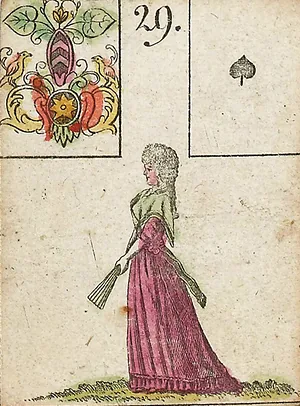 | Woman A♠ | woman, feelings, self | A woman or the one who feels; nearby cards often show her state and situation. |
| 30 | 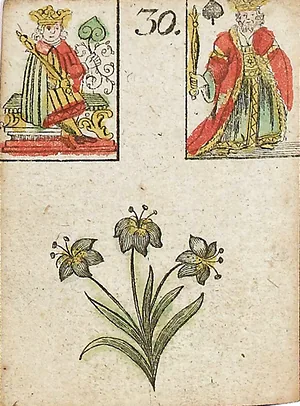 | Lily K♠ | calm, maturity, elders | Calm, maturity, and elders, and also patience; nearby cards seem steadier and slower. |
| 31 | 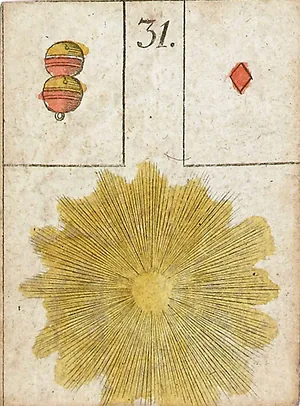 | Sun A♦ | success, light, energy | Success, light, and vitality; it makes nearby cards brighter and smoother. |
| 32 | 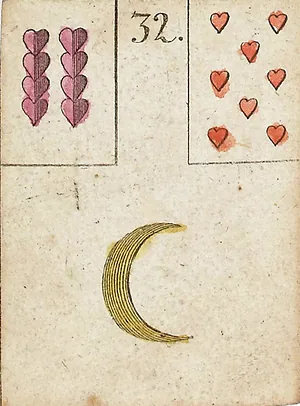 | Moon 8♥ | emotions, reputation, intuition | Emotions, reputation, and intuition, with a dreamy touch; nearby cards become more emotional. |
| 33 | 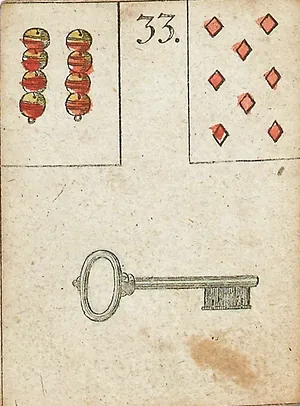 | Key 8♦ | key, solution, opening | The key, a solution, and an opening; it points nearby cards to what matters most. |
| 34 | 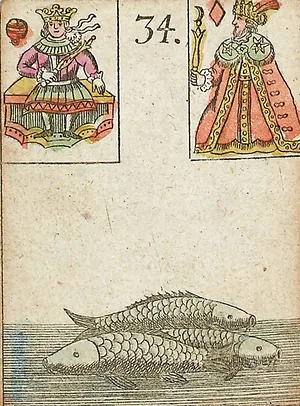 | Fish K♦ | money, flow, abundance | Money, flow, and abundance; one card cannot settle money matters, but nearby cards bring a sense of flow. |
| 35 | 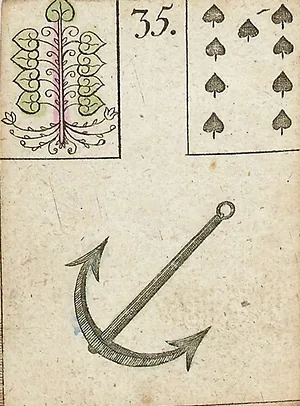 | Anchor 9♠ | stability, persistence, a place to settle | Stability, persistence, and a place to settle; it makes nearby cards firmer and longer lasting. |
| 36 | 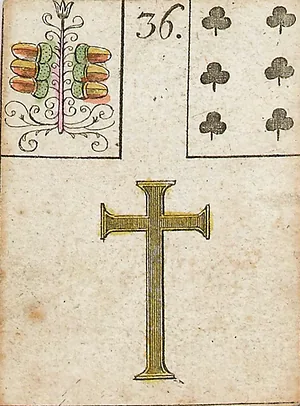 | Cross 6♣ | burden, test, faith | A burden, a test, and faith, a heavier lesson; nearby cards carry duty and endurance. |
FAQ
Do you have to read Lenormand with reversals?
Usually no. Most readers keep the card meanings stable and focus on how the cards relate to each other. If the spread you use sets a direction, follow that spread's rule.
In a three-card spread, should you read the middle card or the left card first?
Read the middle card first to set the main line. Then use the left and right cards to describe and add to it. This keeps details from pulling you off course and keeps the sentence connected.
If I draw a card I do not like, does that mean things will definitely go badly?
No. The cards are more like a reminder or a description. They point to a state worth noticing. It is more useful to treat them as a clue for adjusting your direction than as a final answer.
Can I draw cards again for the same question?
Yes, but there is no need to do it often. Repeated draws tend to scatter your attention. Write down the first draw and how you felt at the time, then check back later. That is usually more helpful.