The High Priestess Tarot Card Meaning: Reversed, Love, as Feelings, Yes or No

Draw a Classic Tarot spread →Free, no sign-up. Think of your question, then draw.
In one line: Quiet but certain inside; the answer is not ready to be said out loud.
| Keywords | |
|---|---|
| Upright | intuition, stillness, watching first |
| Reversed | suppressed feelings, self-doubt, hidden information |
| Type | Major Arcana 2 |
| Yes/no (our grading) | depends on the other cards |
Quick answers: yes/no · love · career
- Yes/No: Under our grading, The High Priestess depends on the other cards. Yes/no is the least reliable use of tarot—prefer “how should I approach this?”.
- Love: Feelings are there but unspoken; reversed, coolness or second-guessing each other.
- Career: Good for research and preparation, not for showing your hand yet; reversed, something is missing from the picture.
*FateClear Editorial Team*
Want to draw a Classic Tarot spread? Draw cards.
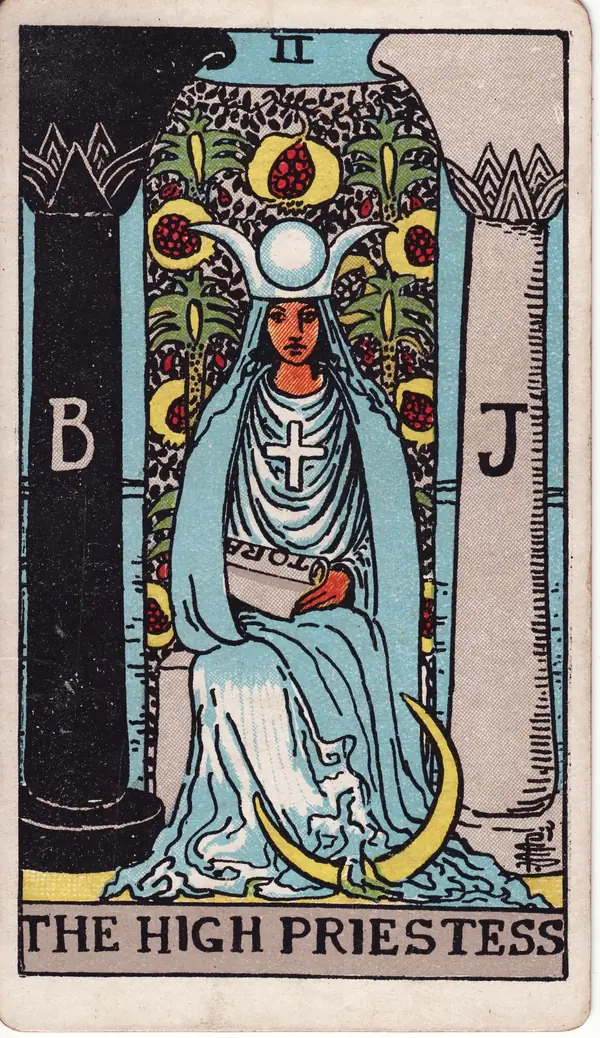
In the Classic Tarot, The High Priestess is Major Arcana 2, and her element is water. She sits between two pillars, a pomegranate-patterned veil behind her, a crescent moon at her feet, and a scroll in her lap that is only half visible. Nothing in the image hurries.
Her core meaning is simple: quiet but certain inside; the answer is not ready to be said out loud. The number 2 is not about doubling here. It marks a division between what can be shown and what must stay private for now.
When she appears upright or upside down, she usually describes someone who knows more than they are saying. In reverse, the still water turns over: calm observation becomes pressure, second-guessing, or information that never quite reaches the surface. The sections below move through love, what someone is thinking, work, money, health, advice, and the way she behaves in a spread.
The High Priestess Symbolism: What Each Detail on the Card Means
She faces forward and sits upright, knees together, hands resting over the scroll in her lap. Her lips are closed, her gaze level. The pose is not meant to feel distant. It shows attention turned inward: she takes in what she feels before deciding whether to answer. Upright, this makes her claim credible—she knows more than she has said. She is listening, and she is not ready to reveal herself. Reversed, the same stillness sours. Her body stays put while her mind curls inward, and the calmer her face, the harder her turmoil is to see.
An equal-armed cross rests on her chest, four branches meeting at the center. It suggests four directions balanced at one point, and an inner order in which emotion, reason, intuition, and practical reality share the same table. Upright, this supports her refusal to take sides too fast. She can hear two opposing accounts without turning one person into an enemy. Reversed, the center comes apart. Someone else's mood drags her off balance, or she claims objectivity while her preference has already chosen a side.
The scroll lies across her knees, mostly hidden by her robe, with only a section visible. Knowledge here is never fully displayed. Some of it waits for the right moment, some for a relationship stable enough to hold it, and some must be sought. Upright, this explains her gaps in speech: she is not manufacturing mystery, only placing information carefully. Reversed, the covered part can become deliberate concealment. She withholds whatever no one asks for, and she ignores what she herself should examine. Protective reserve and evasive silence are not the same thing.
Her robe is mostly blue, lined in white, its folds falling like water. Blue suggests reason and coolness; white suggests clarity. Together they describe a lucid warmth, not an absence of feeling. Upright, this lets her observe her own emotions without being swept away by them. Reversed, blue turns cold and white turns blank. One person buries every feeling until nothing shows; another keeps a composed face while the interior floods. The calm is no longer a skill. It is a container that has stopped holding.
Two pillars flank her, one black and one white, like a doorframe without a door. They divide visible from invisible, known from unknown, conscious thought from what moves beneath it. Black also carries older associations with the feminine, fear, and the unlit parts of experience. Upright, she sits between the poles without declaring a thing wholly good or wholly bad. Holding both is her strength. Reversed, the poles become opponents. She sees only one side, or she is so afraid of choosing that she stays stuck in the frame.
Behind her hangs a tapestry of pomegranates and palms, separating her seat from a deeper space. The pomegranate's red skin and many seeds suggest hidden vitality, desire, and possibilities not yet opened. The palm's green speaks of endurance, hope, and growth that takes time. The veil is a boundary between what may be shown and what stays private. Upright, it suggests someone rich inside but reluctant to display it; a secret here protects rather than deceives. Reversed, the cloth grows too thick. Protection becomes isolation, and a person hides so long that she forgets how to leave.
An upturned crescent lies beneath her feet. Its light is incomplete, but enough to reveal what is near. The moon governs cycles, the subconscious, emotional tides, and subtle impressions that stronger light would erase. Upright, she moves with that rhythm. Some matters need a season before they can be seen, and temporary uncertainty is not failure. Reversed, the rhythm breaks. Moods swing, the body asks for rest while she keeps pushing, or waiting becomes drifting. Then she is neither watching nor acting, only being carried.
Water moves behind the tapestry, not close to her feet and not fully hidden. It stores memory, emotion, and deeper feeling. Still, it reflects; stirred, it can overwhelm. Upright, she approaches it through quiet, which gives her intuition roots. Her knowing does not come from nowhere. Reversed, the water either rises until reason goes soft, or it is shut so far behind the cloth that she speaks only in facts. That version can look clear and competent while cutting her off from the clues she needs.
The numeral II does more than mark a sequence. It sets one self beside another object, and that pairing makes observation possible: contrast creates perspective, distance creates reserve. Upright, the two lets her see both sides of a relationship without assuming she is its center. Reversed, the number splits. You face me; choosing and being chosen pull against each other; the harder someone tries to keep every option, the less she can move. The two becomes a standoff, not a connection.
The High Priestess Kabbalah and Tree of Life
In the Tree of Life, The High Priestess sits on the thirteenth path, assigned to the Hebrew letter Gimel, whose meaning is "camel." The path joins Kether (the Crown), the first sphere, to Tiphareth (Beauty), the sixth. Kether is the undifferentiated source at the top of the Middle Pillar, the pure point before anything separates. Tiphareth is balance, harmony, and the sense of a self at the center, also on the Middle Pillar. Because one sits above the other, the path runs straight down through the Abyss that divides the supernal triangle from the worlds below.
Tradition describes movement from right to left as contraction, left to right as expansion, and vertical descent as extension into the world. Her path belongs to the last kind. Its work is to bring insight from the heights into the ordinary self. She carries something of the Crown's purity and something of Beauty's centeredness, so she is not meant to float above life. The insight has to find a place in a person's inner life and conduct.
The camel is the necessary image. It does not build a bridge, yet it can carry a load across trackless country. It endures thirst and distance, and it knows when to stop. Her intuition works in that manner: the light is partial, the route is not marked, but it can still take someone from one side to the other. She does not hand over the answer. She lets understanding form while you cross.
In love, when she appears in the position for what the other person thinks, there is often a faint impression that has not yet become speakable. He may have noticed you and still be checking whether it is safe. Pressure sends him back to shore; a steady, low-demand exchange gives the unspoken words room to surface. At work, she resembles the research or planning stage. A direction exists and some material has been reviewed, but if the idea stays at "this could work" without a written proposal or a small test, it remains in the air. In personal growth, she asks that insight from meditation, reading, or solitude become a boundary or a habit. Otherwise, knowing more is just another way to avoid living.
Classic Tarot tradition links her to the Moon. The Moon governs tides, cycles, and changes that happen in shadow, which fits Gimel's passage through the Abyss. It does not light the whole road. It gives enough light to keep walking.
The High Priestess Numerology
In the Classic Tarot, The High Priestess is numbered 2, and reducing 2 still leaves 2. In numerology, then, she answers to herself; no later Major Arcana takes her place. The real tension is with the card before her, The Magician. Number 1 acts, speaks, and puts the tools on the table. Number 2 receives, compares, and watches for a reaction first. Placed side by side, they resemble a speaker and a listener, or two tempos: act, then observe; observe, then act. When both appear in a reading, the question is often whether the moment calls for a sentence or for silence.
The character of 2 is cooperative, sensitive, and attentive to other people's moods. It reads a room through small reactions. It does not rush to the front, yet it is often first to feel the atmosphere change. A friend says "nothing's wrong," and the number 2 hears the delay before the answer. Used well, that gift becomes tact and proportion. Pushed too far, it becomes overreading: a pause gets translated into several meanings, none of them confirmed.
People with a life-path number of 2 are often described in terms close to hers: quiet, precise, quick to absorb another person's emotion, and in need of private space. That is a comparison, not a verdict. A single card cannot define an identity. Whether a person resembles this card depends on the whole spread, the present situation, and the choices she actually makes.
Returning to the card's meaning, 2 explains why she lives between inside and outside. She has seen both sides, so she will not speak as if only one exists. Upright, this sensitivity gives her insight. Reversed, the same sensitivity turns into internal friction: other people's feelings enter, and she has no reliable way to release them. The number does not make her weak. It gives her an instinct to connect before she judges.
What does The High Priestess mean upright?
Upright, The High Priestess is a slow kind of intelligence. She is not slow-witted; she simply refuses to decide before she has enough to go on. In a meeting, she lets others talk, then explains the real disagreement afterward. When a friend pours out a problem, she listens without interrupting and sends one precise message two days later.
Her intuition is not magic. It is years of observation settling below the surface and nudging her at the right moment. She can sit with an unanswered question, which is a rare skill. Her shadow is overthinking: “let me look a little longer” can quietly become “I never looked at all.”
The High Priestess reversed meaning
Reversed, the calm does not disappear so much as lose its footing. Solitude that once felt nourishing becomes lonely. A hunch that was clear becomes crowded with self-doubt. You replay one sentence at night and act normal by day; a perfectly ordinary reply from someone can circle in your head for hours.
Hidden information often shows up here too, though not always as a deliberate lie. Maybe you did not ask. Maybe the other person has not figured it out either. Guessing rushes in to fill the blank. The work of the reversed card is to settle your feelings first, then handle the facts. Trust the intuition, but give it a test: ask one question, check one detail, sleep on it.
The High Priestess in love: single, in a relationship, reconciliation
In love, The High Priestess rarely answers the question “Is anyone there?” first. She asks a more private one: are you willing to be known? This is a card of mutual observation, of two people standing near a door and waiting for the other to knock. That can be tender, and it can be frustrating. The readings below look at upright and reversed love, then at single life, an existing relationship, and the possibility of reconciling.
The High Priestess upright love
Upright in love, the connection is real but understated. There may be long talks, shared quiet, and a feeling that the other person understands more than they say. Do not expect grand declarations right away. This card favors warmth that grows through consistency rather than a sudden blaze.
The risk is assuming silence equals intimacy. It does not. Two people can be comfortable and still be hiding the sentence that matters. Let the quiet be a place to listen, not a place to hide.
The High Priestess reversed love
Reversed in love, the problem is usually not a lack of feeling. It is a lack of words. One person holds something in, the other fills the gap with guesses, and the space between them gets crowded with imaginary conversations. On the surface, nobody is fighting. Underneath, there is a low hum of tension.
Reversed love often appears in small, repetitive gestures rather than a dramatic fight. You pick up the phone every few minutes even though no notification has arrived. A three-word reply lands like a verdict, and you begin drafting explanations for a tone that may only mean the person is tired. At home, someone says "I'm okay" while their jaw is tight and their eyes stay on the screen. The remedy feels almost too ordinary: say one honest sentence without decoration, then ask a question that can be answered plainly. Not "What are we?" but "Are you free Thursday evening?" Clarity is not guaranteed, but it gives both people something real to respond to.
The High Priestess love for singles
When you are single, an upright High Priestess seldom says that attention is absent. More often it says you are letting it pass. A coworker brings you coffee without being asked. An acquaintance keeps inventing questions about a project that could be answered in one line. In a group chat, one person responds only when you write and ignores everyone else's jokes. You register each moment, feel a small lift, then explain it away as good manners. Caution has a purpose, especially after being hurt. But if every signal is dismissed before it is tested, solitude stops being a choice and becomes a habit.
Part of you likes the order of your own life: the quiet evening, the weekend with no plans. But enjoying solitude and locking the door are different things. You do not need to change your whole rhythm. Give the person who keeps reappearing ten more minutes of your attention and see what happens.
The High Priestess in a relationship
In a relationship, upright The High Priestess describes a bond that has gone quiet. Quiet is not automatically bad. Sometimes it is trust. But it can also be two people processing everything alone. One says, “If I have to explain it, you should already know.” The other genuinely does not know.
He comes home silent because he is thinking about work; you read it as anger. You say “nothing” when something is wrong; he takes you at your word and goes back to his screen. Understanding is not telepathy. It is built through repetition. Choose an unhurried evening and replace one “I assumed” with one “I actually feel.”
The High Priestess and getting back with an ex
With an ex, upright The High Priestess is a pause, not a promise. Your former partner may still be watching from a distance without saying a word. You may also be unsure whether you miss the person or simply miss being chosen. This card does not respond well to pressure.
Low-contact, ordinary conversation is more useful than a dramatic appeal. Watch three things: whether they initiate, whether they can name what went wrong, and whether their actions have changed. A feeling is a beginning, not a plan. Reconciliation needs more than a familiar voice on the phone.
The High Priestess as feelings: how they feel about you
When The High Priestess appears in a feelings position, she describes what someone is holding inside, not a full read of their private thoughts. No card can give you that. What she offers is a pattern: attraction mixed with caution, interest kept behind a composed face.
These four parts take up the upright reading first, then the reversed one, before turning to two practical questions: how this person may see you and what they may intend. That order matters. Attraction, perception, and intention are different layers, and blending them produces confident guesses that collapse on contact. Read each part on its own before you combine them. Then use the whole portrait as preparation for a real exchange, not as a replacement for one. A card can help you choose a question, notice a pattern, or stay calm while you listen. It cannot tell you what another person would say if you asked, and it should not be treated as though it can.
The High Priestess upright as feelings
Upright as feelings, the message is often, “I noticed, but it is not time yet.” They are watching how you respond. When you move closer, they register it. When you step back, they register that too. This is not indifference. It is a need to feel safe before speaking.
They may remember a small detail you mentioned, look at your posts without reacting, then ask about it as if the thought just occurred. Pressure makes them withdraw; steady warmth brings them forward. There is also a less generous version: they enjoy the ambiguity because it lets them stay unaccountable. Time and action will tell you which one you are dealing with.
The High Priestess reversed as feelings
Reversed as feelings, the message is less "I dislike you" than "I have not worked out my own position." The emotion is real, but it is poorly contained, so it leaks out in inconsistent ways. One day they send a long, unusually open message; the next, they answer in single words or disappear for a weekend. They may share a painful story at midnight and act like a polite stranger by Tuesday. Or they suggest "let's just see where it goes," not because they are relaxed, but because a clear decision feels dangerous. This is not automatically bad faith. Fear, old disappointment, and plain indecision can all produce the same behavior. What you need is not another analysis of their tone, but one honest opening and a specific question.
Hidden information can play a part, but it is not always deceit. Sometimes it is fear, indecision, or old hurt they have not named. Give them one honest opening and one specific question, such as “What would you like this to be?” Then pay attention to what they do after they answer. Consistency is the real confession.
The High Priestess as how someone sees you
As how someone sees you, The High Priestess makes you look self-contained and a little mysterious. They may see depth, independence, and a private inner life. They may also find you hard to read, which can be attractive and intimidating at the same time.
People often project a story onto that kind of quiet: “She has it all figured out,” or “He is hiding something.” Neither may be true. If you want to be met, offer one clear signal that does not require them to guess. Mystery can draw someone in, but warmth is what keeps them from standing at the door forever.
The High Priestess as intentions
As intentions, this card points toward someone who wants to understand before they act. Their interest is real, but it is filtered through caution. They may prefer to observe, gather information, or keep a connection private for a while.
That is not automatically dishonest; some people simply need time to trust their own feelings. Still, secrecy can protect them at your expense. If you are giving more clarity than you receive, say so. Ask what they want and watch whether their behavior matches their words. Good intentions without follow-through are still just intentions.
The High Priestess career and work (upright & reversed)
In a work reading, The High Priestess is about information, timing, and listening well. She is not the card of the loudest voice in the room. She is the one who heard the client hesitate, noticed the missing line in the brief, or understood why two departments keep talking past each other.
Her professional strength is accuracy. Her risk is waiting so long to speak that the moment passes. The sections below cover upright and reversed career readings.
The High Priestess upright career
Upright in career, she favors preparation and quiet confidence. Before an interview, study the role, the team, and the actual work rather than only the company slogan. In the room, listen for what is not being said.
Your advantage is steadiness: you can read subtext, stay calm, and ask the question everyone else skipped. Research, writing, counseling, analysis, and support roles all suit this energy. So does any job where trust must be earned slowly. Just do not let “I need to prepare a little more” turn into a reason not to send the application. At some point, preparation must meet the room.
The High Priestess reversed career
Reversed in career, self-doubt and poor communication tend to travel together. You leave a meeting wishing you had spoken, then replay the perfect sentence all afternoon. A vague “we’ll see” from a manager becomes a full disaster in your imagination. News arrives third-hand and you treat it as fact.
When information is murky, do three things: write down the actual question, ask the person who can answer it, and set a deadline for your decision. If the workplace stays opaque, build skills you can carry elsewhere before you move. Intuition is useful, but in reverse it needs a paper trail.
The High Priestess for money and finances
Money-wise, The High Priestess is neither a jackpot card nor a warning of ruin. She asks you to see clearly before you act. Organize your accounts, read the terms, and keep an emergency cushion.
If a deal feels wrong, that instinct deserves attention, but it does not replace the numbers. Put the feeling beside the facts: the feeling tells you whether you want to do it, the numbers tell you whether you can afford to. Reversed, the fog thickens. You may avoid asking a question because it feels awkward, skim a contract, or spend to soothe anxiety. For loans, shared money, or guarantees, get the agreement in writing. No card promises a return, and no single opportunity should carry everything you have.
The High Priestess for health
On health, The High Priestess is not a diagnosis and does not point to a specific illness. She is more useful as a reminder that the body often carries what the mind has not processed. Sleep may be light, energy may dip in cycles, appetite may shift with mood.
You might tell yourself it will pass because you do not want to make a fuss. Treat rest as real plans instead: a consistent bedtime, less scrolling before sleep, a quiet stretch in the day. If a symptom continues or gets worse, see a doctor. Do not use a card to explain it away, and do not use one to answer a pregnancy question. That belongs with a test and a medical professional.
The High Priestess as advice
The High Priestess’s advice sounds simple: do not say it yet. That does not mean never say it. She is asking you to let feeling and fact meet before you speak.
Upright, she teaches patience and attention. Reversed, she teaches you to settle yourself before you make a decision. Both directions point to the same habit: notice what you know, notice what you are only guessing, and wait until the difference is clear. Then act.
The High Priestess upright as advice
Upright, write down what you actually observed before you interpret it. Separate the facts from the story you are telling yourself. Then wait for one piece of evidence to arrive. It might be a reply, a document, a second conversation, or simply the way someone behaves when they think no one is watching.
After that, turn around. The pomegranate is behind her for a reason: the opportunity may be in the message you did not answer or the person you keep avoiding. When you do speak, say one clear sentence rather than emptying every feeling at once. Clarity is kinder than a flood.
The High Priestess reversed as advice
Reversed, handle the emotion before you handle the problem. Decisions made at peak frustration usually need to be cleaned up later. Give yourself a buffer: a walk, a shower, a night of sleep, then reply. Trust the hunch, but attach an action to it. Ask one question, check one fact, wait one day.
If self-doubt has been running for weeks, do not carry it alone. Talk to someone trustworthy, and seek professional support if it is affecting sleep, work, or your daily life. Reversed is not telling you that you are wrong about everything. It is telling you that you need clearer information, not more guesses.
The High Priestess as a person
As a person, The High Priestess describes someone quiet, observant, and slow to reveal themselves. They are not cold; they are private. They notice the detail everyone else missed, remember it, and bring it up at exactly the right time. They need solitude the way other people need company.
Give them a quiet room, a long walk, or an afternoon with no demands and they recharge. Their shadow side is overthinking and delay. They can stay inside their own head so long that life outside feels like an interruption. Their mood moves in cycles, which is part of the lunar symbolism. When they are clear, they are remarkably perceptive. When they are not, they can mistake withdrawal for wisdom.
The High Priestess reversed as a person
Reversed as a person, the same traits turn inward and become harder to reach. They may be evasive, moody, or unable to make a decision. Sometimes this is someone protecting a genuine vulnerability. Sometimes it is someone who has learned that secrecy keeps them in control.
You may feel that you are always the one asking and never the one being told. Be compassionate, but do not mistake mystery for intimacy. A private person can still be honest. If the silence keeps growing whenever you ask a direct question, that pattern is information too.
How to place it in a reading
Position changes her voice. In the past, she can mark a quiet period, a secret, or a choice made on instinct that shaped your present caution. In the present, she says you know more than you have said and the situation is not ready for a public answer. In the future, she suggests a season of patience and private processing; events will reveal themselves, but not at the speed you want. In an advice position, she asks you to record, verify, and reply later. As an obstacle, she can mean overprotection, endless analysis, or someone keeping information from you.
Her neighbors matter just as much. Beside The Magician, there is a tug between speaking and holding back, one force pushing forward while the other presses pause. Beside The Hermit, solitude doubles and a relationship can drift into two separate lives unless someone breaks the silence. Beside The Moon, intuition is strong but imagination is stronger, so important matters need facts. Beside The Emperor, structure and inner feeling pull against each other, often around rules or boundaries. Beside The Lovers, the choice is not only about attraction but about honesty and shared values. The traditional Moon correspondence is a useful reminder here: her knowing often arrives through rhythm and the body before it becomes a sentence.
Our take
When The High Priestess enters a spread, the first question is not usually yes or no. It is which words have already been spoken and which are still moving under the surface. Her specialty is the gap between available information and public information, so the more specific the position, the more useful she becomes.
In the position for what the other person thinks, she usually signals reserve, not absence of interest. The person may have noticed you and may also be weighing what speaking would cost. Perhaps he is watching whether you are steady; perhaps he simply likes an ambiguity that asks nothing of him. Do not write his lines for him. Read the neighboring cards. The Magician suggests he can express himself and mainly needs a moment when speaking feels possible. The Page of Swords points to more questions, tests, and messages, so information starts to rise. The Moon or The Hermit thickens the silence, and what you hear may be only the tip of the iceberg.
In a decision spread, her role is to gather before committing. If a three-card spread asks whether to move forward and she lands in the advice position, she is not ordering an endless delay. She asks you to separate three things on paper: the facts, the other person's behavior, and your own limit. Then set a date for review. She can keep you from deciding on too little information, but she cannot become an excuse for never deciding. Beside cards of communication, facts surface. Beside heavy stagnation, ask one concrete question instead of guessing.
Her lunar correspondence has practical use in a spread. First check whether the matter has a cycle; then check whether you are in an emotional low. At a low point, temporary coldness looks final, and a day or a full cycle can restore proportion. The Moon also asks you to separate a recurring feeling from a recent fact. The feeling needs care. The fact needs verification. Keep those two tasks apart, and the rest of the spread reads more honestly.
The High Priestess in Different Positions: Past, Present, Advice, Obstacle
Her position changes the question she answers. She is not decoration in a slot; the slot decides which part of her meaning is in use.
In the past position, she often points to a quiet season, a secret kept out of speech, or a choice made on instinct. The position asks what shaped the present, and her answer is that silence once protected you and may also have kept you from learning something. Upright, the experience made you careful and observant. Reversed, the old episode has not really ended; unprocessed concealment or lingering doubt still colors your reactions.
In the present, she says you hold more information than has been made public and the situation is still in its observing stage. The position asks what is happening now. Her answer: do not reveal your hand before you see who is doing what. Upright, the waiting is conscious; you know what you are waiting for. Reversed, quiet has become suppression. Facts are unclear, or you have started substituting guesses for conversation.
In the future position, she predicts a stretch that requires patience. Matters will reveal themselves, but not at the speed you demand. The position asks what comes next, and her answer leans toward "not yet public." Upright, the delay contains preparation and is useful for getting ready. Reversed, the wait may stretch longer, or you may act too early on thin information and lose an advantage you already had.
In advice, she asks you to record, check, and choose a time to speak. The position asks what to do. Her method is not passivity: separate sensation from fact, then decide which sentence needs saying and to whom. Upright, observation before response lowers the chance of misreading. Reversed, she warns against using "I need to think" as a shield. Ask one specific question. Put an end date on the thinking.
In the obstacle position, she can mean excessive guard, words withheld, unequal information, or analysis that paralyzes action. The position asks what is stuck. Caution, a virtue elsewhere, has become distrust. Reversed, the block may not be another person's concealment at all. It may be your own refusal to look. Or the guard is beginning to loosen, and you have not yet grown used to saying things directly.
As an outcome or clarifier, she usually describes an ending that has not gone public. The matter clears in private, or the answer arrives after more time. The position asks where this lands. Her answer stops at the threshold and refuses a black-and-white verdict. Reversed, the result is more likely a delayed explanation, an extended ambiguity, or a confession that comes late. It is not automatically bad, but the unclear portion has a price, paid in time.
Read every reversal as the upright energy in excess or currently off balance, then look at the opposite face. A favorable card reversed usually halves the benefit; it does not erase it.
The High Priestess Three-Card Example (Fictional Example)
Fictional example: The people and events below are invented and serve only to show how a reading can be built.
A querent had been involved for three months with a man whose intentions were unclear. Sometimes he initiated a meeting; sometimes he left her message unanswered for two days. She wanted to know what he actually thought and whether she should keep waiting.
She used a three-card spread: My feelings, what the other person thinks, and relationship direction. The cards fell in that order: Page of Cups upright, The High Priestess upright, and Two of Swords upright.
Page of Cups upright in the first position showed a soft center. A glass of water or one kind sentence could keep her happy for half a day; a slow reply sent her reopening the thread again and again. She was willing to offer affection and willing to believe the connection could grow slowly. The Page also carries a childlike quality. She turned a small gesture into a large signal and placed her expectations in his hands. The position asked what was happening inside her. The answer was genuine warmth, along with a quiet transfer of initiative. It was not asking whether he was a good match; it was asking what she brought to the table.
The High Priestess upright in the position for what the other person thinks did not mean he felt nothing. It meant he had noticed and kept his judgment private. He might remember a minor detail she mentioned, check her updates, and still refuse to put the situation into plain words. He was testing whether she was steady and whether a relationship would disrupt the rhythm he already had. He was also leaving himself an exit. Her upright qualities, observation and tact, made his silence less likely to be malice than caution. Another possibility existed: he enjoyed the blur because clarity would force a choice. Pressure would only make him more careful. The card did not promise that he would speak. It showed that something remained unoffered.
Two of Swords upright in the relationship direction put the near future in a standoff. Neither person moved first. The figure is blindfolded, with two blades crossed over the chest, defending and postponing at once. This is not an immediate breakup, and it is not an immediate union. It is a pause. The card can feel like a pause button: both parties sense there is something to handle, and both choose not to touch it yet. The air element fills the space with thought and weighing, which also reduces action. Unless someone removes the blindfold, the surface stays calm while the decision waits underneath.
Only one Major Arcana card appeared, which gave the matter weight for both people without making it irreversible. The elements told their own story. Page of Cups is water; The High Priestess corresponds to the Moon and water; Two of Swords is air. Water and air do not push directly toward action, and fire and earth were absent. There was plenty of feeling and analysis, but very few actual meetings, confirmations, or promises. The temperature was equally telling: the Page felt warm, while The High Priestess and Two of Swords felt cool. The whole picture was a little warmth wrapped in two layers of composure. The story was not complicated. She liked him, he had noticed, and each was waiting for the other to send a safe signal. So the connection hung in midair. The short-term judgment was that the ambiguity would continue and no clear answer would arrive soon. That was not a disaster, but more waiting would drain her.
For advice, she did not need to keep asking, "Do you like me?" That question makes a person who is already watching from a distance retreat faster. A better move was one concrete, low-pressure invitation: a meeting with a set time, followed by attention to whether he arranged it. After giving him one opening, she could set an observation window of two or three weeks and judge by his actions rather than her hopes. If the pattern stayed at last-minute invitations and vague replies, that was information, not a reason to wait harder. She also needed to return attention to her own life. A single message should not decide the weather of an entire day. The High Priestess asks for clarity, not an indefinite vigil at the door. Treat the wait as a chance to gather information, not as a test of endurance.
Common Misreadings of The High Priestess
Her quiet invites extreme readings, and each extreme hides a more ordinary truth. These are the usual swings.
One common mistake is to read her as cold or emotionless. Upright, she uses few words, but few words do not prove an empty interior. She keeps feeling inside and first checks whether the other person is safe enough to receive it. In the position for what someone thinks, her silence may be caution or a taste for ambiguity; look at behavior and nearby cards. Calling it rejection can close a door that was only latched. Assuming deep devotion because someone is quiet is the opposite error.
Another misreading is that she requires endless passive waiting. Waiting is one of her methods, not a permanent condition. She asks you to collect information, see the shape of the situation, and choose when to speak. Without a deadline, observation turns into avoidance. In a real reading, set a checkpoint: by a certain date, or once you have specific facts, make a decision. A useful checkpoint can be a date on the calendar or the end of a specific conversation. She opposes movement in fog. She does not oppose movement itself.
A third error is treating every reversal as proof of lying or a third party. Reversed, she more often describes unclear information, emotion held too long, or a person who has not made sense of his own position. Concealment is possible, but one card cannot establish it. Use the neighboring cards and real evidence instead of turning the reversal into an interrogation. Make the doubt concrete. Ask a question that can be answered, then compare the answer with consistent behavior.
She is sometimes mistaken for a psychic who can read another person's mind. Her intuition comes from long observation and from the quiet that lets impressions settle. It is not supernatural access. The scroll on her lap is only partly visible, which admits that knowledge is incomplete. Trust a first sense, then test it: ask one question, check one detail, wait one day. Treating intuition as proof and treating it as worthless are both ways of missing the point.
Finally, she is not reserved for women or for one fixed personality. The card describes a mode of receiving, watching, and holding back, and anyone can enter that mode for a while. Locking her to a gender or a character type hides the more useful question: who is observing here, who is withholding, and who has not finished the sentence? In a spread, her position and neighbors tell you more than whether someone matches a feminine image.

FAQ
These are the questions readers ask most often about The High Priestess. The answers follow the common readings of the Classic Tarot and this site’s approach, which treats her as a prompt to pause rather than a fixed verdict. Use the overall spread and your own circumstances as the final authority.
Is The High Priestess a yes or no card?
It depends on the other cards. On its own, she is neither a clear yes nor a clear no. Upright, she leans toward “wait and see.” The answer may be forming, but it is not ready to be announced. Reversed, she leans toward “the information is incomplete,” which is also not a yes or no. Look at her neighbors. A card of movement nearby can soften her pause into “yes, but slowly.” A card of confusion, secrecy, or blockage calls for sorting out the missing facts first. The spread gives the verdict; she sets the pace.
What does The High Priestess reversed mean in a yes or no reading?
There is still no fixed answer. Reversed, she usually means the facts are incomplete, so a firm verdict would be premature. Someone may be withholding something, or you may be avoiding a question because you are afraid of the answer. Either way, the ground is not solid enough for a verdict. Ask what is missing, then ask for it directly. Once the gap closes, the rest of the spread will read more honestly. Until then, treat “I don’t know yet” as the accurate answer.
What does The High Priestess mean if you have a secret crush?
They have probably noticed you, but they are not ready to say so. Upright, the person may be watching for signs of safety. They remember small things, glance your way, or find reasons to be nearby, yet keep the conversation casual. That is observation, not rejection. Reversed, the signal gets murkier. They may be confused about their own feelings or worried about what speaking would change. Rather than analyzing every message, create one natural chance to talk in person. A real conversation tells you more than a week of decoding.
What does The High Priestess mean for marriage?
She emphasizes honesty and depth more than timing, so discuss the practical questions before you make plans. Upright, there may be real understanding between you, but also a habit of leaving important things unsaid. Before marriage, talk about money, family boundaries, children, and how you handle conflict. Do not assume your partner already knows. Reversed, pay attention to avoidance. It does not prove something is wrong, but it does suggest that a few topics need daylight. Ask specific questions and listen for specific answers.
What does The High Priestess mean as an outcome?
The outcome is not fully revealed yet. Expect a period of watching, waiting, and piecing things together. She suggests that the final shape of the situation is still private, even if you can feel it forming. Do not force a public result before the private work is done. If the cards around her are active, the waiting may be short. If they are inward or confusing, give it more room. Use the time to gather facts rather than rehearse worst-case scenes.
What timing does The High Priestess suggest?
No exact date. She suggests a slower, private season rather than a quick answer. Timing in the Classic Tarot is rarely precise, and this card is especially reluctant to hurry. Her lunar symbolism points to cycles, moods, and gradual change rather than a single dramatic moment. Read the pace from the surrounding cards. Movement cards shorten the wait; cards of stillness or secrecy lengthen it. Plan for weeks rather than hours, and let the situation reveal its own rhythm.
Does The High Priestess mean pregnancy?
The card does not answer pregnancy questions. Use a medical test and speak with a doctor. Symbols of water, moon, and hidden knowledge are sometimes read as fertility in a very loose poetic sense, but that is not a reliable answer. A tarot card cannot confirm or rule out a pregnancy. If you are wondering, take a test and consult a medical professional. Do not let a reading delay medical care or create false certainty in either direction.
What zodiac sign is The High Priestess?
The High Priestess is traditionally associated with the Moon. In astrology, the Moon governs tides, cycles, memory, and the parts of life that happen below conscious attention. That fits her quiet, receptive, and private nature. She is also linked with water, which is why her intuition is described as a current rather than a thought. This does not make her a zodiac sign; it is a traditional correspondence, not a sun-sign label.
Is The High Priestess a good or bad card?
She is neutral. Not lucky or unlucky, but a pause for insight. Upright, she supports patience, observation, and trusting a well-tested hunch. Reversed, she warns about suppressed feelings, self-doubt, and missing information. Neither direction is a verdict on your worth or your future. Ask what the card is asking you to notice. If you need action, her pause may be a caution. If you have been rushing, her pause may be a gift.
Related cards
- The Magician: He turns a thought into action while she holds action back, so together they ask you to choose the right moment to speak.
- The Hermit: Both cards love solitude, and together they can double the silence until someone finally says the first honest sentence.
- The Moon: Intuition and imagination both run high here, so keep important decisions anchored in facts you can check.
- The Emperor: Structure meets inner knowing, often around boundaries, rules, and the difference between duty and genuine feeling.
- The Lovers: Choice and values come forward, reminding you that honesty matters more than a comfortable atmosphere.
- The Fool: One wants to step off the cliff while the other is still studying the path, which captures the feeling of wanting to move and hesitating anyway.