The Devil Tarot Card Meaning: Reversed, Love, as Feelings, Yes or No

Draw a Classic Tarot spread →Free, no sign-up. Think of your question, then draw.
In one line: The chain is loose; the hard part is wanting to walk away.
| Keywords | |
|---|---|
| Upright | desire, obsession, being bound |
| Reversed | breaking free, seeing the dependence, detox |
| Type | Major Arcana 15 |
| Yes/no (our grading) | leans no |
Quick answers: yes/no · love · career
- Yes/No: Under our grading, The Devil leans no. Yes/no is the least reliable use of tarot—prefer “how should I approach this?”.
- Love: Strong pull that may be unhealthy—dependence or control; reversed, starting to see it and wanting out.
- Career: Tied down by pay, contracts or habit; reversed, a chance to break loose.
*FateClear Editorial Team*
Want to draw a Classic Tarot spread? Draw cards.
The Devil is Major Arcana 15 in the Classic Tarot, an earth card traditionally linked with Capricorn. It arrives late in the Major Arcana, after lessons about choice, discipline, and intimacy. Its number is 15 and its element is earth, so the card keeps returning to what is tangible: bodies, money, habits, power, and the very real appetite for all of them.
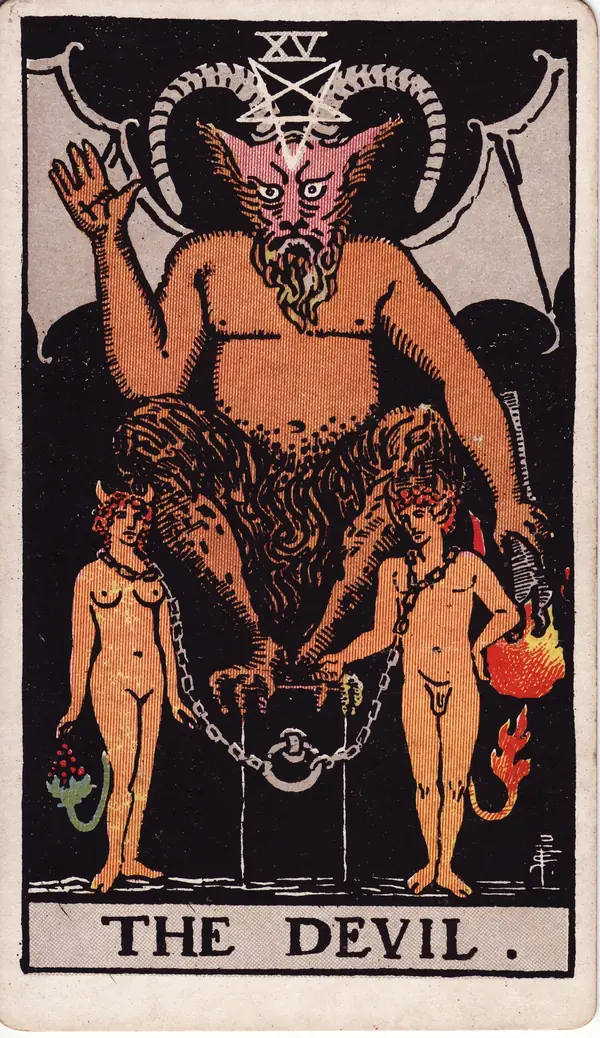
Two people stand chained to a dark stone pedestal. Above them looms a horned, winged figure holding a torch, and the space around them is heavy with shadow. The chains around the people's necks look absolute at first, but they are loose enough to lift away. That detail matters. The Devil is rarely about a locked door; it is about a door you keep deciding not to use.
The one-line meaning is: The chain is loose; the hard part is wanting to walk away. Its upright keywords are desire, obsession, and being bound. In reverse, the keywords shift to breaking free, seeing the dependence, and detox. The card is not a cartoon villain. It is a mirror held up to what you crave, what you tolerate, and what you tell yourself you cannot leave. When it appears in reverse, the mirror turns toward the moment you begin to see the chain.
The Devil Symbolism: What Each Detail on the Card Means
Horned goat head. At the center stands a massive goat-headed figure with a human body. Its horns curve upward, and its eyes face the viewer straight on. The horns make animal appetite visible; the direct stare feels like a question: What do you actually want? Upright, desire is seen and enlarged. Reversed, desire has not vanished—the person simply notices that stare and pulls the impulse back a little.
Inverted pentagram on the forehead. Two points face up and three face down, the reverse of the usual pentagram. It turns the normal order of spirit governing matter upside down, suggesting that the senses, profit, and control have taken charge. Upright, values are ranked backward. Reversed, it is as if someone reaches up to turn the star right side up: first comes the admission that things are inverted, then comes adjustment.
Raised hand and torch. One arm is lifted with the palm facing out, while the other hand points a torch toward the ground, its orange-red flame aimed at the earth. The raised palm seems to say, "Stop here." The downward fire presses light and heat into the ground. Upright, you are drawn in even though you know the price. Reversed, you have started to brake, but the ember is still burning and cooling down will take time.
Batlike wings and claws. The wings behind the figure are not feathered. They are membranous, sharply angled, and the hands and feet are closer to an animal's claws. The same body carries both "fly away" and "hold tight": the more you try to escape, the harder you may grip. Upright, this often shows control and possession. Reversed, it shows the conflict of wanting to let go and being unwilling to.
Black stone seat and dark background. The square pedestal under the two people is a deep black, and the background offers almost no open sky or recognizable landscape. In color symbolism, black is often tied to fear, shadow, and what remains unspoken. The closed setting makes the problem seem to have no exit. Upright, you are trapped inside the situation. Reversed, the darkness is still there, but a crack has opened in the view.
Naked man and woman with slack chains. Neither figure wears clothes, and each has a collar around the neck connected to the pedestal, though the collar still has room. Nakedness leaves desire and vulnerability uncovered; the slack chain shows that the bond has an outer form and an inner consent. Their postures are not really struggling. They look accustomed to the arrangement, and their faces show no obvious terror. Upright, ask who is keeping the chain in place. Reversed, ask who has finally realized it can be lifted off.
Fruit and fire on the tails. In the common image, the man's tail ends in fire and the woman's in a cluster of fruit. The fruit stands for the senses, harvest, and the temptation to take "just a little more," while the green adds a hint of growth. The fire stands for impulse and energy. Placed together, they show that desire can nourish or burn. Upright, tell the fruit apart from the fire. Reversed, cut back the supply and let the flame grow smaller.
Number and overall composition. The card is numbered 15. The two people are placed low in the frame while the enormous figure fills the upper half, creating an oppressive imbalance of scale. The number places the card in the middle of the Major Arcana: its subject is not the final destination but a choice that has to be faced. Upright, the choice is put in front of you. Reversed, the choice has already appeared; the follow-through is just slow.
The Devil Kabbalah and Tree of Life
In the Classic Tarot tradition, The Devil corresponds to the 26th Path on the Tree of Life. The Hebrew letter is Ayin, whose original pictograph means "eye." The path links Tiphareth (Beauty), on the middle pillar and concerned with center, balance, harmony, and the self, with Hod (Splendor), on the left pillar of Severity and concerned with reason, language, and analysis. It carries the tone of both ends: the centered sense of "who am I" and the mind that takes everything apart in order to explain it. What matters about the 26th Path is that desire does not stay a feeling; it gets interpreted and justified.
Direction matters too. In the Classic Tarot tradition, energy tends to contract when a path runs from the right side to the left, expand when it runs from left to right, and descend into ordinary reality when it drops vertically. This path runs diagonally from central Tiphareth to Hod on the left. It can be read as bringing wholeness into analysis; read the other way, it returns order to the center for integration. Ayin as "eye" is therefore not only about seeing the world. It also means being seen, being stared at, and claiming something with a stare. Obsession often starts here: not in simple wanting, but in endlessly defending the want with reasons.
That correspondence is useful in concrete situations. In love, Tiphareth asks, "Can I still be myself?" while Hod is "the things he says, the explanations he offers." When someone keeps using the other person's explanations to convince themselves, the path tilts toward Hod: the more analysis, the weaker the center. At work, Hod covers data, contracts, and reports, while Tiphareth covers self-worth. If you stake all your worth on metrics, you become bound. In personal growth, Ayin asks you to see what you are looking at and what is watching you. Once your sight is clear, the chain loosens by one notch.
Its astrological correspondence is usually given as Capricorn. Capricorn values structure, time, responsibility, and visible results, which fits the Tiphareth-to-Hod movement "downward into the ground, into the language of reality." Once a desire has a plan and a recognized status, it becomes harder to put down. A good reading question is therefore: Which real-world need is this attachment protecting?
The Devil Numerology
The Devil is number 15. Reduce 15 and you get 6 (1 + 5), the number of The Lovers. This does not turn The Devil into The Lovers. It places both cards on the same numerical thread. Six is about relationships, giving, care, harmony, and perfection; when that care loses its boundaries, it can slide into possession, people-pleasing, or "I did so much for you—you can't leave now." The Devil is like the shadow side of The Lovers' theme. It is still about choice and the ordering of values, except that desire and dependency have obscured the choice.
The number 15 also keeps traces of 1 and 5. One is an independent starting point; five is about reaching outward and testing limits. First comes "I want," then "I want more," and only then does the matter settle into the relationships and responsibilities of 6. Read in that order, it becomes clear why The Devil often appears in the process of "it started as liking and turned into being unable to leave." Numerology offers a sequence of stages here, not a verdict.
People with life path number 6 are often described as willing caregivers who value family and commitment, and who tend to put other people's needs ahead of their own. For them, this card works as a mirror. When giving turns into control, or when perfectionism makes it hard to leave a draining relationship, it is time to inspect the boundaries. The restorative side of 6 also appears here: admit that you need connection, and practice not buying it with self-sacrifice. Six is also linked with healing and care, and The Devil adds a reminder: care for your own boundaries before you care for everyone else.
In a reading, treat 6 as a question: Is my giving a choice, or is it fear of losing? The answer does not need to be clear right away. The question itself can turn the Devil's chain from "fate" back into something you can negotiate.
What does The Devil mean upright?
The Devil upright magnifies wanting. You may be drawn to a person, a paycheck, a status, or a sense of control even when your better judgment keeps raising a hand. The card does not say the object of your desire is evil. It says the attachment has started to crowd out your freedom.
In real life, this can look like a relationship with secrets, a flirtation that thrives on uncertainty, or a job where the money is good and the atmosphere is corrosive. Friends may warn you; you may defend the situation anyway. For salespeople and business owners, the same energy can be useful: hunger, nerve, and the will to compete. The key is whether the hunger serves you or runs you.
The Devil reversed meaning
The Devil reversed is not instant liberation. It is the first honest look at the chain. You may still feel the pull of a third party, an ex, a spending habit, or a job that flatters your ego, but you no longer fully believe the story that you cannot survive without it.
In work, gossip or rivalry may be fading, though the damage is still visible. You might also notice that your desire remains large while your follow-through lags, leaving a situation half-finished. The good news is that the spell is cracking. The difficult part is turning recognition into repeated action. Detox is rarely a single dramatic gesture; it is a series of small refusals.
The Devil in love: single, in a relationship, reconciliation
Love readings often bring The Devil when attraction is loud and clarity is quiet. The card can describe passion, but it can also describe possession, secrecy, and the fear of losing access to someone. It is not proof of true love, and it is not proof of doom. Read it as a question about autonomy: can you be yourself inside this connection, or are you performing a version of yourself to keep it alive?
The Devil upright love
Upright in love, The Devil points to intensity that may have tipped into imbalance. There may be magnetic chemistry, frequent contact, and a strong physical or financial dependency. It can also flag control, jealousy, hidden messages, or a third person who takes up more space than anyone admits.
You might stay after a fight because silence feels worse than the argument. Separate desire from security. Wanting someone is not the same as being safe with them, and needing someone is not the same as being chosen.
The Devil reversed love
Reversed in love, the connection is still charged, but the fog is thinning. You may see how much you edit yourself, how often you wait, or how much you explain away. Contact may have slowed, or a third-party influence may be losing force.
That does not mean trust has returned. It means you are less willing to call the arrangement normal. State a boundary once, keep it, and notice what happens. A relationship can survive this review if both people change the pattern rather than just apologize for it.
The Devil love for singles
For a single person, The Devil often shows up as a dangerous kind of familiarity. You may be drawn to someone unavailable, inconsistent, or still tangled with an ex. The excitement feels like proof of chemistry, but it may be proof of anxiety.
You reread messages, imagine their reasons, and give them access they have not earned. Before you call it love, ask what need they meet: loneliness, validation, adventure, or the old comfort of chasing. Slow the pace. Respect should not require you to abandon your standards.
The Devil in a relationship
In an established relationship, The Devil can expose control, secrecy, or a third party. The third party does not have to be romantic. It might be a family member, a work partner, an ex, or a screen that always comes first.
You may fight, make up, and repeat the same argument without touching the real issue. Physical closeness can become a way to avoid conversation. The card invites a factual talk: what is being hidden, who has access to your shared life, and which boundaries keep getting crossed? Do not settle for intensity when you need honesty.
The Devil and getting back with an ex
With an ex, The Devil describes a pull that can outrun good sense. A reunion may happen quickly, fueled by longing, jealousy, loneliness, or the wish to finish an old story. Sometimes that is a genuine new beginning; often it is the same loop with better lighting.
If the relationship involved a third party, money, manipulation, or control, name those conditions before you meet again. Ask whether you miss the person or the intensity. Ask whether anything has actually changed. The Devil is sometimes called a breakup card, but its sharper message is that this bond is hard to release.
The Devil as feelings: how they feel about you
When The Devil appears in a feelings position, resist the urge to treat it as mind reading. It describes an emotional climate: strong desire, uneven power, and a tendency to hold on. The other person's thoughts may be warmer or more conflicted than their actions show. Use the card to ask better questions, not to write a verdict about someone's private mind.
The Devil upright as feelings
Upright, the other person's thoughts are likely charged with attraction and possession. They may see you as magnetic, desirable, and hard to forget. That does not automatically mean they want a healthy partnership.
They may want access without commitment, attention without responsibility, or closeness on their own terms. If they are seeing someone else, this card can describe a wish to keep both options open. Watch for consistency. Do they make plans, tell the truth, and respect a no? Desire is easy to perform; reliability is harder to fake.
The Devil reversed as feelings
Reversed, their thoughts are more divided. They may know the connection is unhealthy, yet still reach for you when they feel lonely or guilty. Messages can arrive in bursts, followed by silence. They might be trying to step back while a habit pulls them forward.
This is not proof that they care deeply, and it is not proof that they care nothing. It means they are stuck between recognizing the problem and accepting the cost of change. You can leave room for that process without volunteering to be its classroom.
The Devil as how someone sees you
As how someone sees you, The Devil gives you a strong presence. They may find you compelling, sensual, or a little dangerous to their peace of mind. You might seem like the person who could loosen their self-control or challenge their usual rules.
There is admiration here, but also a risk of objectification: they may value what you give them more than who you are. Notice whether they are curious about your inner life or only your availability. Being desired is not the same as being known. Let their curiosity about you be part of the test.
The Devil as intentions
Their intentions are often mixed. Upright, the card suggests a wish to possess, control, or keep you close, possibly without full transparency. Reversed, the intention may be to pull away while still keeping a thread attached.
None of this requires assuming malice. People can act from hunger, fear, and habit without intending harm. Still, intention matters less than impact. Look for secrecy, pressure, and inconsistency. If their words promise freedom but their behavior demands compliance, believe the behavior. A clean intention can survive a direct question.
The Devil career and work (upright & reversed)
At work, The Devil is less about a literal wicked boss and more about incentives that bend people. It can describe ambition, office politics, or a role that pays well and costs too much. The card is useful because it asks what you are willing to trade for security, recognition, or a title. That trade is not automatically wrong, but it should be conscious.
The Devil upright career
Upright at work, expect strong appetites and strong competition. There may be gossip, credit-taking, or a colleague who smiles while working against you. You could be tempted by a high salary in a hostile environment, or by a shortcut that saves time but compromises someone else.
Sales, business development, and entrepreneurship can benefit from this energy: you are willing to ask, negotiate, and push. Even then, put agreements in writing and keep a record of promises. Use the drive, but do not let it decide your ethics for you. A win that requires secrecy often comes with a hidden bill.
The Devil reversed career
Reversed at work, the issue is often follow-through. You see the toxicity, the dead-end project, or the unfair arrangement, but you keep saying you will deal with it later. Motivation may be returning in waves. A difficult colleague's influence might be weakening, or a conflict may be cooling.
Before you blame the whole environment, check your own pattern: are you absorbing extra work, avoiding a hard conversation, or chasing a target that no longer matters? Make one concrete move. Update your resume, ask for the missing information, or decline the task that keeps derailing your day.
The Devil for money and finances
With money, The Devil puts appetite on the table. The desire to earn, spend, and display can be creative, but it can also become a way to soothe fear. This card does not promise wealth, and it does not tell you what to buy. It asks you to separate a need from a want and a want from a fear of missing out. Start with the numbers you can control: income, fixed costs, debt, savings, and the subscriptions you forgot. Notice where urgency is being used to rush you.
Upright, the card can favor people who sell, negotiate, or build a business, because desire fuels effort. It also warns about impulse spending, status purchases, and deals that demand an immediate yes. Reversed, money may be tied up in old commitments, loans to friends, or plans that never get executed. Neither position is a reason to gamble. If a decision involves investments, taxes, or debt you cannot easily repay, speak with a qualified professional and read the terms slowly.
The Devil for health
The health message of The Devil is about pressure, routine, and the body's signals, not diagnosis. The card often appears when appetite has become a way to cope: too much food, alcohol, screen time, work, or emotional dependency. You may tell yourself you can keep going, even as sleep gets shallow and your shoulders stay tight.
Treat those as information. Acknowledge one excess and reduce it at the edges. Choose a clear stopping time, a walk, or a quieter evening. If discomfort persists, see a doctor rather than asking a card to explain it. In reverse, the body may be asking for a recovery period, but good intentions do not replace rest. If you are pregnant or trying to conceive, this card cannot answer medical questions. Speak with a doctor.
The Devil as advice
The Devil's advice is not to become passionless. It is to take back the controls. Name what you want without shame, then check whether the wanting has become a leash. The card favors an honest inventory over a dramatic purge. Write down the person, the paycheck, and the habit that consumes the most energy. Ask what each one gives you and what it costs. You do not need a perfect answer today. Seeing the exchange clearly is already a form of freedom.
The Devil upright as advice
Upright, the advice is to study the trap before you assign blame. Are you staying for love, for money, for status, or because leaving feels like failure? Write the conditions you will no longer accept. Practice one clean no.
If you are competing for something, win through skill and clear rules rather than flirtation, secrecy, or a shortcut. Be especially careful with people who offer closeness and ask for unquestioning loyalty in return. You can enjoy desire without handing over your judgment. Keep one part of your life that belongs only to you.
The Devil reversed as advice
Reversed, the advice is to make freedom practical. Reduce one check, one call, one purchase, or one late night. Do not announce a total transformation and then collapse when you miss a day. Small repetitions retrain the nervous system better than a grand vow.
Tell one trusted person what you are trying to change, not so they can police you, but so the pattern loses its privacy. If you need support, seek it. The final decision about leaving or staying remains yours, and it does not have to be made in a single afternoon.
The Devil as a person
As a person, The Devil describes someone with strong appetites and a noticeable effect on a room. They may be charming, ambitious, and skilled at reading what others want. They can also be controlling, secretive, or fond of tests that keep people off balance.
The card is linked with Capricorn, so the energy often shows up as a focus on status, resources, and long-term security. This is symbolism, not a character reading. A real person is more than one card. Use the description to notice dynamics, not to pin a label on someone.
The Devil reversed as a person
Reversed, this person may be in the middle of loosening their own grip. They could be trying to quit a habit, leave a role, or admit that their usual way of relating no longer works. That effort deserves recognition, but it does not erase the past.
They may still swing between control and distance while they learn a different way. Give credit for honest change, and keep your boundaries. You are allowed to care about someone's growth without becoming the place where they practice it indefinitely.
How to place it in a reading
In a spread, start with the position. In the past, The Devil can point to an old attachment, a family pattern, or a bargain that still shapes your choices. In the present, it names the trade you are making right now. In the future, it warns that appetite or obligation may decide the outcome unless you intervene.
Neighboring cards shift the tone. The Lovers bring a question of values and choice; The Tower exposes a structure that cannot hold; Temperance suggests a measured adjustment is possible. Court cards can show who holds the power. Suit cards add texture: Wands emphasize drive, Pentacles money and the body, Swords truth and communication, Cups longing and attachment. The Devil is tied to Capricorn, so practical ambition often runs underneath the drama.
Our take
When The Devil lands in a spread, do not rush to look for bad news. Look first for an exit. The central question is simple: How loose is the chain? If Strength appears nearby, impulse can be tamed gently, without a head-on fight. The Star suggests that recovery and trust are possible after depletion. Ace of Wands brings a surge of new momentum, a sign that you can take the first step. If the cards around it are mostly Swords, or if The Tower is present, the chain may be tightening instead, and the problem may first show up as conflict, exposure, or overwhelming pressure. "Nearby" does not mean only left and right; it also includes cards on the same theme. The more release cards there are, the less airtight the trap looks.
In a relationship spread, position matters even more than the card itself. If The Devil falls in your position, you may be the one who wants to hold on and fears loss. If it falls in the other person's position, pay closer attention to their control, concealment, or practical considerations. When it appears alongside The Lovers, the contrast is especially clear. The Lovers ask, "Am I willing to choose according to my values?" The Devil asks, "Why do I stay when I know this does not fit?" Side by side, the two cards often show attraction pulling against choice, or desire pulling against commitment.
Take a three-card spread of cause, present situation, and direction. If The Devil is in the present, the cards on either side are the two ends of the chain: one is what you cannot let go of, the other is the exit you might take. If it sits in the direction position, that is not fate; it warns that a test is coming. Then check the cause position for an old habit or an old relationship. That will help you judge whether this is an old debt coming back around or a new temptation. Ask: Without this card, how would I choose? With it, what do I see that I did not see before?
The Devil's Capricorn link can bring a practical lens into the spread. Do not ask only "Do I love this person?" or "Do I want this?" Also look at time, duty, money, and sustainability. For a work question, ask whether the attachment produces a real return. For a love question, ask whether the promise can survive ordinary days. The zodiac correspondence does not set a date for events. It brings the question back to the level of real life.
The Devil in Different Positions: Past, Present, Advice, Obstacle
Past. The Devil in the past often points to a tie that has already happened but still shapes the present: an old relationship, an old habit, an old financial stake, or control you did not dare name at the time. The past position asks what brought you here, so this is root-finding, not prediction. Upright, the influence is still concrete, and you may still be using the same coping style. Reversed, it is beginning to loosen, but the aftershocks last a long time. Don't confuse "it is in the past" with "it is completely resolved."
Present. The present position asks what is happening right now. The Devil here usually means you are at the center of desire, dependency, or an exchange of benefits. You can see the chain, and you may not have to keep wearing it. Upright, admit that you want something and that you are reluctant to lose it. Reversed, the current state is out of balance; you may want to break free while secretly glancing back. The point is not to shame yourself. It is to see who is keeping the chain fastened right now.
Future. The future position shows a trend, not a sentence. The Devil ahead suggests a coming test around boundaries and temptation, perhaps in the form of a relationship, money, or a job opportunity. Upright, the test is direct, and you will have to pick a side. Reversed, matters may drag, and there may be relapses even after an ending. If you are prepared, the card can also mean you see the trap early; it does not mean you are destined to step into it.
Advice. The Devil in the advice position rarely tells you to cut things off this instant. It is more likely to say: stop lying to yourself first. Upright, write three columns—what you want, what you need, and what you are afraid of losing—then find the one someone else can most easily use against you. Reversed, reduce the dose in small ways: answer one fewer ambiguous text, make one fewer impulse purchase, finish one task you have been putting off. A reversed positive card often delivers half its benefit; The Devil reversed means the loosening has begun but is not yet steady.
Obstacle. In the obstacle position, the question is what is blocking the matter. With The Devil here, the block is usually not an outside enemy. It is reluctance to let go, fear of loss, sunk cost, or the hope that "a little more time" will fix it. Upright, see your own part in keeping the situation going. Reversed, your resolve may keep flip-flopping: ready to leave today, softhearted tomorrow. Don't begin with whether the other person will change. Begin with whether you are willing to stop supplying the pattern.
Outcome or clarifier. The Devil in the outcome position usually does not mean "it is completely over." It means the result still comes with conditions: even if you get it, a tie may remain; even if you leave, the exit may take a while. Upright, the ending is bound up with desire, interests, or control. Reversed, closure may be delayed, or it may look finished on the surface while your heart has not let go. If it appears as a clarifier, turn your attention to "What can I still do?" instead of waiting for a clean, tidy answer.
The Devil Three-Card Example (Fictional Example)
Fictional example: The people and events below are invented and are used only to demonstrate how to read the cards.
Question: The querent cannot stop scrolling on his phone late at night. He has to get up early the next day, yet one swipe leads to another until the small hours. He wants to know where the habit is stuck and how to change it.
Spread: Body, Mind, Spirit (a three-card spread). Card 1 shows the body and action; Card 2 shows the mind and emotions; Card 3 shows the spirit and direction.
Cards and positions: Card 1, Body/Action, is The Devil upright. Card 2, Mind/Emotion, is Seven of Cups upright. Card 3, Spirit/Direction, is Strength upright.
Card 1, Body/Action: The Devil (upright). The body position gives a direct answer. Late-night scrolling is not simply weak self-control; it is a reward habit that has already become fixed. Work fills his day, and only late at night does his body feel that "this time is finally mine," so he hates to give it up to sleep. The Devil upright lays out the exchange: sleep traded for a bit of control, quick stimulation traded for relief from the day's pressure. The chain is not tight, but his hand already reaches for the phone out of habit. To change this, swearing to go to bed early will not be enough. He needs to give his body a different way to unwind.
Card 2, Mind/Emotion: Seven of Cups (upright). Seven of Cups in the mind position shows that late-night scrolling is not only about the content. It is also about looking at "what if life were different." Short videos, shopping pages, and other people's daily lives are like a row of cups, each holding a possibility: more interesting work, a closer relationship, a freer tomorrow. The more he watches, the harder it is to choose, and the easier it is to feel disappointed with the life in front of him. The point is not to scold himself for fantasizing. It is to admit that scrolling gives his unmet imagination somewhere to go. If the day holds nothing to look forward to, he will use other people's images to fill the gap at night.
Card 3, Spirit/Direction: Strength (upright). Strength in the spirit position offers a direction different from quitting cold turkey. The woman on the card does not wrestle the lion; she calms it with her hand. Applied here, the urge to scroll is not the enemy. He can acknowledge that it is there and then decide when to stop. Strength upright says that he does have steady inner resources; in the past, he has spent them on criticizing himself. Change "Why did I fail again?" into "What do I need right now?" and the direction shifts from suppression to guidance.
The three cards together. Two Major Arcana and one Seven of Cups show that this is not a simple time-management problem. It is a tug-of-war among will, desire, and self-worth. The elements are earth (The Devil), water (Seven of Cups), and fire (Strength). Earth gives the habit a physical shape, water gives it emotional fantasy, and fire gives it action and heat. Air is missing: he does not lack feeling; he lacks a clear, workable plan. In tone, The Devil is dark, Seven of Cups is like looking through fog, and Strength carries warm light. The overall movement runs from dark to warm: first see the shadow, then borrow a little warmth to walk out.
Overall assessment. The Devil is not asking him to renounce pleasure. It points to a real need: "time that belongs to me late at night." Seven of Cups reminds him that the more alternative lives he scrolls through, the more important it is to choose one direction he can actually ground. Strength says that change comes from steady companionship with himself, not from one fierce act of self-punishment. Taken together, the cards suggest "meet the need first, then change the routine," not "smash the phone."
Advice for the querent. First, move the charger out of the bedroom and set a fixed "off-duty" time for the phone, so his body learns that night has a boundary. Second, ten minutes before bed, write down one small thing he genuinely looks forward to tomorrow; this gives the imagination of Seven of Cups somewhere to land. Third, when the urge rises, take three slow breaths before deciding whether to pick up the phone. That is Strength's "soothe first, then choose." Fourth, allow the occasional slip and return to the routine the next day. Shame only feeds The Devil and makes him larger. If he keeps losing sleep or his mood stays low for a long stretch, he should consider talking to a qualified professional.
Common Misreadings of The Devil
Misreading one: The Devil means a bad person, so the querent or the partner must be the problem. The card describes desire, dependency, and structures of self-interest, not a moral verdict. Upright may simply show that someone has lost a boundary; reversed may show that the boundary is coming into view. If you rush to assign guilt inside a spread, you miss the layer "Why am I staying?" Translate the card into behavior: What did the other person do? What did you give? Which line was crossed?
Misreading two: If The Devil appears, a breakup, an affair, or a third party is certain. The card can involve a third party, concealment, or a conflict of interests, but those are possibilities to verify, not automatic facts. Position and neighboring cards still matter. If The Star, Strength, or Ace of Wands is nearby, there is often a way out. Ask about facts first and emotions second. Do not let one card invent a story for you.
Misreading three: The chains are tight, so the person has no choice at all. In the classic image, the chains have room to move, and that is exactly what denies absolute powerlessness. The Devil shows someone held by desire or habit, not physically locked in place. Reading it as "this is the only way" makes the querent more passive. Instead ask, "Which step is hardest right now?" and return attention to the part that can be acted on.
Misreading four: Reversed means automatic release, while upright is the only position that requires effort. Reversed often means the upright energy is excessive or currently out of balance; loosening and delay can exist at the same time. It does not equal freedom, and it certainly does not mean the problem has vanished. Do not use reversal as a good-news/bad-news switch. Look at where it falls: in advice, it means reduce the dose; in the obstacle position, relapse; in the outcome position, an ending that is not clean.
Misreading five: The Devil is only about lust and has nothing to do with practical life. It also covers money, position, social favors, family pressure, and sunk cost. Many people cannot leave not because of love but because of rent, children, reputation, or years already invested. If Pentacles or Wands appear alongside it, lay the practical conditions on the table and do the math. Reading only the feeling can mistake a structural trap for personal weakness.

FAQ
These questions come up often when The Devil lands in a reading. The short answers below keep the site's usual grading, then leave room for the context only you can supply.
Is The Devil a yes or no card?
It leans no. The card points to attachment, secrecy, or a cost that is not being named. Upright, a yes may look promising on the surface but carry hidden conditions. Reversed, the situation is loosening, yet it is still unresolved. If your question is whether to continue a draining arrangement, the card favors pausing and inspecting it rather than pushing ahead. Ask what you would be agreeing to, not just what you hope will happen.
What does The Devil reversed mean in a yes or no reading?
It still leans no. Reversed, the knot is loosening, but the situation has not become clear or settled. Reversed can suggest progress: you are seeing the dependency, or the other party is losing their hold. That does not turn it into a green light. It often means the right move is to keep distance, gather facts, and let the pattern finish breaking. If you act from impatience now, you may recreate the same bond in a new form.
What does The Devil mean if you have a secret crush?
It suggests strong attraction mixed with fixation. Check whether the person is available, consistent, and honest with you. A secret crush under The Devil can feel thrilling because it stays in the imagination. You may read small signals as proof of a bond and accept a position that keeps you waiting. The card asks you to look at the whole situation: are they free to choose you, do they make time, and do they tell the truth? Do not trade your dignity for a maybe.
What does The Devil mean for marriage?
It is a caution, not a verdict. Look for control, secrecy, or dependence before you decide anything permanent. Marriage questions can involve real love and real fear at the same time. The Devil may flag a third party, financial pressure, family interference, or a pattern where one person always gives in. It can also show two people staying because divorce feels too costly. None of that automatically ends a marriage. Name the facts, set a bottom line, and consider trustworthy outside support. One card cannot settle a lifelong decision.
What does The Devil mean as an outcome?
As an outcome, it warns that desire or obligation may shape the result more than clear choice. The outcome may still be what you want, but the path to it could involve compromise you have not admitted. Upright, watch for secrecy, power struggles, or a win that traps you. Reversed, the outcome may bring release, though perhaps slowly and with lingering contact. Treat the card as a prompt to change the ending while you still can. Outcomes are not fixed, especially when the reading exposes the pattern early.
What timing does The Devil suggest?
No fixed timeline. The card points to repeated cycles, delays, and attachment rather than a clean date. Timing questions rarely get a precise answer from one card. The Devil can suggest that a situation will linger because someone keeps feeding it. Reversed, delays may come from hesitation or a half-finished exit. Instead of waiting for a date, watch for the moment the pattern loses its charge. That shift in desire is often the real turning point. If you need a practical deadline, set one for yourself and review the facts then.
Does The Devil mean pregnancy?
It does not confirm pregnancy. Take a test and consult a doctor for any actual concern. The Devil is not a medical card, and no tarot card can establish pregnancy. It may reflect anxiety, pressure, or a sense of being bound to a decision, but that is symbolic. If pregnancy is possible, use a reliable test and seek medical guidance. Do not let a card delay care or push you toward a conclusion. Health questions belong with qualified professionals, especially when the stakes are this personal.
What zodiac sign is The Devil?
Capricorn. The Devil is traditionally associated with Capricorn, the earth sign of ambition, endurance, and material responsibility. That link fits the card's concern with tangible desire, status, and the structures people build or tolerate. Capricorn energy can be disciplined and strategic, but under pressure it can also become rigid or controlling. Keep this as symbolic context. Your own chart and lived choices matter far more than a single correspondence.
Is The Devil a good or bad card?
It is neither pure good nor pure bad. It is a mirror for desire and dependence. The card becomes harmful when appetite runs the whole show: when you keep choosing a situation that shrinks you, or when someone uses your need against you. It becomes helpful when it forces an honest look at the bargain. Many people meet The Devil at a moment when they are finally ready to stop pretending. That is not a curse. It is an invitation to choose with open eyes.
Related cards
- The Lovers: also about attraction and choice, but it emphasizes honesty and shared values rather than possession.
- Temperance: offers a middle path where desire and restraint can coexist.
- Strength: shows how to handle instinct with patience instead of force.
- The Tower: arrives when a false structure finally collapses and release becomes unavoidable.
- The Star: follows exhaustion with a quieter kind of hope and room to breathe.
- The Magician: reminds you that your own resources and agency are still in the room.