Strength Tarot Card Meaning: Reversed, Love, as Feelings, Yes or No

Draw a Classic Tarot spread →Free, no sign-up. Think of your question, then draw.
In one line: Not brute force—patience that calms the beast.
| Keywords | |
|---|---|
| Upright | gentle persistence, self-control, courage |
| Reversed | losing your temper, low confidence, forcing it |
| Type | Major Arcana 8 |
| Yes/no (our grading) | leans yes |
Quick answers: yes/no · love · career
- Yes/No: Under our grading, Strength leans yes. Yes/no is the least reliable use of tarot—prefer “how should I approach this?”.
- Love: Tolerance smooths friction, a bond that holds up; reversed, outbursts or swallowing too much.
- Career: Slow, steady work will land; good for patient negotiation; reversed, stop gritting your teeth through it.
*FateClear Editorial Team*
Want to draw a Classic Tarot spread? Draw cards.
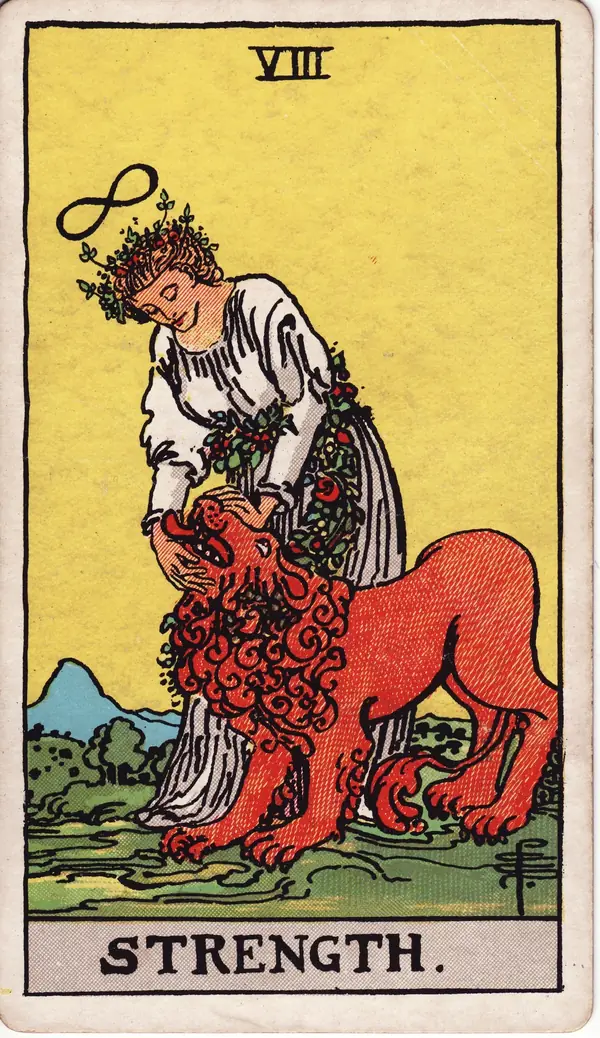
Strength is Major Arcana 8 in the Classic Tarot, placed after the Chariot and before the Hermit. The Chariot has just shown speed and forward drive; now the task changes. Instead of pressing harder, the card asks you to gather your energy and use it with care. Its element is usually given as fire, yet the scene is calm: a figure in white leans toward a lion under a bright yellow sky, one hand resting along the mane. The lion is not choked or beaten. It is soothed.
The core line is simple: not brute force, but patience that calms the beast. Strength is not a louder voice or a harder stance. It is staying steady while anger, desire, and fear are all present. Upright, that steadiness becomes gentle persistence. Turn it upside down and the same energy can appear as a short temper, low confidence, or the habit of forcing what needs time.
The card does not remove the difficulty in front of you. It asks a more useful question: can you keep your balance while it is happening? When Strength appears, name what the lion represents in your situation—a temper, an appetite, a fear, or a person who is hard to reach. Then the meanings below have somewhere real to land.
Strength Symbolism: What Each Detail on the Card Means
The leaning figure and her expression The woman tips forward a little, both hands settling near the lion's nose and mouth. The gesture is not a pin; it is closer to reassurance. Her face is calm, with none of the smugness of a victor. That posture turns force into negotiation: when you face your own temper, an appetite, or a stubborn person, you move closer first and guide second. Upright, this points to steady influence. Reversed, it can warn that closeness has become over-accommodation, or that "I have to keep you in line" has made everything tense.
Her hands and the lion's muzzle She carries no weapon and does not grab the animal by the throat. Instead she supports and closes its upper and lower jaws. The lion still has teeth and power; it has not been destroyed. The image treats instinct as something other than an enemy. What matters is whether it can be held with gentleness. Upright, this reads as emotion being acknowledged and then settling. Reversed, the grip goes slack and tight by turns: either impulse runs loose, or too much force is applied.
The white dress Her clothing is white and simply cut, a quiet contrast to the lion's gold. White suggests clarity, composure, and restraint. Real mastery starts with a clear self, not with a show of volume. Upright, the dress supports a "gentle but awake" kind of persistence. Reversed, white can become a cover for "nothing is wrong." The card then asks you not to perform calm until it turns into suppression.
The infinity symbol above her head A horizontal infinity sign floats above her. It links higher awareness with what the body is doing. Patience, the sign suggests, is not a single act but a choice repeated in a loop. Upright, that means long-term self-regulation. Reversed, the loop may be stuck: you circle the same emotion and call it endurance. The way out is a different response, not another round of gritting your teeth.
The lion The lion's mane is full and open, its head held lightly. It looks powerful, yet also a little loosened after being soothed. It stands for instinct, heat, desire, and courage, as well as for that difficult, short-tempered person outside you. Upright, you do not run from this force; you work with it. Reversed, it takes the lead. That may show up as rage, bravado, or a backlash after too long under wraps.
The wreath and plants Flowers wind around the figure, and green plants grow nearby. A wreath often belongs to completion and celebration, but here it is not a trophy for defeating an opponent. It is evidence that a relationship can still hold. Green brings peace, growth, and hope. Upright, soft methods create lasting change. Reversed, the card warns that if only the appearance of harmony remains, the thorns underneath have not gone anywhere.
The yellow sky and distant landscape Most of the background is a warm yellow, with hills far off and green ground underfoot. Yellow sits between heat and coolness, like reason in sunlight. The distant hills say this matter has a longer road ahead. Upright, the scene supports the endurance that comes from seeing the whole picture before acting. Reversed, the yellow can look too bright, all restless heat and bravado. You rush to prove yourself and stop noticing the distance.
Overall composition and number The figure is above and the lion below, yet neither is trampling the other; the two levels answer each other. The infinity sign lifts the relationship into awareness. The number is not the picture's main actor. Strength is card 8 in the order, and 8 stands for a mastery that can be put to practical use. Upright, a person guides instinct. Reversed, the human and animal have swapped places, and leadership must be recovered.
Strength Kabbalah and Tree of Life
Strength corresponds to the 19th path on the Tree of Life. Its Hebrew letter is Teth, whose shape is often read as "serpent." The path runs horizontally between the fourth sephirah, Chesed (Mercy), and the fifth, Geburah (Severity). Chesed sits on the right pillar and speaks of expansion, giving, and a stable order. Geburah sits on the left and speaks of force, cutting, conflict, and correction. Because the path crosses both pillars, it does not choose one side. It puts "I am willing to give" and "I dare to set a limit" on the same line.
Direction matters. In the classic tarot tradition, moving right to left contracts the current: mercy cannot be boundless, and giving has to pass through a cut. Moving left to right expands it: severity should not be only punishment, and strength must be able to become support. Extension and grounding belong to the downward vertical, but this path is horizontal. Its work is therefore the back-and-forth between the two sides, not a one-way push toward the ground.
This structure keeps the card from ending at "be gentle." In love, mercy alone turns into endless accommodation; severity alone turns into control. Strength asks for both at once: care about what the other person is going through, and say clearly where the line is. Work follows the same pattern. A manager can offer resources but still has to set standards and deadlines. Without one side, a team either drifts apart or becomes too afraid to speak.
In personal growth, the path asks a direct question: can you accept your own desires and still tell them, "This far"? The serpent fits that idea. It is not chopped off; it is seen and tamed. Astrology often links Strength with Leo. The lion's heat, dignity, and pride resemble the fire at the severity end. What soothes that fire is the generosity at the mercy end. Join the two, and you get the card's quiet, weighty steadiness.
Strength Numerology
Strength is number 8. In numerology, 8 is not reduced further, so unlike a two-digit card it does not fold into another Major Arcana figure. Eight is its own foundation, and the emphasis falls on a stage that is already formed and now needs management. The number is often described as knowing how systems work, valuing results and resources, and having a head for administration. It is not about charging ahead. It is about knowing where effort belongs and how to make it produce something real.
That fits this card. The figure does not beat the lion into submission; she finds its rhythm. Eight does not rely on enthusiasm alone either. It turns enthusiasm into force that can be directed. In love, the lesson of 8 is to tend the relationship: invest, but keep the long view. At work, it means coordinating people, resources, and timing instead of doing every task by main force. Lasting results come from sustained command of the situation, not one burst.
Someone whose Life Path number is 8 is often said to carry a similar temperament: goal-oriented, focused on outcomes, and not fond of looking weak. This card can serve as a mirror. You may be good at running a situation, but do not make "holding it together" your only option. Learning to distribute work, delegate, and rest brings you closer to the mature side of 8. This is a reference point, not a verdict.
The rhythm of 8 can also be read as a cycle of gathering and releasing. Holding back anger today does not mean swallowing it forever. Showing tolerance today does not mean giving up a principle. Take charge first, then act; steady yourself first, then move. That is closer to Strength than reading 8 as simple dominance.
What does Strength mean upright?
Upright, Strength brings self-control and courage into the same room. It does not mean you have no temper. It means you can pause half a beat and choose a better sentence. Picture a demanding client who keeps changing the brief. The upright response is not to flatter and not to slam the table, but to restate the facts, set the limit, and keep the door open. Gentle persistence travels farther than one dramatic confrontation. You may not solve everything today, but you stay in charge of your own conduct.
Strength reversed meaning
Reversed, Strength lives between two extremes: not holding back and holding on too long. One person loses their temper the moment they feel provoked, then regrets it all evening. Another keeps a calm face while resentment stacks up, until a small thing sets off a flood. The card can also point to low confidence—being capable but feeling unworthy, so you wear hardness like armor. Reversed is not a verdict of failure. It asks you to admit you are tired, govern what you still can, and stop forcing the rest.
Strength in love: single, in a relationship, reconciliation
In love, Strength is about soft power: staying warm without disappearing, and holding a boundary without turning it into a weapon. The card rarely describes a passive relationship. It describes two people with wills of their own who are learning how to meet. The upright side favors honest, steady communication; the reversed side warns that emotion may be driving the pace. Read the sections below with the actual history in mind.
Strength upright love
Upright in love, you are drawn to someone capable and self-possessed. That attraction is healthy as long as you do not shrink yourself to keep them. Real closeness means you can admire their strength and still keep your own footing. When you disagree, say what you need in plain language instead of sulking, testing, or giving in just to keep the peace. Warmth with a spine is attractive. Your kindness is a choice, not a strategy, and your limits give it weight.
Strength reversed love
Reversed in love, emotion often outruns judgment. You may know that checking a phone or sending a third message is a bad idea, and do it anyway. Or you swallow every discomfort to keep things smooth, then explode over something small. The real issue is usually not whether love exists, but who is setting the rhythm and whether both people feel safe enough to be honest. Before demanding an answer, look at the pattern. Are you reacting to the present, or to an old fear?
Strength love for singles
For a single person, Strength can show up as admiration that tilts into overinvestment. Someone is impressive, composed, and a little distant, and you find yourself trying harder to prove you are worth their attention. The card asks you to slow down. Consistent contact, clear interest, and a life that still belongs to you will tell you more than one grand gesture. If you are always guessing, waiting, or auditioning for love, treat that as information. Mutual respect should feel like ground beneath you, not a prize to earn.
Strength in a relationship
In an established relationship, Strength often appears during a rough patch rather than a honeymoon. One of you is stubborn; the other has a file of past grievances ready to open. The urge to win can feel urgent, but winning the argument may cost you the connection. Shift from "I need to prove I am right" to "how do we live with this?" State a boundary firmly without barbing it. Leave the room to cool off without using silence as punishment. The person who can regulate their own storm makes repair possible.
Strength and getting back with an ex
With an ex, Strength does not endorse chasing. It asks you to become steady before you decide whether to reach out. Sort through what actually ended the relationship, strip out the blame, and keep the honest need underneath. If you do make contact, one short, respectful message carries more weight than a stream of late-night texts. If they answer, rebuild trust slowly and discuss the pattern that broke. If they decline, stop. That is not defeat; it is self-control. Dignity matters more than the last word.
Strength as feelings: how they feel about you
When Strength lands in a position about the other person's thoughts, it often describes the atmosphere between you rather than a simple verdict on attraction. They may be noticing your composure, your warmth, or the pressure they feel around you. Upright and reversed point to different experiences: one feels steadying, the other feels tense. Keep the specific question in view, because the same card can describe deep respect or quiet avoidance.
Strength upright as feelings
Upright, they likely see you as someone with quiet resilience. You seem warm but not easily thrown, and that can be both attractive and a little intimidating. They may sense that you can see through charm, so they are less likely to play games. If they are moving slowly, it may be respect rather than indifference. They want to meet you as an equal, not manage you. The card suggests they take you seriously, even if they do not say so out loud.
Strength reversed as feelings
Reversed, they may feel that your emotions have been unpredictable lately, or that you say you are fine while clearly holding something back. They could also be projecting their own exhaustion: unable to face conflict, they retreat and call it space. Separate two possibilities. Are they distant because they do not care, or because they currently lack the capacity to show up? The card cannot settle that for you. It does suggest that the space between you is carrying tension, and guesswork will only make it heavier.
Strength as how someone sees you
As a mirror of how someone sees you, Strength shows a person who is composed under pressure. They may describe you as capable, dignified, and hard to rattle. There is a gentle quality to this impression, but not softness without substance; people sense that you will not be pushed around indefinitely. Some find that quietly impressive. Others feel slightly exposed, as if you can tell when they are pretending. You do not need to perform toughness. Your steadiness is already visible, even when you are not trying to prove anything.
Strength as intentions
As intentions, Strength is patient rather than possessive. The other person may want to earn your trust instead of rushing it, and they may hold back because they do not want to spoil something real. That can look like restraint, which is easy to misread as disinterest. Ask whether their actions are consistent over time. Reversed, the intention becomes muddier: fear, pride, or a need to control may be mixed in with genuine care. Watch how they respond when you set a boundary. Their reaction will tell you more than any declaration.
Strength career and work (upright & reversed)
At work, Strength points to handling demanding tasks without turning every difficulty into a personal war. It favors competence that is quiet, consistent, and durable. The card does not promise an effortless project or an immediate promotion; it describes the inner posture that makes progress possible. Upright, you pace yourself and keep your authority. Reversed, you may take on too much or hide uncertainty behind a hard front. In both cases, the practical question is the same: what can you actually control this week?
Strength upright career
Upright in career, you are suited to work that requires ownership and composure. In a job search, look toward roles where you can manage a process, calm a client, or steady a team. In an interview, tell one concrete story about a difficult situation you handled without losing your head; vague claims about passion land less well than specifics. On the job, break a messy project into stages, name risks early, and keep updates factual. If you are considering a move, check your motive. Growth is a strong reason; escape alone often carries the same problem to a new address.
Strength reversed career
Reversed in career, the danger is overcommitting and then refusing to admit it. You may accept work beyond your experience because you fear looking incapable, then stay late trying to cover the gap. Or a teammate drops the ball and you quietly absorb their tasks until you are resentful and exhausted. Short-term heroics can look responsible while damaging your work. Ask for help earlier. Negotiate deadlines with real information. Say what you can deliver and what you cannot. If the workload is unsustainable, document it and speak to the right person.
Strength for money and finances
With money, Strength is less about windfalls and more about managing appetite and risk. Upright, it favors living within your means, saving for a stated goal, and taking only risks you understand. You can delay a purchase without feeling deprived, and walk away from a deal that pressure is pushing you toward. Reversed, spending tends to follow emotion: comfort shopping after a hard day, jumping on a limited offer, or spending to prove you are fine. The card promises no wealth and gives no investment instructions. Ask: do you need this, or are you buying a feeling of control?
Strength for health
On health, Strength speaks to stress, rest, and daily rhythm rather than diagnosis. Long stretches of tension often show up first in sleep, shoulders, appetite, or a tight chest. Some people forget to rest when they are busy; others feel more anxious the moment they stop. Treat the body as a partner to care for, not a machine to override. Build in small recovery points: a walk, an earlier night, a pause between meetings. If a symptom persists or interferes with daily life, see a doctor. Tarot can remind you to pay attention; it cannot tell you what is wrong.
Strength as advice
The advice of Strength is to move your attention from controlling other people to steadying yourself. That shift is not passive. It takes courage to state a boundary calmly, to wait for a better moment, and to keep a promise to yourself when no one is watching. Upright, trust gentle persistence. Reversed, stop confusing tension with strength. Either way, the direction is the same: recover your center first, then deal with what is outside you.
Strength upright as advice
Upright as advice, keep going in a way you can sustain. Decline the request you cannot meet, and say it plainly. Prepare for the conversation instead of rehearsing the perfect comeback. End the arrangement that keeps draining you, even if the ending is awkward. Break the large goal into one action you can complete today. Your advantage is not overwhelming force; it is the impression that you mean what you say and will not be hurried into a worse decision. Courage looks ordinary here: a calm no, a kept promise, a next step repeated.
Strength reversed as advice
Reversed as advice, do not turn one bad reaction into a verdict on your character. You are not weak because you lost your temper or because you need help. Start with something small you can still govern: eat a real meal, take a walk, write down the tasks spinning in your head, apologize where an apology is owed. Then ask what you are actually afraid of—being rejected, being seen as incompetent, or being abandoned? Naming the fear reduces its grip. Reach out to someone steady. Strength returns through support and practice, not self-punishment.
Strength as a person
As a person, Strength describes someone with a soft exterior and a firm core. They listen before they respond, and they do not need to dominate a room to be taken seriously. Their kindness has limits; they will help, but they will not be endlessly used. A stubborn streak runs underneath the calm—once they commit, they can outlast almost anyone. They may seem gentle until a principle is tested, and then their resolve becomes clear. The card describes a tendency, not a fixed label. Real people move in and out of this posture.
Strength reversed as a person
Reversed as a person, Strength can point to someone who uses toughness as cover. They may be quick to snap, slow to apologize, and uncomfortable with vulnerability. Another version is the person who seems endlessly patient but keeps a private ledger of resentments. They give and give, then feel invisible when no one notices. Neither version is a villain. Both are protecting something tender. If this is you, practice saying "I am struggling" before you reach your limit. If it is someone else, respond to the fear underneath without accepting harmful behavior.
How to place it in a reading
Where Strength sits in a spread changes its work. In a past position, it can describe a period you survived through endurance or a moment when you held your temper under real pressure. In the present, it points to the lion in the room: a temper, a fear, or a difficult person. In the future, it suggests a process that rewards continued effort rather than one burst of force. In an advice position, read it as soft firmness. Its traditional astrological correspondence is Leo. Next to the Emperor, expect a test of wills; next to the Chariot, a reminder that speed needs a brake; next to the Hermit, a call to quiet reflection.
Our take
When Strength appears in a spread, do not rush to recite keywords. First look at how difficult its neighbors are. If it sits beside a Five or a Swords card, with their arguments, pressure, and cutting edges, Strength is usually not telling you to back down. It is giving you a firm hand for a tense room. Conflict is already here. Lower the heat, then discuss terms. The test is often "can you avoid making every sentence final?" The sharper the neighboring card, the more this should be read as patient de-escalation, not a contest to see who is loudest.
Next to a card from the Cups suit, Strength speaks more softly. Cups bring emotion, memory, and movement within a relationship. Here Strength looks like gentle care: receive what the other person is experiencing, then talk about what to do. It is not endless coaxing, and it is not carrying every emotion for them. It is offering a steady response while they are panicking. If there are too many Cups, watch for "comfort only, no limits." Gentleness needs a boundary to stand on.
In a personal-growth spread, Strength often lands in the advice position. These spreads ask not what someone else will do, but how you can adjust. The advice is usually to recover your center before dealing with the outer problem, and to move your attention from managing other people to the part you can answer for. If Strength falls in the obstacle position, look for overcontrol, white-knuckling, or swallowed anger. The surface may look steady while everything inside is pulled tighter.
You can use a Development, Obstacle, Advice spread, or Past, Present, Future. In the future position, Strength says the matter will take shape through continued investment. In the advice position of the other spread, it often needs a practical card beside it to bring it down to earth. Astrology links it with Leo, so it can act as a dignity thermometer: is the person respected and seen, or provoked into a fight over face? A nearby Sun or Wands card raises the heat; Swords warn against turning self-respect into a need to win.
Strength in Different Positions: Past, Present, Advice, Obstacle
Past The past position asks what shaped the present situation. Strength here often points to a stretch carried through patience: caring for someone hard to deal with, holding your temper under pressure, or finishing something alone when no one supported you. It explains why the person is now especially sensitive to conflict, or why they always yield first. Reversed in the past, it can show over-suppression, being forced to grow up too fast, or an outburst that was never handled well and still sends ripples forward.
Present The present position asks what is actually happening now. Strength here says the current task is to steady emotion, desire, or the pace of a relationship. Difficulty is real, but the answer is not a head-on collision. Upright, the person still has the lead. Reversed, the balance is off: maybe the temper is too hot, or maybe they have been holding on too long. The card asks them to admit "I am tight right now" before choosing a next step, instead of covering insecurity with a harder face.
Future The future position asks where the present direction leads. Strength in the future rarely means instant success. It means the matter enters a period of adjustment that rewards sustained effort. Upright, the situation becomes more manageable if the rhythm holds. Reversed, the same patience may run out, or impatience may force a repeat of the same cycle. Lengthen your expectations and do not judge the whole by one performance.
Advice The advice position asks how to respond. Strength here usually offers firmness with a soft surface: a gentle tone, a clear boundary; listen first, but do not agree to every request. Upright, the advice is workable because the person has the capacity to carry it out. Reversed, they need to restore energy and confidence first. Otherwise the "gentleness" turns into people-pleasing, and the "firmness" turns into a sulk.
Obstacle The obstacle position asks what is in the way. With Strength here, the block is often not an outside enemy but a tug-of-war with one's own instinct. Overcontrol can smother a relationship, or long suppression can send emotion looking for an exit. Reversed makes this especially clear: bravado, jealousy, fear of losing face, or the fixed idea "I have to win." The card suggests letting out that held breath before deciding what truly needs protecting.
Outcome / hint card The outcome position asks where things may land. Strength here usually means the situation closes in a way that can still be managed, rather than one side totally crushing the other. Upright leans toward stability through patience and boundaries. Reversed suggests a discounted result: the card is positive by nature, and reversal halves the benefit rather than turning it malicious. As a hint card, it is not a prediction. It tells you that self-control and persistence are the skills to practice next.
Strength Three-Card Example (Fictional Example)
Fictional example: The people and events below are invented and serve only to show how a reading might work.
Question: The querent has just been promoted to team lead and inherited a group with mixed experience and uneven cooperation. One person challenges assignments in public; another agrees in the meeting and drags afterward. He wants to establish authority but fears damaging relationships. He asks how to lead from here.
Spread: Development, Obstacle, Advice.
Cards and positions: Card 1, "Development," is Strength upright. Card 2, "Obstacle," is the Five of Swords upright. Card 3, "Advice," is the King of Pentacles upright.
Card 1, "Development": Strength upright. The development position shows where things are heading. Strength upright says the team can be led; it is not unmanageable. Trust, however, will take time. The querent's advantage is his ability to keep his emotions steady. He does not need to overpower everyone on day one. Several tests may follow: someone may deliberately push back just to see whether he loses control. If rules are clear and he does not rush to strike back, influence will build little by little. "Development" here is not a quick win. It is a shift from being tested to being accepted.
Card 2, "Obstacle": Five of Swords upright. The obstacle position names the real sticking point. The Five of Swords upright carries competition and internal friction. Someone on the team may turn discussion into a scoreboard, winning the argument while losing the cooperation. The querent may also be provoked into pulling rank. Swords belong to air: thinking is fast and words are sharp, but they leave cuts. If he keeps sorting out who is right in public, the team will only grow more guarded. The obstacle is not that the task is too hard. It is that everyone is fighting over who gets to decide.
Card 3, "Advice": King of Pentacles upright. The advice position offers something workable. The King of Pentacles upright values resources, rules, and concrete results. Turn vague expectations into clear assignments, deadlines, and checkpoints. Support people who are willing to work; deal with repeated delays through process rather than a burst of temper. The king also asks the querent to stand firmly in his own role as someone who provides resources, not someone who only makes speeches. Practical steps could include one-on-one conversations, clear priorities, and moving verbal promises into a shared table.
The story together and overall judgment. Only one Major Arcana card appears, which suggests the situation will be settled mainly through daily management, not a sudden turn of fate. Strength is fire, with Leo's heat and dignity. The Five of Swords is air, and it can turn that heat into argument. The King of Pentacles is earth, responsible for bringing the heat down to solid ground. The warm Strength and cool Five of Swords cross each other; earth has the final word, which means practical methods matter more than more emotion. No Cups means water is missing: the team may not be expressing emotion well. If the querent talks only about tasks, he will seem cold. If he tries only to be the nice guy, the Five of Swords will drag him into its contest. The overall judgment is that he can steady the team, but only if he stops playing public win-or-lose and replaces it with clear rules and steady support.
Advice for the querent. In the first week, hold one-on-one conversations and hear each person's real concerns about the division of work. Do not rush to settle who is right in a meeting. In the second week, put responsibilities, deadlines, and acceptance standards in writing, and explain the reasons for changes openly. With someone who challenges the rules, talk privately, give one chance to correct course, and state the consequences plainly. Each day, leave a little time to review: which sentence answered the problem, and which one only defended his pride? Strength does not mean swallowing anger. It means choosing a more effective response while angry. If someone is still undermining cooperation after a month, handle it through process. Do not confuse "leading the team" with "making everyone like me."
Common Misreadings of Strength
Misreading 1: Strength means endless yielding. The card does speak of gentleness, but gentleness is not the same as having no limit. The figure does not hit the lion and does not run from it. She touches it and guides it. If you read the card as "keep enduring," you make the suppression of the reversed card sound reasonable. Look for boundary cards in the spread. A nearby Swords card or the Emperor strengthens the case for stating the rules clearly, not asking the person to give in one more time.
Misreading 2: Reversed means complete failure or no strength. This site reads reversal as an excess of the upright energy or a current imbalance. A positive card reversed usually means the benefit is cut in half. A person with Strength reversed often still has ability; they are simply too tense, tired, or rushed in this moment. When it appears reversed, ask first where the effort has gone too far. Do not announce that the situation is hopeless. If it lands in the advice position, restore your condition before discussing method.
Misreading 3: Strength is a way to control another person. The picture is not an animal show, and the lion is not chained. Treating Strength as "how to make someone obey" turns the reading into manipulation. In love, it can become checking a phone or demanding a declaration. The better view is to manage your own reactions first, then influence the relationship. If Strength appears with the Five of Swords, be especially careful not to turn the conversation into a contest.
Misreading 4: A strong person should never ask for help. The opposite is closer to the truth. Being able to admit you need support shows that pride has not tied your hands. Reversed Strength often shows up in someone who is white-knuckling a heavy load and refuses to divide it. If a Pentacles card sits beside Strength, make "asking for help" concrete: resources, budget, or staff. Do not reduce it to emotional reassurance.
Misreading 5: Strength is only for love questions. It appears just as often in work, study, health, and personal growth, with different details in each setting. Work looks at management and execution; study at endurance and anxiety; health at routine and stress. Applying "gentle persistence" to every background erases the specifics. First establish what the position is asking, then see what the card says in that setting.
Misreading 6: The lion must mean an affair or an enemy. The lion is closer to instinct and untamed force. It may be a temper, a desire, a fear, or a difficult boss or family member. Jumping straight to "third party" creates unnecessary fear. Look at the cards around the lion and at the context of the question. In a relationship reading, ask first whether it points to an unspoken conflict between the two people. Do not draw a conclusion from an animal image alone.

FAQ
These are the questions readers ask most often about Strength. A single card offers a perspective, not a substitute for context, communication, or practical judgment. The same card can read differently depending on whether it is upright or reversed, where it sits in the spread, and which cards surround it. The answers below follow the site's existing grading. For decisions with real consequences, combine the reading with facts and, where needed, professional advice.
Is Strength a yes or no card?
Yes. In our grading, Strength leans yes, and upright it is fairly clear. It is not an automatic yes that removes effort. The card says the situation can move in your favor when you stay patient and keep your conduct in hand. Upright, you are more likely to communicate well, hold your position, and let a tense moment pass without making it worse. Reversed, the yes is softer. Something in the situation needs to be settled first—usually your own frustration, confidence, or habit of forcing. If the question has a deadline, the practical conditions still matter. Strength supports a yes; it does not override reality.
What does Strength reversed mean in a yes or no reading?
It still leans yes, but with a condition: settle the frustration or self-doubt before you push. Reversed does not flip the card into a no. It shows resistance that is partly internal. You may be rushing, taking a rejection personally, or trying to control a person instead of addressing the actual problem. Once you lower the emotional temperature, the path often becomes clearer. If the question is about whether to act now, the answer may be "not yet" rather than "never." Wait until you can speak or decide without needing to win. Then the underlying yes has room to show itself.
What does Strength mean if you have a secret crush?
It suggests quiet interest and a slow approach, not a confession blurted out in a burst of nerves. The card favors steadiness over performance. You do not need to manufacture reasons to appear, and you do not need to test their attention with jealousy or silence. Let conversation build naturally. Notice whether they meet you with consistency and respect. If you are doing all the reaching, that is worth seeing clearly. Strength also asks you to keep your own life warm and full, so the connection is a choice rather than a lifeline. When the moment comes, honesty delivered calmly will sound more like you than a rehearsed speech.
What does Strength mean for marriage?
It leans toward workable, provided both people practice equality and honest boundaries. The card is not a guarantee and not a warning that the relationship is doomed. It asks how the two of you handle friction. Can you disagree without one person crushing the other? Can the quieter partner say what they need before resentment hardens? Upright, there is real capacity for patience and repair. Reversed, watch for long-term suppression, control disguised as care, or one person carrying all the emotional labor. Marriage is not won by endurance alone. It is maintained by two people who can be strong without becoming rigid.
What does Strength mean as an outcome?
A favorable outcome that arrives through steady effort rather than a sudden stroke of luck. The card suggests you will look back and see that progress came from repeated small choices: the conversation you did not avoid, the boundary you finally set, the break you took before you burned out. It is a good outcome, but it may not feel dramatic when it arrives. Upright, you are likely to have the inner resources to see it through. Reversed, the outcome still has potential, but it depends on addressing the weak point—usually impatience or a confidence problem. Do not confuse a quiet result with a disappointing one.
What timing does Strength suggest?
No fixed date. Strength points to steady progress, often measured in weeks or a season, not hours. This is not a card of instant results. It describes a process that gains momentum through consistency, so the timing depends heavily on how quickly you can stabilize your own energy and follow through. Its traditional link to Leo sometimes places the theme in late summer, but that is a symbolic correspondence, not a schedule. If you are waiting for a decision, watch for a period when the emotional weather settles. If you are building something, expect the timeline to reflect the work you put in.
Does Strength mean pregnancy?
It does not confirm or rule out pregnancy. Take a test and speak with a doctor for a clear answer. The card is about patience, care, and self-control, not a medical result. Some readers associate it with the body's endurance or with a gentle approach to health, but that is far too general to answer a pregnancy question. If you are trying to conceive, the useful message is to support your rest, reduce stress where you can, and follow medical guidance. If you are worried about a possible pregnancy, do not rely on a card. Use a reliable test and seek professional advice. Tarot should not be used to make a health decision.
What zodiac sign is Strength?
Leo. The traditional astrological correspondence is Leo, the fire sign ruled by the Sun. That fits the imagery: warmth, pride, a lion, and the challenge of governing raw energy without killing its spirit. Leo is often associated with courage, generosity, and a need for dignity, all of which appear in Strength's better expressions. The shadow side is ego, stubbornness, and reacting badly to being challenged. You do not need to know astrology to read the card, but the Leo link can add a useful layer when you are thinking about temperament and timing.
Is Strength a good or bad card?
Good-leaning, though it asks for patience and self-control before it feels good. Upright, it suggests you have what it takes to handle a hard situation without losing yourself. That is a positive position, even if the process is demanding. Reversed, the card is not a disaster. It points to a temporary imbalance: a short fuse, shaky confidence, or the strain of holding too much. Think of it as a signal to adjust rather than a sentence. The card's promise is practical. When you govern your own reaction, you keep more options open, and more options usually mean a better outcome.
Related cards
Strength gains nuance from the cards around it. Read these as angles of the same situation, not as fixed definitions. A card that emphasizes control can show where a power struggle is forming; a card that emphasizes balance or repair can show what helps. The short notes below are starting points. The full picture still depends on the question, the position, and the rest of the spread.
- The Emperor: Both care about control, but the Emperor leans on structure and authority while Strength works through inner regulation, so together they can signal a standoff between two strong wills.
- The Chariot: The Chariot moves by force of will, and Strength arrives to remind you that momentum needs a brake before it becomes recklessness.
- The Hermit: The Hermit turns inward, and beside Strength it suggests that quiet reflection will reveal what the lion in your situation actually represents.
- Temperance: Both cards value balance, but Temperance focuses on blending and rhythm while Strength focuses on holding your ground under pressure.
- The Star: The Star brings hope and recovery, and with Strength it often points to trust rebuilt slowly through consistent, gentle effort.
- The Magician: The Magician favors initiative, and Strength adds the reminder that acting first is not the same as acting wisely.