Ace of Swords (1 of Swords) Meaning: Reversed, Love, as Feelings, Yes or No

Draw a Classic Tarot spread →Free, no sign-up. Think of your question, then draw.
In one line: A sword piercing a crown: suddenly your mind is clear.
| Keywords | |
|---|---|
| Upright | clarity, truth, decisiveness |
| Reversed | muddled thinking, harsh words |
| Type | Swords · air |
| Yes/no (our grading) | leans yes |
Quick answers: yes/no · love · career
- Yes/No: Under our grading, Ace of Swords leans yes. Yes/no is the least reliable use of tarot—prefer “how should I approach this?”.
- Love: Speaking openly makes things transparent; reversed, words that wound.
- Career: Clear decisions, breakthroughs; reversed, misjudgment.
*FateClear Editorial Team*
Want to draw a Classic Tarot spread? Draw cards.
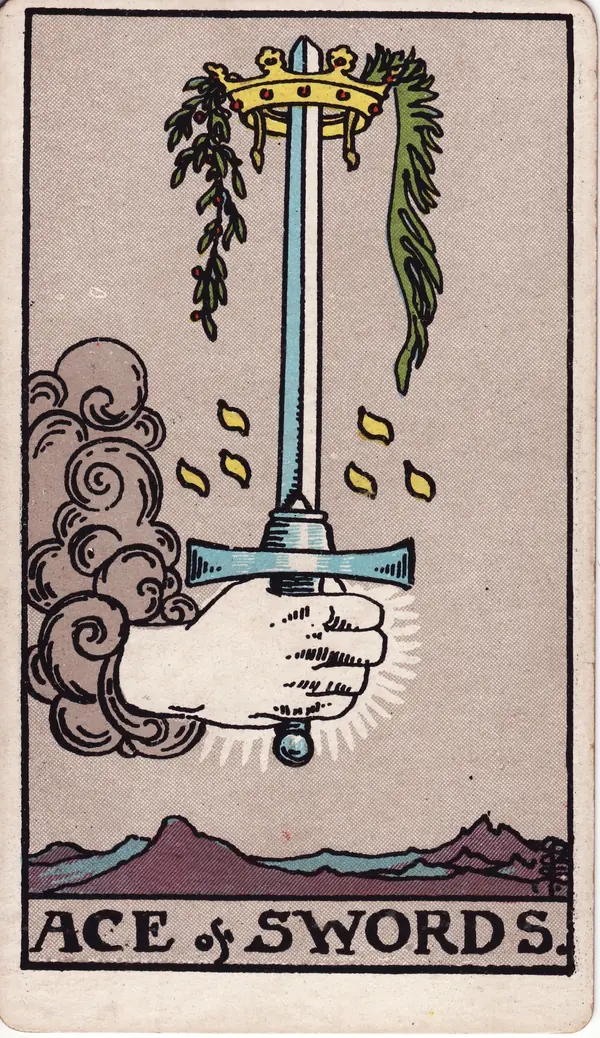
In the Classic Tarot, the Ace of Swords opens the suit of Swords. Its type is Swords · air, and its number is one, the instant before a thought becomes a plan. A hand emerges from a cloud and grips an upright blade; the tip lifts a crown, while olive and palm branches hang on either side. The scene is spare, yet it holds a beginning and a moment of seeing in the same breath.
You will also find it written as 1 of Swords, which is a useful reminder of its role. Aces are starting points, and this one begins with air: perception, language, and judgment. Its one-line meaning is simple: A sword piercing a crown: suddenly your mind is clear. The upright keywords are clarity, truth, and decisiveness; in reverse, they shift toward muddled thinking and harsh words.
In the Tree of Life, the Ace of Swords is often linked with Kether, the crown, where possibility has not yet split into details. In everyday terms, that is the second before you name what is wrong or finally admit what you want. When the card arrives in reverse, the same insight can feel blocked by fear, noise, or poor timing. Either way, it asks a practical question: will you face what you now see, and will you act with care?
Ace of Swords Kabbalah and Tree of Life
The Ace of Swords is a minor card, so on the Tree of Life it is traced through its number and suit rather than through a path number, the way a major card is. Its number is one, and it sits in Kether (the Crown), the first sephirah on the middle pillar, where energy has not yet separated into distinct forms. That is the pure starting point. The suit is Swords, the element of air, and it works through Yetzirah, the world of Formation, one of the four worlds. Read the two layers together: Kether gives this beginning its quality—an original insight with no shape yet—while Yetzirah shows the level it operates on, in thought, language, and judgment before anything tangible exists. The card therefore does not mean the matter is settled. It means you see it first.
Fictional example: A person has just realized that they and their partner keep avoiding the same subject, but they have not decided how to bring it up. Kether is the fresh judgment; Yetzirah shows that it is still only a thought and a possible wording. Do not confuse “I know what I think” with “my partner understands.” The same gap can appear at work when a plan has a clear direction but the resources and execution are not ready. Write out the core idea and confirm the key facts before you promise a result. In personal growth, you may finally name an old pattern while the new habit is barely formed. Seeing it matters, but it takes repetition before it shapes daily life.
If you treat the purity of Kether as a command to act immediately, you will rush. If you stay only in Yetzirah, you will think much more than you do. When reversed, the source is not necessarily dark; the trouble is more likely blocked expression or missing information. Astrologically, this card is often placed at the source of air and linked with Libra, Aquarius, and Gemini. That fits the Crown as a starting point and Formation as the realm of thought: a clear idea comes first, and choice and expression can follow.
Ace of Swords Numerology
The Ace of Swords carries the number one. In the minor cards, numbers can be read as stages of a developing situation, and one marks the start of something new: a direction has appeared, the outline is still rough, but it is enough to take a first step. Paired with air, this is not a vague fresh start. It is a distinct thought, a judgment, or a sentence that finally gets said. Numerology also treats one as the first push from nothing into something: establish a position before you try to expand it. It does not need a second person the way two does, and it is not in a hurry to branch outward the way three is.
One has an independent, opinionated nature and a willingness to charge first. Picture a pole standing straight up: it holds its own ground and is not afraid to move first. That suits the sharpness of the Ace of Swords, which does not wait for someone else to supply the answer. It forms a view. The matching major card is the Magician. The Magician also stands at a beginning and stresses turning an idea into action and using the tools at hand. The Ace is closer to the flash of insight before the sword is swung: see clearly, then decide how to move. Set side by side, one card emphasizes initiation and integration, while the other emphasizes discernment and expression. In daily life, the lesson of one is less about capability than about the courage to stand up and answer for your own judgment.
In numerology, a Life Path number of one also carries initiative and self-direction. For someone with that number, the Ace of Swords can be a reminder that independent judgment is a strength, but “I’ll handle it myself” should not become a refusal to listen. The card can support starting a plan or stating a position, and it also asks you to check that your information is complete before you charge ahead. Treat this as a prompt for reflection; the spread and the actual situation still set the terms.
Ace of Swords and the Element of Air
The Ace of Swords is an air card. Air governs thought, language, judgment, and the exchange of information, and there is a tautness to it: the mind moves fast, words come out direct, and stress collects around the head. In this card, air is not a loose breeze. It is a focused current that blows away vagueness and exposes the shape of a problem. That is why it often shows up as one frank explanation, one decision, or a sudden moment of understanding. Cups tend to feel first and Pentacles tend to build first; this card lights up the concept first.
Elements support or rub against one another. Fire and air readily feed each other: action gains support from ideas, and ideas find ground through action. Water and earth are comparatively steady, allowing feeling and practical reality to hold each other. Fire and water tend to clash; enthusiasm meets emotion and the result is often fog before it is anything else. When the Ace of Swords appears with Wands, clarity is likely to lead somewhere. With Cups, watch for a conversation where you win the point and lose the feeling. Air does not generate fuel on its own. It needs fire to drive it and water to soften it, or it can turn into thoughts that spin without landing.
When a spread holds many Swords, the theme usually involves worry, communication, and pressure. A person may analyze the same issue repeatedly or begin to speak more sharply. In love, this can be the moment a long-avoided subject is finally put on the table. At work, it may mean checking information again and making responsibilities explicit. In personal growth, it may be the recognition that a particular thought has been draining you. Air can bring clarity, but too much of it can disturb sleep and make stillness difficult. Once you see the issue, leave some breathing room for your body and emotions. If many Swords appear alongside reversals, people often have plenty of thoughts but cannot gather them; the more they debate, the more scattered it becomes. Writing the points as a list will usually help more than another round of argument.
What does Ace of Swords mean upright?
Upright, the Ace of Swords is about mental clearance. Something that felt tangled begins to make sense, and you can name the real issue instead of circling it. This is the card of the honest conversation, the decisive application, the boundary stated once and clearly. It favors decisions made after you have gathered enough facts, not endless rehearsal.
The clarity it brings can feel bracing. You may realize a job has no future, a friend has been unreliable, or a relationship keeps asking you to shrink. The point is not to become cold. The point is to stop pretending that confusion is protection. A clean answer often costs something, but it also returns your energy. Expect relief mixed with nerves, and take the next step anyway.
Ace of Swords reversed meaning
Reversed, the Ace of Swords describes clarity under pressure. The thoughts are there, but they arrive out of order. You might rehearse a conversation for hours and then say the one sentence that wounds. Or you might stay silent while guesses harden into facts. Information can be missing, timing can be off, and the urge to settle everything now can make the mess worse.
This is not a doom card. More often it says the blade is being used before the hand is steady. Before you push for an answer, separate what you know from what you fear. Slow the exchange. Ask one precise question. If you cannot be clear and kind at the same time, wait until you can.
Ace of Swords in love: single, in a relationship, reconciliation
In love, the Ace of Swords rarely announces soft romance. It announces a moment of honesty. You may finally understand what a pattern means, or you may need to say something you have been polishing for weeks. The card does not promise that honesty will feel tender. It promises that honesty will show you where the relationship actually stands, which is more useful than another month of guessing.
Ace of Swords upright love
Upright in love, this Ace favors directness with a warm heart. A conversation can clear away assumptions, and a clear boundary can protect affection rather than damage it. If you are dating, pay attention to whether words and actions match. If you are committed, this is a good time to discuss a practical issue without dragging in every past grievance.
The risk is turning a needed talk into a cross-examination. State what you observed, how it landed, and what you need next. Leave room for a real response. Clarity is not the same as winning. When both people leave the conversation knowing the truth, the card has done its job.
Ace of Swords reversed love
Reversed in love, the problem is often translation. You know what you feel, but it comes out as blame, sarcasm, or silence. Your partner hears the edge and misses the need underneath. Meanwhile, you may be filling in gaps with stories rather than asking. Small misunderstandings grow heavy when nobody checks the facts.
Repair starts with fewer words and more precision. Replace “you always” with what happened this time. Ask whether you understood correctly before you defend yourself. Avoid making a permanent decision during a spike of anger. If the same argument keeps returning, the issue is not the topic; it is the way both of you handle confusion. Get clear before you get loud.
Ace of Swords love for singles
For singles, the Ace of Swords is a reality check disguised as a fresh start. You may stop chasing mixed signals and start noticing consistency. A new person could catch your attention because the conversation is sharp and honest, though the spark may feel more mental than dreamy. That is not a bad sign; attraction can grow from respect.
Keep your standards without turning them into a wall. Ask direct questions and watch what happens. Someone who is genuinely interested can handle clarity. Someone who needs you to stay confused is giving you useful information. Let truth, not fantasy, decide whether this person earns more of your time.
Ace of Swords in a relationship
In an established relationship, the Ace of Swords often brings a necessary conversation about money, chores, family, or the future. The subject may be ordinary, but the underlying question is larger: are we willing to tell each other the truth? A calm, specific talk can reset the tone for weeks.
Do not use the card as permission to be cruel. Honesty without tact is just another way of leaving the room. Name the problem, own your part, and propose one change you can both test. If the talk becomes a contest of logic, pause and return to the actual need. Relationships grow when truth is paired with repair.
Ace of Swords and getting back with an ex
With an ex, the Ace of Swords asks whether anything has actually changed. Missing someone is not the same as being ready to rebuild. The card favors an honest review: what broke, what each person contributed, and what would need to be different this time. Without that review, a reunion is often just nostalgia with better lighting.
If you reach out, keep it clean and specific. Say what you want to discuss and why. Do not use a casual message to test whether they will chase you. If they avoid the real subject, treat that as an answer. Reconciliation is possible, but it needs new understanding, not just old feelings.
Ace of Swords as feelings: how they feel about you
When the Ace of Swords appears in the “feelings” position, it points to a mental and evaluative tone. Someone may be thinking carefully about you, noticing details, and forming a conclusion. This does not automatically mean warmth or commitment. It means their head is engaged, and their assessment matters to how they move next. They may be trying to decide what you mean to them, rather than simply enjoying the moment.
Ace of Swords upright as feelings
Upright, they feel clear about you. They see your strengths and your limits, and they are less interested in playing games. Their affection may show up as direct communication, practical help, or a willingness to define things. If they have been distant, this can mark the point where they stop avoiding a decision.
The feeling is not necessarily soft, but it is real. They may respect you enough to tell you the truth even when it is awkward. Do not mistake steadiness for a lack of emotion. Ask yourself whether you want someone who sees you accurately. With this card, being understood clearly is part of the connection.
Ace of Swords reversed as feelings
Reversed, their feelings are harder to read because they are harder for them to read. They may care and still sound dismissive. They may want to move closer but keep choosing defensive language. Their thoughts could be caught between old hurt, current attraction, and fear of saying the wrong thing.
This is a state of static, not necessarily a lack of feeling. Give them room to sort it out, but do not become the interpreter of every mixed message. Look for a pattern of actions over time. If they cannot offer clarity after a fair chance, you are allowed to stop waiting for a perfect explanation.
Ace of Swords as how someone sees you
As how someone sees you, the Ace of Swords says they view you as sharp, candid, and mentally awake. They may admire your ability to cut through nonsense, and they may also feel slightly challenged by it. You probably do not strike them as passive or easily led.
That can be attractive, but it can also make them cautious. They might wonder whether you are judging them or whether they can keep up. If you want to soften the picture, let them see your curiosity as well as your precision. Ask questions. Let them be smart too. The card shows respect; intimacy grows when respect has room to breathe.
Ace of Swords as intentions
Their intention is to get to the truth. Upright, they want a conversation that settles something, not another round of vague reassurance. They may intend to state a boundary, ask a direct question, or make a decision they have been postponing. Reversed, the intention is there but the delivery is unreliable.
Do not assume every direct move is hostile. Sometimes someone is trying to be honest and simply lacks finesse. Watch whether they follow through. An intention to be clear becomes trustworthy when it is repeated in action, especially when the topic is uncomfortable. Words open the door; behavior tells you whether they meant it.
Ace of Swords career and work (upright & reversed)
At work, the Ace of Swords is a card of diagnosis and decision. It favors the moment you stop describing the problem and start naming the next step. That could mean revising a proposal, asking for a raise with evidence, or leaving a role that has quietly become a dead end. The air element here is not abstract; it shows up in emails, meetings, plans, and the words you choose.
Ace of Swords upright career
Upright, your thinking is an asset. You can spot the flaw in a process, explain it plainly, and propose a workable fix. This is a good time to prepare for an interview, present a plan, or have the conversation you have been avoiding with a manager. Be concrete. People are more likely to trust a clear argument than a long list of worries.
Momentum favors action, but not recklessness. Check your facts before you send the message. Ask what success would look like, then measure the choice against it. If a new opportunity appears, ask the questions that matter: scope, support, pay, and expectations. Clear terms now prevent resentment later.
Ace of Swords reversed career
Reversed, the workplace risk is haste. You may be so tired of the current situation that any exit looks like relief. Do not confuse escape with strategy. Read the contract, confirm the details, and wait for the missing information before you resign or accept. A vague promise from a manager is not the same as a written plan.
Communication also needs care. Tone in a message can travel further than you intend. Put important agreements in writing and keep a record of decisions. If a team is blaming each other, protect your work and seek advice before you confront anyone. The card asks for patience while the picture sharpens.
Ace of Swords for money and finances
With money, the Ace of Swords is about seeing the numbers plainly. It supports organizing accounts, reading the fine print, and asking direct questions about fees, splits, or repayment. This is not a promise of sudden wealth, and it is not a signal to take a bold financial gamble. Its gift is accuracy.
Upright, you can cut through a confusing arrangement and make a practical budget. Reversed, you may be avoiding a statement or trusting a pitch that sounds too easy. Slow down. List what you owe, what you earn, and what you can safely set aside. If a decision involves real risk, get independent advice and read before you sign. Clarity is the win here, not a guaranteed return.
Ace of Swords for health
On health, the Ace of Swords speaks to the nervous system and the pace of your thoughts. It often appears when you have been overthinking, sleeping poorly, or holding tension in your jaw and shoulders. The card invites you to notice the body’s signals without turning them into a diagnosis.
Upright, it can support a practical reset: a steadier bedtime, fewer screens late at night, a short walk, or writing down the tasks that keep circling. Reversed, stress may be making it hard to rest, and you may be pushing through fatigue. If discomfort continues or worsens, see a doctor. This page cannot diagnose or cure anything, and pregnancy questions need professional guidance rather than a card reading.
Ace of Swords as advice
The Ace of Swords gives advice in two directions. Upright, it asks you to cut through what is false. Reversed, it asks you to put the blade down until your hand is steady. The difference is timing. Truth is not an excuse to be careless, and patience is not an excuse to avoid a decision forever. The card wants both courage and aim.
Ace of Swords upright as advice
Say the true thing, but choose the useful version of it. Write down the facts, your feelings, and the request you need to make. Then have the conversation or make the choice. Do not wait for perfect certainty; wait only until you know enough to act without guessing.
Aim the sword at the problem. If you are dealing with a person, separate their behavior from their worth. Be direct about the impact, not cruel about the character. Set a deadline for your decision if you tend to circle. Clarity becomes confidence after you take one honest step.
Ace of Swords reversed as advice
Pause before you speak or sign. The Ace reversed suggests that something important is missing, or that emotion is doing the talking. Give yourself a night before sending the message, ending the relationship, or quitting the job. Use the pause to check facts, not to build a stronger case against someone.
If you have already said too much, repair it. Apologize for the delivery without abandoning the point. Ask what the other person heard. If they refuse to engage, stop performing clarity for an audience that will not listen. Step back, gather yourself, and return when your words can match your intention.
Ace of Swords as a person
As a person, the Ace of Swords describes someone with a quick mind and a low tolerance for pretense. They speak directly, value evidence, and often see the weak point in an argument before others have finished. They can be stimulating company and a formidable problem-solver.
Their shadow is impatience. They may mistake honesty for permission to be blunt, or confuse being right with being helpful. They usually respect people who can hold their own and dislike emotional fog. If this card represents someone in your life, expect them to show care through advice, honesty, and action more than through sentiment.
Ace of Swords reversed as a person
Reversed, this person may be sharp without aim. They could be scattered, defensive, or prone to saying the thing that ends a conversation rather than opens one. They might also be someone whose confidence hides confusion; they argue hard because they are not sure what they actually think.
Do not take every harsh word as a final verdict on you. At the same time, do not keep volunteering for the blade. Set a boundary about tone. If they can hear it and adjust, there is room to talk. If they turn the boundary into another attack, believe the pattern. Clarity includes knowing when to step back.
How to place it in a reading
In a spread, the Ace of Swords can mark a new understanding, a decision point, or a truth that will not stay buried. Its position matters. In the past, it may show a moment when you saw something clearly but did not act. In the present, it asks what you are refusing to name. In the future, it suggests a conversation or choice that brings the situation into focus.
Nearby cards show the cost and method. A Two of Swords can reveal a choice you avoid; a Three of Swords can show words that landed badly. Several Swords increase mental activity and overanalysis. A major card may make the decision echo through a larger life chapter.
Our take
Our take is simple: the Ace's clarity is sharp; use it on the problem, not the person. This card is genuinely helpful when you need to stop pretending, but it can tempt you to turn honesty into a weapon. The healthiest reading keeps both truths in view: you are allowed to see clearly, and you are responsible for how you deliver what you see.
Do not treat it as a bad omen. Treat it as a clean tool. Name the issue, ask the honest question, and make the decision you have been postponing. Then leave room for the other person to respond. The Ace works best when truth is paired with aim.

FAQ
These are the questions readers ask most often about this card. Each answer starts with the short version, then explains how to apply it without turning the card into a fixed verdict. Use these responses as starting points for your own reading, not as replacements for context, other cards, or your own judgment. Take what fits and leave the rest.
Is Ace of Swords a yes or no card?
It leans yes. The Ace of Swords generally supports moving forward, especially when you have enough information and are willing to be direct. It is not a promise of an easy outcome, only a favorable tilt toward a clear decision. If the question involves a conversation, this card suggests having it. If it involves a choice, gather the facts and act. The yes is strongest when honesty, not impulse, is leading.
What does Ace of Swords reversed mean in a yes or no reading?
It still leans yes, but with a caveat: clarify the facts and timing before you act. The reversed Ace does not usually flip the answer to no. It suggests that the path is there but the message, information, or emotional temperature is off. Acting now could create avoidable friction. Slow the process down, ask one more question, and check what you may be assuming. If the missing piece appears, the yes becomes steadier. If the other party keeps avoiding clarity, that avoidance is your answer.
What does Ace of Swords mean if you have a secret crush?
It means you are starting to see the situation clearly, and you should trust actions over hopeful guesses. With a secret crush, this card often arrives when the fantasy is thinning. You may notice that their signals are inconsistent or that you have been explaining away their distance. That can sting, but it is useful. Ask yourself what you actually know, not what you hope. If you want more information, make one low-pressure, specific move and observe the response. Do not build a relationship in your head while the real one stays unspoken.
What does Ace of Swords mean for marriage?
It points to an honest conversation about the practical realities of marriage, not an automatic yes or no. The Ace of Swords can show a proposal, a serious discussion, or a moment when both people need to state what they want. It favors clarity about money, family, living arrangements, and expectations. Those topics are not unromantic; they are how love becomes a shared life. The card does not predict whether you will marry. It asks you to bring facts and feelings into the same room. If the conversation strengthens trust, that is meaningful. If it reveals a fundamental mismatch, that is meaningful too.
What does Ace of Swords mean as an outcome?
As an outcome, it suggests a clear resolution or a truth that changes your next move. You can expect the fog to lift in some area, even if the answer is not the one you wanted. A decision may be made, a conversation may finally happen, or you may simply stop tolerating ambiguity. The outcome is less about a perfect result than about regained mental footing. You will know where you stand and what to do next. That is often the most valuable kind of ending, because it gives you a real beginning.
What timing does Ace of Swords suggest?
There is no fixed timing; it often suggests days to a few weeks, or the moment a key fact becomes clear. The Ace is a beginning, so it tends to move faster than slower cards. Still, timing in tarot is not a schedule. Watch for a conversation, message, or realization that sharpens the issue. If you need a practical marker, look to the next time you must make a decision. The card is less interested in a date than in readiness. Clarity is the trigger; once it arrives, the timeline usually shortens.
Does Ace of Swords mean pregnancy?
No. This card speaks to mental clarity, not pregnancy, so it cannot confirm or rule it out. The Ace of Swords is associated with air, thought, and communication. It has no reliable connection to fertility or pregnancy. Anyone can draw it for any reason, so it should not be read as a yes or no about conception. If you are trying to conceive or think you may be pregnant, use a medical test and speak with a doctor. A tarot card is not a diagnosis, and this page does not offer one.
What zodiac sign is Ace of Swords?
Traditionally, it is linked with the root of air, covering Libra, Aquarius, and Gemini. This correspondence comes from the card’s element rather than a single zodiac sign. Air governs thought, language, and perspective, so all three signs can reflect the Ace’s mental energy in different ways. Libra brings balance and fair judgment, Aquarius brings invention and distance, and Gemini brings curiosity and quick exchange. Use these as flavors, not fixed rules. The surrounding cards and the question will tell you which one is most relevant.
Is Ace of Swords a good or bad card?
It is best read as neutral to positive; the outcome depends on how you use the clarity. The Ace of Swords is not a lucky charm, and it is not a curse. It gives you a sharp tool: the ability to see and name what is real. Used with care, it can end confusion and open a path. Used carelessly, it can wound. Ask whether you are aiming at the problem or at a person. If you can stay honest without becoming cruel, the card leans helpful. If you are using truth as a weapon, the same energy can cost you more than it gives.
Related cards
- Two of Swords: continues the theme of choice, but adds stalemate and avoidance.
- Three of Swords: shows what happens when sharp words and hard truths land in the heart.
- Page of Swords: brings the Ace's curiosity into a younger, more experimental energy.
- King of Swords: turns the Ace's insight into steady judgment and ethical authority.
- The Magician: shares the “begin now” charge, but works through resourcefulness and will.
- The Fool: offers another starting point, one guided by instinct rather than clear analysis.