Two of Swords (2 of Swords) Meaning: Reversed, Love, as Feelings, Yes or No

Draw a Classic Tarot spread →Free, no sign-up. Think of your question, then draw.
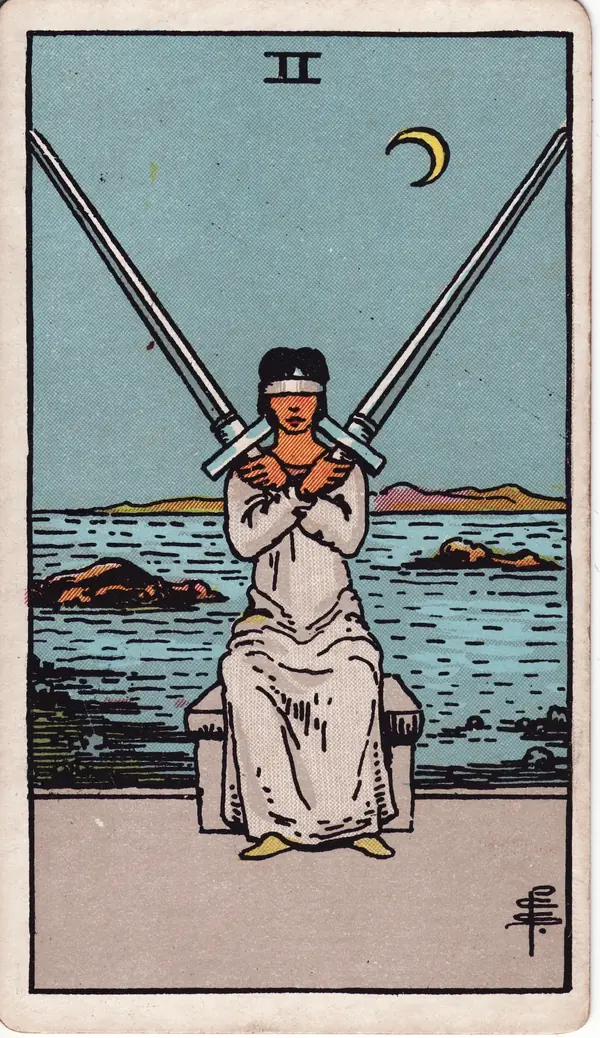
In one line: Blindfolded with crossed swords—not looking, not moving.
| Keywords | |
|---|---|
| Upright | stalemate, avoidance, not choosing yet |
| Reversed | information surfaces, forced choice |
| Type | Swords · air |
| Yes/no (our grading) | leans no |
Quick answers: yes/no · love · career
- Yes/No: Under our grading, Two of Swords leans no. Yes/no is the least reliable use of tarot—prefer “how should I approach this?”.
- Love: A dilemma or cold war; reversed, finally having to face it.
- Career: Putting off the decision; reversed, new facts force a side.
*FateClear Editorial Team*
Want to draw a Classic Tarot spread? Draw cards.
The Two of Swords is the second card in the suit of Swords in the Classic Tarot. Swords belong to air, the element of thought, language, and judgment, and the number two brings two sides into view at once. This is rarely a card of outward battle. More often it shows an inner standoff: two truths, two risks, or two people waiting for the other to move first. It is also written "2 of Swords."
The image is memorable. A seated figure wears a blindfold and holds two swords crossed over the chest. Behind the figure, the water stays calm. The pose looks composed, almost protected, yet it is also a pose of refusal. The one-line meaning is simple: blindfolded with crossed swords—not looking, not moving.
Upright, the card points to stalemate, avoidance, and the choice not to choose yet. When it appears upside down, or in reverse, the blindfold begins to slip: information surfaces and a decision is forced. Neither position is a verdict. The card shows where your attention is stuck and asks what would change if you looked.
Two of Swords Kabbalah and Tree of Life
The Two of Swords is a Minor Arcana card, so on the Tree of Life we look to its number and suit rather than to a path. The number two belongs to the second sephirah, Chokmah (Wisdom), the first impulse and the masculine driving force; it sits on the right-hand Pillar of Mercy. The suit of Swords belongs to Yetzirah, the world of Formation, which is the plane of air. Read the two lines together: the sephirah tells you the nature of the step, while the world tells you the level on which it happens. Fire is will and action, water is emotion, air is thought, earth is physical reality and matter. The card’s structure is therefore clear: an impulse that has not yet taken shape is stalled in the mental plane, being weighed over and over.
This also explains why the scene shows inner friction rather than an outer fight. Chokmah’s energy is undivided, prior to judgment—a push that is neither right nor wrong, only “wants to move.” Yetzirah then places that push inside thought and language, where it splits into two options, two accounts, two sets of risk, each holding the other back. The blindfold does not mean feeling is absent. It means feeling has not yet been allowed to become a sentence or an action.
In love, someone may feel a strong pull that is entirely real, but at the air level it turns into rereading the other person’s messages and rehearsing every possible reply while never saying the words aloud. Seeing this correspondence keeps you from jumping to “he doesn’t love me”; the impulse is still there, it simply has not landed. At work, the urge to change direction or pitch a new plan may be strong, yet it stays in comparison, planning documents, and other people’s opinions, and the proposal never goes out. In personal growth, a moment of clarity—“I can’t keep living this way”—is dismantled the next day into a pros-and-cons list, and the more you calculate, the less you dare to move.
The practical value of this correspondence is that it asks you to tell the levels apart. Feeling is not in short supply; what is missing is the action that carries the impulse from the mental plane into reality. The usual astrological link is the Moon in Libra. The Moon rules emotion, Libra rules weighing and relationship, and together they match the card’s inner turbulence and outward balance—the raw push of Chokmah being weighed again and again by air.
Two of Swords Numerology
The Two of Swords carries the number two. In the numbered sequence of the Minor Arcana, two marks the stage where another person enters the picture or a choice appears: one is still a single starting point, while two brings contrast, a second party, and therefore weighing. This fits the image exactly. The two swords are equal in weight, neither one wins, and so the figure stays put.
Two’s character is cooperative, sensitive, attentive to other people’s moods, and skilled at reading a room. Someone like this can see every person’s position, which makes crude side-taking harder. In the card, that becomes “I understand why both sides make sense, so I cannot speak easily.” Its matching Major Arcana card is the High Priestess: both are quiet and both keep what they know inside. One leans toward listening to the inner voice; the other holds still between two options. The contrast is useful—the High Priestess’s silence preserves depth, while the Two of Swords’ silence looks more like a postponed decision.
In a reading, the number also suggests that the question is rarely about you alone. It may involve a partner, a coworker, a family member, or a condition that has not yet shown itself but is shaping your judgment. Even when that second party is silent, their presence changes the calculation. Before forcing an immediate choice, identify who or what the “other” is. The lesson of two is not solitary decisiveness; it is finding a bearable balance between relationship and choice. If someone with a Life Path number of two draws this card, it can serve as a gentle reminder: your sensitivity is a gift, but do not let “consider everyone’s feelings first” become a permanent suspension. Treat this as a reference point, not a fixed verdict; the same person may land differently at another stage.
Two of Swords and the Element of Air
The suit of Swords belongs to air. Air’s basic nature is thought, language, and judgment, and it also carries pressure; a blade can cut others as easily as it cuts the self. It is rational, direct, nostalgic, and persistent, and it needs a space where it can be understood. Air has no motive power of its own: fire must ignite it and water must nourish it. In a spread, this often appears as a great deal of thinking and very little movement. In the Two of Swords, air takes the form of two crossed blades—not swung outward but held in front of the chest, so that thought itself becomes a line of defense.
The elements cooperate and clash. Fire and air work well together: fire supplies direction, air puts things into words. Water and earth pair naturally: emotion finds a container, reality finds ground. Fire and water tend to collide, one pressing forward while the other retreats into feeling. The deadlock in the Two of Swords is often air held back by water: when emotion goes unprocessed, thought turns into repeated rehearsal. It can also be air suppressing fire—an impulse to act is pinned down by “let me think about it again.”
When Swords dominate a spread, it usually points to heavy thinking, dense information, and a strong sense of pressure; the mind holds meeting after meeting and action keeps being postponed. In that setting, this card is less likely to ask for another layer of analysis than to ask you to stop the air for a moment: write down the known facts, set a deadline, take one smallest step. In love, stop trying to work out the other person’s thoughts from every sentence. At work, do not replace one real conversation with more proposals. In personal growth, let yourself take an imperfect first step. Air has to land before the next move can exist.
What does Two of Swords mean upright?
Upright, the Two of Swords describes a mind that has built a careful defense. You may know the options, maybe even know which one you lean toward, but taking the step feels unsafe. So you compare, replay conversations, imagine worst cases, and call the delay patience. The crossed swords protect you from a sharp edge, but they also keep comfort and contact at a distance. The peace is real, though thin.
This card often appears when someone is afraid of being wrong, hurting another person, or reopening an old wound. The stalemate is not proof that you lack intelligence or courage. It is proof that the stakes feel high. Still, avoidance has a cost: time passes, other people make choices for you, and the quiet starts to feel heavy. Notice what you are refusing to look at, without forcing an answer before you have steadied yourself.
Two of Swords reversed meaning
Reversed, the Two of Swords usually means the blindfold is coming loose. Something you overlooked, minimized, or hoped would resolve itself moves into plain sight. It might be a bill, a mixed message, a health signal, or a truth you have known for a while. The old balance cannot hold, so a choice is forced—sometimes by a deadline, sometimes by another person's honesty, sometimes simply because you are tired of pretending.
This is not automatically bad news. Seeing clearly can hurt, especially if you preferred the version where no one had to decide. Emotions may swing between relief and resentment. You might want to act immediately, just to end the discomfort. Slow down enough to separate what you now know from what you fear. The useful question is not "Why did this take so long?" but "What will I do with what I can finally see?"
Two of Swords in love: single, in a relationship, reconciliation
In love, the Two of Swords often shows two people with real concern for each other who are also protecting themselves. Conversation may be polite but shallow; one person waits to feel safe, the other waits for a sign. The card does not say love is absent. It asks whether caution has become the relationship's main language. The sections below look at single life, an existing partnership, and the question of reconciliation.
Two of Swords upright love
Upright in love, the card shows affection held behind a gate. You may care deeply and still choose the careful sentence, the delayed reply, or the subject you never raise. The other person can feel the distance without understanding it. Dates can be pleasant and still leave you lonelier than before, because the real subject stays under the table. The card invites honesty about the gate itself: What would I need in order to speak plainly? What am I afraid would happen if I did?
Two of Swords reversed love
Reversed in love, the withheld material starts to surface. A partner may finally say what has been bothering them, or you may realize that a calm routine was covering resentment. Arguments can be sharp because they carry months of unspoken detail. That does not mean the relationship is over. It means the old arrangement is. Repair requires more than apologizing for tone; it requires naming the actual need, listening without preparing a defense, and agreeing on one concrete change you can both keep.
Two of Swords love for singles
For a single person, the upright Two of Swords often looks like a half-open door. You may like someone, study their messages, and still never offer a clear invitation. Or an old disappointment makes every new person look like a risk. Loneliness grows, but it is not necessarily caused by a lack of interest from others. It can come from standing behind your own crossed swords. Ask whether your caution is protecting a real boundary or simply keeping every possibility at arm's length.
Two of Swords in a relationship
In an established relationship, this card tends to show a communication freeze rather than a dramatic breakup. Chores, money, intimacy, in-laws, or future plans become topics everyone circles without landing. You may wait for your partner to understand without being told; they may wait for you to bring it up. The household can run smoothly while the emotional center goes quiet. Choose one issue, not the entire history, and set a time to talk when neither of you is exhausted. Silence is also a message, but it is a poor substitute for a conversation.
Two of Swords and getting back with an ex
With an ex, the upright card suggests mutual watching from a safe distance. You may check their profile, draft a message, delete it, and tell yourself you are just gathering information. They may do the same. Reunion is not ruled out, but nostalgia alone is not a foundation. Before reaching out, identify what actually ended the relationship and what has changed since. If the same problem is still waiting at the door, a warm conversation will only reopen the same loop. Clarity first; contact second.
Two of Swords as feelings: how they feel about you
When this card appears in a question about another person, it describes their inner posture toward you more than a fixed verdict. The blindfold says they are not ready to look directly at the situation. The crossed swords say they are protecting something—pride, peace, an existing commitment, or a wound. It does not mean they think nothing. It means their thoughts are guarded, and action may lag behind what they privately notice.
Two of Swords upright as feelings
Upright, the other person's thoughts are likely divided. Part of them may be drawn to you; another part is listing reasons to wait. They could be weighing timing, distance, past hurt, or how a step toward you would affect the rest of their life. Their behavior may look inconsistent: warm one day, formal the next. Try not to turn every pause into a rejection. At the same time, do not give endless credit to interest that never becomes a clear action. You are allowed to read the pattern, not just the potential.
Two of Swords reversed as feelings
Reversed, their defenses are less reliable. Something has made the situation harder to ignore, so their private thoughts may leak into their behavior. They might send a message after weeks of silence, then pull back; or admit a concern they previously denied. This can feel like progress, and it may be. But movement is not the same as readiness. Watch whether their new honesty comes with a plan or only with more turmoil. You can welcome the opening while keeping your own pace.
Two of Swords as how someone sees you
They may see you as composed, self-contained, and difficult to read. That can be attractive and intimidating at the same time. Perhaps they suspect you have strong opinions but rarely show them, or they sense a line they should not cross. If you have been protecting yourself, they may mistake your caution for coolness. This card asks you to consider the signal you are actually sending, not the one you assume is obvious. A small, direct gesture can do more than another round of guessing.
Two of Swords as intentions
Their intention is usually to pause, gather more information, and avoid a decision that cannot be undone. That is not necessarily manipulation. It can be genuine caution, especially if they have been hurt or are managing competing responsibilities. Still, good intentions can become a way of keeping you available without offering clarity. If you need movement, say so plainly and listen to the answer. The card favors honest waiting over vague promises—and it gives you permission to stop waiting if the pause has no end.
Two of Swords career and work (upright & reversed)
At work, the Two of Swords often shows a decision that has become a standoff. The facts may be available, but no one wants to own the next step. You might be comparing two roles, two approaches, or two versions of your future while the daily work keeps piling up. The card does not promise that one option is perfect. It asks you to name the trade-off, set a deadline, and stop letting the decision make itself.
Two of Swords upright career
Upright, you may be stuck between options that each have a real cost. One job pays more but asks for a longer commute; one project feels meaningful but lacks security; one conversation could clear the air but also invite conflict. You gather more details, ask more people, and still postpone the application or the meeting. Preparation has a limit. Write down the two or three criteria that matter most, give yourself a date, and choose with the information you have. A workable decision beats a perfect one that never arrives.
Two of Swords reversed career
Reversed, the delayed information arrives. A manager reveals the real scope of a project, a budget changes, a role disappears, or a colleague finally says what everyone suspected. The result may be an unwelcome adjustment or a sudden request to commit. Do not make a permanent move in the first wave of adrenaline. Separate the facts from the humiliation or anger you may feel at being kept in the dark. Then decide what protects your long-term interests. If you need support, seek proper professional advice rather than an impulsive resignation.
Two of Swords for money and finances
The Two of Swords is not a windfall card. It is about how clearly you are facing your money and how long you are willing to postpone a necessary review. Upright, you may avoid opening the statement, comparing the real numbers, or admitting that a spending pattern no longer fits. Reversed, the numbers surface, sometimes through a due date or an unexpected cost. Neither position predicts riches or ruin. Make the facts visible, distinguish needs from habits, and do not take on debt just to quiet anxiety. For large decisions, seek qualified guidance. This is a card of honest accounting, not financial promises.
Two of Swords for health
On health, the Two of Swords speaks to stress, rest, and the signals people tune out when life feels urgent. The blindfold can represent ignoring fatigue, tension, or a persistent worry because there is no convenient time to deal with it. The calm water behind the figure may be deceptive: the body can look steady while the nervous system is running hot. Build simple recovery into your day—regular meals, a consistent bedtime, breaks from screens, and movement that feels sustainable. If discomfort continues or worsens, see a doctor. This card cannot diagnose anything, and it should never replace medical care.
Two of Swords as advice
The advice of the Two of Swords is not "decide faster." It is "see clearly before you decide." When you are defensive, the mind narrows: every option looks like a trap, and every pause feels safer than it is. The card asks you to lower the emotional noise first, then look at the facts, then choose one small action. That order matters. A decision made from fear tends to recreate the fear. A decision made from a steadier place can be revised without becoming a crisis.
Two of Swords upright as advice
Upright, remove one corner of the blindfold. Ask one specific question instead of rehearsing the whole future. Check one fact, read the contract, request the missing detail, or notice what the other person actually does rather than what you hope they mean. Then set a small deadline: three days to reply, one week to compare offers, one conversation before the month ends. The point is not to force a dramatic answer. It is to break the trance of endless weighing and let reality correct your imagination.
Two of Swords reversed as advice
Reversed, the pressure to decide may be high, but your first job is to steady yourself. Name the fear in plain language: fear of rejection, of loss, of being wrong, of admitting you already knew. Then give yourself a short buffer before any irreversible step. Talk to someone trustworthy who will not simply agree with you. After the first rush of information passes, ask what you would choose if you were not trying to avoid discomfort. The answer may be simpler—and more honest—than the tangle you have been carrying.
Two of Swords as a person
As a person, the Two of Swords describes someone sensitive, observant, and cautious. They often see both sides of an issue before anyone asks them to, which can make them seem indecisive when they are actually overloaded with detail. They dislike being pressured and may go quiet rather than risk a clumsy confrontation. Under the calm surface is a strong need for safety. They are not cold; they are careful. Once trust is established, their loyalty can be steady, but earning it may take patience and consistent behavior.
Two of Swords reversed as a person
Reversed, this person may be at the edge of their usual defenses. A long-held worry is breaking through, and they might act abruptly after months of restraint. They could overexplain, withdraw, or make a decision they later want to revisit. It is also possible that they finally see a situation accurately and need time to absorb it. Offer compassion without becoming their emergency contact for every feeling. Clear boundaries help more than guessing. Ask what they need, then take their answer seriously—including a request for space.
How to place it in a reading
In a spread, begin with the position. In a present position, the card points to a pause or a standoff. As an obstacle, it can mean overdefense or a refusal to look at evidence. In the position for the other person's thoughts, it suggests someone who is weighing the situation and not yet ready to act. The surrounding cards add texture: more earth may mean practical concerns, water may mean emotional hesitation, fire may mean the pressure to move, and air may mean more analysis. Look for what keeps the blindfold in place, not only what the swords are protecting.
Our take
Our take is that the blindfold in the Two of Swords is self-tied. No outside villain has to hold it there. Most people who land on this card already sense part of the truth; they are simply not ready to let that truth change their plans. That is why the card can feel frustrating and oddly comforting at the same time. Removing the blindfold is the hardest step and the most useful one. It does not guarantee a painless answer, but it returns the decision to your own hands. That is where real movement begins.

FAQ
The questions below come up often with this card. A short answer comes first, followed by context. Keep in mind that the position in the spread and the surrounding cards can adjust the emphasis. Read the direct answer as a summary, then use the explanation to see whether it fits your situation. A single card is a starting point for reflection, not a substitute for medical, legal, or financial advice.
Is Two of Swords a yes or no card?
It leans no. The card describes a hold, not a clear green light. In a yes-or-no question, the Two of Swords usually points to delay, avoidance, or conditions that have not been met. The matter is not necessarily closed forever, but the present energy does not support a confident yes. If you are asking whether to act now, the card favors waiting until you have more information or a steadier mind. If you are asking whether something will happen immediately, it leans against that too. Use the surrounding cards to see whether the pause is protective or simply stuck.
What does Two of Swords reversed mean in a yes or no reading?
Still leans no. Reversed brings movement, but it is not a clean yes. Reversed, information surfaces and a choice may be forced, yet that does not mean the outcome is favorable or settled. It often describes a situation that must be handled rather than one that is ready to be celebrated. If you ask whether a plan will succeed right away, the card suggests more work, conversation, or adjustment is needed. The yes/no grade stays at leans no because the core issue—clarity before commitment—is still unresolved.
What does Two of Swords mean if you have a secret crush?
Probably guarded interest or quiet confusion, not an open invitation. In a secret crush, the Two of Swords often shows that both people are holding back. You may be analyzing every signal instead of offering one clear one; the other person may sense something but choose not to ask. The card does not prove they are uninterested. It shows that the channel is blocked by caution on at least one side. If you want movement, start with a low-pressure, specific interaction. Watch what they do with it. Do not build a relationship in your head while the real one stays untested.
What does Two of Swords mean for marriage?
Not a clear endorsement yet. Something important still needs an honest conversation. Marriage questions with this card often involve practical or emotional issues that have not been fully discussed: money, housing, family boundaries, children, or the pace of commitment. The card can also show one person avoiding the subject because they fear the answer. Upright, the emphasis is on the unfinished conversation. Reversed, that conversation may be arriving whether anyone feels ready. Do not let a single card decide a marriage. Let it show you which topic needs truth, then judge the relationship by how both people handle that truth.
What does Two of Swords mean as an outcome?
A slow, unresolved outcome or a decision reached only after delay. As an outcome, the Two of Swords rarely promises a sudden resolution. It suggests that the situation will remain suspended for a while, or that a choice will be made under pressure rather than from calm confidence. The result may be a compromise, a postponement, or a boundary that finally gets drawn. If earlier cards show avoidance, this can be the consequence of waiting too long. If they show careful preparation, it can be a necessary pause before a better decision.
What timing does Two of Swords suggest?
Timing is slow and unclear; expect a pause rather than a quick answer. The Two of Swords does not offer a precise timeframe. Its energy is static, so it often points to days or weeks of weighing rather than an immediate event. A decision may arrive when a deadline, a new piece of information, or another person's action breaks the standoff. Instead of waiting passively for a date, set your own checkpoint. Ask what you need to know by then, and what you will do if the answer still has not come.
Does Two of Swords mean pregnancy?
No conclusion should be drawn from this card about pregnancy. The Two of Swords is not a pregnancy test and cannot confirm or rule out conception. In a reading, it may reflect stress, uncertainty, or a tendency to delay a conversation about family planning, but those are symbolic associations only. If pregnancy is possible or you have concerns about fertility, use a medical test and speak with a doctor. A tarot card can help you name your worries; it cannot give you a physical answer.
What zodiac sign is Two of Swords?
Traditionally, the Two of Swords corresponds to the Moon in Libra. This pairing blends Libra's urge for balance and relationship with the Moon's sensitivity, mood, and hidden currents. It fits the card's picture of outward calm and inner unrest: the desire to keep the peace can make a person avoid the very conversation that would create real harmony. Libra also weighs options carefully, sometimes to the point of paralysis. The Moon in Libra is a traditional correspondence, not a rule about who will draw the card. It is one more lens for understanding the card's atmosphere.
Is Two of Swords a good or bad card?
Not bad. It is a difficult but useful pause. The Two of Swords can feel unpleasant because it withholds relief. You want an answer, and the card gives you a blindfold. Yet its presence can be valuable: it shows where fear is making the decision, and it offers a chance to gather facts before acting. Left alone, avoidance grows. Used well, the pause becomes preparation. Judge the card by what you do with the stillness, not by whether it feels comfortable.
Related cards
Related cards help place the Two of Swords in context. None of these pairings is fixed; they are starting points for comparison. Notice whether the neighboring card deepens the standoff, explains its cause, or offers a way through. A single repeated theme across several cards matters more than a clever combination. Read them as a conversation rather than a checklist.
- Three of Swords: painful truth and grief; with the Two, the avoided conversation may concern a hurt that is already present.
- Four of Swords: rest and retreat; with the Two, the pause can be restorative, but only if it is not just hiding.
- Eight of Swords: feeling trapped; with the Two, self-protection may harden into a sense of helplessness.
- Justice: weighing and accountability; with the Two, the need to choose becomes more serious and the consequences clearer.
- Two of Cups: mutual exchange; with the Two of Swords, the question is whether both people will put down their guard and speak.