Four of Swords (4 of Swords) Meaning: Reversed, Love, as Feelings, Yes or No

Draw a Classic Tarot spread →Free, no sign-up. Think of your question, then draw.
In one line: Laying the sword down to recover first.
| Keywords | |
|---|---|
| Upright | rest, pause, recovery |
| Reversed | forced halt, restlessness, not enough rest |
| Type | Swords · air |
| Yes/no (our grading) | depends on the other cards |
Quick answers: yes/no · love · career
- Yes/No: Under our grading, Four of Swords depends on the other cards. Yes/no is the least reliable use of tarot—prefer “how should I approach this?”.
- Love: The relationship needs a cooling-off period; reversed, restless nights.
- Career: Take leave, recharge; reversed, unable to stop when you should.
*FateClear Editorial Team*
Want to draw a Classic Tarot spread? Draw cards.
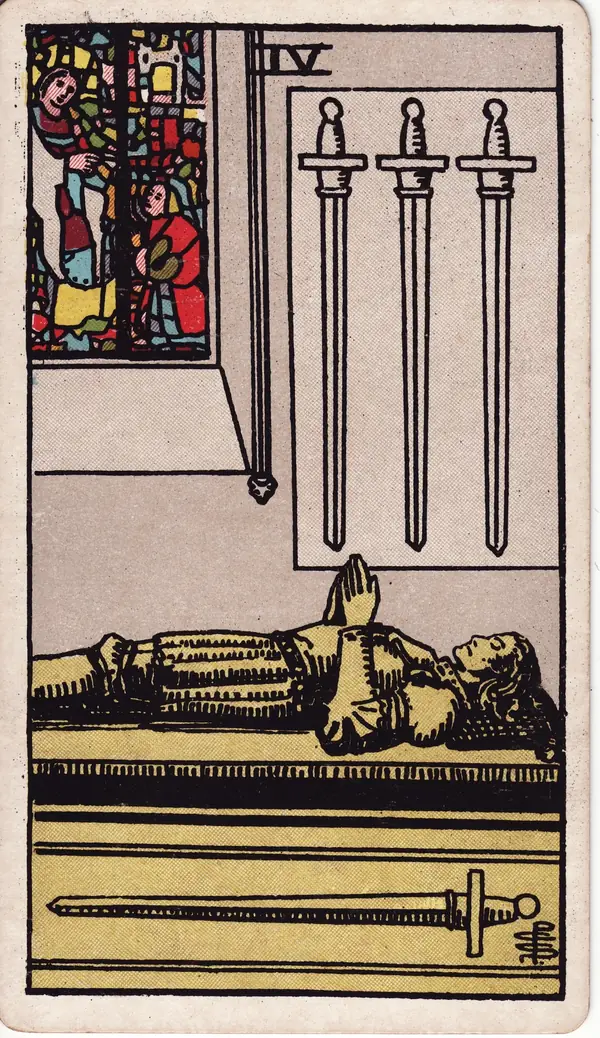
The Four of Swords belongs to the suit of Swords, the air element, and carries the number four. In the Classic Tarot, the card is also written 4 of Swords, and its image is one of the quietest in the deck: a figure lies on a stone slab, hands folded as if in sleep or prayer, while three swords hang on the wall and a fourth rests beneath them. A stained-glass window glows behind the figure, letting in light without glare. Nothing in the scene moves except breath.
Swords speak to thought, language, judgment, and conflict, so the rest shown here is mental as much as physical. It is not lazy collapse; it is the mind stepping back from a fight that has already used too much of it. Four brings structure, boundaries, and a stable base in numerology. In the Tree of Life, the fourth position is associated with compassion and generous expansion, which gives this silence a protective warmth rather than a cold edge.
At its core, the card says: laying the sword down to recover first. It is not death, defeat, or the end of a connection. It is a necessary pause—the finished battle left on the wall, the last blade set aside, the breath allowed to steady before the next step. When it appears upside down, or in reverse, that pause becomes harder to hold, and the reading turns toward restlessness and delayed recovery.
Four of Swords Kabbalah and Tree of Life
In the Classic Tarot's system of correspondences, the minor arcana are not mapped onto the paths. Instead, each card is placed by two markers: its number tells you which sephira it occupies, and its suit tells you which world it belongs to. The Four of Swords carries the number four. Four is Chesed (Mercy), the fourth sephira on the Tree of Life, on the right-hand Pillar of Mercy. Its nature is expansion, giving, and a stable order that is held up rather than forced down. Swords is the air suit, and air belongs to Yetzirah (Formation), one of the four worlds and the level where thought, language, and concepts are assembled. Read together: the lesson is to steady yourself and keep some room, and the place where it plays out is mind and speech.
That placement explains the stone chamber on the card. Chesed's stability is not bought through suppression. You have to fill yourself first, so there is something to give. The rest in the Four of Swords is not a blank, passive pause; it is the container of thought being set upright. Yetzirah adds that what is actually being sorted is ideas, wording, and judgment, not visible action. The card often appears right after an argument ends or a piece of work goes in: the activity has stopped, but the mind is still finding its place.
In love, this correspondence is very concrete. After a fight, two people go silent. On the surface it looks like a cold standoff, but through Chesed it can be the work of rebuilding spare energy: don't rush to explain; wait until there is inner room, so the words that come later have less sting. Read only through Yetzirah, though, and you can see that the silence is still running the other person's sentence over and over. That is why the quiet needs a clear time to return. Without one, stability slides into delay.
At work, it resembles the cleanup after a project closes. Four gives a sense of order: archive the files, write down the process clearly, catch up on the communication you owe people. Yetzirah reminds you that all of this happens at the level of understanding and may not produce new progress right away. That keeps you from dismissing the pause just because nothing visible has changed.
In personal growth, four is about drawing a boundary around yourself. The expansion of the Pillar of Mercy sounds outward, but it starts by storing something inward. The Four of Swords asks you to practice one thing: let yourself stop answering the world for a while, take back your own way of measuring things, and go out again when you are no longer empty. That is closer to the card's real meaning than forcing yourself to look strong.
One astrological note: the common correspondence is Jupiter in Libra. Jupiter's expansion and the four's sense of having enough room echo each other.
Four of Swords Numerology
In life-path numerology, a minor card's number first shows what stage a matter has reached. Four sits at stability, and also at the marker for a plateau or a small achievement: the earlier threeway tug-of-war is over, the situation has finally taken shape, and once shaped it usually stops changing quickly. Picture a house with its shell finished. It keeps out weather, but the next job is the interior, not another floor. The Four of Swords matches this stage: the swords are hung, the person lies down, and the business is parked at “temporarily enough.”
The character of four is steady, square, and fond of accumulation and security. It likes clear boundaries, honest accounts, and promises that hold. It dislikes sudden rule changes and emotional ambushes. In the Swords suit, this becomes “putting thought into a frame”: stop letting ideas scatter, sort them by weight, and keep only what truly needs handling. The gain is finally being able to settle. The cost is clinging to old methods and putting off a necessary adjustment.
Four's Major Arcana counterpart is the Emperor. The Emperor is order, responsibility, and control, seated in authority and giving orders. The Four of Swords is like the Emperor alone after court: the authority remains, but the person rests. Compare them: one raises the structure, the other recovers inside it. Learn only the Emperor's hardness and rest looks like weakness; learn only the Four's stillness and the structure falls apart.
If your life-path number is four and this card appears, consider this angle: you already tend to arrange things well and may treat “holding steady” as the only correct answer. The card may be reminding you that stability is not immobility, and that regular maintenance suits your strengths better than endurance. This is a reference, not a verdict; the question and the neighboring cards still matter.
Four of Swords and the Element of Air
The Swords suit belongs to air. In the Classic Tarot, air is usually summed up as thought, language, judgment, and pressure: quick reactions, reasoning, direct speech, and analyzing before feeling. It brings clarity and a sharp edge—the same sentence can clear up a problem or cut someone. Swords are often nostalgic and persistent, replaying old scenes in the mind, and they need to be understood. By the fourth card, all of this becomes “let the wind stop for a while.”
Court cards work a little differently. They read as the rank's element layered over the suit's element. Each of the four ranks has its own elemental temperament, and combined with air it shows “how a certain element uses air.” That is why ranks within the same suit can behave so differently. The Four of Swords is not a court card, but its direction is clear: air does not move on its own. Fire drives it and water nourishes it. When both are low, air just circles in place, and the more you think, the more tangled it gets.
The elements cooperate and clash. Fire and air get along: wind feeds fire, fire gives wind direction. Water and earth get along: feeling has a place to land, reality has support. Fire and water oppose each other, one rising and one sinking, and together they make confusion. The Four of Swords' difficulty is usually too much air and too little fire: much thought, no getting up. Or water is too weak, emotion is pressed into a flat line, and only analysis remains.
A spread heavy with Swords usually means heavy thinking and pressure, with far more time spent in the head than in actual movement. If other Swords sit nearby, the quiet is discounted: resting on the outside, holding a meeting on the inside. If Cups or Pentacles are close, air has somewhere to land, and the rest is more likely to become real recovery.
In daily life: after a fight, air makes you replay every sentence until you feel more wronged; when work is stuck, air keeps you revising the plan but refuses to let you sleep; when self-doubt rises, air blows a small mistake up into a whole verdict about who you are. The Four of Swords asks you to turn the air down: stop analyzing, let the body rest, and when fire catches again, air will know where to blow.
What does Four of Swords mean upright?
Upright, the Four of Swords means rest, pause, and recovery. The three swords on the wall stand for arguments already had and decisions already made; the blade beneath the figure says you have not lost your edge, you are simply choosing not to use it yet. The stained-glass window keeps the room from feeling sealed. Light still enters.
This card often follows a sprint—a project delivered, a fight ended, an exam finished. Relief may arrive late. You might feel foggy or want to sleep for days. That is the mind and body catching up, not decline. The best version of this card is deliberate and time-bound: you know why you are stopping and that you will rise again. Rest without a return date can quietly become avoidance.
Four of Swords reversed meaning
Reversed, the Four of Swords points to a forced halt, restlessness, and not enough rest. The body may be lying down while the mind keeps reopening the same conversation. You replay what you said, imagine what they thought, and plan scenes that have not happened. The room is quiet, but the internal noise never lowers. Time passes; exhaustion stays.
Sometimes the pause is imposed from outside: a schedule collapses, an illness interrupts, a relationship goes silent without explanation. You may resent being stopped. In other readings, the card says the rest you took was too shallow to restore you. You had the afternoon off, but you answered messages the whole time. Before pushing harder, make the rest real. A pause that never reaches the nervous system will not return your clarity.
Four of Swords in love: single, in a relationship, reconciliation
Romance under the Four of Swords tends to slow down. The card does not usually announce a dramatic breakup or a sudden declaration. It shows a stretch of quiet in which attraction may still be present but is not being acted on loudly. The useful question is whether that quiet is repair or avoidance, and the answer usually lives in what happens when the pause ends.
Four of Swords upright love
Upright in love, the Four of Swords suggests a calm interval. Someone may need space after a tense stretch, or both people may be recovering from outside stress. The connection is not necessarily cooling; it is being set down gently so it can breathe. Watch for small signs of return: a thoughtful message, a willingness to talk, a familiar routine resumed. If the silence has no explanation and no end, name that. Healthy rest has a door back.
Four of Swords reversed love
Reversed in love, the quiet feels less clean. One person may say they need space while still checking in, or the couple may avoid each other without ever naming the problem. The house is peaceful on the surface and tense underneath. This is the card of the cold war that neither side knows how to end. The way out is concrete: ask for a time to talk, name what you need, and agree on when you will reconnect. Vagueness will only feed the loop.
Four of Swords love for singles
For a single person, the Four of Swords often arrives after a draining chapter. You may be tired of half-hearted dating, tired of explaining yourself, or simply tired. The card favors a deliberate break from the search, not a permanent withdrawal. Use the time to notice who makes you relax and who keeps you performing. If someone shows interest now, you do not have to rush to prove anything. A steady person will not disappear because you took a night to yourself.
Four of Swords in a relationship
In a relationship, this card can describe a healthy cooldown or a risky shutdown. The healthy version sounds like: “I am worn out tonight. Can we talk tomorrow after dinner?” The risky version is silence with no time frame, used to punish or avoid. Keep ordinary life going—meals, chores, small kindnesses—so the pause does not erase the relationship. Then come back and address the real issue. Two people who can rest apart and return without drama usually build something sturdier.
Four of Swords and getting back with an ex
Getting back with an ex under the Four of Swords is not usually a green light for a dramatic reunion. It is a signal to stop pushing for an answer. The worst conflict may be over, which leaves room for repair, but room is not the same as readiness. Ask whether the reason you split has actually changed, or whether you are simply lonely. A clear, limited period of no contact can be kinder than daily half-conversations. Let calm return before you decide.
Four of Swords as feelings: how they feel about you
When the Four of Swords appears in a feelings position, it describes a current state more than a final verdict about you. Someone can care and still need distance; someone can be distant because they are overwhelmed. Read this card alongside the cards around it and with the person's recent behavior. Silence is information, but it is not the whole story.
Four of Swords upright as feelings
Upright, their thoughts run toward needing room to breathe. They may be recovering from conflict, work pressure, or an emotional overload that has little to do with you. The three hung swords suggest they are not looking for another fight. The blade beneath them means they are still guarded. They may care more than they are showing, but they do not have the energy to prove it right now. Pay attention to whether they come back after resting.
Four of Swords reversed as feelings
Reversed, their thoughts are less settled. They want quiet but cannot find it. They may draft messages and delete them, pull away and then reappear, or say they need space while watching your every move. This is not necessarily manipulation; it can be plain confusion. Still, you are allowed to name the mixed signals. Care that arrives only in anxious bursts is hard to build on. Look for consistency after the restless patch, not intensity during it.
Four of Swords as how someone sees you
They may see you as reserved, private, or hard to read. The Four of Swords gives you a calm surface, and people often project their own ideas onto that calm. Some will find it restful; others will worry that you are pulling away. If you have been quiet lately, they may read it as disinterest even when you are simply depleted. A short, honest sentence about your need for space can prevent a lot of guessing.
Four of Swords as intentions
Their intention is usually to protect their peace, not to hurt you. They want a break from conflict, a chance to think, or simply a night without demands. That does not mean they are plotting an exit. It does mean they may postpone a hard conversation until they feel steadier. You can respect the pause without agreeing to endless silence. Ask for a general time frame, then watch whether their actions match their words.
Four of Swords career and work (upright & reversed)
At work, the Four of Swords is rarely a dramatic card. It shows a slowdown, a waiting period, or a needed recovery after a push. The important distinction is between a strategic pause and a stall that has become a habit. Your position in the spread, and the cards nearby, will tell you which one you are looking at.
Four of Swords upright career
Upright, the card often follows a completed effort: the proposal sent, the interview finished, the launch delivered. You have done the visible work, and now the response is out of your hands. This is a poor moment for frantic follow-ups. Use the gap to organize your notes and portfolio, review what you would do differently, and restore your sleep. If you are considering a new job, plan it after you are rested. A decision made from exhaustion is rarely your best one.
Four of Swords reversed career
Reversed, work can bring a halt you did not choose: a project frozen, a role changed, a body that refuses another late night. You may be tempted to push through, but the card warns that fatigue is distorting your judgment. Small problems look enormous; a sharp email feels justified. Avoid quitting, confronting a manager, or taking on more while you are at your lowest energy. Set limits around messages and hours, and get help if stress is affecting sleep or health.
Four of Swords for money and finances
With money, the Four of Swords is not a card of bold gains. Upright, it describes a plateau: income is steady enough, spending is under control, and there is no need to force a move. This is a good time to review subscriptions, automatic charges, and monthly obligations, and to build a modest cushion. If you are waiting on a payment or a decision, patience is more useful than panic. The card makes no promise of wealth, and it is not a signal to chase a hot tip.
Reversed, the risk is restless spending or rushed decisions. Anxiety can make a purchase feel like relief, and fatigue can make risk look smaller than it is. Put a cooling-off period between the urge and the click. For debt, loans, or investments, speak with a qualified professional rather than relying on a card. Steady habits matter more here than a clever shortcut.
Four of Swords for health
Health-wise, the Four of Swords is a card about rest, stress, and routine—not diagnosis. Upright, it asks you to take fatigue seriously. You may be sleeping poorly, clenching your jaw, or feeling worn out before the day begins. Treat rest as part of the plan: a consistent bedtime, fewer screens at night, a real day off, and room to say no. If discomfort, insomnia, or anxiety persists, see a doctor. A card cannot tell you what is wrong with your body.
Reversed, the message is that rest is not landing. You may be lying awake with your mind at work, or technically off while still answering every message. Short breaks help, but they cannot replace sleep and proper care. If you are managing a chronic condition or worried about a symptom, follow medical advice rather than reading a card. The card's only firm instruction is to stop ignoring your body's signals.
Four of Swords as advice
The Four of Swords gives unusually direct advice: recover before you decide. It does not ask you to be impressive, productive, or available every hour. It asks you to treat rest as part of the work rather than a reward you must earn. The upright and reversed positions differ mainly in whether you can choose the pause or keep sliding away from it.
Four of Swords upright as advice
Upright, give yourself permission to stop. Put the rest on the calendar and tell the people who need to know: “I am offline tonight; let's talk tomorrow.” Write down the three things circling your mind, not to solve them, but to set them where you can see them. When you return, take one small action—clear the desk, answer the important message, step outside. You do not need to come back at full speed.
Four of Swords reversed as advice
Reversed, start with the thing that keeps you from resting. Move the phone out of reach, close the extra tabs, and give your mind one clear task: “We will handle this at nine tomorrow.” If silence makes you anxious, tell a trusted person rather than spiraling alone. Then check whether your rest is truly restorative or just avoidance in a blanket. Set a return time. And avoid major decisions about work, love, or money while you are this depleted.
Four of Swords as a person
In personality readings, the Four of Swords suggests someone with a rich inner life and a low tolerance for unnecessary noise. They are often observant, private, and slower to react than the people around them. They may seem remote at first, but they are usually processing more than they show. Their challenge is not laziness; it is knowing when solitude has become a wall.
Four of Swords reversed as a person
Reversed, this person may be chronically tired and unable to switch off. They can seem distant, forgetful, or inconsistent because their mind is always half-elsewhere. They may promise to rest and then fill every free hour, or cancel plans at the last minute because they are depleted. It is worth being compassionate, but not endlessly flexible. Clear expectations help them more than silent resentment. They need rest, boundaries, and sometimes professional support—not another person to manage their exhaustion.
How to place it in a reading
In a spread, the position changes the card's tone. In the present position, it points to a pause or recovery already underway. In the advice position, it says rest is the next right action. In an obstacle position, it can mean you have been still too long or are avoiding a conversation. In the future position, it suggests a slower season ahead, often with time to regroup before a decision.
Neighboring cards shape what kind of quiet this is. Beside gentle cards, the pause looks restorative. Beside harsh or chaotic cards, silence may be hiding unresolved conflict. Beside other stalled cards, check whether rest has turned into procrastination. Reversed, look closely at the cards around it: they often show whether the restless energy is finally releasing or deepening. Read the whole spread, not just this one card.
Our take
The Four literally says go rest, and we take it at face value. We do not treat this as a doom card, a secret omen, or a dramatic turning point. It is a plain invitation to stop before you break, and that is rarer—and more useful—than it sounds. The figure is not dead; the swords are not gone. They are simply set aside for now.
The real question is whether the pause restores you or becomes a place to hide. If you return with a clearer head and a little more strength, the card has done its job. If you keep lying there while the anxiety grows, look at the surrounding cards and ask what you are avoiding. The card offers the pause. What you do with it is yours.

FAQ
These are the questions readers ask most often about the Four of Swords. The short answers below are starting points, not replacements for the full spread. A single card rarely answers a whole situation, so keep the question specific and read the nearby cards before you settle on a conclusion. That is especially true with this quiet, easily misunderstood card.
Is Four of Swords a yes or no card?
It depends on the other cards. By itself, it leans toward “pause,” not a clear yes or no. The grading here is intentionally flexible. Upright, it often means wait, recover, or let the situation settle before acting. Reversed, it can mean the pause is restless or that the conditions are not yet clear. Neither position is a hard no, and neither is an enthusiastic yes. Look at the surrounding cards for direction. A practical question—"Should I reach out this week?"—will usually give you a cleaner reading than "Will everything work out?"
What does Four of Swords reversed mean in a yes or no reading?
It still depends on the other cards. Reversed suggests a stalled or restless pause, not a definite no. The energy is stuck rather than settled. Something may be delayed because rest has not really happened, or because the people involved keep reopening the same issue. That can look like a no, but the card itself is more about timing and readiness than refusal. Read the nearby cards for what needs to change. If the rest of the spread is active and hopeful, the block may be temporary. If it is heavy and static, address the exhaustion before expecting a clear answer.
What does Four of Swords mean if you have a secret crush?
It often means they are quiet and self-focused, not necessarily uninterested. Your crush may be dealing with their own stress or simply moving slowly. The card does not reveal a hidden passion, and it does not prove indifference. Watch their behavior over time rather than reading meaning into every pause. For your part, keep your life full enough that one delayed reply does not decide your mood. A light, low-pressure conversation will tell you more than a week of analysis.
What does Four of Swords mean for marriage?
It favors calm reflection before a big decision, not a rushed wedding or a rushed ending. If you are married, the card may point to a season of low energy or emotional distance that needs care rather than panic. If you are considering marriage, it asks you to slow down and discuss practical realities: money, household responsibilities, family boundaries, and the conversations you have been avoiding. A rested couple makes better decisions. If there is abuse or immediate danger, do not wait for a card reading—seek safety and qualified help.
What does Four of Swords mean as an outcome?
The outcome is a slower season: rest, recovery, and a pause before the next move. Upright, this is usually protective. Something may be delayed, but the delay gives you time to heal or rethink. Reversed, the outcome may include fatigue or a warning about boundaries you have been ignoring. It is not a final verdict on the whole situation. Treat it as a pace and a condition: the result arrives after recovery, not in the middle of depletion.
What timing does Four of Swords suggest?
It suggests delay and recovery time rather than immediate action, with no fixed deadline. Some readers connect the number four with four days, four weeks, or four months, but that is a symbolic prompt, not a schedule. The better question is: how long until you can think clearly again? The card favors a pause that lasts long enough to restore sleep, perspective, and calm. Use the surrounding cards and real-world deadlines for practical timing. Do not turn a need for rest into a countdown that makes you more anxious.
Does Four of Swords mean pregnancy?
No. It does not confirm pregnancy, and it cannot rule pregnancy out. The card is about rest and recovery, not fertility or medical status. If pregnancy is a possibility and that matters to you, take a test or speak with a doctor. A reading can help you think about your feelings and choices, but it must not be used as a diagnosis. Anyone who is pregnant or trying to conceive should follow medical guidance, especially when fatigue or other symptoms are present.
What zodiac sign is Four of Swords?
The common traditional correspondence is Jupiter in Libra. Libra brings balance, fairness, and a need for peace; Jupiter adds perspective and a wish for room to breathe. Together they fit a card about stepping back so a situation can be seen fairly. This is an astrological association used in some readings, not a statement that everyone born under a particular sign will feel the card the same way. Treat it as an extra layer of meaning, not a rule.
Is Four of Swords a good or bad card?
It is neutral to gently positive: a protective pause rather than a misfortune. The card rarely brings dramatic loss. It usually shows a needed rest, a delay, or a recovery period. That can feel frustrating if you want momentum, but it is often kinder than pushing through. Reversed, the warning is that rest is not working or has been forced, so the experience can feel more unsettled. Even then, the card points toward a correction rather than a disaster. Its value depends on whether you use the pause well.
Related cards
Cards that sit close to the Four of Swords help you see whether the pause is repair, avoidance, or the aftermath of conflict. Compare the tone of the neighboring cards before you decide.
- Three of Swords: heartbreak and painful truth often come before the need to withdraw, so this card can show what the Four is resting from.
- Five of Swords: conflict that leaves everyone depleted, which makes the Four's retreat understandable.
- Six of Swords: a gradual move away from trouble, echoing the Four's need to leave exhaustion behind.
- Eight of Swords: feeling trapped, which differs from the Four's chosen rest and can help you tell the two apart.
- Four of Cups: another pause, though this one is more about emotional apathy than mental fatigue.