Five of Swords (5 of Swords) Meaning: Reversed, Love, as Feelings, Yes or No

Draw a Classic Tarot spread →Free, no sign-up. Think of your question, then draw.
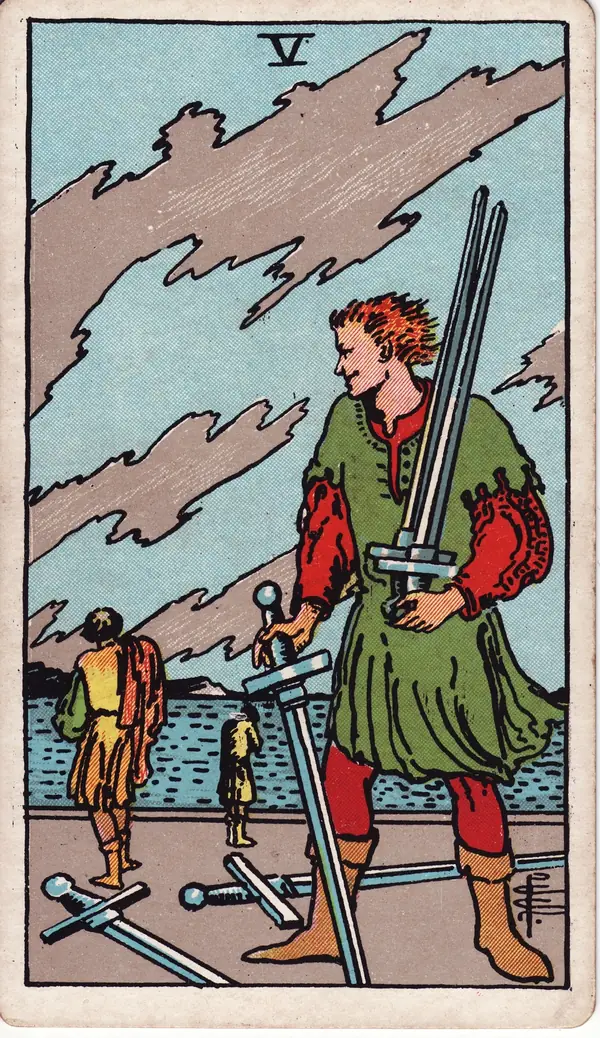
In one line: Smirking with others' swords as they walk away.
| Keywords | |
|---|---|
| Upright | hollow victory, point-scoring |
| Reversed | reconciliation, conceding, dropping pride |
| Type | Swords · air |
| Yes/no (our grading) | leans no |
Quick answers: yes/no · love · career
- Yes/No: Under our grading, Five of Swords leans no. Yes/no is the least reliable use of tarot—prefer “how should I approach this?”.
- Love: Winning the argument but hurting the bond; reversed, willing to make peace.
- Career: Winning at any cost; reversed, stepping back to save relationships.
*FateClear Editorial Team*
Want to draw a Classic Tarot spread? Draw cards.
The Five of Swords belongs to the suit of Swords in the Classic Tarot’s minor arcana, where thought, speech, and judgment take center stage. As a five, it marks a point where stability gives way to friction and old arrangements must be renegotiated. Air is the element here, so the action often happens in conversation: a remark that lands badly, a position defended too long, a debate that should have ended sooner. It is also written 5 of Swords.
The familiar image shows a figure holding several swords and looking back with a smirk while two others walk away, their weapons left on the ground. The sky is restless, the ground uneven, and no one is bleeding. That absence of visible violence makes the scene colder, not kinder. The one-line core is simple: smirking with others’ swords as they walk away.
This is not a card about whether you can win. It is about what winning costs. The argument may be settled, but trust or closeness may have been spent to settle it. In reverse, the focus moves from the open clash to the silence that follows—apology, stubborn pride, or the realization that the prize was not worth the damage.
Five of Swords Kabbalah and Tree of Life
In the Classic Tarot tradition, the Five of Swords is a numbered card, so there is no Major Arcana path number to trace. Read it instead through the sephirah attached to its number and the world its suit belongs to. Five corresponds to Geburah (Severity), the fifth sephirah on the Tree of Life’s left pillar of Severity. Geburah deals with force, pruning, conflict, and correction: tighten when the moment calls for it, cut away what cannot remain, and mend what the dispute leaves damaged. Swords is Air, and the Five falls in Yetzirah, the formative world, one of the four worlds. Yetzirah governs how thought, speech, and judgment take shape, so Severity finds a concrete expression here. It appears as a sentence, a position, a judgment that will not give way—not as drawn steel.
Keep the two layers separate. The sephirah tells you what kind of step this is; the world tells you where it lands. Fire is will and action, water is emotion, air is thought, earth is physical reality. By putting Severity in Air, the Five of Swords makes the clash begin in the mind and on the tongue before it reaches a relationship or a practical decision. In the picture, the winner clutches the swords while the losers turn and walk away. Force is being used to prune a bond: the argument is cut off, and so is part of the connection. This is not simply a card of quarreling. It is about how people set boundaries and who bears the cost.
In love, one person may present the problem in cool, logical terms, as though handing down a verdict. The other doesn’t hear reasons so much as feel a piece of their own space being sliced away. Imagine a couple arguing over who should compromise: the one who wins the point keeps the position and loses some intimacy. At work, the same pattern can appear when a proposal is torn apart in a meeting. Standards rise in the short term, but colleagues stop offering ideas. In personal growth, Severity can turn inward, with one mistake put on trial again and again while every bit of progress goes unnoticed. The card comes alive once you see that Severity is meant to correct, not to erase a person.
Its usual astrological correspondence is Venus in Aquarius. Venus concerns relationships and values; Aquarius favors reason, distance, and personal space. The combination echoes both the coolness of Air and the pruning quality of Geburah. It doesn’t mean no one cares. It means the caring has been tucked inside an argument. The reminder is not to let principle turn into isolation.
Five of Swords Numerology
The Five of Swords carries the number five. In the minor arcana, one through ten works like a scale of development, and five is the point where stability breaks and the situation escalates. The foundation is already built; a new challenge arrives and forces a readjustment. This doesn’t equal failure. It means conflict is becoming visible. Within Swords, the challenge usually concerns ideas, expression, or rules, so a fight that looks sudden has often been building through smaller disagreements.
Five brings a curious, outgoing energy. It likes to test things, venture beyond the familiar, and try another route, though it scatters easily. It won’t accept a rule just because it exists; it asks why things have to be this way. When that outward push meets the sharpness of Swords, it turns into questions, debate, and sometimes a contest to prove oneself. The scene on the card is more than bad temper. It looks like someone arriving with new questions and colliding with an old order, with both sides convinced they are right.
In numerology, five also links to the Hierophant. The Hierophant speaks of shared rules, belief, and what is passed down, while the Five of Swords brings disagreement into the open. When one account of things no longer satisfies everyone, conflict follows. The two cards face each other: order on one side, a challenge to order on the other. The Hierophant supplies a framework; the Five warns that any framework can be questioned. Guard the position and refuse to listen, and the framework becomes suppression. Tear everything down and build nothing, and the questioning only drains energy.
For someone whose life path number is five, this card can serve as a mirror. You may be naturally eager to explore, change your surroundings, and try a new road. Even so, notice whether being different has turned into being against. This is a reference point, not a verdict. The card seems to ask whether the freedom you want has to be proven by beating someone else.
Five of Swords and the Element of Air
The Five of Swords belongs to Air. Air governs thought, language, judgment, and the flow of information. Its temperament is rational and direct; it analyzes first and can speak with great clarity while leaving warmth out. Its strength is seeing through contradictions and naming the problem. Its weakness is pressure: the blade wounds others when turned outward and wounds the self when turned inward. Swords also carries a nostalgic, tenacious streak. Too much thinking replays old conversations long after they have ended. To understand this card, look past the fight to the worry and the wish to be understood beneath it.
Elements cooperate and collide. Fire and Air work well together: fire provides direction and action, while air spreads and clarifies fire’s ideas. Water and Earth also support each other, since emotion needs a real container and reality needs emotional moisture. Fire and Water are more likely to clash, one pushing forward and the other pulling back. In an argument, that can look like one person rushing toward a conclusion while the other is overwhelmed by feeling. The chill of the Five of Swords often comes from Air overpowering Water: the reasoning gets through, and the feelings are set aside.
Many Air cards in a spread usually point to heavy thinking, too much information, and a lot of conversation. The mind circles, and analysis holds the decision hostage. With the Five of Swords, the tendency is sharper: choices exist, but each one becomes something to argue against. If Water and Earth can catch some of that Air, emotions have somewhere to rest and practical steps become possible. The conflict can then come down to earth instead of remaining a scoreboard.
In daily life, this may show up at work as endless rewording in meetings or a standoff over process details. In love, it can be an offhand comment dissected for hidden motives until the mood turns cold. In personal growth, it can be a long list of shoulds that never becomes action. Air needs Fire to move it, Water to soften it, and Earth to ground it. The Five of Swords doesn’t ask you to stop thinking. It asks you not to make thinking the only battlefield.
What does Five of Swords mean upright?
Upright, the Five of Swords puts the thrill of winning on the table, then shows the bill. You may correct a coworker in a meeting, out-argue a relative in the family group chat, or push an exchange until the other person has nothing left to say. Your logic may be sound. The atmosphere still curdles. Collaboration, affection, and trust can drop once the point has been made. The card does not tell you to stay quiet; it asks you not to turn every conversation into a contest.
Five of Swords reversed meaning
Reversed, the card has two common directions. In one, the argument is lost before it starts: words stick in your throat, an attempt at honesty is shut down, and anger turns inward. In the other, you are tired of fighting. You admit your part, drop the need to be right, and look for a practical way forward. The upright keywords—hollow victory, point-scoring—give way to reconciliation, conceding, and dropping pride. Reconciliation does not mean shrinking yourself. It means the relationship or the task matters more than the score.
Five of Swords in love: single, in a relationship, reconciliation
In love, the Five of Swords rarely announces a clean breakup. More often it shows two people who have forgotten the original question because they are busy defending their positions. A small disagreement about plans can become a debate about character. A sharp sentence can be replayed for days. The card asks whether you want closeness or victory, and whether the person across from you has become an opponent instead of a partner.
Five of Swords upright love
Upright in love, words cut. You or your partner may keep a tally of who apologized last, who remembered the date, who was right about the restaurant. One of you wins the exchange; both of you feel a little less safe. This is not proof that the relationship is doomed, and it is not a sign of a third party. It is a warning about contempt and scorekeeping. If the last argument ended with someone going quiet, the issue was postponed, not solved. Repair begins with curiosity: “Are you okay?” before “Why were you like that?”
Five of Swords reversed love
Reversed in love, the fight may go underground. One person says “I’m fine” and means “I am keeping a list.” Another gives in on every small decision to avoid another night of tension, then feels invisible. There can also be real softening: someone admits they were harsh, or both people decide the relationship is worth more than the last word. The difference is whether the concession is mutual. If only one person keeps folding, resentment will find another exit. A calm conversation about one issue—not the whole history—works better than blame.
Five of Swords love for singles
For singles, the Five of Swords is less about finding an enemy and more about noticing how you handle friction. You may be arguing with family about your choices, trading barbs with a coworker, or trying to win a pointless exchange online. Confidence can curdle into a need to dominate. A date may pull back after one too-sharp joke, not because they dislike you, but because they cannot tell whether they are talking to a person or a debate opponent. Let your guard down before someone has to earn it.
Five of Swords in a relationship
In an established relationship, the card often appears around chores, money, in-laws, or the way one partner speaks to the other in front of friends. The subject may be minor; the tone is not. Two articulate people can turn a practical problem into a courtroom. If you recognize yourself in the figure holding the swords, ask what you are protecting—your pride, your version of events, or the relationship itself. If you recognize yourself in the ones walking away, say so before you disappear emotionally.
Five of Swords and getting back with an ex
With an ex, the Five of Swords asks you to look at the reason you separated. If the final fight was a contest neither of you could lose, a reunion will not fix that by itself. Both people may still be rehearsing their closing arguments. Getting back together is not a debate to be won, and an apology offered only to secure a rematch is not repair. It can work if each person can name their own contribution and drop the scoreboard. Without that, meeting again is likely to become round two.
Five of Swords as feelings: how they feel about you
When the Five of Swords appears in a feelings position, it describes someone’s emotional stance toward you, not a verdict on your worth. They may be the person holding the swords, still defending a position, or one of the figures walking away, done with the argument. The card often appears when a disagreement has changed the temperature between you. Their thoughts may be guarded, competitive, or tired. Check the surrounding cards to see whether the distance is temporary or a pattern.
Five of Swords upright as feelings
Upright, they feel they have the upper hand, or at least that they held their ground. They remember the harsh words, including their own, but may not realize how much those words landed. There can be private relief at “winning” mixed with an empty feeling that the warmth is gone. If they walked away in the exchange, their feeling is closer to “I am not doing this again.” Either way, their willingness to reopen the conversation is low. They are protecting a position, not reaching toward you.
Five of Swords reversed as feelings
Reversed, their feelings are harder to read. They may regret how they spoke but feel too proud to say so. They may believe they were misunderstood and have decided that explaining again is pointless. Some people go quiet because they are softening; others go quiet because they are building a case. Do not take “nothing is wrong” at face value, but do not interrogate them either. Watch whether their actions change in small, specific ways. A real shift shows up in the next disagreement, not in a dramatic speech.
Five of Swords as how someone sees you
As how someone sees you, the Five of Swords can cast you as formidable: sharp, quick, hard to argue with. That can be flattering and lonely at the same time. They may see you as someone who always needs the last word, or as someone who withdrew without explanation. Both pictures can be projections shaped by one heated moment. If you want to change the view, you do not need to become passive. Show that disagreement does not threaten the connection. Consistency will do more than a long defense of your character.
Five of Swords as intentions
As intentions, the card is not especially tender. They may intend to defend their position, settle a score, or keep the upper hand. They may also intend to avoid conflict by creating distance. This does not make them cruel; it makes them guarded. If they say they want to repair things, the test is whether they can engage without turning every sentence into a rebuttal. A person who wants closeness will eventually choose understanding over being right. A person who only wants control will keep the argument alive after it has been won.
Five of Swords career and work (upright & reversed)
Work is natural territory for this card. Meetings, negotiations, performance reviews, and shared credit all invite the Swords’ love of precision. The Five appears when that precision becomes a weapon. Someone wins the point and loses the room. Someone proves they were right and finds that no one wants to collaborate. The card does not say you should never disagree at work; it says that being correct is only part of the job.
Five of Swords upright career
Upright at work, you may out-argue a colleague in a meeting, expose a flaw in public, or insist on your method until others stop contributing. The project may move forward, but the team does not. In a job interview, the same energy can appear as overexplaining or correcting the interviewer. If you are leaving a job, be honest about whether the conflict was entirely other people’s fault. A new workplace will have its own difficult personalities. Your reputation for competence grows faster when it is paired with the ability to share credit.
Five of Swords reversed career
Reversed at work, the conflict goes quiet. You may stop speaking in meetings, then replay the conversation at your desk. You may give in on a deadline or a budget just to keep the peace, then carry the extra work alone. In a job search, do not accept obviously unreasonable terms because you dread negotiation. Tell the difference between a battle worth having and a pattern of self-erasure. State a boundary once, clearly, and let the other person respond. If the workplace punishes every honest limit, that is useful information too.
Five of Swords for money and finances
The Five of Swords is not a money card in the sense of predicting windfalls or losses. It describes the human side of money: who decides, who contributes, who gets the final word. Air brings calculation and argument, so disputes tend to come through contracts, shared expenses, or negotiations. Upright, watch for winning a small point at the cost of a larger relationship or deal. Reversed, watch for silence—agreeing to terms you resent, then feeling trapped. Read the fine print, name your limits, and keep money conversations clear. The card promises neither wealth nor ruin; it asks for fairness and proportion.
Five of Swords for health
In health, the Five of Swords offers no diagnosis and predicts no specific illness. It is better read as a stress signal. Are you sleeping badly because you are replaying an argument? Are your shoulders up near your ears? Air is linked with breath and the nervous system, and conflict often shows up there first: a tight jaw, a dry throat, a headache after a tense call. If a symptom persists or worsens, see a doctor rather than assigning it a tarot meaning. Rest, routine, and honest conversation support you; they are not a substitute for medical care. If you are pregnant, follow your clinician’s guidance.
Five of Swords as advice
The advice of the Five of Swords begins with a question: was this victory worth what it cost? The card does not ask you to become a doormat, and it does not encourage you to win every exchange. It hands you a ledger. On one side is the point you want to make; on the other is the trust, cooperation, or peace you may spend to make it. Sometimes the honest answer is to speak. Sometimes it is to stop. The difference lies in what you are protecting.
Five of Swords upright as advice
Upright, pause before the next sentence. Ask whether you want to solve the problem or make the other person surrender. If it is the problem, soften the delivery and name your concern instead of their flaw. If you have already said something cruel, do not hide behind “I’m just honest.” A brief, specific repair—“That came out sharper than I meant, and I’m sorry”—does more than another round of proof. At work, protect the relationship the project will need tomorrow. Winning the meeting is not worth losing every future conversation.
Five of Swords reversed as advice
Reversed, stop telling yourself to swallow it. First separate what you can release from what has become a boundary. Dropping pride does not require abandoning your position; reconciliation does not require accepting blame for everything. Choose a time when neither of you is exhausted, discuss one issue, and leave the old evidence out of it. If the other person refuses to engage, you are allowed to stop auditioning for their understanding. Put your energy back into sleep, work, and people who can hear you. Peace bought by constant self-erasure is not peace.
Five of Swords as a person
As a person, the Five of Swords describes someone quick, articulate, and hard to pin down in an argument. They may enjoy the cut and thrust of debate, or they may be the one who goes quiet and keeps a private record of every slight. There is often intelligence here, and a strong sense of principle. The shadow is a need to be right that outranks warmth. They can be charming when relaxed and surprisingly cold when challenged. The card does not make them a villain; it shows where their defenses do the most damage.
Five of Swords reversed as a person
Reversed, this person may be tired of their own combativeness. They might apologize awkwardly, concede a point they would once have fought for, or step back from a family feud. That can be growth. But the reversal can also describe passive aggression: someone who avoids the argument, agrees in public, and punishes you in private. If you are dealing with this person, pay attention to consistency. An honest concession sounds like ownership. A resentful one sounds like a favor. You do not have to keep arguing to find out which is which.
How to place it in a reading
Placement changes the card’s tone. In a present position, it points to a conflict that is active or freshly ended. As an obstacle, the blockage is often rigidity—yours or theirs—rather than a lack of ability. In an advice position, it asks you to count the cost of winning. In the future, it can flag a clash of opinions or a negotiation that needs a clean exit. Nearby Wands add heat; Cups add emotional weight; Pentacles bring money or practical stakes. A major card nearby suggests the pattern is larger than one quarrel. On the Tree of Life, the fifth position is associated with severity, the force that sets limits; here, strength without measure becomes the warning.
Our take
Our take is simple: The Five asks what you actually won—count the cost before you fight to win. The smirk in the image is not triumph; it is the loneliness of having cleared the room. Upright, the card warns against turning a conversation into a battlefield. Reversed, it warns against swallowing a grievance until it poisons you. In both cases, the way out is proportion. Ask whether the point you are defending will matter next week. If it will, speak clearly. If it will not, let the sword stay on the ground.

FAQ
These are the questions readers bring to this card most often. A single card can only offer one angle, so treat each answer as a starting point rather than a final verdict. The most useful reading comes from your situation, the card’s position, and the other cards around it. With that in mind, here are direct answers to the most common questions.
Is Five of Swords a yes or no card?
It leans no. The card usually points to friction, hidden costs, or a win that leaves you worse off, so a clean yes is unlikely. That lean is not absolute. If your question concerns a competition or negotiation, the resistance is stronger; for a small daily matter, the cost may be minor. Reversed does not flip the answer into a confident yes. It often means the conflict has gone quiet rather than disappeared, so progress may still be blocked by unspoken resentment. Read the other cards for any softening influence.
What does Five of Swords reversed mean in a yes or no reading?
It still leans no. Reversed often shows the argument moving underground rather than resolving cleanly. There may be a genuine wish to reconcile, but pride, unfinished hurt, or one-sided concession can keep the situation stuck. A yes built on silence is fragile. If you are asking whether to push for an answer now, wait until the emotional weather clears. If you are asking whether repair is possible, the card says maybe—but only if both people can speak honestly without keeping score.
What does Five of Swords mean if you have a secret crush?
It is not a warm green light. The card suggests guardedness, mixed signals, or a connection weighed down by pride. You may be analyzing every message, deciding who should text first, or turning a small misunderstanding into a test. The other person may sense the defensiveness without understanding it. This card does not reveal their private feelings, and it does not mean they dislike you. It asks you to drop the scoreboard. One easy conversation, without probing or proving, will tell you more than another week of rehearsal.
What does Five of Swords mean for marriage?
It is not a prediction that a marriage will fail. It highlights how the two of you handle disagreement. In an established relationship, the card often appears around chores, in-laws, money, or the way one partner speaks in front of others. The topic may be small; the tone needs attention. If you are preparing for marriage, notice whether conflicts end with one person silenced or with a shared solution. The card does not point to a third party. It asks whether the bond can survive being wrong sometimes, and whether both people can repair without keeping a ledger.
What does Five of Swords mean as an outcome?
As an outcome, it suggests a hollow victory or a conflict that costs more than it gives. You may get the decision, the apology, or the last word, then discover that the relationship or the atmosphere has changed. Reversed as an outcome can mean a delayed reckoning: the argument ends, but the resentment remains, or one person eventually concedes without feeling heard. The card does not seal the future. It shows the likely shape of events if the current approach continues. Changing the approach can change the ending.
What timing does Five of Swords suggest?
There is no fixed timeline. The card tends to time itself by a conflict—soon, while the issue is still live. Swords often move quickly, so the matter may surface within days or a few weeks rather than months. But this is a pattern of events, not a calendar date. Watch for the next conversation, meeting, or family gathering where the same subject returns. That is when the card becomes active. Reversed can stretch the timing because silence can last longer than open disagreement. Do not build a decision around a guessed date; build it around how you will respond when the moment comes.
Does Five of Swords mean pregnancy?
No. This card does not indicate pregnancy, and it cannot confirm or rule it out. The Five of Swords speaks about conflict, pride, and the cost of winning. It has no reliable connection to fertility or conception. If you are trying to conceive, worried about a possible pregnancy, or navigating pregnancy, use a test and talk with a qualified clinician. Tarot can help you reflect on stress and communication, but it is not a medical test. Do not let a card make a decision that belongs with your doctor and your own judgment.
What zodiac sign is Five of Swords?
Its common traditional correspondence is Venus in Aquarius. Aquarius is an air sign, associated with principle, perspective, and a certain emotional coolness. Venus brings questions of value, attraction, and what we are willing to share. Together, this combination can describe someone charming but detached, fair-minded but stubborn, and more comfortable discussing a feeling than feeling it. It can also show a relationship where ideas are easy and warmth needs deliberate effort. This is a traditional association, not a rule about every person born under those placements.
Is Five of Swords a good or bad card?
It is neither purely good nor purely bad. It becomes harmful when winning matters more than the people involved. The card does contain real difficulty: conflict, distance, and the empty feeling that follows a victory. But it can also be useful. Sometimes a disagreement must be named before a relationship can become honest. Sometimes recognizing a hollow win is the first step toward changing how you argue. The card becomes constructive when you use it to examine your motives and repair what can still be repaired. It becomes destructive when you treat it as permission to keep scoring points.
Related cards
The Five of Swords makes more sense beside the cards that share its weather. Read them as different responses to the same tension.
- Four of Swords: The pause after the quarrel, when rest and retreat are wiser than another round.
- Two of Swords: The refusal to choose, held in tense balance, which can look calmer than the Five but avoids the real issue.
- Six of Swords: A quiet departure from rough water, useful when the only remaining victory is distance.
- Five of Cups: Grief over what was lost, echoing the emptiness that follows a win no one can enjoy.
- Five of Wands: Open competition and noise, hotter and more chaotic than the cold standoff of the Five of Swords.