Five of Wands (5 of Wands) Meaning: Reversed, Love, as Feelings, Yes or No

Draw a Classic Tarot spread →Free, no sign-up. Think of your question, then draw.
In one line: Five people waving sticks—noisy, but nobody is hit.
| Keywords | |
|---|---|
| Upright | competition, arguments, crosstalk |
| Reversed | avoiding conflict, escalating infighting |
| Type | Wands · fire |
| Yes/no (our grading) | leans no |
Quick answers: yes/no · love · career
- Yes/No: Under our grading, Five of Wands leans no. Yes/no is the least reliable use of tarot—prefer “how should I approach this?”.
- Love: Squabbles and disagreements; reversed, refusing to talk or resentment piling up.
- Career: Fierce competition, lots of debate; reversed, infighting or problems left to fester.
*FateClear Editorial Team*
Want to draw a Classic Tarot spread? Draw cards.
The Five of Wands belongs to the suit of Wands, the fire suit of the Classic Tarot. Its number is five, and it also appears in readings as "5 of Wands." Wands carry drive, appetite, and forward motion, so this card rarely describes a purely mental disagreement. It describes several people wanting to move at once, each convinced their direction should come first. You may meet it during a week when every task, relative, and coworker seems to demand an immediate answer.
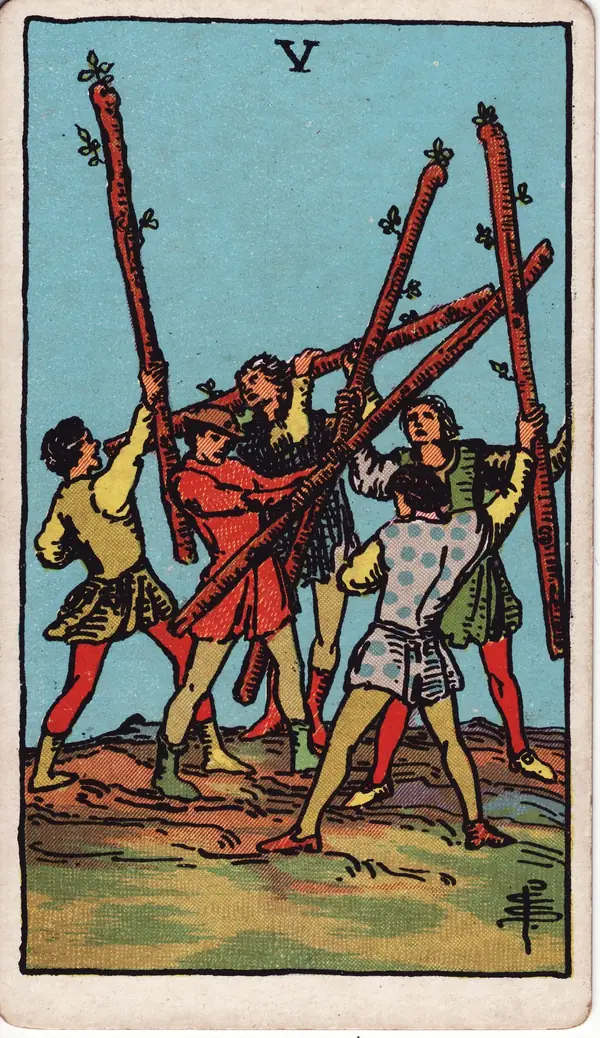
The picture is almost theatrical: five figures raise wooden staves, bodies twisted, mouths open, feet planted on uneven ground. The scene is loud, but look closely and nobody is actually struck. That detail matters. The fight is real enough to raise your pulse, yet it is often a contest over space, credit, or sequence rather than a plan to hurt anyone. In the Classic Tarot, the card catches the moment before a scuffle becomes a wound. When it arrives upside down, the noise tends to move indoors, where it can be harder to hear.
At its center, the Five of Wands is about multiplied effort: many hands pushing, few shared rules. On the Tree of Life, the number five carries severity and contraction, a reminder that fire needs a container or it simply burns through the room. The card's one-line meaning is blunt: five people waving sticks, noisy, but nobody is hit. That is not a promise that no one will be bruised. It is an invitation to turn scattered heat into something useful before exhaustion takes over.
Five of Wands Kabbalah and Tree of Life
The Five of Wands is a numbered card, so on the Tree of Life we start with the number five and then look at the plane the Wands suit belongs to. Five falls at Geburah (Severity), the fifth sephirah, on the left-hand Pillar of Severity. This sphere concerns power, cutting, conflict, and correction. Its position gives it a tone of tightening, limiting, and setting things straight. Wands belong to the archetypal world among the Four Worlds, the fire-led plane where will, motive, and action take form. Layer those meanings and the Five of Wands is not just an argument. Multiple wills push ahead at once, hit a boundary, and have to be trimmed before they can form a workable order. The sephirah explains the nature of the step; the world explains the level at which it occurs: will and action.
This framework helps translate the card into real situations. In a relationship, two people may each want to arrange the weekend their own way. On the surface they argue about time; underneath, will is colliding with will. Severity's lesson is to establish shared rules first rather than let one person dominate. At work, several plans may move forward while resources are scarce. The cutting then becomes a matter of priorities and clear role boundaries, and the fire-led archetypal world shows that people are not just discussing—they are ready to act. In personal growth, the Five of Wands often shows up when desires are numerous and energy is scattered. The corrective side of the sphere means dropping some goals so the remaining actions can actually be effective.
Its common astrological correspondence is Saturn in Leo. Saturn brings limits and structure; Leo emphasizes self-expression and dignity. That echoes both the tightening quality of Severity and the fire element's wish to express itself: the desire to be seen has to accept rules. If you see only the quarrel, you miss what Saturn asks. Passion has to pass through discipline before it has a chance to become a result. The point of learning this correspondence is not to memorize labels. It is to notice the creativity behind the conflict, the part that needs organizing.
Five of Wands Numerology
The Five of Wands carries the number five. Among numbered cards, five generally marks a stage where a new challenge emerges and the situation escalates. Earlier steps have been set out, more participants enter, the existing arrangement stops being enough, and everyone must coordinate again. It is not the same as failure. It is closer to a concentrated test that reveals hidden disagreements and scarce resources at the same time.
Five's character leans curious, fond of travel, and eager to spread outward. It is open to new people and fresh possibilities, but it also scatters; once interests multiply, focus is hard to keep. This fits the image closely: five wooden staves raised in different directions, lively and energetic but lacking a common direction. The friction in this card seldom means someone is naturally quarrelsome. More often, outward energy has not yet found shared rules.
In numerology, five corresponds to the Major Arcana card The Hierophant. The Hierophant speaks of tradition, learning, shared standards, and experience that has become established practice. That can seem the opposite of the Five of Wands' disorder, yet the two complement each other: when a group of wills wants to move forward together, it needs a framework everyone accepts. The Five of Wands asks who sets the rules; The Hierophant offers a reference for how rules gain acceptance. Read together, the cards suggest that conflict does not only need to be calmed. It needs to be led into an order people can follow.
For someone with a life path number of five who draws this card, it can serve as a reminder: your curiosity and drive are resources, but right now you should check whether you have opened too many fronts at once. Pick one direction before you talk about expanding. The lesson of five is often to gather scattered interests back into a single goal you can finish. This is only a reference, not a settled judgment about personality.
Five of Wands and the Element of Fire
The Five of Wands belongs to fire. Fire's basic nature is action, desire, momentum, and control; it tends to act before discussing, and its physical energy and enthusiasm are direct. Here fire is not one quiet flame but five fires burning at once. Each person pushes their own version, so there is competition to speak, to go first, and to claim resources. The vitality is real, and so is the drain. The card honors action while warning that friction must be managed.
Elements cooperate and clash. Fire and air work well together: air supplies ideas, fire turns them into action. Water and earth also support each other: feeling has somewhere to land, and practical reality has a foundation. Fire and water are more likely to clash, since one wants to move ahead while the other pulls back, and their rhythms rarely match. When the fire in the Five of Wands lacks air's clarity, only force remains; without the softening influence of water and earth, a discussion can become a head-on collision. This does not mean emotion or practicality are unimportant. It means fire needs direction and boundaries.
A spread heavy in fire usually shows fast-moving events and eager people, along with a risk of overload. Common signs include a packed schedule, several tasks taken on at once, or strong-willed people who will not give way. In concrete terms, the Five of Wands may appear as a meeting where proposals compete for one budget, a family gathering arguing over time and place, or a team pushing one another before a deadline. There is enough action. What is missing is sequencing and rest.
One practical response is to give the fire an outlet. Write the goals into a list, mark their order, state who owns each part, and set aside time to recover. Fire does not mind being busy; it minds burning without direction. Clear boundaries can turn the same enthusiasm from mutual resistance into shared momentum.
What does Five of Wands mean upright?
Upright, the Five of Wands puts conflict on the table. Picture a meeting where three people talk over one another, a family group chat arguing about holiday plans, or a week with four deadlines and one calendar. The card favors action over pure gossip: someone claims the project, someone else grabs the best shift, and a third person starts without waiting for approval. Motives are not necessarily cruel. Resources, attention, and timing are simply too tight for everyone to go first. The upside is honesty. Nothing is being swept away. The downside is crosstalk, bruised pride, and the chance that the loudest voice, not the best idea, sets the pace.
Five of Wands reversed meaning
Reversed, the Five of Wands does not become peaceful. It becomes quiet. People say "whatever works" in the meeting and complain in the hallway; a couple agrees to drop the subject and then keeps score for a month. The card can show two different responses: avoiding conflict altogether or letting infighting escalate behind closed doors. Both preserve the appearance of calm while the actual disagreement stays alive. This is why silence around this card deserves suspicion. A truce can be useful, but only if someone eventually names the issue. Without that step, the group is not resting. It is reloading.
Five of Wands in love: single, in a relationship, reconciliation
In love, the Five of Wands is less a verdict than a map of friction. The heat often gathers around ordinary logistics: whose turn it is to cook, how weekends get divided, whether friends come before a partner, how fast a commitment should move. A couple may not be fighting at all; they may simply be exhausted by competing schedules. Still, the card asks you to notice where "we" keeps turning into "me versus you." The argument itself is not the whole story. The tone underneath it usually is.
Five of Wands upright love
Upright in love, disagreement is visible and often productive. Two people debate the budget, the guest list, or the meaning of a late reply, and both stay in the conversation. There may be sparks here, including attraction, but also a habit of turning small preferences into a contest. The healthiest use of this card is specific speech: "I need Sunday afternoon to myself" works better than "you never think about my time." When the couple can attack the problem instead of each other, the friction becomes negotiation. When every point must be won, affection starts to feel like a scoreboard.
Five of Wands reversed love
Reversed in love, the fight goes underground. One partner says "it's fine," the other stops asking, and the topic returns three weeks later wearing a different complaint. You may see cold treatment, polite distance, or a sudden willingness to spend every evening elsewhere. This is not resolution. It is delay with better manners. The card can also point to escalating infighting, where old grievances are dragged in to prove a point. If you recognize that pattern, slow the exchange down and name the real issue before it hardens into resentment.
Five of Wands love for singles
For singles, the Five of Wands often describes a crowded field rather than an empty one. Several people may be circling, or one person may send mixed signals while a friend offers a very different kind of attention. The problem is not a lack of options. It is the noise. You might feel pushed to choose quickly, compete for someone's notice, or prove you are the fun one. None of that tells you who is actually available. Take the pace off. Watch how people behave when they are not performing for an audience, and let consistency matter more than chemistry alone.
Five of Wands in a relationship
In an established relationship, this card tends to surface through logistics: chores, money, in-laws, parenting, and the division of invisible labor. One person feels they are carrying more; the other feels constantly corrected. The Five of Wands does not require a dramatic betrayal to explain that tension. It can grow from a hundred small moments of "I thought you already did it." The useful move is to agree on how you disagree. Set a time, keep the topic narrow, avoid bringing in every past mistake, and end with one concrete change. Structure will not remove the heat, but it keeps the heat from scorching the whole house.
Five of Wands and getting back with an ex
Asking about an ex, the Five of Wands points to old accounts and wounded pride. Both people remember who said what, and both may want the other to concede first. That can look like playful sparring from a distance, but underneath it is a contest over who gets to be right about the past. Reconciliation is possible here, though not through one grand apology alone. The better question is practical: what will we do differently the next time this argument starts? If the answer is only "you should have listened," the same fight is waiting at the door. If it is a shared rule, there is something to build on.
Five of Wands as feelings: how they feel about you
When the Five of Wands appears in a question about someone's thoughts, it shows how they handle tension, not a hidden transcript of their thoughts. They may be interested and still guarded, or calm on the surface while several concerns pull at them. The card is especially useful for noticing whether they move toward a problem or away from it. Do not treat a single reading as proof of love or indifference. Look for the pattern between what they say and what they do when the conversation gets uncomfortable.
Five of Wands upright as feelings
Upright, they likely experience you as someone who can hold their own. There may be admiration, irritation, and a strange sort of enjoyment in the back-and-forth. They might argue a point just to stay engaged, or tease you in a way that tests where the boundary is. Work, friends, and family may also be competing for their attention, so their focus comes in bursts. If they keep returning to the discussion, even to disagree, they are still invested. If they only want an audience, the exchange will feel one-sided.
Five of Wands reversed as feelings
Reversed, they are more likely to pull back from the heat. They may tell you everything is fine while becoming harder to reach, or agree in the moment and disappear afterward. This does not automatically mean dislike. It can mean they do not know how to handle the friction without losing control or disappointing you. Still, good intentions do not equal follow-through. Notice whether they return with a real conversation or only with pleasant small talk. The second pattern keeps a connection comfortable but shallow.
Five of Wands as how someone sees you
They may see you as spirited, direct, and a little intimidating. You are the person who says the awkward thing first, who notices when a plan is unfair, or who refuses to smile through a bad decision. That can be attractive and exhausting in the same week. If the card is heavily reversed in their position, they may read you as combative or unpredictable instead. Context matters: the same quality that looks like courage in a brainstorm can look like stubbornness at the dinner table. Their view is partial, not final.
Five of Wands as intentions
Their intentions tend to be about establishing terms. They may want to see whether you can disagree without falling apart, whether you will fight fair, and whether your pace matches theirs. That can produce provocative behavior: testing questions, small challenges, or a refusal to make the first soft move. It does not necessarily signal a wish for commitment. It signals a wish to know the rules. Judge the intention by whether they stay present after the test. Someone who enjoys the clash but never offers steadiness is enjoying the game, not building a relationship.
Five of Wands career and work (upright & reversed)
At work, the Five of Wands is a familiar Monday morning: too many priorities, too few hands, and a meeting where everyone has a different urgency. It can describe healthy competition for a promotion, a messy handoff between departments, or a hiring process with several strong candidates. The card does not predict failure. It predicts that progress will require negotiation. Your task is to separate the competition that sharpens you from the competition that merely drains you, then protect the hours when real work actually gets done.
Five of Wands upright career
Upright in a job search, expect competition and a process with many voices. Several candidates may be in the running, interviews may repeat, and the hiring team may disagree about what it wants. At work, you may be pulled between managers, asked to cover someone else's emergency, or caught in a dispute over credit. Do not try to win by volume. Clarify the priority, confirm who decides, and put agreements in writing. A short list of what matters this week is worth more than a loud defense of everything you could theoretically do.
Five of Wands reversed career
Reversed at work, conflict becomes indirect. The meeting ends with nods, then the real objections appear in private messages. Deadlines slip because no one owns the handoff. Blame travels faster than information. This is the card's warning about escalating infighting: the fight is no longer about the work, only about who looks responsible. Protect yourself without becoming secretive. Stay out of factions, document decisions, and ask for written expectations. If the environment rewards constant maneuvering, the larger question may be whether you want to keep paying that toll.
Five of Wands for money and finances
Financially, the Five of Wands is not a promise of sudden wealth, and it should never be read as a hot tip. Its concern is divided resources. Money is being pulled in several directions at once: family requests, social obligations, repairs, subscriptions, and the small purchases that feel too minor to track. Upright, you may notice many competing expenses and a temptation to solve them by spending faster. The useful response is a simple budget with fixed costs, flexible costs, and a cushion for surprises, reviewed before the month gets loud.
Reversed, the concern shifts to unclear accounts. A shared household may avoid discussing who pays for what; a freelance project may have vague terms; a friend may treat a loan as a mood rather than a date. The card asks you to look at the numbers without turning the conversation into an accusation. Say what you can afford, put shared expenses in one place, and do not cover for everyone to keep the peace. For complex tax, debt, or investment decisions, consult a qualified professional. Certainty about your own limits is worth more than a confident guess about the market.
Five of Wands for health
Health-wise, the Five of Wands speaks to strain rather than a specific illness. It describes the body under too many demands: sleep broken by a racing mind, shoulders that stay lifted, digestion that reacts to stress, and a shorter fuse than usual. Upright, you may be running from one obligation to another and calling it normal. Reversed, the pressure may turn inward, showing up as fatigue, headaches, or a loss of appetite that you keep explaining away. Neither direction is a diagnosis. They are signals to reduce the load and pay attention.
Build rest into the schedule before the body demands it. Keep meals regular, move in a way that feels good rather than punishing, and tell one trustworthy person what is actually going on. If symptoms persist, worsen, or worry you, see a doctor. Pregnancy questions and new or unexplained pain belong with a clinician, not a card. The Five of Wands does not ask you to be tough. It asks you to notice where you are bracing, and to give that place a little room.
Five of Wands as advice
The advice of the Five of Wands is neither "keep quiet" nor "win at all costs." It is to make the mess workable. Separate the fights worth having from the ones that are only looking for an outlet. A disagreement about a deadline, a boundary, or a fair share of work deserves words. A disagreement about who was slightly rude at a party may deserve a pause. Specificity is the tool here. The more concrete the issue, the less room it has to become a contest of personalities.
Five of Wands upright as advice
Upright, turn the argument into a set of rules. Name the goal, the deadline, the person who decides, and the next step. Give everyone a turn without letting the loudest person set the tone. In a relationship, this might mean choosing a time to talk and keeping the topic to one issue. At work, it might mean a written priority list and a clear owner for each task. Competition can be useful when it is aimed at a shared standard. It becomes destructive when the only standard is who appears to be winning.
Five of Wands reversed as advice
Reversed, stop pretending that silence is harmony. Find the issue everyone has been tiptoeing around, then name it without turning it into a prosecution. Set a boundary you can actually keep, and consider bringing in a neutral third person if the same argument keeps circling. Rest before the conversation if you are already raw; exhaustion makes every sentence sound like an attack. If the other person refuses to engage after a genuine invitation, you are allowed to stop waiting for a different version of them to appear.
Five of Wands as a person
As a person, the Five of Wands describes someone with quick reflexes and a competitive streak. They are often the first to volunteer, the first to challenge a bad plan, and the first to turn a quiet dinner into a debate about politics, movies, or the correct way to load a dishwasher. They are not usually cruel. They simply experience friction as a form of contact. With clear rules, they can be generous, loyal, and energizing. Without them, they can leave a room feeling like everyone has just played a game nobody agreed to join.
Five of Wands reversed as a person
Reversed, this person may avoid direct conflict and still manage to make their displeasure known. They say "I'm fine" with a tight smile, forget a promised favor, or bring up the real complaint through a side comment. Alternatively, they may be the one who is always embroiled in drama, drawn to fights that never quite resolve. Both styles keep others guessing. What they need, and what you need around them, is a safer route to plain speech. A calm, specific question often does more than matching their indirectness.
How to place it in a reading
Position changes the card's job. In the past, the Five of Wands can show an old argument whose habits still shape the present. In the present, it points to active friction or a schedule with too many claimants. In the future, it suggests a period of competition, negotiation, or competing advice before a decision settles. In an advice position, it asks for rules before rhetoric. Read the surrounding cards for context. Four of Wands or Six of Wands nearby can make the conflict look like a phase that leads somewhere stable; Five of Swords or a tower card can warn that the fight is doing real damage.
The card also becomes clearer when you look at repetition. Several fives in one spread emphasize disruption and competing demands; several fire cards can turn a small debate into a bonfire; a run of earth cards may mean the argument is really about money, time, or security. If a major arcana card sits beside it, the stakes are larger than the immediate quarrel. And if the Five of Wands is reversed, pay attention to what is not being said in the reading itself. The quiet is often the message.
Our take
Our take is that the Five of Wands is mostly healthy friction. It is not a villain card, and it is not a failure card. It is what happens when several people care enough to push at the same time. Set clear rules, and the fight can become brainstorming: ideas collide, weak plans get exposed, and the group moves forward with fewer illusions. Leave it ruleless, and the same heat becomes a contest of egos. The deciding factor is not whether conflict exists. It is whether the conflict has a container. Build the container first, then solve the problem.

FAQ
Is Five of Wands a yes or no card?
It leans no. The card shows competing pulls rather than a clean green light. A simple yes would require a clear direction and shared willingness. Here, attention is split. Upright, people are at least talking; reversed, they may be avoiding the subject. Neither guarantees a smooth outcome. If the question is "will this go smoothly," the card suggests extra negotiation. If it is "is this worth pursuing," the answer may still be yes, but only with conditions and clear boundaries.
What does Five of Wands reversed mean in a yes or no reading?
It still leans no. Quiet conflict is not agreement, and the delay usually works against a simple yes. Reversed often looks calmer than upright, which can fool you into reading silence as consent. In a yes-or-no context, unspoken objections usually slow things down or reverse them later. Ask what is being avoided. If the answer is a real issue, treat the delay as information, not as a secret yes.
What does Five of Wands mean if you have a secret crush?
It suggests mixed signals and a little sparring, not a clear mutual opening. The person may enjoy the banter, notice you, and still be unavailable or unsure. The card often shows up when attraction is mixed with performance: teasing, one-upmanship, checking who will text first. That does not prove a hidden romance. Watch for consistent initiative, not just lively conversation. You do not need to force a confession to find out where you stand. Ask one clear question and let the response be the response.
What does Five of Wands mean for marriage?
It points to negotiation and adjustment, not a direct sign of divorce. Family opinions, budgets, parenting, and living arrangements can all create competing claims. The card is not a divorce prediction. It is a warning that "we'll figure it out" is not a plan. Upright, there is room to talk and compromise. Reversed, cold wars and avoidance need attention before they become the relationship's default. A counselor or mediator can be useful when the same fight keeps returning with new costumes.
What does Five of Wands mean as an outcome?
The outcome is friction that needs structure, not a fixed win or loss. The result may be a compromise, a clearer set of boundaries, or a decision to stop competing. It can also be exhaustion if no one changes the rules. Look at the card beside it: steady cards point to a phase that resolves; sharp swords or major upheaval point to a cost. The Five of Wands rarely gives a clean victory. It gives a choice about how to handle the clash.
What timing does Five of Wands suggest?
Timing is unsettled: expect rounds of back-and-forth rather than one clean date. Fire moves fast, but five voices multiply the delays. Expect a short season of repeated conversations, or a decision that arrives in stages rather than one neat moment. Reversed can stretch things out through avoidance. Use the time to clarify your own terms instead of waiting for a date to announce itself. A practical deadline you set yourself is more useful than guessing someone else's.
Does Five of Wands mean pregnancy?
No. This card does not answer pregnancy questions. Tarot cannot confirm or rule out pregnancy, and this card certainly does not. It speaks to stress, competing demands, and physical strain at most. If pregnancy is possible or you have symptoms that concern you, take a test and speak with a doctor. Do not let a reading delay medical care or create false certainty in either direction.
What zodiac sign is Five of Wands?
Saturn in Leo is the common traditional correspondence. Leo brings pride, performance, and the wish to be seen; Saturn adds restriction, rules, and delay. The combination fits the card's flavor of people competing for recognition while bumping against limits. This is a symbolic layer, not a personality test. It can be useful when you want a second angle on the card's theme.
Is Five of Wands a good or bad card?
Neither. It is a card of manageable friction, not a curse. Upright, the conflict is visible and can be worked with. Reversed, it is more likely to fester. The card becomes difficult when people stop listening and start keeping score. It becomes constructive when differences are treated as material to sort rather than evidence that the other side is worthless. The card is not against you. It is asking for order.
Related cards
- Four of Wands: a reminder that a stable base can make friction feel less threatening.
- Six of Wands: shows what comes after the contest, when effort finally receives recognition.
- Five of Swords: another conflict card, but one that weighs the cost of winning more heavily.
- Two of Wands: a decision point that often appears beside this card when several plans compete.
- The Chariot: turns divided momentum into forward movement, provided everyone agrees on the direction.