Six of Wands (6 of Wands) Meaning: Reversed, Love, as Feelings, Yes or No

Draw a Classic Tarot spread →Free, no sign-up. Think of your question, then draw.
In one line: Riding into town—everyone sees what you've achieved.
| Keywords | |
|---|---|
| Upright | victory, recognition, confidence |
| Reversed | letdown, empty fame, pride |
| Type | Wands · fire |
| Yes/no (our grading) | leans yes |
Quick answers: yes/no · love · career
- Yes/No: Under our grading, Six of Wands leans yes. Yes/no is the least reliable use of tarot—prefer “how should I approach this?”.
- Love: Being valued and proud of the bond; reversed, disappointment or worrying about appearances.
- Career: Promotion, awards, recognition; reversed, credit taken or praise without substance.
*FateClear Editorial Team*
Want to draw a Classic Tarot spread? Draw cards.
The Six of Wands is also written 6 of Wands, and it belongs to the Wands suit in the Classic Tarot. Wands carry fire: drive, courage, and an appetite for action. The number six follows the friction of the Five, so this card arrives when effort has produced something visible and the room finally turns to look. Its one-line meaning is easy to hold: Riding into town—everyone sees what you've achieved.
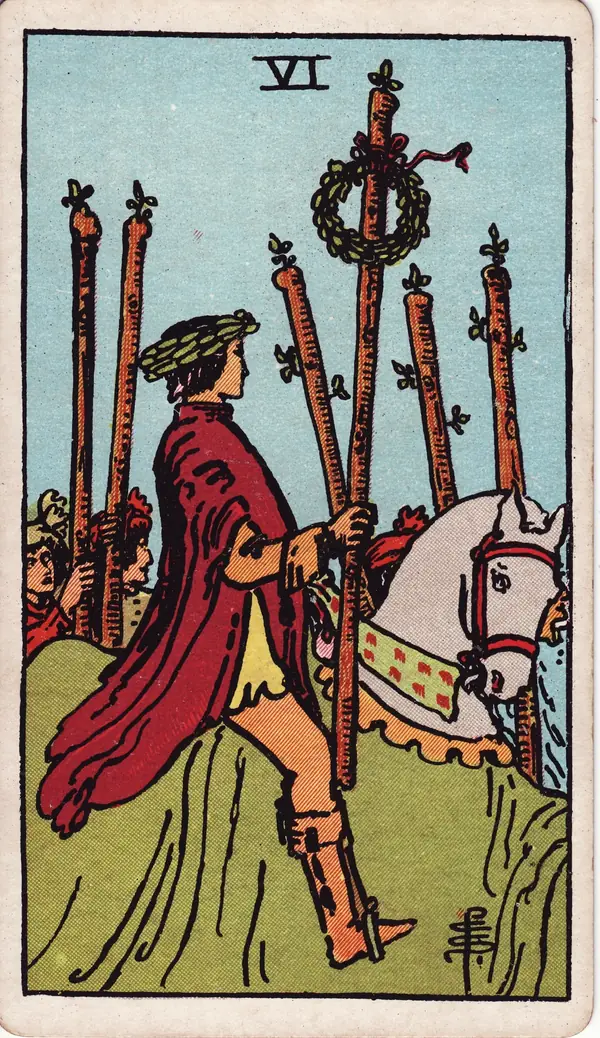
The image shows a figure on horseback moving through a crowd, a wreath on his head and another tied to his staff. People raise their own wands in greeting. There is noise, color, and momentum, but also a quiet question: what happens after the parade? In the Tree of Life, six sits at Tiphareth, the center of Beauty, where balance lets light pass through. Success here is not only dominance; it is the steadiness to hold attention without losing yourself.
When the card lands upside down, the wish for recognition does not disappear. It may simply become anxious, private, or tangled with pride. Read it as a card about visibility, support, and the responsibility that comes with being seen.
Six of Wands Kabbalah and Tree of Life
In Classic Tarot correspondences, the Six of Wands is one of the numbered minor arcana, and its six sits at Tiphareth (Beauty), the sixth sephirah on the Tree of Life. Tiphareth stands on the middle pillar, where the forces on either side meet and balance. Its themes are harmony, wholeness, and a stable self. This does not mean conflict disappears; it means that after earlier struggles a person finds a center to live from. The suit corresponds to fire, and the card also belongs to Atziluth, the archetypal world among the four worlds. Two layers are useful: the sephirah describes the nature of this step, while the world describes the level on which it unfolds. Fire concerns will and action, water feeling, air thought, and earth practical reality. The victory of the Six of Wands is therefore less about private reassurance and more about having your will confirmed, then acting so others can see it.
This structure helps split being seen into an inner and outer layer. In love, a public relationship and the blessing of friends and family are outer expressions of Atziluth. What actually steadies the bond is whether the two people are aligned in values and in the direction of their lives; that is the work Tiphareth asks for. If there are only photographs and occasions while privately each person goes their own way, the correspondence has broken down.
Work follows the same pattern. A proposal approved, a presentation given, a project reaching a milestone—these are fire unfolding in practical life. The sephirah reminds you that the result should serve a more complete self, not just outshine a colleague. In personal growth, you may have just left a stretch of self-doubt and begun to admit what you can do. The Six of Wands does not ask you to camp in the applause. It asks you to bring that confidence back to your center and take the next step.
The Classic Tarot tradition often links this card to Jupiter in Leo. Jupiter enlarges confidence, while Leo needs a stage, and that fits the image of a center being lit up and actions being witnessed. The light should come through—but its source remains in you.
Six of Wands Numerology
The Six of Wands carries the number six. In the numbered minors it comes after the Five and before the Seven. The previous card often brings contest and friction, while the next brings a fresh challenge, so the Six feels like a temporary pause: events have produced a result, but feelings still need to be rearranged. In stage terms, six often points to choice, the search for balance, and nostalgia. On this card, victory is not the finish line. You decide how to treat the result—whose congratulations to accept, whom to credit, and whether you are still brooding over an earlier effort that went unseen. Nostalgia can also attach to old recognition, making you compare today's applause with what came before.
Six is often described as generous, nurturing, and devoted to harmony and high standards, with family and relationships at the center. It is willing to put on a good show for others and can treat being needed as the source of its worth. The public recognition of the Six of Wands brings this pattern into the light. You are glad not only because you won, but because someone has finally affirmed what you gave. But if the applause stops and your mood collapses, the shadow of six appears: overgiving, perfectionism, and using achievement to earn love.
The major arcana counterpart is the Lovers. The Lovers deals with choice, the ranking of values, and union. The Six of Wands brings choice into public view: whom you stand with, what goal you work toward, and whether you accept support. Both cards remind us that harmony is not about pleasing everyone; it is about matching inner values with outer action. The Lovers leans toward a private decision; the Six of Wands leans toward that decision being openly confirmed. The two make a useful pair.
If six is your life path number, use this card as a mirror: are you once again caring for others in order to buy approval? Numerology is only a reference; it cannot draw conclusions for a person.
Six of Wands and the Element of Fire
The Six of Wands belongs to fire. In Classic Tarot, fire carries drive, responsibility, and command of a situation. Its gift is daring and the willingness to shoulder the load; when trouble appears, it acts first. Its weak spot is putting feelings into words, so it may push through exhaustion. Here fire makes the result tangible. It is not "I think I did fine" but standing before people, finishing the task, and letting supporters see. The triumph has heat and a cost, because once fire is seen it wants to keep proving itself.
Fire and air cooperate: air gives direction, fire gives thrust. Water and earth support each other, water nourishing and earth receiving. Fire and water pull opposite ways, one outward and one inward, creating the tug between wanting to shine and fearing exposure. When many Cups appear beside it, a public win may stir something private, and applause may not reach the need underneath. Beside Swords, watch the pressure of being evaluated in words. A fire-heavy spread puts action, competition, and visibility in the foreground; the person is busy and can easily overdo it. In our view, that calls for planned rest—do not mistake "I can still handle it" for "nothing is wrong."
At work, extra fire pushes you to compete for the chance to present or lead the charge, but too little water can blind you to colleagues' feelings. In love, fire takes a relationship public and encourages initiative, yet it may chase "we look happy" and forget to ask whether either of you is tired. In personal growth, fire supplies the spark and is well suited to showing finished work; when it runs too hot, it becomes comparison or a fight for the spotlight. Give fire direction, let water cool it, and let earth give it somewhere to land.
What does Six of Wands mean upright?
Upright, the Six of Wands carries victory, recognition, and confidence. It often appears when a private effort becomes public: a proposal is approved, a project goes live, a tryout ends with your name on the list, or a family member finally says they are proud. The support around you is not only polite applause; people offer introductions, resources, or a seat at the table. Fire makes confidence visible, so you speak more freely about what you built. Still, the wreath marks a stage, not the whole road. Enjoy the welcome, then check what the next stretch asks of you.
Six of Wands reversed meaning
Reversed, the Six of Wands points to letdown, empty fame, and pride. The work may be real while the acknowledgment is thin: a win is ignored, credit goes elsewhere, or congratulations arrive without help. Another version is internal—needing the room to approve before you trust your own result. Fire stalls when it has no honest outlet, and people can become irritable, competitive, or overly polished. Check whether support is missing or whether applause has become the price of self-respect. The card does not cancel success; it asks you to separate substance from display.
Six of Wands in love: single, in a relationship, reconciliation
The love reading depends less on chemistry than on how public and supported the bond feels. Six of Wands love is rarely secretive; it wants witnesses, introductions, and a sense that friends and family are glad for you. That can be lovely, and it can be pressure. Use the surrounding cards to see whether the attention is nourishing the relationship or replacing private honesty.
Six of Wands upright love
Upright in love, the relationship has a healthy outside face. A partner introduces you without hesitation, friends include you both, and a difficult week brings practical help rather than vague encouragement. If you are dating, someone may play matchmaker or speak warmly about you to others. The warmth is genuine, but do not let a good audience substitute for a good conversation. Ask whether the same courtesy exists when no one is watching. Public support is a bonus; private steadiness is the foundation.
Six of Wands reversed love
Reversed in love, the bond may feel unsupported or overexposed. Relatives question it, friends compare your partnership to theirs, or one of you wants to keep things quiet for reasons that never get explained. Sometimes the issue is performance: you look happy for photos and avoid the subject on the drive home. Recognition matters, but it cannot repair a trust gap. Name what feels unsafe, and notice whether your partner defends the relationship or only defends their image.
Six of Wands love for singles
For singles, the Six of Wands brings attention and helpful connections. A coworker asks what you are looking for, a friend offers an introduction, or you meet someone at a celebration where you feel unusually at ease. Say yes to the invitation, but keep your own pace. Being admired is not the same as being chosen well. Let interest build through consistent messages and plans, not through a crowd's encouragement. The right person should make you feel seen in private, not just envied in public.
Six of Wands in a relationship
In an existing relationship, this card often shows a couple who can celebrate each other openly. You may attend a work event together, receive good news as a team, or finally feel accepted by each other's circle. It also asks you to share the spotlight. If one person's career is soaring, make room for the other's smaller wins. A relationship stays warm when praise flows both ways. Use the good season to talk about logistics, money, and the next shared goal while spirits are high.
Six of Wands and getting back with an ex
With an ex, the Six of Wands suggests that mutual friends or public occasions could reopen the door. A reunion at a party, a message after your name comes up in conversation, or a sincere apology delivered without an audience are all possible. The risk is treating reconciliation as a trophy. Ask what has changed since the breakup, not who would be impressed if you got back together. If the old pattern is still intact, a warm welcome will only lead to the same goodbye.
Six of Wands as feelings: how they feel about you
When the Six of Wands shows up in a feelings position, look at the emotional weather around being seen. Someone may feel proud to be connected to you, or may worry about measuring up. The card describes a person who notices your light and is aware of the crowd around it. Context decides whether that awareness becomes affection, distance, or a need to perform.
Six of Wands upright as feelings
Upright as feelings, this person regards you with admiration and a touch of pride. They may mention you to friends, save your messages, or feel genuinely lucky to have your attention. There is warmth here, but also a social dimension: they care how the connection looks and may enjoy being associated with you. That is not automatically shallow. Just remember that admiration is a feeling about your qualities; love is a decision about your needs. Watch for consistent effort after the excitement settles.
Six of Wands reversed as feelings
Reversed as feelings, the person may feel overshadowed, overlooked, or unsure where they stand. Your success could make them proud and uneasy at the same time. They might withdraw to protect their ego, hide the connection from others, or wait for you to prove you still need them. Some of this is insecurity rather than lack of care. Still, you are allowed to want a partner who can celebrate you without turning your good news into a competition.
Six of Wands as how someone sees you
As how someone sees you, the Six of Wands casts you as confident, capable, and a little commanding. They notice the way you handle a room, finish what you start, and receive attention without collapsing. You may seem more certain than you feel. If you want them to know the softer side, let them see a decision you are still making or a failure you have survived. Being admired is a start; being known requires a less polished frame.
Six of Wands as intentions
As intentions, the card points toward openness and forward motion, with a caveat about image. This person may want to date you publicly, introduce you to friends, or support a goal you care about. They enjoy the idea of being a good partner in visible ways. But ask whether their plans include quiet Tuesday evenings and difficult conversations, not only celebrations. Intentions built mainly on pride can fade when the applause stops. Look for follow-through that does not require an audience.
Six of Wands career and work (upright & reversed)
In work, the Six of Wands is one of the clearest cards of earned attention. It favors pitches, launches, interviews, awards, and any moment when your contribution needs to be named. It can also expose the gap between being praised and being properly supported. Read it as a question of visibility with consequences, not simply a lucky break.
Six of Wands upright career
Upright at work, your effort reaches the right eyes. A manager repeats your idea with your name attached, a client renews because they trust you, or a hiring panel makes their enthusiasm clear. Use the window: ask for the budget, the title, or the introduction while people are paying attention. Share credit generously, especially with the people who made the result possible. Then write down what worked. A public win becomes a durable reputation only when it is followed by reliable work.
Six of Wands reversed career
Reversed at work, recognition is uneven. A launch succeeds and the team hears nothing, a promised promotion stalls, or praise comes with extra unpaid work. You may also be the one overplaying confidence because a setback feels humiliating. Before assuming the worst, gather facts: what was actually decided, who controls the next step, and what evidence is missing. Have a private conversation with the person who can change the outcome. Rebuild trust through small, documented deliveries rather than a louder performance.
Six of Wands for money and finances
Money follows the card's theme of earned visibility. A bonus, final invoice, raise, or new client may arrive because someone witnessed your work. That is a reason to review your pricing, not to assume the next month will be easy. Put extra income toward obligations and a modest cushion before upgrading your lifestyle. If a promised payment is late, ask for terms in writing and keep a record. Reversed, the warning is about image spending: treating people, buying status, or lending money to seem successful. Generosity is fine when it fits your budget; appearances are a poor financial adviser.
Six of Wands for health
The Six of Wands is not a health diagnosis. It describes the body under attention: performing, being evaluated, holding good posture while tired. You may feel energized by a completed goal, then crash after the celebration. Protect sleep, take real breaks between events, and notice tension in your shoulders, jaw, or eyes. If you feel unwell, see a doctor rather than reading the card for a cause. Anyone who is pregnant should follow medical guidance, not a tarot verdict. Rest is part of sustaining success.
Six of Wands as advice
The advice is to receive recognition without making it your oxygen. The card wants you to enjoy the win, name the people who helped, and then choose the next step for reasons sturdier than applause. Upright, the lesson is graceful confidence. Reversed, it is resilience when the crowd is quiet or critical. Both directions ask you to keep ownership of your own measure.
Six of Wands upright as advice
Upright, accept the compliment instead of deflecting it. Then get practical: thank the people who supported you, document the result, and ask for the resource that will help you repeat it. Celebrate in a way you can afford and remember. Before you commit to the next visible role, ask whether you want the work or only the recognition. The healthiest victory makes your life larger, not just your audience.
Six of Wands reversed as advice
Reversed, stop auditioning for people who are not paying attention. Identify the support you actually need—clear feedback, a fair credit split, a mentor, or simply rest—and ask for it directly. If pride is keeping you from admitting a mistake, repair it with a specific action. You do not have to win over every skeptic. Build a quieter record of reliable work, and let the next round of recognition find something solid to land on.
Six of Wands as a person
As a person, the Six of Wands describes someone who is comfortable being seen. They can present a project, rally a group, and accept a compliment without shrinking. There is fire in their manner: quick decisions, warm confidence, a taste for momentum. They often become the spokesperson or the one others remember. The shadow is dependence on the spotlight. A mature version shares credit and can be gracious when someone else rides ahead.
Six of Wands reversed as a person
Reversed as a person, this figure may be charming in public and fragile in private. They could chase titles, name-drop, or turn a setback into a story that protects their image. Another version is someone whose confidence has been bruised and who now avoids attention altogether. Neither is a fixed character. Ask how they behave when they lose, when no one claps, and when a friend succeeds. Those moments reveal whether the confidence has roots.
How to place it in a reading
Place the Six of Wands by position before you interpret it. In the past, it can mark an earlier win that still shapes your confidence; in the present, a season of visibility; in the future, a result that will be witnessed. In an obstacle position, the block may be pride or fear of judgment. As an outcome, it suggests recognition, though reversed it can mean a mixed public response. Check the cards beside it for the difference between support and spectacle.
Our take
Our take is warm but clear-eyed: the applause in the Six is real, but don't let the next move be only for applause. The card deserves its reputation as a positive omen. It shows effort turning into acknowledgment and gives you permission to enjoy that. The caution is subtle. Recognition can become a habit you chase instead of a gift you receive. Let this win strengthen your work and your relationships, not just your image. Then the confidence will have somewhere to live after the crowd goes home.

FAQ
These are the questions readers ask most often about the Six of Wands. Each answer begins with the short version, then explains how to apply it without losing the nuance of the card.
Is Six of Wands a yes or no card?
Yes. It leans yes, especially when the question involves visibility, approval, teamwork, or a result you have already worked for. The card is generally favorable in a yes-or-no reading. It suggests that effort can be acknowledged and that people with influence may support you. The answer is strongest when you have done the practical work and are ready to be seen. Treat it as a confident yes rather than a guarantee. If the question depends on someone else's private decision, the card shows openness and positive attention, not control over their choice.
What does Six of Wands reversed mean in a yes or no reading?
Still leans yes, but with delays and a need to repair support, messaging, or confidence before the result feels solid. Reversed, the Six keeps its basic direction. The opportunity is not usually canceled; it is underrecognized or tangled with pride. You may need to clarify who gets credit, ask for a promised resource, or lower the volume of your own performance. Give the situation time to catch up with the work. A direct conversation often does more than another public appeal.
What does Six of Wands mean if you have a secret crush?
It suggests your good qualities are noticeable, but the person may hesitate to act while you are in the spotlight. In a crush situation, this card often means you stand out. They may admire your confidence, hear good things about you from others, or enjoy watching you in your element. That does not always translate into private courage. Watch for small, consistent signs: a message that continues a conversation, an invitation without a group, a question about your actual life. If they only engage when others are around, keep your expectations steady and let their behavior tell you more than the card.
What does Six of Wands mean for marriage?
Generally positive: the relationship can receive public support, though the celebration should not replace honest planning. The Six of Wands tends to favor engagements, introductions, and ceremonies that bring people together. Families may be more willing to show up, and friends may share genuine enthusiasm. It is a good card for being open about the relationship. Reversed, pay attention to budget and to whose approval is driving the plans. A beautiful event cannot settle questions about daily life, money, or communication. Make the private agreement first, then invite the world to celebrate it.
What does Six of Wands mean as an outcome?
A visible result, recognition, or a moment when effort is acknowledged; reversed, the outcome arrives with mixed reactions. As an outcome, the card points to a conclusion that other people can see. You may receive a title, a public yes, a finished project, or an apology that clears your name. The result tends to carry social weight. Reversed, the result may still come, but the response is uneven. Some people celebrate while others question. Decide in advance what success means to you so that outside noise does not rewrite the ending.
What timing does Six of Wands suggest?
Often soon after a period of effort, such as the end of a project, event, or evaluation; it rarely names a precise date. The Six of Wands has a processional feel: something has been completed, and now it is being presented. Timing often lines up with a launch, a results day, a performance, or a gathering where news becomes public. Use the other cards and the calendar around the question for specifics. This card describes the season of acknowledgment, not a clock. If the opportunity is already in motion, expect movement when a decision becomes visible to others.
Does Six of Wands mean pregnancy?
No, the Six of Wands is not a pregnancy card; it speaks about recognition, confidence, and public support, not fertility. Nothing in the image or the card's core meaning points to pregnancy. It is better read as a question of being seen, receiving credit, or stepping into a more public role. If you are trying to conceive or have health concerns, rely on medical testing and professional advice. A tarot card cannot confirm or rule out pregnancy, and it should not be used that way.
What zodiac sign is Six of Wands?
Jupiter in Leo is the common traditional correspondence, linking expansive confidence with a need to shine. Jupiter brings growth, generosity, and belief, while Leo brings warmth, performance, and a desire to be recognized. Together they describe the card's blend of optimism and visibility. Some readers also connect the Six of Wands with the broader fire element and the number six's theme of harmony after conflict. You do not need to use astrology to read the card well, but the correspondence can add a useful layer when the question is about confidence or public reception.
Is Six of Wands a good or bad card?
Mostly good. It affirms effort and brings support, though it warns against chasing applause for its own sake. The Six of Wands is usually a welcome card. It suggests that work is noticed, that a relationship can be acknowledged, and that confidence is justified by something real. Its shadow appears when recognition becomes the only measure of worth. Reversed, the card can show pride, letdown, or empty praise. Even then, it is a prompt to rebalance, not a prediction of disaster.
Related cards
- Five of Wands: the competition and friction that make this win feel earned.
- Seven of Wands: the next test, where you must defend the position you have gained.
- The Chariot: another card of public momentum, with more emphasis on direction and control.
- The Sun: clearer, simpler joy and success, with less concern about reputation.
- Three of Cups: the shared celebration that often accompanies this kind of recognition.
- Page of Wands: the first spark of ambition and the wish to show what you can do.