Five of Cups (5 of Cups) Meaning: Reversed, Love, as Feelings, Yes or No

Draw a Classic Tarot spread →Free, no sign-up. Think of your question, then draw.
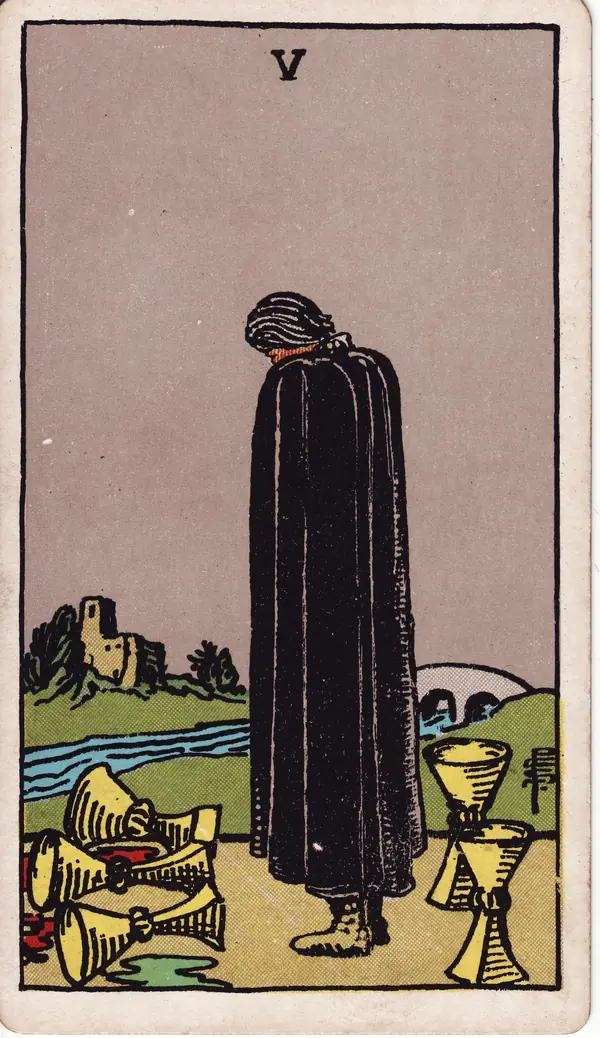
In one line: Three cups spilled; two still stand behind.
| Keywords | |
|---|---|
| Upright | loss, regret, focusing on what spilled |
| Reversed | acceptance, seeing what's left, recovery |
| Type | Cups · water |
| Yes/no (our grading) | leans no |
Quick answers: yes/no · love · career
- Yes/No: Under our grading, Five of Cups leans no. Yes/no is the least reliable use of tarot—prefer “how should I approach this?”.
- Love: Grief after a breakup or letdown; reversed, starting to let go.
- Career: Setbacks and losses; reversed, finding what can be saved.
*FateClear Editorial Team*
Want to draw a Classic Tarot spread? Draw cards.
The Five of Cups is the fifth card in the Cups suit of the Classic Tarot, numbered five and tied to water. If Cups speak the language of attachment, memory, and emotional weather, the Five is the moment the weather turns. Something has been lost, and the mind keeps returning to it. The familiar image shows a cloaked figure standing before three overturned cups while two cups remain upright behind them. A river runs nearby, and the road ahead asks for a choice.
It is also written 5 of Cups. The core meaning is simple: three cups have spilled, and two are still standing. Most people see the spill first. Regret arrives before the inventory of what remains, which is why this card often appears when someone is replaying a loss instead of noticing available support.
Read upright, it points to grief and fixation on the missing part. Read in reverse or upside down, it can show the first turn toward acceptance, or a deeper refusal to look back. Either way, the card is less a verdict than a question about where attention is going.
Five of Cups Kabbalah and Tree of Life
In the Tree of Life correspondence, the Five of Cups is first a number card, so begin with the number five and its place in Geburah (Severity), the fifth sephirah. Geburah sits on the left pillar of Severity, and its nature is power, cutting, conflict, and correction. It is not only punishment. It works more like a blade that separates things which have been mixed together. The suit then adds its element: Cups belong to water and to Briah, the World of Creation among the four worlds. Read together, the card describes an emotional matter passing through a severe cut. Geburah explains why the step hurts; Briah explains that the hurt lands in feeling and relationship. Together they say more than the bare word loss.
Number cards are not given a path number, and they carry no Hebrew letter. The important point is this crossing of number, sephirah, suit, and world. That structure helps separate being wounded from seeing clearly.
Fictional example: after a breakup, someone keeps replaying the good years. The energy of Severity pushes them to see which promises were never kept and which boundaries were crossed. The fallen cups are facts. The two cups still standing are not cheap comfort; they are friends who can still be relied on and dignity that can still be protected. Once the cut is admitted, the loss does not have to be dressed up as fate.
At work, a failed project or a broken partnership calls for an inventory. Which efforts should stop? Which responsibilities need clearer lines? Which experience is worth keeping? If self-blame takes over, Severity turns into inner friction. If it is used to end a pointless drain, it becomes correction. The same applies to personal growth. Five in water can magnify emotion, while Geburah asks for boundaries around it. You may be sad without collecting every fault as your own. Blame the whole environment and you miss what you can adjust; blame only yourself and you miss the structural limits.
Classic Tarot tradition often gives this card the astrology of Mars in Scorpio. Mars brings cutting and action; Scorpio deepens emotional concentration. This echoes the structure of Severity expressed through water: the pain is strong, yet the ability to tell things apart can grow inside it.
Five of Cups Numerology
In numerology, the Five of Cups begins with the number five. Number cards from Ace to Ten are often read as stages in a developing situation, and the fifth stage is not a cozy midpoint. It is where a new challenge appears and the situation escalates. The first four may have just established a little order. Five arrives like an outside force that knocks the arrangement sideways: a plan gains a variable, a relationship brings up an old account, and a person is forced to choose a position again. The image of the Five of Cups shows the emotional reaction after that escalation. The foundation is not absent; it has been shaken, and attention goes straight to the cracks.
The character of five is easy enough to recognize: curiosity, a wish to go out, openness to new things, and a tendency to scatter. More steps can mean a more scattered heart. In this card, the outward push may look like searching for an exit—talking to anyone who will listen, rereading old messages, comparing your life with other people's. It may also look like avoidance, leaving the real task aside. The gift of five is that it keeps a person from freezing in place. The risk is mistaking movement for a solution.
The major arcana card tied to five is the Hierophant. The Hierophant speaks of shared norms, belief, and an order that can be followed. The Five of Cups brings the problem to those frames: when an expectation fails, does your old way of relating still apply? The link between the cards is not surface mood. It is the question "Do I keep following the old order?" One card asks you to examine tradition; the other asks you to examine the standard behind the loss.
If five is someone's life path number, drawing the Five of Cups can be a useful reference, not a verdict. You may want to move outward, but first tell exploration from busyness that covers sadness. Rearranging the route is more useful than forcing yourself to feel cheerful at once. Every number is only a reference, never a fixed destiny.
Five of Cups and the Element of Water
The Five of Cups belongs to water. In Classic Tarot, water governs emotion, memory, relationships, and inner experience. Its strength is sensitivity to small things; its weakness is the tendency to stay inside what it feels. In this card, water gives loss an echo. A sentence never spoken, a familiar place, a song in a shop—any of these can bring the emotion back up. Water does not hurry to supply an answer. It first lets a person feel "I really did lose something." That sensitivity is real, and it is also the place where this card is most often misread. Intense feeling does not prove that nothing can change.
The Five of Cups is a number card, so an element reading looks only at the water of the suit. There is no court rank element to add on top; only Cups court cards combine their rank's element with the nature of water. Water itself is not a bad element. It can hold, and it can also let things build up. When feeling sits too long, a person circles the same memory and mistakes "I still remember" for "we can still go back."
Elements also cooperate and clash. Water and earth work well together: earth brings emotion down to practical reality, turning "I am very sad" into "eat something today, sleep, then handle one thing." Fire and air work well together: fire supplies drive, air supplies a plan. Fire and water are more likely to conflict. One wants to act now; the other is still feeling. The result can be an impulsive confrontation followed by regret. In a Five of Cups reading, steady earth in the spread makes it easier to use the two standing cups for rebuilding. Strong fire may turn grief into an argument or a decision. That can be fast, but it may burn parts that could still be repaired.
When Cups dominate a spread, common themes are overthinking, heavy feeling, and slow action. In a love question, too much water can mean strong old emotions and strong empathy, along with many imagined versions of the other person's silence. At work, it can mean caring a great deal about atmosphere and recognition while losing sight of concrete progress. At that point, adding an earth step or borrowing fire's willingness to act is more useful than another round of emotional analysis.
What does Five of Cups mean upright?
Upright, the Five of Cups carries loss, regret, and a focus on what spilled. It shows up when a person keeps returning to the version of events that did not happen: the relationship that could have lasted, the job that almost came through, the money that should not have been spent. The cloaked figure is not without options. The two standing cups are real. But disappointment has narrowed the field of vision.
This is not a card of total ruin. It is a card of absorbed attention. The sadness is genuine, and so is the loss, yet the remaining resources have not vanished. The river in front of the figure suggests that crossing over will take time. No single piece of advice will dissolve the regret. Upright, the card asks for honesty first: name what was lost, then check whether every ounce of attention has been handed to the past.
Five of Cups reversed meaning
Reversed, the Five of Cups is not simply the upright card turned into good news. It has two possible directions. One is acceptance, seeing what is left, and beginning to recover. The other is a deeper withdrawal: refusing comfort, avoiding the next step, and circling the same disappointment until it becomes a private identity.
The difference usually comes from context. Supportive surrounding cards, a real network of people, and a willingness to ask for help point toward the first reading. A heavy spread, isolation, and repeated rumination point toward the second. Reversed can also mean that someone is hiding grief behind a calm surface. They say they are fine, but they are still keeping accounts on an old wound. The card asks for honesty rather than a performance of strength.
Five of Cups in love: single, in a relationship, reconciliation
In love, the Five of Cups shifts the question away from whether someone loves you and toward whether you can see the affection that is actually present. A person may be waiting for one specific response while ignoring a kinder, steadier one nearby. The card does not ask anyone to settle. It asks them to stop grading every possibility against a loss.
Five of Cups upright love
Upright in love, the card often reflects a fixation on an unmet response. Someone flirts with you, but you only remember the person who never called back. Your partner apologizes, but you replay the argument instead of hearing the repair. The two standing cups can represent loyalty, shared history, or a genuine offer of closeness that has not been noticed yet.
This does not mean the disappointment is imaginary. It means the disappointment has become the whole story. A useful next step is to separate the specific hurt from the general conclusion. "I was hurt when you forgot our plan" is workable. "You never care" closes the door before anyone can respond.
Five of Cups reversed love
Reversed in love, the card asks whether someone is actually moving forward or only talking about it. One version is healthy: the person stops comparing every new date to an ex, accepts that the old relationship has ended, and becomes available again. The other version is stuck: they say they have moved on, but every conversation circles back to the same grievance.
Watch actions rather than declarations. Are they making time, listening, and adjusting? Or are they waiting for you to prove something before they risk anything? Reversed love can be a quiet turning point, but it can also be a longer detour through the same hurt. The card favors the version where someone tells the truth about what they still need.
Five of Cups love for singles
For singles, the Five of Cups often appears when an old attachment is still setting the standard for everyone new. You may keep old messages, revisit a certain song, or decline invitations because no one feels quite right. The issue is not that you are picky. The issue is that you may be measuring new people against a ghost.
The two upright cups can be friends, hobbies, or fresh social chances that you have not given a fair look. You do not have to force attraction or rush into a relationship. Start by naming what you are still mourning. If the loss belongs to an ex, create a small closing ritual. If it belongs to a fantasy, acknowledge the fantasy without letting it run the whole search.
Five of Cups in a relationship
Inside a relationship, the upright Five often shows up as a season of disappointment. A special day passed without much effort, a message went unanswered, chores feel uneven, and suddenly the whole relationship looks thin. The complaint may be valid, but the card warns against letting one disappointing chapter overwrite every good page.
The better move is specific speech. Instead of opening with "you always" or "you never," describe one event and its effect. "When I was sick last week and you did not check in, I felt alone" gives the other person something to respond to. The standing cups are still there: shared routines, past care, and the willingness to keep showing up.
Five of Cups and getting back with an ex
With an ex, the Five of Cups usually says that fondness and hurt are both present. The three fallen cups hold the disappointments that led to the breakup. The two standing cups hold memory, chemistry, and whatever care survived. Nostalgia alone is not a plan, because the original problem will still be waiting when the reunion glow fades.
Before reopening the door, ask whether both people can discuss the practical issues: communication, boundaries, money, family, or whatever caused the split. If only one person is doing the reaching, a little warmth can look like a full invitation when it is not. Reconciliation works when it builds a new way of being together, not when it simply restores the old pattern.
Five of Cups as feelings: how they feel about you
As a feelings card, the Five of Cups suggests that the person's emotional focus is on disappointment rather than fresh excitement. They may care about you and still be preoccupied with something that went wrong between you. Their inner weather is cloudy, and their responses may be slower or more guarded than usual.
Five of Cups upright as feelings
Upright as feelings, they are likely replaying a moment when they felt let down. Perhaps you canceled plans, spoke sharply, or seemed distant during a stretch when they needed reassurance. They may now read ordinary moments through that lens. A short reply feels like rejection. A missed call feels like proof.
This does not mean they have stopped caring. It means their attention is caught on the injury. They may struggle to name it directly because they do not want to seem petty. If you want clarity, ask about a specific recent moment rather than demanding a summary of their entire emotional state. A concrete question is easier to answer than "what are you feeling?"
Five of Cups reversed as feelings
Reversed as feelings can show a thaw. They may be starting to see your good intentions again and to recognize that the relationship is not only made of disappointment. They might be ready to talk, though perhaps not ready to forget. The reversal often marks the moment when someone stops rehearsing the argument and considers the possibility of repair.
It can also show stubborn withdrawal. They may care deeply but feel trapped between wanting closeness and fearing another letdown. In that state, they might test you, go quiet, or wait for you to make the first move. Look for consistent behavior over time. One warm message is a moment; a pattern of honest contact is a change.
Five of Cups as how someone sees you
When the Five of Cups describes how someone sees you, they may view you as someone carrying sadness, or as someone still attached to a past chapter. They might see you as disappointed in them, even if you have not said so directly. In some readings, they see you as the person who got away, which can make them cautious rather than bold.
They may also see you through the filter of one painful event. If that is the case, their view is incomplete, but it is still their current view. You cannot argue someone out of a perception. You can offer steady, ordinary evidence that contradicts it: reliability, follow-through, and calm conversation over time.
Five of Cups as intentions
As intentions, the Five of Cups is not a card of pursuit. It suggests that the person's intention is shaped by disappointment. They may want to protect themselves from another loss, or they may want an apology before they invest further. Their actions could look inconsistent because one part of them wants to move closer and another part wants to keep a safe distance.
Check whether their intentions are spoken or only implied. A person who intends to repair will usually name the problem, make a concrete gesture, and accept a conversation. A person who only wants relief from guilt may offer vague warmth and then disappear again. The card asks you to read the whole pattern, not one hopeful sign.
Five of Cups career and work (upright & reversed)
At work, the Five of Cups often appears around disappointment with results: a promotion that went elsewhere, a project that lost support, or a role that looked better from the outside. The card is less about ability and more about where attention goes after a setback.
Five of Cups upright career
Upright in career, you may be focused on the opportunity that did not materialize. A rejection email stays open on your screen, or you keep replaying an interview answer you wish you had given differently. Meanwhile, other leads, supportive colleagues, and usable skills are still available but less visible.
This is a poor moment for a dramatic resignation made out of frustration. It is a good moment to separate the disappointments into categories. Is the problem the work itself, the manager, the pay, or the lack of growth? Once the complaint is specific, you can decide whether to negotiate, wait, or prepare an exit. The card does not forbid leaving. It asks you not to leave while your eyes are only on the spilled cups.
Five of Cups reversed career
Reversed in career can be a genuine turning point. You stop repeating the same complaint, update your resume, ask for a conversation, or learn a skill that gives you options. The reversal supports small, concrete movement. It favors the person who takes one step this week over the person who makes a grand plan and changes nothing.
There is also a risk: impulsive action after a long period of swallowed frustration. Quitting without a buffer, sending an angry message, or taking the first offer just to escape can recreate the same problem somewhere else. Check your finances and your reasons before making an irreversible move. If the same conflict keeps following you from job to job, the card invites you to examine the part you can change.
Five of Cups for money and finances
With money, the Five of Cups tends to point toward dissatisfaction with what has already happened rather than a sudden windfall or a total collapse. You may regret a purchase, feel behind compared with others, or fixate on a loss. The card asks you to look at the whole account, not only the line that hurts.
Upright, it can show avoidance. You do not want to open the statement because you already feel bad about the number. Or you keep comparing your progress to someone else's and conclude that your own effort is pointless. A calmer approach is to name the actual situation: what came in, what went out, what obligations remain, and what breathing room exists.
Reversed, the financial picture may be shifting. You might finally face the bills, trim a subscription, or ask for help organizing your budget. That is recovery. The other possibility is anxious swings: extreme frugality followed by a impulsive splurge, or a wish to win back a loss with a bigger risk. The card does not promise wealth and does not recommend specific investments. It supports steadiness, accurate information, and decisions made outside a panic.
Five of Cups for health
On health, the Five of Cups is best read as a prompt about stress, rest, and emotional load. It can describe the kind of low mood that affects sleep, appetite, and energy. You may lie awake rehearsing an old conversation, skip meals because you do not feel hungry, or carry tension in your shoulders without noticing it.
Upright, the card asks you to take basic care seriously. Keep a regular bedtime, eat something simple even when appetite is low, take a short walk, and tell one trusted person how you are doing. These are not cures for grief, but they keep the body from being neglected while the mind works through it.
Reversed, recovery may be starting, but there is a risk of overdoing it. Someone who feels a little better may fill the calendar and crash again. Pace matters. Pay attention to persistent headaches, stomach trouble, a racing pulse, or fatigue that does not lift. If symptoms continue or worry you, see a doctor. Tarot cannot diagnose illness, and pregnancy cannot be confirmed or ruled out by this card.
Five of Cups as advice
The advice of the Five of Cups is not to pretend the loss did not happen. It is to stop letting the loss occupy the entire view. Upright, the work is to turn around. Reversed, the work is to make that turn practical. Both ask for emotional honesty and a clear look at reality.
Five of Cups upright as advice
Allow the disappointment to exist. You do not have to rush toward gratitude or forgiveness. Then do one concrete thing that acknowledges what remains. Write down two resources you still have: a friend who answers the phone, a skill you can use, a job that still pays the bills, or an interest that has not died.
Choose one small action that follows from that list. Send the message, tidy the desk, take the class, ask for the meeting. The point is not to feel instantly better. The point is to give your attention somewhere to land besides the spilled cups.
Five of Cups reversed as advice
Reversed, be careful of two extremes. One is endless delay dressed up as depth: waiting for the perfect moment, the full apology, or a feeling of total closure before you move. The other is a sudden overcorrection: a dramatic decision meant to numb the discomfort rather than solve it.
Set a short review period, perhaps two weeks. Notice sleep, mood, and whether your actions are changing anything. If you are still circling, talk to someone you trust or seek appropriate support. Recovery is not a performance of being fine. It is the gradual return of choice.
Five of Cups as a person
As a person, the Five of Cups describes someone who feels deeply and remembers clearly. They may be nostalgic, sensitive to disappointment, and prone to replaying conversations. They are often the one who recalls the exact wording of a hurtful comment, but also the one who remembers a small kindness years later.
This person may be in a low season rather than showing a permanent personality. They could be grieving a relationship, a career setback, or a version of life they expected. They may withdraw without explaining why, not out of coldness but because they do not want to burden others. Patience helps, but so does a direct, gentle invitation to talk.
Five of Cups reversed as a person
Reversed, this person may be emerging from that low season. They are beginning to accept what happened and to consider what comes next. They might be more open to company, more willing to laugh, and more able to speak about the past without being swallowed by it.
Alternatively, they may be quietly entrenched. They insist they are over it, but their choices still orbit the old wound. They may avoid new commitments or compare everyone to someone who is gone. The reversal asks for self-honesty: is this acceptance, or is this grief wearing a calm face?
How to place it in a reading
Start with the position. In a past position, the Five of Cups often points to an unprocessed loss that still shapes present choices. In the present, it shows attention caught by regret. In a future position, it suggests a moment when a disappointment will need to be faced, not a guaranteed failure. The card marks a turning point, but the direction of the turn is not fixed.
Look at the surrounding cards. Warm Cups cards, such as the Three or Six, make the two standing cups easier to see. Sharp Swords cards, such as the Five or Nine, can intensify blame or anxiety. A major arcana card nearby suggests that the situation is tied to a larger life transition, so a single mood should not be treated as the whole story.
Then return to the question. For love, ask whether both people are willing to talk. For work, ask whether the complaint has become a substitute for action. For money, ask whether regret is preventing a clear look at the numbers. The same card enters through different doors, but the core remains: acknowledge the spilled cups, then count the ones still standing.
Our take
We do not read the Five of Cups as a card of permanent failure. The sadness is real, and so is the regret, but the image leaves room to turn around. Two cups are still standing. The road is still there. What is missing is not rescue but a change of attention.
The turn in the Five is turning around. That does not mean forcing a smile or pretending the loss was small. It means giving some of your focus to what can still be used, repaired, or grieved properly. You are allowed to be sad. You are also allowed to notice that not everything is gone.

FAQ
These are the questions readers ask most often about the Five of Cups. The answers below keep the upright and reversed meanings in view, but a card is only one part of a reading. Real conversations, practical choices, and qualified professional advice matter more than any single symbol.
Is Five of Cups a yes or no card?
It leans no. The card's focus on loss and regret makes a clear yes unlikely while the underlying disappointment is still active. This is a "not yet" or "conditions are poor" kind of no, not a curse. If you are asking whether a plan will succeed, the card asks you to check what has already been lost, delayed, or left unresolved. The answer can change if the situation changes.
What does Five of Cups reversed mean in a yes or no reading?
It still leans no, though less firmly. Reversal shows movement and reflection, not a completed reversal of fortune. Someone may be starting to accept reality or see another option, but the old disappointment has not fully cleared. Treat the reversed card as a cautious no with an opening. Look for practical signs of progress rather than reading the reversal as an automatic yes.
What does Five of Cups mean if you have a secret crush?
It suggests you are focused on a response you have not received, so the connection is not clear enough to call mutual. You may be analyzing small signals while ignoring whether the other person takes steady action. Upright, the feeling is absorbed in longing. Reversed, you may begin to see the situation more clearly, or you may simply become more conflicted. Watch for consistent interest, not one encouraging moment.
What does Five of Cups mean for marriage?
It points to disappointment that needs an honest conversation. It does not mean the marriage is doomed. There may be an old hurt, an unmet expectation, or a subject both people avoid. If both are willing to talk, the card can mark the beginning of repair. If only one person is trying, it asks you to see the relationship as it is rather than as you hope it will become.
What does Five of Cups mean as an outcome?
The outcome is a period of reckoning with loss, followed by a choice about what to do with what remains. It does not promise that everything works out, but it also does not say everything is over. Expect a moment when the disappointment becomes impossible to ignore. The result depends on whether you turn toward the two standing cups or stay fixed on the three that fell.
What timing does Five of Cups suggest?
No fixed timeline. Cups timing tends to follow emotional readiness rather than a calendar date. The card describes a process: recognition, grief, then a gradual shift of attention. Surrounding cards and the position in the spread can offer more specific clues. In practice, it is more useful to ask what needs to happen before the next step than to demand an exact date.
Does Five of Cups mean pregnancy?
No. The card cannot confirm or rule out pregnancy. Take a test or speak with a doctor for a real answer. Cups can relate to emotional and bodily themes, but that does not make this card a medical indicator. If you are trying to conceive or worried about a possible pregnancy, use reliable medical information rather than symbolic readings.
What zodiac sign is Five of Cups?
Mars in Scorpio is the traditional correspondence for this card. Scorpio brings emotional depth, memory, and a tendency to hold on to what hurt. Mars adds intensity and the will to act, though that will can turn inward as resentment or outward as a push to move on. These qualities fit the card's atmosphere of concentrated feeling and slow release.
Is Five of Cups a good or bad card?
It is not simply bad. It is a hard but honest card that shows what is gone and what is left. The pain it describes is real, and it should not be minimized. Yet the two standing cups keep it from being a card of total defeat. Its value lies in the invitation to turn around, count what remains, and make a choice from there.
Related cards
The Five of Cups often gains clarity when read beside other Cups cards or cards of conflict and departure.
- Four of Cups: also shows dissatisfaction, but here the emphasis is boredom and a closed-off attitude rather than grief over a specific loss.
- Six of Cups: brings nostalgia and old connections, which can make the past feel warmer and the present harder to leave.
- Eight of Cups: concerns walking away in search of something else, and it often sharpens the question of whether to stay or go.
- Three of Cups: offers friendship and shared support, helping the two standing cups become visible.
- Five of Swords: adds conflict and the urge to win, which can turn regret into a contest over who was more wronged.