Eight of Cups (8 of Cups) Meaning: Reversed, Love, as Feelings, Yes or No

Draw a Classic Tarot spread →Free, no sign-up. Think of your question, then draw.
In one line: Arranging eight cups neatly, then turning toward the mountains.
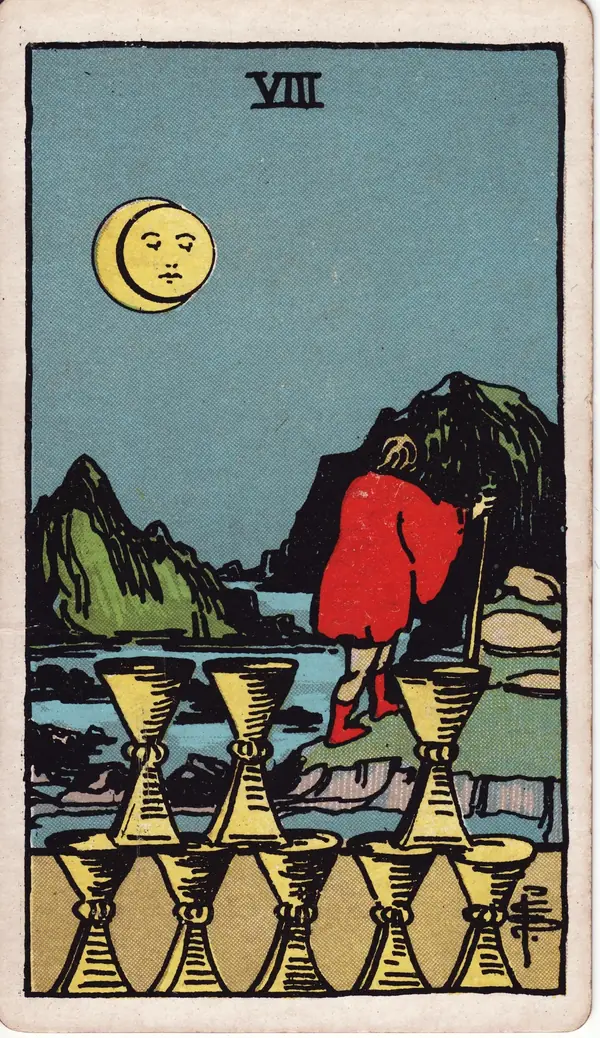
| Keywords | |
|---|---|
| Upright | walking away, seeking more meaning |
| Reversed | reluctance, escapism, going back and forth |
| Type | Cups · water |
| Yes/no (our grading) | leans no |
Quick answers: yes/no · love · career
- Yes/No: Under our grading, Eight of Cups leans no. Yes/no is the least reliable use of tarot—prefer “how should I approach this?”.
- Love: Leaving a relationship that no longer fulfils; reversed, wanting to go but unable to.
- Career: Leaving a stable but empty job; reversed, unsure whether to go.
*FateClear Editorial Team*
Want to draw a Classic Tarot spread? Draw cards.
The Eight of Cups is the eighth card of the suit of Cups, a minor arcana card tied to water. In the Classic Tarot it shows eight cups stacked in a careful row with a gap left open, while a cloaked figure walks away from them toward dark mountains under a moon. It is also written 8 of Cups. The one-line core: arranging eight cups neatly, then turning toward the mountains.
Water usually means closeness, but here it carries a different note — the quiet realization that what you have does not fully reach you. Eight is a number of structure and reckoning. In the Tree of Life the eighth position is linked with Hod, the seat of discernment and limits, and in numerology eight often marks a cycle closing and a price being counted. The card is less about throwing something away than about taking honest inventory first.
Read in reverse, the same figure seems to walk, stop, and glance back. The road is not busy; it is solitary, which is why this card rarely promises an easy exit. Below, the upright and reversed meanings, love, what the other person is thinking, work, money, health, and placement in a spread each get their own space.
Eight of Cups Kabbalah and Tree of Life
The Eight of Cups is a minor card, so on the Tree of Life it does not take a Major Arcana path number or Hebrew letter. Instead, look at where the number sits and which world the suit belongs to. Eight belongs to Hod (Splendor), the eighth sephirah, on the left pillar associated with Severity. Hod leans toward reason, language, analysis, and discernment: it separates what has been mixed together, puts names to feelings, and accepts that resources and ability have limits. Cups belong to Briah (Creation), a world symbolized by water, where emotion, imagination, and relationships move and flow. Put the two together, and the Eight of Cups is not a sudden urge to run. It is an emotional first sense that something is off, followed by an honest inventory, and finally an admission that some gaps cannot be filled by adding another cup. The sephirah tells you what kind of step this is; the world tells you where it happens. That is why the card cares less about the size of the outer event than about the quiet assessment already finished inside.
Fictional example: someone keeps dating and answering messages while privately checking off questions: Do I feel understood? Are we headed the same way? Are my needs always pushed to later? Once the answers are clear, the exit can look sudden.
At work, it is like a job audit: score pay, growth, relationships, and meaning; note what can be negotiated and what requires a different environment. It is not a resignation sent in a fit of temper. In personal growth, it helps separate “my intuition says go” from “I am simply bad at facing friction,” because Hod’s analytical side makes the reasons testable.
The usual astrological correspondence is Saturn in Pisces. Saturn brings boundaries, responsibility, and a reality check; Pisces dissolves edges, idealizes, and feels compassion. Their meeting mirrors discernment with emotional water: feeling is allowed, but it must be given a shape.
Eight of Cups Numerology
In the Classic Tarot, the Eight of Cups carries the number eight. If minor numbers mark stages, eight has moved past freshness, choice, and conflict into progress and action. It also means enough has accumulated to be assessed: you have seen most of what is there, so the next step is movement, with resources prepared. Eight is not frivolous. It cares about patterns, results, and what goes in versus what comes back. It knows how to manage, and it wants the accounts to balance. That creates a useful tension with this card’s image. The figure does not leave because nothing was gained. The figure leaves after weighing the numbers and finding that more investment will not bring what is wanted.
Compare it with Strength, the Major Arcana card of the same number. Strength uses inner steadiness to tame impulse; the Eight of Cups uses clear discernment to end an investment that no longer nourishes. One holds energy inward, the other turns outward, but neither wins by force. Each steadies the self before acting. Strength’s lesson is the fear of being dragged by emotion; the Eight’s is the fear of knowing a mismatch and still not daring to stop. Both begin by admitting what is here.
For someone on life path eight, this card can be a reminder to inventory investments: where time, feeling, money, and talent go, whether the return is worth it, and which costs are just sunk-cost attachment. That is a reference point, not a verdict. The Eight need not mean failure. It can be active reallocation: leave the cups that no longer serve you where they stand, carry the experience, and walk into the next stretch. Progress is not always addition. Sometimes space appears only after subtraction.
Eight of Cups and the Element of Water
The Eight of Cups is a number card in Cups, and its element is water. Water’s nature is feeling, memory, empathy, and imagination. It draws people close while keeping many words unspoken. Water understands emotion well but struggles to turn feeling into action; when a relationship or setting needs to be cut, attachment slows the feet. This is not a court card, so no rank element sits over the suit element here. Only court cards combine a rank’s element with the suit’s water. For this card, water gives a soft judgment: the departure is not born from hate, but from an inner well that no longer answers.
Among elements, fire and air tend to feed each other, while water and earth cooperate more easily. Fire and water clash: one wants to act now, the other is still feeling and remembering. Push too hard and the result is impulse or endless back-and-forth. When Cups dominate a spread, emotion and relationships take the lead. The person may replay feelings while action lags. The Eight there often is not leaving on the spot; the heart left long ago, while the body still stands in the doorway.
A partnered person may endure because shared memories are hard to release, yet keep postponing the real gap. At work, someone may feel loyal to the team’s atmosphere and avoid applying elsewhere even when growth is limited. In personal growth, “wait a little longer” can be mistaken for gentleness. Borrow earth here: write down the reasons for leaving, the timeline, housing, and money plans. Also keep fire from taking over, and avoid irreversible decisions at emotional peaks. Water needs to be heard, but it also needs a boundary. That is this card’s lesson.
What does Eight of Cups mean upright?
Upright, the card describes a departure that starts on the inside rather than in a fight. The cups still stand and the water is still there, but drinking from them no longer answers the real question. So the person sets them down and takes the mountain path. This can look dramatic — quitting, moving out, ending a friendship — or it can be very quiet, like finally admitting that a good situation is not your situation. The card does not say the past was bad. It says the past has stopped being enough, and you noticed.
Eight of Cups reversed meaning
Reversed, walking turns into pacing. You know where the gap is, but leaving feels unsafe, so you put the cups back one at a time and promise to decide later. Common shapes: breaking up and returning within a week, refreshing job listings without applying, telling friends you are fine while rehearsing an exit speech in the shower. Reversed is not a verdict that you must go. It is a warning against letting fear choose for you, and against calling endless tolerance gratitude.
Eight of Cups in love: single, in a relationship, reconciliation
Love is where this card gets asked about most, and the usual fear is that it means nobody loves you. More often it points to a mismatch between what a connection offers and what you actually need: company, understanding, or a shared direction. The card does not rush you toward someone new or push you out the door. It asks you to name the missing piece out loud, because a vague ache is much harder to work with than a specific request.
Eight of Cups upright love
Upright in love, the card usually shows one person quietly measuring the distance. They may still be warm and present, yet something in them has stepped back to look at the relationship from a few feet away. You might notice fewer future plans, longer pauses before answers, or a new interest in time alone. This is not automatically a breakup. It is a signal that the connection needs an honest conversation about what each of you wants next, not another round of guessing.
Eight of Cups reversed love
Reversed in love, the back-and-forth becomes the pattern. Someone threatens to leave and then stays; someone asks for space and then texts at midnight. The relationship may look stable from outside while both people are exhausted by the same argument in new clothes. The card asks a plain question: are you staying because the bond is good, or because change is frightening? If it is the second, that is not shameful — but it is a reason to stop pretending everything is settled.
Eight of Cups love for singles
For singles, the Eight often appears as a habit of disqualifying people quickly. Someone is kind but laughs at the wrong moments; someone is steady but texts too slowly; someone is exciting but vague about Tuesday. High standards are healthy. Trouble starts when every small flaw becomes a reason to vanish, because then the search never lands. Before you walk, check whether you are protecting a real boundary or chasing a picture no living person can match.
Eight of Cups in a relationship
In an established relationship, the card tends to point at something tolerated for a long time. The surface still works — bills get paid, holidays get planned — but one person has started doing emotional math in private. Maybe intimacy has thinned, maybe a family boundary keeps getting crossed, maybe careers have quietly pulled you apart. The risk is not leaving. The risk is staying while your attention has already moved out and letting silence speak for months.
Eight of Cups and getting back with an ex
For an ex question, the upright card leans away from a reunion. A departure usually had a reason, and missing someone does not erase that reason. The useful work is separating loneliness from love: do you want that specific person back, or do you want to feel chosen again? If both people will address the original problem, a return can be honest. If not, treating the goodbye as finished is kinder than a second round of the same lesson.
Eight of Cups as feelings: how they feel about you
People asking what someone feels usually want a clean answer, and this card rarely gives one. It describes a movement inside a person — the sense that something is missing, or a wish to step back and check. Feelings are not actions, and the Eight is often felt long before it is spoken. Watch for consistency between words and behavior. A warm sentence followed by three days of silence tells you more than the sentence alone.
Eight of Cups upright as feelings
Upright, their feeling runs something like: I care, but this does not fully hold me. They may be genuinely fond of you and still feel a distance they cannot explain. Sometimes it is about the relationship; sometimes their own life feels off and they need room to think. Practically, expect less availability and more reflection. Do not chase every pause as if it were a rejection, and do not ignore a pattern of withdrawal that keeps repeating.
Eight of Cups reversed as feelings
Reversed, the feeling is torn. They miss you and resent needing you; they want closeness and also want an exit nearby. That can produce hot-and-cold behavior that is confusing to receive: plans made and canceled, honest talks that end in silence, affection offered and then pulled back. The card suggests they are not settled, and unsettled people rarely make good promises. Give them room to decide, but do not let their indecision become your full-time job.
Eight of Cups as how someone sees you
As how someone sees you, the Eight can mean they view you as the one who might leave — independent, hard to pin down, a little distant. Or it can mean they see you as someone with higher expectations, someone who will not stay where things feel half-full. Neither picture is an insult. Both suggest they are watching to see whether you are truly available. If you want to be read as committed, consistency over time will do more than any speech.
Eight of Cups as intentions
As intentions, the card points toward a plan to step back, not necessarily a plan to hurt you. They may intend to slow things down, test how life feels without the relationship at the center, or settle a personal decision first. That is different from malice, and it is also different from commitment. Listen for language about space, timing, and figuring things out, then check whether their calendar matches what they say.
Eight of Cups career and work (upright & reversed)
At work, the Eight of Cups tends to arrive when a role has become comfortable but flat. You know the systems, you like some of the people, and the paycheck is real, yet Monday mornings feel like borrowing energy from next week. The card supports a thoughtful exit, not a dramatic one. Before you move, list what you can carry with you: skills, contacts, savings, a portfolio, a clear sense of what you refuse to repeat. Then decide whether the problem is the job or the field.
Eight of Cups upright career
Upright in career, the card favors leaving a position or path that no longer fits. That might mean resigning, transferring teams, turning down a promotion that would trap you, or closing a business that has quietly stopped working. It also covers smaller moves: dropping a draining client, ending a side project, asking to change your schedule. The key is direction. A departure with a reason and a plan reads very differently from a departure that is mostly relief.
Eight of Cups reversed career
Reversed in career, the movement stalls. You complain about the job every week but never update your resume; you accept a new offer and then spend months wondering if it was a mistake; you stay because the team is nice while the work has hollowed out. The card asks you to separate three things: lack of skill, lack of information, and plain fear. The first two can be fixed with training and conversations. The third needs a deadline, not another year.
Eight of Cups for money and finances
Money is where this card is most often misread as a promise of loss. It is not. The Eight asks whether a familiar arrangement still serves you: a spending habit, a business partnership, a side income, a salary that costs you sleep. Upright, it may mean finally closing an account, ending a collaboration, or admitting a venture has run its course. Reversed, it often looks like throwing more money at something because quitting feels like failure. The card offers no guarantee of wealth and no specific investment advice. It asks you to read the statements honestly and separate hope from arithmetic.
Eight of Cups for health
The Eight of Cups talks about health through stress, routine, rest, and the signals a body sends when a situation has gone on too long. It might appear as poor sleep during a job you dread, tension that eases only on weekends, or appetite changes when you are anxious. The card cannot diagnose anything and does not replace medical care. If a symptom persists, worsens, or worries you, see a doctor. Reversed, it often describes knowing you need to stop and continuing anyway.
Eight of Cups as advice
The advice here is not "leave" and it is not "stay." It is "know what you are looking for." A departure without a destination tends to recreate the same dissatisfaction somewhere else, and a stay without honesty tends to turn into resentment. So the card asks for specifics: what exactly is missing, what would genuinely meet it, and what are you willing to pay in time, money, and comfort to find out. Vague longing is easy. A written list is harder and far more useful.
Eight of Cups upright as advice
Upright, write two short lists. On the first, name what has run out: recognition, intimacy, challenge, peace, whatever is true. On the second, name what you want next in plain language a friend could understand. Then mark which items are fixable inside your current situation and which need a different environment. If you go, plan the handover and the buffer. If you stay, set a review date. Either way, the choice becomes a decision instead of a mood.
Eight of Cups reversed as advice
Reversed, stop demanding an immediate verdict from yourself. It is possible to love someone and still need to leave, and possible to be afraid and still choose to stay. Admit both parts without judging them. Then set an observation window — four to six weeks, for example — and record facts rather than interpretations: what changed, what was promised, what actually happened. When the window closes, decide with the evidence in front of you. Gratitude for the past should not become an excuse to ignore the present.
Eight of Cups as a person
As a person, the Eight describes someone with an inner standard they rarely announce. They can be gentle, accommodating, and easy to be around while privately keeping a tally of whether a situation still fits. When they leave, people are often surprised, because the decision was made quietly and long before it was spoken. At their best, they explain themselves before they go. At their worst, they disappear and let silence carry the message.
Eight of Cups reversed as a person
Reversed as a person, the same sensitivity turns restless. This is the friend who keeps almost moving cities, the partner who keeps almost committing, the colleague who keeps almost resigning. They are not dishonest on purpose; they are caught between a fear of wasting their life and a fear of losing what they have. They may need reassurance more than they admit. Being close to them asks for patience, and also for boundaries, because their unfinished decisions can consume yours.
How to place it in a reading
Where the card lands changes how it speaks. In a past position, it points to a departure that already happened and still shapes the present. In the present, it suggests you are standing at the door with your hand on the frame. As an obstacle, it can be reluctance or the belief that something better is always around the corner. As advice, it asks for an honest audit before you move. The traditional astrological correspondence is Saturn in Pisces — Saturn drawing boundaries, Pisces dissolving them — so the card often reads as a reality check on a dream.
Our take
Our take is that the Eight of Cups is not a failure card. It is a card about enough: recognizing that a good thing has reached its ceiling and that staying past that point costs more than leaving. We would not read it as a command to walk out today. We would read it as an invitation to get specific about what you are missing and what you would need in order to find it. Know what you are looking for before you leave; that sentence keeps this card from becoming an excuse to run.

FAQ
Is Eight of Cups a yes or no card?
It leans no. The card points to withdrawal and a path away from the current situation rather than a clear yes. In a yes-or-no reading, the Eight suggests the thing you are asking about will not be satisfied by the present arrangement. That does not make it impossible; it makes the current route a poor fit. If your question is whether this will work out as it is, the answer is likely no. If your question is whether to look elsewhere, the card is more sympathetic, though it still wants a destination rather than just an exit. Turning the question into a choice — what would need to change for this to become a yes — usually gives a clearer reading.
What does Eight of Cups reversed mean in a yes or no reading?
Still leaning no, with more hesitation. Reversed suggests delay, mixed signals, and a decision that keeps being postponed. The card describes someone circling the same choice. In yes-or-no terms, the outcome often depends on a decision that has not really been made, so you may get a temporary yes from someone who cannot commit to it, or a no that keeps reopening because neither side has closed the door. Treat it as a timing card rather than a verdict. Ask what evidence would show the situation has actually changed, and set a date to review it; without that, the back-and-forth lasts longer than the issue deserves.
What does Eight of Cups mean if you have a secret crush?
It usually means the crush is draining you more than feeding you. The card suggests stepping back rather than waiting for a signal. With a secret crush, the Eight shows up when you have been reading small clues for a long time — reply speed, tone, a seat chosen at lunch — and building a whole story out of them. The card is less interested in whether they like you and more interested in what the waiting is doing to your days. If the uncertainty makes you anxious or distracted, either say something plainly or deliberately turn your attention back to your own life. Leaving a road with no echo does not mean you were unlovable; it means you stopped paying rent to a hope that never sent a bill.
What does Eight of Cups mean for marriage?
It usually points to an unspoken gap in the relationship. It does not predict divorce, and it does not tell you to stay. In a marriage question, the Eight tends to surface what has been avoided: money, intimacy, in-laws, division of labor, or where the two of you actually want to live in ten years. One person may be going through the motions while quietly calculating the distance. The card asks for a real conversation, possibly with a counselor or a trusted third party. If both people are willing to adjust, staying can be a genuine choice. If only one is doing the work, the card asks you to be honest about that too.
What does Eight of Cups mean as an outcome?
As an outcome, it suggests a departure or a deliberate ending, often a necessary one. In an outcome position, the Eight usually describes the situation resolving through separation rather than repair: a job left, a lease ended, a friendship allowed to fade, a phase of life closed. The tone is not tragic; the figure is walking toward something, not wandering. Expect the result to feel quieter than you imagined, with relief mixed with grief, and both are appropriate. The card's condition is direction. If you leave with it, the ending becomes a beginning.
What timing does Eight of Cups suggest?
Timing is not fixed here. The card suggests a slow, internal process rather than a sudden event. Water cards rarely move at the speed people want. The Eight describes a decision that ripens over time — weeks or months of noticing, then a moment when the step becomes obvious. Some readers link it to late winter or to the turn into a new season, but no calendar date is guaranteed. A practical approach is to watch for the point where staying becomes more effortful than leaving. That shift is often the real timing signal, so set your own review date instead of waiting for a memo.
Does Eight of Cups mean pregnancy?
No. This card cannot answer a pregnancy question, and it should not be read as a yes or no. The Eight is about emotional direction and leaving a situation behind, not about the body's capacity to conceive. Reading it as a pregnancy sign would be guesswork dressed as insight, and it could create real anxiety in either direction. If pregnancy is possible and you are unsure, take a test or speak with a doctor. Tarot can help you sort out how you feel about the possibility, but it cannot tell you what is happening in your body.
What zodiac sign is Eight of Cups?
The common traditional correspondence is Saturn in Pisces. Saturn brings boundaries, responsibility, and the discipline of saying enough. Pisces brings empathy, imagination, and a tendency to dissolve edges. Together they describe the Eight well: someone gentle who still needs a firm line. Some readers also connect the card with the later degrees of Pisces or with the water signs generally. In practice, the Saturn-in-Pisces pairing is the one most often used, and it is a useful lens for the card's blend of longing and limit.
Is Eight of Cups a good or bad card?
Neither, though it often feels heavy. It is a clarifying card about whether to continue. It reads as bad when you are on the receiving end of someone's quiet withdrawal, or when you are leaving something you loved. It reads as good when it ends a long stretch of self-deception and gives you permission to stop forcing a fit. The measure is direction. Leaving with a reason tends to produce growth; leaving to escape a feeling tends to reproduce it elsewhere. Ask which one you are doing, and the card's tone becomes clear.
Related cards
These cards often appear alongside the Eight of Cups, and each clarifies a different part of the story. Some deal with illusion, some with satisfaction, some with feeling stuck. None of them overrules the Eight; they simply help you tell the difference between searching and running. Pull the one that makes you uncomfortable, since it usually has the most to say.
- Seven of Cups: stacks options into fantasy and reminds you that "better" stays imaginary until it is tested.
- Nine of Cups: shows contentment already in hand, the direct contrast to the Eight's sense that something is still missing.
- Five of Cups: fixates on what was lost and forgets the cups still standing behind.
- Four of Cups: boredom with what is offered, a closer relative of staying than of leaving.
- The Hermit: withdraws on purpose to find answers, sharing the Eight's quiet mountain road.
- Eight of Swords: feels trapped by thoughts rather than circumstances, useful for telling "I want to go" apart from "I cannot."