Seven of Cups (7 of Cups) Meaning: Reversed, Love, as Feelings, Yes or No

Draw a Classic Tarot spread →Free, no sign-up. Think of your question, then draw.
In one line: Seven cups of visions, all looking good.
| Keywords | |
|---|---|
| Upright | fantasy, too many options, daydreams |
| Reversed | reality check, making a choice |
| Type | Cups · water |
| Yes/no (our grading) | depends on the other cards |
Quick answers: yes/no · love · career
- Yes/No: Under our grading, Seven of Cups depends on the other cards. Yes/no is the least reliable use of tarot—prefer “how should I approach this?”.
- Love: Lots of fantasy, or choosing among several people; reversed, back to reality.
- Career: Too many options, unrealistic plans; reversed, finally settling on a goal.
*FateClear Editorial Team*
Want to draw a Classic Tarot spread? Draw cards.
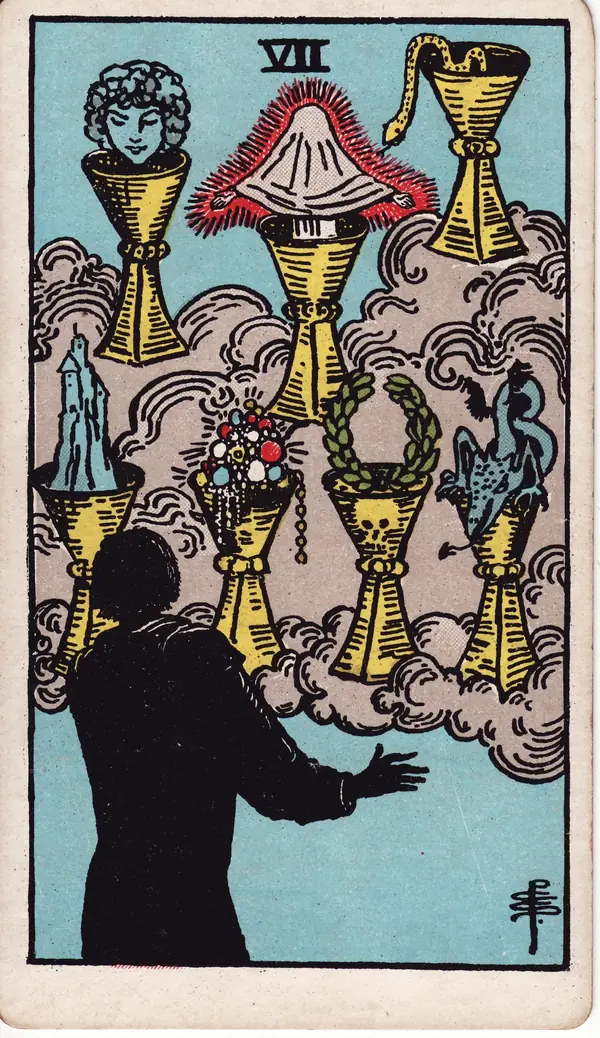
Seven of Cups belongs to the Cups suit of the Classic Tarot, a Minor Arcana card of water and the number seven. A dark figure stands before a cloud bank while seven cups float above the ground. The cups hold a castle, jewels, a laurel crown, a dragon, a face, a snake, and a cloaked stranger. Each advertises a different life; none has landed. The one-line meaning: seven cups of visions, all looking good.
Also written 7 of Cups, the card appears when desire is vivid but commitment is thin. Someone can describe the future in detail and still avoid the first step. It does not scold imagination. It asks which vision you will test in ordinary life. Turned upside down, the cups begin to spill; what looked lovely may become costly or simply not yours.
Seven follows the nostalgic Six and comes before the walking-away Eight. The heart has tasted sweetness; now it must sort possibilities. The useful question is not which dream looks best, but which one can begin today.
Seven of Cups Kabbalah and Tree of Life
The Seven of Cups is a Minor Arcana card, so it takes no Major Arcana path number. On the Tree of Life, the seven returns to the seventh sephira, Netzach (Victory), while the Cups suit settles into its own world. Netzach governs emotion, desire, and persistence and sits on the right-hand pillar of Mercy. Cups belong to Briah (Creation), whose nature is water. Together they show more than a hard time choosing: desire being shaped at the emotional level—what you want, how you imagine getting it, whether you will keep at it. The sephira supplies the nature of the step; the world supplies where it happens. Fire is will and action, water is emotion, air is thought, earth is reality. Water in Briah means the cup is made in the mind before reality tests it.
What makes this structure useful is that it separates a strong craving from a clear direction. Fictional example: In love, someone may long for closeness and have every detail of a shared life arranged in their head, yet never ask whether the other person wants the same pace. Netzach's emotion and persistence appear as a capacity to invest in the picture; Briah shows the picture is still a subjective creation. "Too many choices" is not fickleness. It is desire not yet filtered through conversation and action.
Work shows the same gap. Someone may feel real enthusiasm for a field, collect material, sketch a brand, imagine the finished work, and still not send the first application. If Netzach's persistence only protects the fantasy, it reinforces a castle in the air. Give some of it to concrete steps—meet someone in the field this week, finish a small sample—and desire starts to land. In self-growth, the card often shows a wish to become several people at once: freer, more successful, more loved. The point is not to kill desire but to ask which longing deserves continued feeding.
This card is often paired with Venus in Scorpio: intense feeling fixed on deep imagination, echoing Netzach's desiring nature and water's sensitivity. Understanding that link does not add a mystical label to the card. It reminds you that intensity alone is not the answer. The real question is whether intensity can be channeled into verifiable action.
Seven of Cups Numerology
The Seven of Cups carries the number seven. In the Minor Arcana, the number first marks a stage: conflict, but also a look ahead. It is not a Major Arcana number, so there is no need to reduce it further; seven is already a point that must be faced. The conflict need not be a quarrel. It may be several wishes pulling against one another in the same mind. The forward look comes from those wishes forcing a person to raise their head and judge the next direction.
Seven's character leans toward analysis and investigation. It digs like a detective and is not satisfied with the surface story. The Major Arcana seven is the Chariot, which drives two opposing forces forward by will—a useful parallel for finding a way through contradiction. In the Seven of Cups, that analytical drive can turn outward into endless comparison of opportunities, or inward into the question "Why do I want every one?" The first delays; the second can break desire into manageable parts.
For someone with a life path number of seven, this card can act as a mirror. You study before you act, but studying too long becomes another form of avoidance. The card does not decide for you. It offers a reference: use curiosity to tell real from false, and will to choose one road instead of analyzing seven cups until dawn. For the seven personality, honest feedback from a small experiment is often more useful than more information.
Seven of Cups and the Element of Water
The Seven of Cups belongs to the suit of Cups, whose element is water. In the Classic Tarot tradition, water corresponds to emotion, mood, relationships, and feeling. Its strength is sensitivity to subtle shifts; its weakness is mistaking a feeling for a fact. Water gives all seven cups a tempting shine. Not every option is workable, but each stirs emotion, so none is easy to put down. This is not a court card, so it takes only the suit's water and adds no rank element. Court cards work differently: Page, Knight, Queen, and King each bring an elemental nature that must be read with water.
Elements cooperate and clash. Fire and air feed each other, water and earth support each other, and fire and water conflict. In this card, water supplies imagination and desire, earth pulls imagination back to budget, time, and physical sensation, and fire pushes action. Water without earth thinks beautifully and lands little. Water with too much fire may grab an unexamined cup on impulse. A clash is not good versus bad; it means two rhythms need a new order.
When a spread holds much water, emotion, relationships, and feeling are usually central, often with more thinking than doing. The Seven of Cups can then intensify projection: one sentence from someone becomes a whole drama, or an opportunity becomes the doorway to an ideal life. In love, check whether the other person's behavior matches the story in your head. At work, look at the conditions the path requires, not only how it feels. Add earth in practical ways—a budget, a schedule, real feedback—so water has a container and imagination does not flood everywhere.
What does Seven of Cups mean upright?
Upright, the Seven emphasizes seeing rather than receiving. The figure's feet never touch the ground, and that is the point: attention is stretched across too many futures. A person may want to move and stay, begin a romance and protect their solitude, launch a project and keep it hidden until it is perfect. Imagination works overtime while the calendar stays blank.
It often appears when someone has collected ideas but avoided a decision. Folders fill with plans; saved posts describe another career; conversations begin with “someday” and end in more research. None of that is wasted. Yet the Seven asks you to notice the gap between a desire and a decision. Fantasy, too many options, and daydreams describe a mind crowded with unlived lives.
One test helps: Which cup would still interest me on a wet Tuesday, after the excitement fades? The answer is usually smaller and less cinematic. That is a good sign.
Seven of Cups reversed meaning
Reversed, the fog starts to lift. Some cups drop and crack. Others hold salt water instead of wine. The keywords—reality check, making a choice—sound tidy, but the experience is often messy. A budget proves the trip cannot happen this year. A flirtation loses its spark in daylight. A glamorous job turns out to be mostly scheduling.
Sometimes the wake-up comes from outside: a delayed payment, a frank conversation, a plan that collapses. Sometimes it is internal: you finally admit you do not want the life you have been describing. Both versions sting. Clarity is more useful than another month of hovering, even when it arrives through disappointment.
The trap is swinging from “I want everything” to “I deserve nothing.” A broken fantasy is not a broken person. Keep the desire, revise the route, and shrink the next step until it can be done this week.
Seven of Cups in love: single, in a relationship, reconciliation
In love, the Seven is a projection card. It shows what happens when attraction meets imagination and the two run ahead of evidence. The person in front of you becomes a character in a story you have already outlined: how they will text, what holidays will look like, who they will become after they grow up a little. None of this is malicious. It is how hope makes a home.
Seven of Cups upright love
Upright, the card points to chemistry with a screenplay attached. You may be drawn to someone's potential more than their present behavior. Dates feel cinematic; conversations linger; you replay small moments for clues. Meanwhile, the actual person—tired, inconsistent, unsure—is harder to see.
This can feel wonderful, and it can keep you waiting. A midnight message carries more weight than a canceled plan at noon. Compare the story with the evidence. Are they making room for you in their week? Do they follow through on small things? If not, the fantasy is doing work the relationship is not.
Seven of Cups reversed love
Reversed in love, the screenplay loses its special effects. You notice the mismatch between what you hoped and how they behave. Perhaps they are kind but unavailable, or exciting but unreliable. Perhaps you realize you have been auditioning for a role in their life while they never asked you to move in.
This is not automatically the end. It is the moment when a relationship can become honest. The conversation you have avoided—about time, money, exclusivity, family, or the future—starts to feel necessary. If both people can speak plainly, disappointment can turn into realignment. If only one is willing to look, you can stop editing reality to fit the dream.
Seven of Cups love for singles
For a single person, upright Seven often means a long list and a short runway. You know the feeling you want, but not the ordinary behaviors that would build it. A profile catches your eye because it suggests a life you envy; a friend introduces someone lovely, but you fixate on one detail that does not match the vision.
Translate the fantasy into three observable traits. “Emotionally available” might mean they answer difficult questions without vanishing. “Adventurous” might mean they leave the house on a free Saturday. Give one real person a chance to show those traits over time. Standards are not too high; they simply need to be recognizable in daily life.
Seven of Cups in a relationship
In an established relationship, the Seven upright can show up as comparison. You remember how anniversaries “should” feel, how a partner “should” respond, or what another couple's vacation looks like. The real person beside you may be tired from work, worried about money, or simply quieter than the ideal in your head.
A common scene: you spend an evening planning a future house, trip, or family milestone, and every detail is gorgeous. Then nobody checks the budget, the calendar, or who will handle the paperwork. Romance turns into resentment when invisible labor lands on one person. Ask what this week needs, which bill is due, who is cooking, and when you will both rest. Concrete care keeps romance from floating away.
Seven of Cups and getting back with an ex
When an ex is involved, the upright Seven is a master editor. It keeps the late-night talks and deletes the recurring argument. It remembers the good version of the person and quietly removes the reasons you left. You may miss the relationship you wanted, not the one you had.
Before reaching out, make two columns. On one side, write what you specifically miss: a ritual, a laugh, a feeling of being chosen. On the other, write what was unworkable: the silence, the jealousy, the different plans, the exhaustion. If the left side is all atmosphere and the right side is all structure, slow down. A conversation without a reconciliation agenda can be useful. Ask how they live now, not how they might change.
Seven of Cups as feelings: how they feel about you
What someone thinks about you is not the same as what a card secretly broadcasts. The Seven describes a pattern of attention, not a transcript of their mind. Read it alongside recent actions and the tone of your contact. Upright, the pattern is imaginative and open; reversed, it is more sober and selective. Context matters as much as imagery, especially when you are hoping for a particular answer.
Seven of Cups upright as feelings
Upright, they likely find you intriguing and easy to picture in their future. You may occupy a vivid place in their imagination: a person they could travel with, introduce to friends, or build something with. That does not mean they have decided to do any of it. The feeling is real, but it is still a draft.
Their behavior may be warm and inconsistent. They text with enthusiasm, then disappear into their own week. They suggest a plan without naming a day. They enjoy the possibilities you represent, including ones they are not ready to choose. If you want clarity, offer one concrete invitation and watch the response. Interest that can meet a calendar is worth more than late-night conversation.
Seven of Cups reversed as feelings
Reversed, their view of you is becoming more grounded. They may still be attracted, but they are noticing practical friction: distance, timing, money, conflicting obligations, or different expectations. The dream is losing its glow, and that can make them more honest—or more likely to step back.
Do not assume the shift is about your worth. It may be about their capacity. A person who becomes direct is giving you better information than one who keeps promising “someday.” Ask a plain question about what they want the connection to look like now. Listen for specifics, not poetry. If they cannot offer a clear next step, believe the clarity they are showing you.
Seven of Cups as how someone sees you
They probably see you as someone with options, appeal, and a certain mystery. You may seem like the kind of person who has a rich inner life—someone with plans, tastes, and a future that could go in several directions. That can be flattering. It can also make you feel like a character rather than a person.
The Seven can put someone on a pedestal made of possibility. They admire the idea of you and may fill in blanks with their own wishes. If you want to be known, let them see the mundane parts too: your tired days, your fixed habits, the small things you need. You do not have to perform the fantasy to be chosen.
Seven of Cups as intentions
Their intentions are usually not sinister. The Seven often describes someone who genuinely enjoys the spark and wants to keep possibilities open. They may imagine a future with you while also imagining other lives, other cities, or simply more freedom. The problem is not a secret plan; it is the absence of a plan.
You can test intention without an interrogation. Suggest a specific time, place, and activity. Notice whether they confirm, negotiate, or drift. Someone who wants to build something will usually welcome a small concrete step. Someone who only wants the pleasant fog will keep the invitation vague. Let follow-through tell you what imagination cannot.
Seven of Cups career and work (upright & reversed)
At work, the Seven is about the distance between a vision and a deliverable. It appears in brainstorms, job hunts, and career changes—anywhere a person can see several attractive futures but has not committed resources to one. It can describe a manager with ten ideas and no owner for the next task, or a candidate with three versions of a resume and no clear interview story.
Seven of Cups upright career
Upright in a job search, you may be applying in several directions and tailoring nothing. The resume has buzzwords from three industries; the cover letter sounds as if it were written for a category, not a role. Interviews go well until someone asks what you actually want to do. The Seven's energy is expansive, but hiring managers need a focused story.
At work, the card can look like a meeting full of elegant slides and no owner for the next task. Ideas multiply; deadlines do not. If this is your project, pick one idea and define a small pilot: what will be tested, who does it, what it costs, and when you will review the result. Ask for a written next step rather than another presentation. Imagination is an asset when it is attached to a date.
Seven of Cups reversed career
Reversed at work often brings a necessary correction. A role is less glamorous than advertised. A side project earns less than hoped. A promotion arrives with stress you did not anticipate. The ego feels the drop before the mind can use the information.
There are two unhelpful reactions. One is shame: “I should have known better, so I am bad at this.” The other is a frantic pivot: “I must prove myself immediately with a new plan.” A calmer response is to separate the fantasy from the skill. Which part was unrealistic—the timeline, the market, your interest, or your available energy? What can be salvaged? Maybe the project was wrong but the skill is useful. Decide from evidence, not wounded pride.
Seven of Cups for money and finances
With money, the Seven is less about how much you have and more about whether you are treating a picture as a number. Upright, it can mean planning the reward before calculating the cost. An opportunity sounds exciting, so you imagine the return and skip the fees, waiting time, taxes, or worst-case scenario. A budget may be built on income you hope for rather than income that actually arrives.
The practical move is unglamorous: write down what comes in, what goes out, and what a choice would require. Ask how long the money would be tied up, what happens if the plan fails, and whether you could absorb that outcome without damaging essentials. Reversed, the gap becomes visible and the task is to stabilize before chasing a comeback. Neither position promises a windfall, and neither is investment guidance. For large contracts, get independent, qualified advice.
Seven of Cups for health
The Seven's health message is about mental noise and daily rhythm, not diagnosis. Upright, the mind may be busy late into the night: replaying conversations, rearranging plans, imagining outcomes. Sleep gets shorter, meals become irregular, and exercise stays a beautiful idea. The body receives the bill quietly at first—fatigue, tension, trouble concentrating.
Reversed, the bill may arrive more directly. A letdown can leave you unusually tired. You may finally notice that a routine is unsustainable. Simplify: protect sleep, eat at regular times, move gently, and leave unscheduled space. Write down worries and separate what can be handled today from what cannot. If low mood, insomnia, pain, or other symptoms persist, speak with a doctor or a qualified mental health professional. A card cannot diagnose illness or determine pregnancy; use appropriate medical care for those questions.
Seven of Cups as advice
The advice of the Seven can be stated simply: bring the dream into contact with reality. Upright, that means choosing one cup to test. Reversed, it means recovering after a cup breaks and rebuilding trust in small, finishable steps. The point is not to kill imagination. It is to give imagination a door into the week. A dream that never meets a calendar stays a mood.
Seven of Cups upright as advice
Take a sheet of paper and list the seven cups as seven lines. For each one, write three things: the first action you can take this week, the cost in time or money, and the date you will check the result. “Change careers” becomes “message two people in the field and ask for a fifteen-minute conversation.” “Start painting” becomes “make one small study on Thursday and show it to no one.” If you cannot fill in the three parts, the cup is probably still a mood, not a plan.
Then choose one line. Not forever—just for a short trial. Tell a friend what you completed, not what you imagined.
Seven of Cups reversed as advice
Let the disappointment be real. A cracked cup does not need a speech about lessons; it needs to be set down. Delete the option that cannot work, not because you are punishing yourself, but because you need the space. Do one small task from beginning to end and notice that you can still finish things.
Rebuild rhythm before making a large decision. Keep a simple record of what you actually do each day. Limit exposure to other people's polished lives if it turns your own into a comparison. Ask for help in specific terms: “Can you review this budget with me?” is easier to answer than “I feel lost.” The reversed Seven is not asking you to become small. It is asking you to stand on ground that can hold you.
Seven of Cups as a person
As a person, the Seven describes someone with a vivid inner theater. They can describe a future in Technicolor, connect unrelated ideas, and make a room feel full of possibility. People are drawn to their enthusiasm. They may be creative, curious, and generous with dreams.
The shadow side is follow-through. They can become attached to the thrill of beginning and restless once a project needs maintenance. They may keep several people, plans, or identities at a low simmer because choosing one feels like losing the others. This does not make them dishonest by default. It means their relationship with commitment is still forming. Watch what they do after the exciting part ends.
Seven of Cups reversed as a person
Reversed, this person may be in a humbler season. A plan did not work, a relationship did not match the picture, or a job lost its shine. They might be quieter, more practical, or unusually direct. Or they may be withdrawn while they sort through the wreckage of an illusion.
Do not decide who they are from one card. Look for the direction of travel. Are they facing facts, asking better questions, and making smaller promises they can keep? Or are they swinging between grand new plans and self-blame? A person who can tolerate disappointment without turning it into a story about their worth is usually ready for something sturdier.
How to place it in a reading
In a spread, start with the position. In an advice position, the Seven asks you to narrow the field. In an obstacle position, it may point to too many options, a romanticized plan, or a refusal to choose. In a feelings position, it describes imagination and divided attention rather than a fixed verdict. The same card can be a warning in one slot and an invitation in another.
Then look at the neighbors. More Cups deepen emotional and relational themes. Swords bring analysis, questions, and the need to say something plainly. Pentacles pull the issue toward money, time, and the body. Wands add urgency and action. A Major Arcana card nearby suggests the choice touches a larger life stage. With the Moon, projection is especially strong; verify details instead of trusting atmosphere. The traditional Venus in Scorpio link adds desire, intensity, and the risk of placing a powerful fantasy onto a person. Number seven implies enough experience has accumulated; the next move is evaluation, not more collecting.
Our take
We do not treat the Seven of Cups as a bad card. It is a desire inventory. It shows how much you want and how little you have committed, and that honesty is useful. The danger is not dreaming. The danger is using the dream to avoid a decision you already suspect.
The Seven's advice is to turn each cup into a testable plan—the empty ones will show. A cup with steps, costs, and a review date deserves a trial. A cup that evaporates when you ask for a first action can be set down without drama. You do not have to choose the right life today. Choose one direction you can check this week, and let the result teach you more than the fantasy can.

FAQ
These questions come up often, but a card does not have one fixed answer for every person. Read the Seven in its position, note the cards around it, and keep the question specific. A love question and a work question can produce different readings from the same card. The replies below offer direction, not a substitute for your own judgment.
Is Seven of Cups a yes or no card?
It depends on the other cards. Alone, the Seven is too ambiguous to give a clean yes or no. Upright, it shows many options and little commitment, so the honest answer is often “not yet” or “the conditions are unclear.” Reversed, a decision is forming, but the card still does not say which way it will go. Look for cards that show follow-through, resources, or a clear offer. Without them, treat the Seven as a prompt to gather more information rather than a green light.
What does Seven of Cups reversed mean in a yes or no reading?
It still depends on the surrounding cards. Reversal usually means clarity is replacing fantasy, not that the answer is automatically no. The question may be premature. Someone is waking up to the real cost, which could lead to a yes with conditions or a no with relief. Check whether the other cards show action, agreement, or a solid foundation. If they do, the reversal can support a grounded yes. If they show confusion or withdrawal, wait for a clearer signal.
What does Seven of Cups mean if you have a secret crush?
You are probably imagining more than you know. The card points to projection, not proof of mutual interest. A crush gives the mind room to build a private story. You notice a glance and write a scene; you read a kind message as a promise. The Seven asks you to separate affection from assumption. Spend time with the person in ordinary situations. Learn how they treat people, how they handle plans, and whether they make room for you. Interest that survives real contact is worth acting on.
What does Seven of Cups mean for marriage?
It asks you to discuss real logistics before treating the wedding picture as a promise. Marriage readings often attract beautiful imagery, and this card can make the ceremony feel more real than the life after it. Talk about housing, money, work, family boundaries, children, and how you will handle conflict. Upright, the risk is skipping those conversations because the romance is exciting. Reversed, the conversations may arrive with a jolt. Neither position predicts whether you should marry. It asks whether the two of you can build a shared reality, not just a shared fantasy.
What does Seven of Cups mean as an outcome?
The outcome is still open because several options have not been tested. This is not a card of fixed fate. It suggests a situation with many attractive possibilities, incomplete information, or a choice that keeps being postponed. With supportive cards, it can mean a decision finally gets made. With confused cards, it can warn that someone is still chasing the prettiest option rather than the most workable one. Treat it as a call to define what success would look like and what evidence you need.
What timing does Seven of Cups suggest?
No fixed timing. The card points to delay from indecision rather than a specific date. Cups cards are not reliable clocks, and the Seven's fog makes exact prediction even less useful. Look at practical deadlines, the other cards, and the pace of the people involved. If someone is waiting for perfect clarity, the delay may continue until a real consequence forces a choice. Ask what would need to happen this month for movement to begin. That answer is more helpful than a guessed date.
Does Seven of Cups mean pregnancy?
No. This card cannot confirm or rule out pregnancy; take a test or speak with a clinician. The cups are symbolic vessels, and the Seven's theme is imagined outcomes, not medical evidence. A reading may reflect hope, fear, or the many different futures someone is picturing. It should not be used to make a health decision. If pregnancy is possible and you need an answer, use a reliable test and appropriate medical care. Do not let a card stand in for a doctor.
What zodiac sign is Seven of Cups?
Venus in Scorpio is the common traditional correspondence. This pairing blends Venus's attraction and pleasure with Scorpio's intensity, privacy, and emotional depth. In a reading, it can describe a desire that is magnetic and a little obsessive, or a fantasy projected onto someone mysterious. It is a symbolic link, not a claim that everyone born under a certain sign will meet this card. Use it as a layer of meaning, not a birth chart verdict.
Is Seven of Cups a good or bad card?
Neither. It is a mirror for desire, not a verdict on your future. Upright, it can bring creativity and a wide sense of possibility, but it can also scatter your energy. Reversed, it can bring healthy clarity, though the clarity may arrive through disappointment. The card becomes helpful when you use it to name what you want and choose one honest next step. It becomes unhelpful when it is used to avoid a decision. The card is not the judge; it is the mirror.
Related cards
- Three of Cups: Shared joy and company bring the Seven's visions back to real connection.
- Eight of Cups: Walking away from a disappointing option helps separate longing from need.
- Seven of Swords: Strategy and missing information remind you to check facts before trusting a pretty offer.
- Seven of Pentacles: Patience and investment ask what a plan will cost in time.
- The Moon: Projection and fog grow stronger here, so verify details instead of trusting atmosphere.
- The Magician: Turning intention into action supplies the follow-through the Seven often lacks.