Seven of Pentacles (7 of Pentacles) Meaning: Reversed, Love, as Feelings, Yes or No

Draw a Classic Tarot spread →Free, no sign-up. Think of your question, then draw.
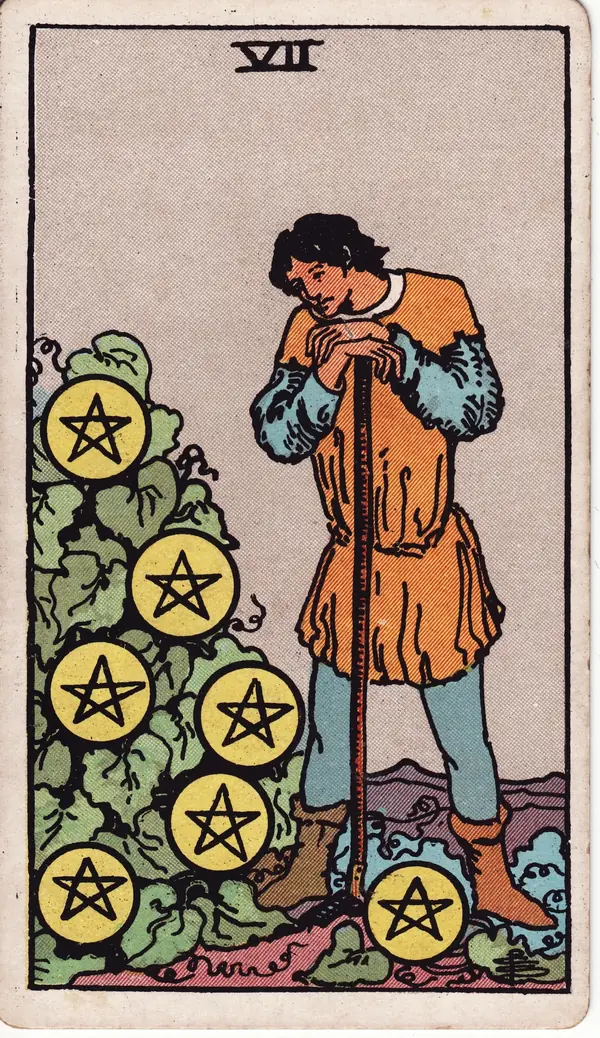
In one line: Leaning on a hoe, looking at the tree, weighing whether it's worth it.
| Keywords | |
|---|---|
| Upright | patience, assessment, awaiting harvest |
| Reversed | impatience, no return on effort |
| Type | Pentacles · earth |
| Yes/no (our grading) | depends on the other cards |
Quick answers: yes/no · love · career
- Yes/No: Under our grading, Seven of Pentacles depends on the other cards. Yes/no is the least reliable use of tarot—prefer “how should I approach this?”.
- Love: The bond needs time to grow; reversed, lots of effort, little to show.
- Career: Long-term investing, mid-point reviews; reversed, time to change course.
*FateClear Editorial Team*
Want to draw a Classic Tarot spread? Draw cards.
The Seven of Pentacles is the seventh card in the suit of Pentacles—often called Coins—in the Classic Tarot's Minor Arcana. Numbered seven, it sits in the earth element, where the concerns are time, labor, money, the body, and anything that grows slowly. You may also see it written as 7 of Pentacles.
A figure rests on a hoe beside a tree. Coins hang in the branches, and a few harvested ones lie at his feet. He is neither planting nor picking. He is looking, calculating, and perhaps wondering whether the fruit will ever repay the care he gave it.
At its core, the card asks whether the harvest is worth the work. It can appear upright or upside down, and its reversed side usually sharpens the worry behind that question. This is not a card of fresh starts. It marks the middle of a long effort, where patience and honest review matter more than speed.
Seven of Pentacles Kabbalah and Tree of Life
In the Classic Tarot tradition, the Seven of Pentacles is a Minor Arcana card. When you read its Tree of Life correspondence, the important markers are not the path number but two coordinates. The number seven belongs to the seventh sephirah, Netzach (Victory), while the suit of Pentacles belongs to Assiah, the material world among the Four Worlds. Netzach sits on the right-hand Pillar of Mercy, where the themes are emotion, desire, and persistence. Assiah is earth in elemental terms, pointing to physical reality, the body, time, and results you can touch. Put those together and the card is not an abstract instruction to wait a little longer. It is a test of whether you will keep investing in something visible. The sephirah explains the nature of this step: a person is already caught by a situation, with emotion and desire mixed in, which is why letting go feels hard. The world explains the level where the situation lives: not only in private thoughts or moods, but in ledgers, work hours, land, and daily logistics. What it adds to a reading is a way to turn assessment from a vague phrase into concrete action. So when the card appears, ask two questions at once: what makes this hard to release, and what has already built up in real life?
Fictional example: In love, someone keeps checking how often the other person responds. On the surface they are waiting for a message; underneath, the persistence of Netzach is at work, because they cannot release the companionship they have already invested in and desire is still present. Assiah asks them to look at how the two people actually divide their time and whether they are willing to meet and discuss a future, rather than relying on a private sense of grievance. At work, a project is mostly finished, and the person keeps pushing because so much has already gone into it. Through Assiah, the practical review should look at output, resources, and deadlines, not enthusiasm. In self-growth, this same pattern reveals that what is hardest to release is often not the goal but the part of the self that once tried so earnestly. Someone may know a path no longer fits and still hesitate to turn because of everything already invested. The common astrological pairing for this card is Saturn in Taurus. Saturn brings a sense of time and limitation; Taurus values land and accumulation. Together they echo the card's message: this cannot be rushed, yet it will leave a mark.
Seven of Pentacles Numerology
Number seven has two layers of meaning in numerology. In the development sequence of the Minor Arcana, it stands after the sixth card and before the eighth. It brings friction and forces a person to look up at the next step: the situation has reached its midpoint, old arrangements are starting to fall short, and the person must deal with the immediate snag before the road ahead becomes visible. Seven's character tends to be analytical and investigative. Faced with a problem, it asks questions layer by layer like someone solving a case and is not satisfied with surface explanations. When this thread reaches the Seven of Pentacles, it explains why the card is not simply about waiting. The person is protecting an existing investment while checking the terms and calculating the return; mentally, an investigation is already underway. Set it back in the sequence from one to ten, and seven also reminds the person that more pushing, near-completion, and a final result still lie ahead. The current difficulty is not a period. So the Seven of Pentacles carries both friction and room for something not yet revealed. When judging, stretch the timeline a little.
Its corresponding Major Arcana card is the Chariot. The Chariot is about moving forward with a sense of direction and controlling the situation through will. The Seven of Pentacles pulls the same force down a notch: first check the road and the fuel, then decide whether to keep going. The two do not contradict each other. One stresses action; the other stresses accounting before action. Without a check, the Chariot's drive can become blind acceleration. Without action, the Seven's checking can become spinning in place. Add seven's investigative nature, and the card looks more like a pause for inspection than a decision to abandon the journey. For someone with Life Path number seven, drawing the Seven of Pentacles can serve as a reminder: you are naturally analytical, but do not let analysis turn into procrastination. Break the problem into parts, look at the evidence clearly, and give yourself a definite time to decide. This is one angle for observation, not a final verdict. The spread and the real situation still matter.
Seven of Pentacles and the Element of Earth
The Seven of Pentacles belongs to earth. Earth cares about what can land in reality: time, physical energy, money, objects, and whether an effort leaves a result behind. It is not driven by a burst of enthusiasm but by repetition, waiting, and concrete arrangements. On this card, earth gives waiting a shape. It is not sitting empty and hoping; it is loosening the soil, watching the weather, and counting the cost. Because earth is heavy here, the Seven of Pentacles tends to judge slowly. It wants evidence before it will admit that a direction is right or wrong. When earth is strong, the person is not without emotion. They simply prefer to see facts before taking a position.
This is a Minor Arcana card, so there is no court card's rank element layered over the suit element. Read the earth nature of the suit itself, then add the stage suggested by the number seven. Among the elements, fire and air tend to feed each other, while water and earth can cooperate: water moistens earth, and earth gives water a container. In practical terms, emotion needs concrete arrangements to hold it. Fire and water clash. One wants speed, the other depth, and haste can burn through patience. If many fire cards sit beside the Seven of Pentacles, the person may want to see results immediately. If water cards dominate, they may keep turning feelings over and delay a practical check. These are tendencies only. Read the whole spread.
When earth is heavy in a spread, the theme usually moves toward practical matters: money, work, housing, the body's rhythm, and the cost in time. In a question about love, the focus shifts from do they love me to how do we arrange meetings, and who carries which responsibility. In work, it settles on resources, output, and deadlines. In self-growth, it asks the person to turn ideas into small, executable steps. Here the Seven of Pentacles works like a checkpoint. First confirm whether there are still conditions to keep watering, then decide whether to prune, change the ground, or wait out this season. It does not promise a harvest. It only brings attention back to visible investment and return.
What does Seven of Pentacles mean upright?
The upright Seven of Pentacles speaks of patience, assessment, and awaiting harvest. You have invested time, energy, or money, and now you pause to see what has come back. In the Classic Tarot tradition, the card favors a clear inventory: what is growing, what has stalled, and what you have been too tired or too hopeful to notice. Patience here is active. It means caring for the tree while it ripens, not staring at it every hour. Assessment is not nitpicking; it is making sure your effort still points toward something you want. Kabbalah links seven with Netzach, a current of endurance—the kind of victory built by staying with a thing.
Seven of Pentacles reversed meaning
Reversed, the Seven of Pentacles carries impatience and the feeling that effort has brought no return. You may check progress constantly, ask for reassurance, or wonder whether you chose the wrong plan. There is a temptation to force a result: add more money, send another message, or abandon everything in one frustrated sweep. None of those moves is automatically wrong, but the reversed card warns that urgency is doing the deciding. Separate disappointment from evidence before you change course. Look at the whole field, not only the branch that failed. Choose from clarity, not exhaustion.
Seven of Pentacles in love: single, in a relationship, reconciliation
In love, the Seven of Pentacles asks a grounded question: is this connection receiving care that can actually grow? It is not a romantic card in the usual sense. It looks at time, effort, availability, and the future two people are building—or failing to build. It often appears when one person is waiting for the other to choose, or when someone is quietly deciding whether to stay.
Seven of Pentacles upright love
Upright in love, there is room to keep observing, but not room to ignore what you see. You might be learning each other's rhythms, recovering from a difficult season, or deciding whether a shared plan is realiztic. The card supports a deliberate check-in: what does each person want, what is actually being offered, and what would make the next few months different? If both people tend the relationship, patience can be generous. If only one waters it, patience becomes a way of avoiding the truth.
Seven of Pentacles reversed love
Reversed in love, waiting has turned sour. You may feel that you have given more than you received, or that every conversation circles back to the same unmet need. The danger is not that the relationship is over; it is that fear is making the choice for you. You might push for commitment to stop the uncertainty, or withdraw to punish the other person. Neither brings lasting relief. Name the imbalance, ask for a specific change, and watch whether behavior follows. If nothing shifts, the kindest move may be to stop pouring energy into an empty cup.
Seven of Pentacles love for singles
For a single person, the Seven of Pentacles asks where you have planted your attention. Perhaps you keep hoping a casual connection will turn serious, or you have narrowed your search to one unlikely person. The card invites a review of your romantic routine. Are you meeting people who share your pace? Are you spending weekends waiting by the phone instead of living your life? Give a promising connection time, but set a private check-in point. Patience should widen your world, not shrink it to one unanswered text.
Seven of Pentacles in a relationship
In an established relationship, this card often marks a season of practical accounting. Who handles the planning, the worry, the bills, the emotional labor? One partner may feel unseen while the other believes everything is fine. The Seven does not demand a dramatic confrontation. It asks for a calm inventory and a shared date to review it. Talk about work schedules, money, family duties, and time alone. A relationship can survive a dry spell when both people know what they are tending. It struggles when one person keeps waiting for the other to notice.
Seven of Pentacles and getting back with an ex
With an ex, the Seven of Pentacles suggests a careful review rather than a rushed reunion. You may be remembering the good harvest and forgetting the soil that stopped producing. Before reaching out, ask what has actually changed. Has either of you learned to communicate differently? Are you returning because you miss the person, or because you cannot bear to leave the investment behind? The card allows for a trial conversation, but not for pretending the old problems vanished. Reconnection needs new behavior, not just nostalgia.
Seven of Pentacles as feelings: how they feel about you
When the Seven of Pentacles appears in a feelings position, it describes someone who is measuring as much as feeling. That does not mean the emotion is fake. Attraction is passing through a practical filter: time, availability, risk, and whether this connection can become stable. The card often shows a person who cares but will not rush. Caution can be healthy, or it can be a hiding place.
Seven of Pentacles upright as feelings
Upright, their feelings are warm but measured. They see potential and are willing to let it develop, yet they are not ready to promise more than they can deliver. They may notice your effort and appreciate it quietly. They might also be preoccupied with work or family, which makes their attention feel inconsistent. The key word is evaluating: they are asking whether the two of you fit in real life, not only in brief, exciting moments. Do not mistake slowness for rejection. Consistent, low-pressure contact will show you more than guessing.
Seven of Pentacles reversed as feelings
Reversed, their feelings are tangled with frustration or fatigue. They may feel that the connection asks more than it gives, or they may be comparing you to an idea they cannot quite name. Impatience can make them distant one day and intense the next. Some people in this position are grieving a relationship that never fully grew; others are simply overwhelmed. The card does not prove that love is absent. It does suggest that their current state is not a stable place from which to build. Watch whether they can talk honestly about the imbalance.
Seven of Pentacles as how someone sees you
As how someone sees you, the Seven of Pentacles casts you as someone worth considering carefully. They may see you as steady, capable, and a little reserved—someone whose worth becomes clearer over time. There can also be a hint of distance in their view, as though they are watching you from across the field instead of standing beside you. They might wonder whether you are as invested as they are, especially if you have been busy or hard to read. Clarity about your own pace and needs will do more than trying to prove your value.
Seven of Pentacles as intentions
As intentions, this card points toward a slow, conditional approach. They intend to keep observing before making a larger move. That could look like friendly check-ins, practical help, or conversations about the future without a firm promise. Their intention is not necessarily to string you along; they may genuinely need more information. Still, intention without movement can become a comfortable way to avoid risk. Pay attention to whether their actions accumulate into something. Do they make time, follow through, and include you in plans? Weigh the pattern, not one charming moment.
Seven of Pentacles career and work (upright & reversed)
At work, the Seven of Pentacles is the pause between effort and results. A project has consumed weeks or months. You can see some growth, but the final outcome is not here yet. This is a useful card for reviews, budget decisions, and career choices that require a longer view. It favors evidence over adrenaline. Whether upright or reversed, the central question is the same: what deserves more of your working life, and what has already taught you what it needed to teach?
Seven of Pentacles upright career
Upright, you are in a good position to assess rather than react. In a job search, review the whole campaign: the roles you target, the story your resume tells, the conversations you have started. One quiet week does not mean the search has failed. At work, gather proof of what you have built. Ask for a check-in with your manager, clarify the next milestone, and identify which tasks drain time without moving anything forward. If you are considering a change, list the skills and relationships you would carry with you. Patience should produce better information, not endless delay.
Seven of Pentacles reversed career
Reversed, the card warns about effort that has lost its direction. You may be busy every day while the work that matters stays untouched. Or you may stay in a role because leaving feels like admitting the years were wasted. That is sunk-cost thinking, and it can keep you in a job long past the point of growth. Do not make a major decision on your worst day. Separate what is genuinely broken from what is merely slow. Then set a review date and a bottom line. If the role cannot meet it, build an exit plan while you still have energy.
Seven of Pentacles for money and finances
With money, the Seven of Pentacles is an accounting card, not a promise of sudden gain. It asks what your spending, saving, and work are actually producing. Which expenses support your life, and which ones soothe a moment? Are you waiting for a return that has no clear timeline? The card favors budgets, emergency funds, and realiztic projections. It does not tell you what to invest in, and it offers no guarantee of profit. If a commitment keeps demanding more money with no measurable progress, treat that as information. Slow, documented decisions serve you better than hopeful guesswork.
Seven of Pentacles for health
Health-wise, this card speaks about pace, rest, and the signals you have been ignoring. It is not a diagnostic card, and it cannot tell you whether a symptom is serious. What it can show is a pattern of pushing through fatigue, skipping meals, or postponing rest until everything else is finished. The body often asks for attention long before it forces a stop. Use the Seven to review your routine: sleep, movement, time outdoors, and the balance between work and recovery. If something feels off, see a qualified doctor. Do not use patience as an excuse to delay care.
Seven of Pentacles as advice
The Seven of Pentacles offers simple advice: step back and look at the whole field. Most people who receive this card are not lacking effort. They are too close to the work to see whether it is still worth it. The card asks for a scheduled review rather than constant monitoring. Checking every day creates anxiety; checking at an agreed time creates usable information. The upright and reversed versions differ mainly in whether you should keep tending or pause the investment.
Seven of Pentacles upright as advice
Upright, choose a date and write down what you want to know. List the time, money, and emotional energy you have put into the situation. Then list what has actually changed because of it. Decide in advance what would count as progress and what would count as a sign to stop. Until the review date, return your attention to daily life: sleep, work, friends, small pleasures. Patience is not endless waiting. It is a container with edges. When the date arrives, use the evidence in front of you rather than the hope you started with.
Seven of Pentacles reversed as advice
Reversed, stop adding fuel before you understand the fire. If you have been pouring money, messages, or hours into something that gives less and less back, take a deliberate pause. That does not have to mean quitting forever. It means creating enough space to think without panic. Rest first if you are exhausted; decisions made from depletion tend to be reckless or frozen. Then ask what you would do if you were starting fresh today. That question often reveals whether you are staying for the person, the goal, or the fear of losing what you already spent.
Seven of Pentacles as a person
As a person, the Seven of Pentacles describes someone who takes the long view. They are usually reliable, practical, and willing to work without immediate applause. They notice details others miss and prefer to understand a situation before committing. This can make them seem cautious or hard to read, especially to people who move quickly. Their gift is endurance; their challenge is knowing when endurance has become stubbornness. They are the friend who helps you move, then asks whether the new apartment fits your budget.
Seven of Pentacles reversed as a person
Reversed, this person may be worn down by waiting. They could be irritable, distracted, or convinced that nothing they do matters. Sometimes they become overly focused on one measure of success—a salary, a follower count, a single person's approval—and lose sight of everything else. They may also keep promising that change is coming without taking a clear step. The lesson is not to try harder at the same strategy. It is to admit what is not working, ask for help, and let a fallow season be a season rather than a verdict.
How to place it in a reading
Position changes how the Seven speaks. In the past, it can show an earlier investment whose results still shape the present. In the present, you are in the middle of an assessment. In a future position, it suggests ripening and review rather than an instant answer. As an obstacle, the block may be perfectionism, impatience, or the refusal to look beyond one measurement. As advice, it asks for a review date and a wider view. Near other Pentacles, the practical stakes increase. Near Major Arcana cards, the choice carries more weight. With Cups, feelings are part of the harvest; with Swords, clarity is needed before action.
Our take
Our take is that the Seven of Pentacles is a halftime review, not a verdict. It arrives when you have enough experience to learn from and enough uncertainty to make waiting uncomfortable. Set a check date instead of checking daily. Put the date on a calendar, write down what you are measuring, and then live your life until it arrives. When it does, compare the evidence with your hopes. Continue if the tree is still growing. Prune, change course, or walk away if it is not. Clear waiting is different from passive hoping.

FAQ
These are the questions readers ask most often about the Seven of Pentacles. Short answers come first, followed by context. A single card cannot settle every decision, and the surrounding cards, the question, and the time frame all matter. Use these responses as a starting point, not a substitute for your own judgment or for qualified professional advice where money, health, or safety is involved.
Is Seven of Pentacles a yes or no card?
Not by itself. In our grading, the Seven of Pentacles depends on the other cards. Upright, it leans toward wait and see, which is not the same as a confident yes. If the surrounding cards show growth and steady effort, the answer may become favorable later. If they show stagnation or conflict, the pause is a warning. Reversed, the card leans toward stopping or changing course, though a supportive spread can soften that. Ask a specific question with a clear deadline, then read the whole spread.
What does Seven of Pentacles reversed mean in a yes or no reading?
Reversed, it usually leans no or not now. The effort is not producing enough return to justify continuing as you have. That does not mean every hope is dead. It means the current approach needs to stop. If you are asking whether to keep spending, pushing, or waiting in the same way, the reversed card advises against it. A yes could return later after a real change in circumstances or behavior. Look for cards that show movement and repair. Without those, pause and reassess rather than force an outcome.
What does Seven of Pentacles mean if you have a secret crush?
With a secret crush, the card suggests quiet observation. The other person may notice you but is unlikely to act quickly. They might be weighing whether you are interested, whether the timing works, or whether they can risk the change. Upright, there is room for gradual connection; a warm conversation can give them something real to respond to. Reversed, they may be stuck in indecision or distracted by their own life. Neither version guarantees that they will make the first move. Show interest clearly, but do not turn your whole life into a waiting room.
What does Seven of Pentacles mean for marriage?
For marriage, the Seven asks for practical review before a final decision. It does not say no, but it says the harvest is not ready yet. The card often appears when a couple needs to discuss timing, money, family expectations, or living arrangements. Upright, there is a foundation to work with, provided both people are honest about what is unresolved. A wedding cannot cover a gap in communication. Reversed, one person may feel that their investment is not being returned. Name the issues and address them; if they are avoided, a date on the calendar will not fix them.
What does Seven of Pentacles mean as an outcome?
As an outcome, the Seven points to a period of waiting and review. The result is still developing, and your next choices will influence it. It is not a final verdict. You may reach a point where you must decide whether to keep investing or accept what has already grown. Clarity will come through evidence and time, not pressure. If the question has a deadline, expect a meaningful assessment around that point. If it does not, create one. The outcome is less about a sudden event than about reaching an honest conclusion and acting on it.
What timing does Seven of Pentacles suggest?
The Seven of Pentacles rarely points to immediate timing. It suggests weeks or months rather than days, with a review point along the way. The number seven can hint at a seven-day, seven-week, or seven-month window, but that is a symbolic pattern, not a precise schedule. More reliably, the card describes a season of growth that cannot be rushed. If you need a decision date, choose one that gives the situation room to show real change. Watch for the moment when the evidence becomes clear enough to compare with your original hope. That moment matters more than a guessed date.
Does Seven of Pentacles mean pregnancy?
The Seven of Pentacles does not answer pregnancy questions. It speaks of patience and review, not conception, and cannot confirm or deny pregnancy. If you are hoping to conceive, the card may reflect the emotional weight of waiting and the temptation to read every sign as a message. That is understandable, but a card is not a test. If you are worried about pregnancy or fertility, speak with a qualified medical professional and use reliable testing. The card's useful message is about caring for your body and peace of mind, not predicting an outcome.
What zodiac sign is Seven of Pentacles?
Traditionally, the Seven of Pentacles is linked with Saturn in Taurus. Saturn brings patience, limits, discipline, and the long lesson of time. Taurus brings earth, steadiness, physical resources, and slow growth. Together they describe a card about doing the work and waiting for the land to respond. This is a common traditional correspondence, not a rule that limits the card to Taurus natives. It is a useful lens when the reading concerns routines, money, or a project that needs endurance, but it does not replace the card's place in the spread.
Is Seven of Pentacles a good or bad card?
Neutral and steady. It is not a promise of good fortune, but it is rarely a disaster card. Its tone depends on whether you use the pause well. Upright, it can be grounded and encouraging: something has been planted, and there is real potential if you tend it. Reversed, it can point to frustration and wasted effort, especially when fear is driving your choices. The card becomes bad mainly when it is ignored—when you keep waiting without review or keep spending without evidence. As a checkpoint, it is one of the more mature cards in the deck.
Related cards
The neighboring Pentacles cards help place the Seven in a larger story. Read them as variations on effort, patience, and return, then notice which one sits closest to the Seven. They often show the phase before or after the pause: planting, working, enjoying, or sharing what has grown. This is not a fixed sequence; it is the story your spread is already telling.
- Six of Pentacles: The Six weighs giving and receiving, while the Seven asks whether your chosen exchange is producing a fair return.
- Eight of Pentacles: The Eight turns assessment into focused craft, a good card when you decide to keep going and improve one thing.
- Nine of Pentacles: The Nine shows the harvest enjoyed in solitude, the self-sufficiency the Seven is working toward.
- Ten of Pentacles: The Ten widens the picture to family, legacy, and long-term security beyond one person's field.
- Wheel of Fortune: The Wheel reminds you that seasons turn and timing is not entirely in your hands.