Six of Pentacles (6 of Pentacles) Meaning: Reversed, Love, as Feelings, Yes or No

Draw a Classic Tarot spread →Free, no sign-up. Think of your question, then draw.
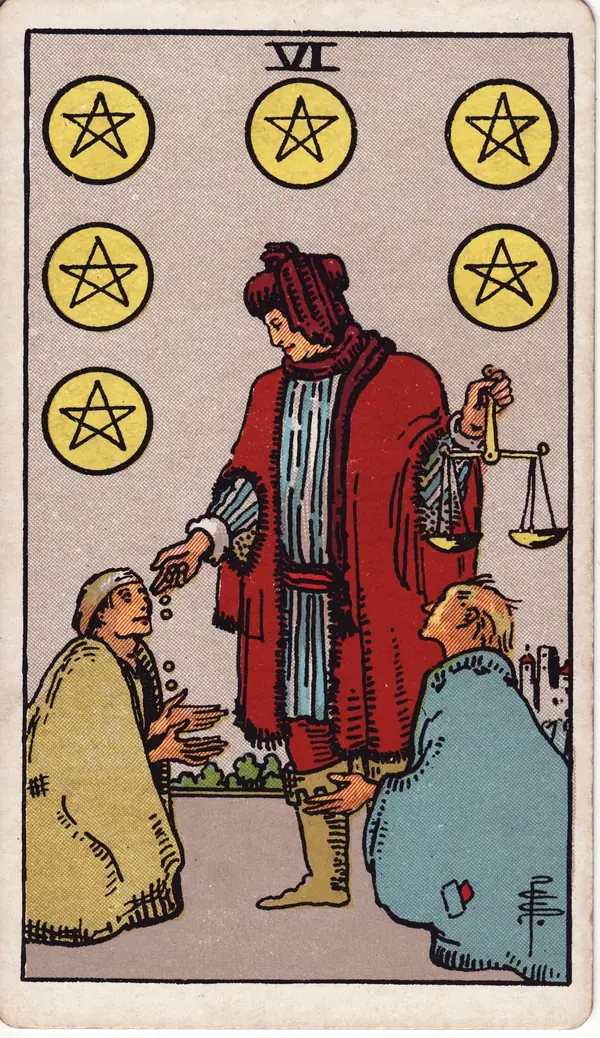
In one line: A person with scales handing coins to those in need.
| Keywords | |
|---|---|
| Upright | giving, receiving, sharing resources |
| Reversed | unequal charity, strings attached |
| Type | Pentacles · earth |
| Yes/no (our grading) | leans yes |
Quick answers: yes/no · love · career
- Yes/No: Under our grading, Six of Pentacles leans yes. Yes/no is the least reliable use of tarot—prefer “how should I approach this?”.
- Love: Balance of giving and receiving; reversed, one always gives.
- Career: Raises, funding, mentorship; reversed, help with strings attached.
*FateClear Editorial Team*
Want to draw a Classic Tarot spread? Draw cards.
The Six of Pentacles is the sixth card in the earth suit of the Minor Arcana, and it also appears as 6 of Pentacles. In the Classic Tarot, a well-dressed figure holds a balanced scale while passing coins to two kneeling people. Six pentacles float above them. Pentacles are also called Coins, a fitting name for a card about money, time, and practical care.
Numerology links six with harmony, proportion, and reciprocity. In Kabbalah, the sixth sphere carries ideas of beauty and central balance, while the earth element brings them down to daily life: rent, rides, meals, favors, and the hours you spend on someone else. Its short meaning is “A person with scales handing coins to those in need.”
The Six is not a simple celebration of generosity. It asks how help is measured, who decides the amount, and whether the receiver keeps their dignity. When the card lands upside down, that question becomes pressing, because the exchange has lost its balance.
Six of Pentacles Kabbalah and Tree of Life
The Six of Pentacles is a numbered card in the Classic Tarot, so its place on the Tree of Life is clear: six belongs to Tiphareth (Beauty), the sixth sphere. Tiphareth sits on the central pillar and speaks of a center point, equilibrium, and harmony. It also describes how a person finds their place between giving and receiving. The sphere does not make this card about "more is better." It makes it about staying in the middle. The suit is earth, which corresponds to Assiah, the material world among the Four Worlds. Those worlds lean, in turn, toward will and action, emotion, thought, and physical reality; Pentacles takes the last layer. Abstract balance therefore lands in money, time, stamina, and opportunity. The sphere defines the lesson; the world defines where it plays out. Together they say balance must become visible in ordinary life, not remain a nice feeling.
This correspondence makes a reading concrete. In love, the question is not only whether the other person is willing to give. It is whether giving reaches daily life: who covers expenses, who cares for a sick partner, who makes the first move toward repair after an argument. If those arrangements tilt one way for too long, the center Tiphareth describes goes off-kilter, and the material ledger starts to show it. At work, the card warns against treating resource distribution as an empty slogan: budgets, staff, credit, and time off need proportions that can be checked. In personal growth, it often asks, "Am I always the one in the caretaker role?" Tiphareth's balance is not a cold split down the middle. It is knowing how much you can give right now and what you need, so the relationship can still stand.
The usual astrological correspondence is the Moon in Taurus. The Moon cares about safety, and Taurus roots safety in concrete resources and a steady rhythm. That echoes both Beauty's mediating role and Assiah's practical layer: make daily life stable first, then talk about grander forms of giving.
Six of Pentacles Numerology
The Six of Pentacles carries the number six. In the numbered Minor Arcana, six has passed the first spark, the pairing, and the partial result. It arrives at a point where choice and balance are required. The question is no longer whether something has begun, but how resources, relationships, and responsibilities can be arranged so everyone can keep going. This stage often carries nostalgia: people remember who helped them and whom they still owe, so the current division is never only about numbers. Old obligations are part of the ledger. The scales in the card's image put the weighing right in the open.
Six leans toward giving and care, and it also reaches for perfection, harmony, and close attention to relationships and family. That is why this card can feel warm and conditional at once: the giver wants to be seen, and the receiver wants respect. Once sacrifice runs in one direction, the harmony six seeks becomes pressure.
The Major Arcana card linked with six is the Lovers. The Lovers makes a choice inside a relationship and accepts what it requires; the Six of Pentacles brings that choice down to concrete giving and receiving. One card stresses values and promises, the other resources and daily life, but both ask, "How do we stay together without losing ourselves?" Giving does not automatically create intimacy, and receiving does not automatically create debt.
If someone's life path number is six, drawing this card can work as a mirror: Do you tend to look after other people before you deal with your own needs? That is a reference point, not a verdict. The card is better used to examine the proportion of what you give than to stick a fixed personality label on you.
Six of Pentacles and the Element of Earth
The Six of Pentacles belongs to the earth suit. Earth is practical and grounded, values visible results, and tends to care about money, material conditions, and real-world arrangements. It does not linger over verbal promises; it wants to know whether the thing actually arrived. The giving here is therefore specific: a loan through a cash-flow squeeze, a meal, an afternoon taking over a partner's chores, or a contact that opens a real opportunity. Earth makes everything measurable, which is why the scale sits at the center. Earth is not cold; it simply shows care in practical ways.
This is a numbered card, not a court card, so no rank element is layered over the suit element. The reading centers on earth and its mix with nearby elements. Traditionally, fire and air feed each other, water and earth receive and support each other, and fire and water tend to clash. In a spread, water cards around the Six can mean care leans toward emotional support while practical arrangements stay unspoken. Fire brings quick action, but distribution rules must catch up. Plenty of air means plenty of talk; someone must ensure follow-through. A heavy earth presence can narrow the focus to practical and financial matters, so do not overlook rest and feelings. A run of fire cards calls for more rest. Too much water can mean thinking without doing, and too much air can mean overthinking.
Here, earth insists that help be sustainable. In love, it may appear as splitting the rent, caring for a sick partner, or remembering the other person's daily habits. At work, it looks like a clear division of budget, staffing, pay, and duties. In personal growth, it means setting aside regular resources for rest and learning. Earth is steady, but too much steadiness can shrink into short-term thinking. So the card also asks: once the accounts are clear, check in with each other's feelings. Do not let practical arrangements crowd out the warmth of the relationship.
What does Six of Pentacles mean upright?
Its upright keywords are giving, receiving, and sharing resources. A friend covers dinner, a colleague passes your name to a hiring manager, or a relative pays a bill you cannot meet this month. The help is concrete, not vague sympathy. Someone has enough for now; someone else needs to accept it.
The card also asks for honesty about limits. Good giving finds out what is needed, offers a workable amount, and lets the other person accept, decline, or ask for a different form of help. The scale is not there to shame anyone. It keeps the exchange visible.
Receiving belongs to this card’s dignity too. You do not have to earn every kindness before accepting it, and you do not have to repay it by nightfall. Say thank you, name what it meant, and stay in the conversation. A healthy cycle can start with one open hand.
Six of Pentacles reversed meaning
Reversed, the Six points to unequal charity and strings attached. The scale remains, but it tilts toward whoever has more money, time, information, or confidence. One person keeps giving while the other keeps shrinking. Or the giving continues only because it keeps the giver needed. The gift may be useful, yet it arrives with a bill no one names.
Two scenes are common. A helper adds more and more support, then expects gratitude or obedience. Or a person who needs help refuses it out of pride and quietly runs themselves down. Both are versions of the same problem: the exchange cannot be discussed honestly.
The reversed card invites a plain question: is this help wanted in this form? Money can solve a practical problem, but it cannot replace respect. Replace “After everything I’ve done for you” with “What would actually make this easier for both of us?” That is how the scale comes back toward level.
Six of Pentacles in love: single, in a relationship, reconciliation
Love under the Six is rarely abstract. It appears in who pays, who drives, who listens after a hard day, and who rearranges their schedule when the other person is sick. That is not unromantic; it is care with a body and a calendar. The card asks whether those practical gifts move in both directions over time.
Six of Pentacles upright love
Upright, the relationship has a workable exchange. One partner may earn more or have more free time, and both can acknowledge that without turning it into a hierarchy. Support during a low season feels natural: one person cooks, the other handles the paperwork, and neither keeps a public scoreboard. The generosity is real because the need can be named.
The shadow is easy to miss. If the same person always hosts, plans, or fixes, gratitude can harden into expectation. Talk about the pattern before it settles. “I love treating you, and I want to feel free to receive from you too” is healthier than silent accounting.
Six of Pentacles reversed love
Reversed, affection can begin to feel like a bill. A gift arrives with a reminder. A partner says “Do whatever you want,” then keeps track of every compromise. One person gives money, opportunities, or reassurance and expects loyalty in return. The relationship may look calm while someone inside feels smaller or permanently indebted.
Name the exchange without turning it into a trial. Say what you thought you agreed to, what you need now, and where you felt pressured. If the other person can hear that and adjust, the bond can recover. If every talk becomes a defense of who gave more, the scale is being used as a weapon.
Six of Pentacles love for singles
For singles, the card often brings a helpful person into view. Someone may introduce you to a friend, show you around a new workplace, or make a social event easier. You may feel drawn to their competence and generosity. That attraction is understandable, but help is not the same as romantic interest.
Test the connection with reciprocity. Accept the kindness, then offer something of your own: coffee, a useful contact, a genuine thank-you. If you are always arranging, paying, or rescuing, pause. Mutuality is the signal here, not the size of the first favor.
Six of Pentacles in a relationship
In an established relationship, the Six usually appears around resources and roles. One person may be the main earner for a while; the other may carry more of the housework or caregiving. That arrangement can be loving and sensible. It becomes corrosive when it is treated as permanent without consent.
Make the invisible visible. Put shared expenses, chores, and rest time on the table, not to audit every dollar, but to see whether the load is fair. Gratitude matters too. A partner who feels appreciated is more willing to keep giving, and a partner who can ask for help is less likely to resent it.
Six of Pentacles and getting back with an ex
With an ex, the Six often points to practical ties that survived the breakup: mutual friends, unfinished money, shared routines, or one person willing to make the first civil gesture. It says conversation is possible. It does not say the old relationship will simply restart.
If you want to reconcile, turn the old imbalance into a new agreement. Who always apologized? Who always waited? Who paid for everything and then felt entitled to decide? Name those patterns before nostalgia takes over. A reunion built by one person’s endless effort is not a reunion; it is a return to the same uneven table.
Six of Pentacles as feelings: how they feel about you
In a feelings position, the Six describes the other person’s inner arithmetic. What do they think they are giving? What do they believe they owe? Where do they place you in that calculation? This is less about pure emotion than about the role they have assigned themselves and the role they have assigned you. The card asks you to listen for the accounting beneath the warmth.
Six of Pentacles upright as feelings
Upright, they think of you as someone worth showing up for. They may feel protective, useful, or proud to be the person who can help. If you are going through a hard time, they want to be steady rather than dramatic. Their care is likely practical: a ride, a meal, a contact, a check-in at the right moment.
There can still be a small scorecard in the background. They want their effort to matter and may notice when it goes unacknowledged. That does not make the feeling false. It means their generosity has a human need attached: please see me as more than a resource.
Six of Pentacles reversed as feelings
Reversed, they may feel drained, obligated, or unsure whether their help is welcome. Perhaps they agreed to too much and now resent it. Perhaps they believe you expect more than they can give. Or perhaps they use generosity to create leverage, so you will feel indebted and less likely to leave.
Their thoughts can be contradictory: “I do so much for you” and “I don’t know how to say no.” Do not try to win the argument inside their head. Look at whether they can set a limit without punishing you, and whether you can decline without losing their affection.
Six of Pentacles as how someone sees you
They may see you as someone who needs guidance, rescue, or a steady hand. That can feel flattering at first, especially if you have been carrying everything alone. It can also reduce you to the receiving role, where your competence and preferences matter less than their ability to provide.
Another version: they see you as the generous one, the fixer, the person who always has something to give. Either picture is incomplete. Ask whether they treat you as an equal who can both accept and refuse. Being seen as good is not the same as being seen clearly.
Six of Pentacles as intentions
Their intention is often to help, share, or stabilize the situation. They may want to be the reliable one, the person who makes things easier. That can be sincere and still carry an expectation: loyalty, closeness, or a say in your choices. The Six rarely offers a completely free gift without some hope attached.
Watch the difference between an intention and a condition. “I want to help you” is open. “I am helping you, so you should...” is a contract you never signed. Their actions will show which one is operating, especially when you decline or ask for time.
Six of Pentacles career and work (upright & reversed)
At work, the Six is about access. Who gets the budget, the training, the introduction, the credit? It can be a mentor opening a door or a manager deciding who receives extra support. The card is favorable when resources move openly, and uncomfortable when help becomes a way to keep someone dependent. It also asks whether you are the one giving too much.
Six of Pentacles upright career
Upright, practical help is available. A former colleague refers you for a role. An interviewer explains what the job is really like. A manager approves the training you asked for. You may also be the one distributing resources: assigning tasks, sharing a contact, or making sure a junior colleague gets credit.
Use the opportunity without pretending the terms do not matter. Ask about pay, scope, and support before you commit. If you are giving help, be clear about what you can sustain. A good professional exchange survives a direct conversation; a fragile one depends on everyone staying vague.
Six of Pentacles reversed career
Reversed, work can become a study in unequal exchange. You take on tasks outside your role because the team needs you, but the raise never arrives. Someone else presents your idea as their own. A promised budget is replaced by praise. The language of family or loyalty may be used to make you accept less than you agreed to.
Protect yourself with specifics. Keep a record of what you delivered, put important agreements in writing, and ask for compensation when the scope grows. Do not pin your whole future on one benefactor. Build skills that travel with you and relationships that are not based on owing someone a favor.
Six of Pentacles for money and finances
The Six does not promise a windfall, and it is not a signal to take a risky financial leap. Its subject is circulation: how money comes in, how it goes out, and who shares the cost. Upright, the card favors clear arrangements. A reimbursement arrives, a friend repays a loan, a household agrees on a fair split, or you find room to help without damaging your own budget.
Make the terms visible. If you lend money, say when you expect it back. If you share expenses, write down the split. If you give, know your limit before the moment arrives. Generosity that quietly relies on your savings is not generosity; it is a future problem.
Reversed, check for spending driven by guilt, appearances, or fear of conflict. You may agree to a loan you cannot afford, cover someone else’s share again, or accept a request because refusing feels rude. Slow down before any transfer, account access, guarantee, or joint commitment. This card offers no specific investment advice; it simply asks you to keep your footing.
Six of Pentacles for health
The Six’s health message is about the balance between giving care and receiving it. You may be the person who organizes everyone else’s meals, appointments, and rest while leaving your own needs for last. Or you may be receiving help and feel so tense about the debt that you cannot relax. The body often notices that tension before the mind admits it.
Upright, support can make a real difference. Someone drives you to an appointment, cooks for a few days, or takes a task off your list. Let that help land. Keep the basics simple: regular meals, enough sleep, gentle movement, and a realiztic schedule. If a symptom persists, worsens, or interferes with daily life, see a doctor for proper assessment.
Reversed, watch for depletion. Long hours of caregiving, skipped meals, broken sleep, and swallowed frustration can show up as fatigue, appetite changes, or poor concentration. These are stress signals, not a diagnosis. Reduce what you can, ask for backup, and protect a block of rest. A card cannot tell you what is medically wrong, and it should never replace professional care.
Six of Pentacles as advice
The Six’s advice is to take hold of the scale without gripping it too tightly. Giving is not automatically noble, and receiving is not automatically weak. What matters is whether the exchange is consensual, visible, and sustainable. Ask what you can offer without resentment, and what you can accept without losing your voice.
Six of Pentacles upright as advice
Be generous with a clear edge. Offer what you can actually sustain, and say so before the favor becomes an obligation. If someone helps you, receive it without rushing to make the scales perfectly even. Gratitude and future reciprocity are enough for now.
Put agreements into words. “I can cover this month, and I will need to split it next month” is kinder than a silent budget that later turns into resentment. Balance is built through small, honest adjustments, not one grand gesture.
Six of Pentacles reversed as advice
Stop treating every request as a test of your goodness. List the recent agreements you accepted while wishing you could decline. Pick one small situation and practice a short refusal: “I can’t take that on right now.” You do not owe a long justification.
At the same time, practice receiving. Let someone bring dinner, cover a ride, or listen without immediately offering something back. If a relationship only works when you are depleted, or when another person controls the resources, step back. Distance can be a form of rebalancing.
Six of Pentacles as a person
As a person, the Six often appears as someone practical and socially aware. They notice who is struggling, know where the useful contacts are, and like to be helpful. They may be generous with money, time, or advice. The question is whether their help leaves room for your autonomy, or quietly purchases a place at the head of the table.
Six of Pentacles reversed as a person
In its reversed form, this person may be the benefactor who keeps a ledger. They give, then remind you. They offer support, then expect access to your decisions. Their kindness can be real and still be controlling. Another version is the exhausted helper who cannot accept anything in return and grows bitter when no one notices.
Judge them by how they handle a boundary. Can they hear “no” without withdrawing warmth? Can they receive without making it a debt? A person who can give and take without keeping score is rare and valuable. A person who only feels secure when others owe them is not offering partnership.
How to place it in a reading
Placement changes the story. In a past position, the Six may point to an earlier benefactor, a loan, or a period when you gave far more than you received. In the present, it often marks a live exchange: a favor being negotiated, a budget being divided, or a relationship where the terms need to be said aloud. In a future position, it leans toward help arriving or an arrangement becoming fairer.
Neighboring cards add texture. With the Five of Pentacles, the need is urgent and the help should be concrete. With the Seven of Pentacles, ask whether the return is worth the wait. With Justice, the scale becomes a matter of accountability; with the Three of Pentacles, roles and credit need to be defined. A major arcana card nearby may show that the issue reaches beyond money into trust or security.
When the Six appears in a choice spread, do not rush to pick a side. First identify who controls the resources and who carries the risk. Then ask what conditions would make the exchange acceptable. The card favors a workable agreement over a dramatic gesture.
Our take
Our take is that the Six asks who holds the scales, then asks you to inspect the conditions behind the gift. Not every kindness is a trap. Some people simply have more room to help, and refusing all help can become its own kind of pride. But a gift that requires silence, gratitude on demand, or control over your choices is not a fair exchange.
We read this as an adjustable card rather than a fixed verdict. Upright, it shows reciprocity that can be maintained. Reversed, it shows an imbalance that can be named and corrected, or a table you may need to leave. The amount matters less than the dignity of both people. If the terms cannot be discussed, the scale is not really shared.

FAQ
These questions come up often when the Six appears in a real reading. The short answers follow the site’s established grading, and the explanations show how the card’s logic leads there. Context, position, and nearby cards still matter, so treat each answer as a direction rather than a fixed sentence.
Is Six of Pentacles a yes or no card?
It leans yes. The card points to available help, a workable exchange, or room to negotiate. The yes is practical rather than magical. Someone may be willing to share resources, and the situation may have more flexibility than it first appears. The scale also asks you to check the terms, because help with conditions is still help, but it is not unconditional. If the card is upright, the exchange is easier to sustain. If it is reversed, the answer may still lean yes, but only after a conversation about money, time, or expectations.
What does Six of Pentacles reversed mean in a yes or no reading?
It still leans yes, but with conditions attached. The reversed card rarely closes the door completely. It suggests that resources or goodwill exist, yet the distribution is uneven. A yes may depend on clarifying who pays, who decides, and what happens if one person declines. Treat the answer as provisional. If the terms can be renegotiated, the situation can move forward. If the other party refuses to discuss them, the practical answer may become a delay rather than an outright no.
What does Six of Pentacles mean if you have a secret crush?
There is a chance for closeness, but it tends to grow through practical kindness rather than a sudden confession. The person may show interest by helping you, sharing a contact, or making time when you need it. That behavior can be genuine affection, but it can also be ordinary generosity. Watch for consistency and mutual effort rather than reading every favor as a romantic signal. If you are always offering help, pull back and see whether they seek you out on their own. A crush becomes a relationship when both people contribute, not when one person earns attention through service.
What does Six of Pentacles mean for marriage?
It can support marriage, provided money, chores, and caregiving are discussed openly. Marriage runs on visible exchanges: income, housework, time with family, and rest. The upright card suggests both people can negotiate these matters without one person becoming the permanent provider or the permanent receiver. Reversed, it warns against a union where one partner subsidizes the other’s comfort or uses money to win arguments. Talking about practical fairness is not unromantic. It is how you protect affection from turning into a ledger of old grievances.
What does Six of Pentacles mean as an outcome?
The outcome is favorable and practical: support arrives, terms get rebalanced, or a fair exchange becomes possible. This is not a fantasy outcome where everything is handed to you without effort. It is more likely a workable arrangement, a helpful connection, or a moment when someone agrees to share the load. You may also be the one who chooses to give. If the card is reversed, the outcome still has potential, but it depends on fixing an imbalance. Read the surrounding cards for whether the correction happens or whether you need to walk away from an unfair arrangement.
What timing does Six of Pentacles suggest?
No fixed timeline; the card ties timing to need, agreement, or a payday rather than a season. The Six is not a fast-moving card. It moves when resources shift, when a conversation about terms finally happens, or when someone realizes they cannot carry the load alone. Watch for practical signals: a budget decision, a repayment, an offer of help, or a meeting where roles are clarified. It can also describe a period rather than a single event. The exchange may unfold over several weeks as both people adjust. Let the process be deliberate; rushing the scale usually produces another imbalance.
Does Six of Pentacles mean pregnancy?
The card does not answer pregnancy questions. It speaks about resources, support, and the balance between giving and receiving, not about fertility or medical outcomes. A card cannot confirm or rule out pregnancy. If you are trying to conceive, think you may be pregnant, or have questions about pregnancy, speak with a doctor or another qualified health professional. Use the card for reflection on care and practical support, not as a medical test.
What zodiac sign is Six of Pentacles?
The common traditional correspondence is the Moon in Taurus. Taurus is an earth sign associated with security, comfort, and tangible resources. The Moon adds emotional need: the wish to feel safe, held, and able to rely on what is steady. Together, they fit a card about material care and the feeling of being provided for. This correspondence is a traditional backdrop, not a rule about who the card will affect. It can help you reflect on stability and trust, especially when the reading involves money, home, or shared resources.
Is Six of Pentacles a good or bad card?
It is generally a good card, though its kindness has terms. Upright, it suggests help, generosity, and an exchange that can be negotiated. It is a favorable sign for receiving support or sharing what you have. The caution is to keep the terms visible so that giving does not become control. Reversed, the card is not a disaster. It shows an imbalance that has become uncomfortable, often because someone is overgiving or overdepending. Once that is named, the repair can begin, or you can choose to leave the uneven table.
Related cards
- Five of Pentacles: hardship and help sit side by side here, so the Six asks for aid that is timely and concrete.
- Seven of Pentacles: this card is about patience and assessment, reminding you to check whether your giving is sustainable.
- Three of Pentacles: collaboration and defined roles matter, especially when credit and contribution need to be clear.
- Ten of Pentacles: family and long-term resources are in view, showing how one distribution affects the whole household.
- Justice: the scales become a question of fairness and accountability, which helps you test the terms behind a favor.
- Temperance: balance and exchange are central, pointing toward reciprocity that can last.