Ten of Pentacles (10 of Pentacles) Meaning: Reversed, Love, as Feelings, Yes or No

Draw a Classic Tarot spread →Free, no sign-up. Think of your question, then draw.
In one line: Generations gathered, the household secure.
| Keywords | |
|---|---|
| Upright | family, legacy, long-term wealth |
| Reversed | family disputes, financial risk |
| Type | Pentacles · earth |
| Yes/no (our grading) | leans yes |
Quick answers: yes/no · love · career
- Yes/No: Under our grading, Ten of Pentacles leans yes. Yes/no is the least reliable use of tarot—prefer “how should I approach this?”.
- Love: A lasting bond with family support; reversed, family disagreements.
- Career: Family business, long-term assets; reversed, inheritance or money disputes.
*FateClear Editorial Team*
Want to draw a Classic Tarot spread? Draw cards.
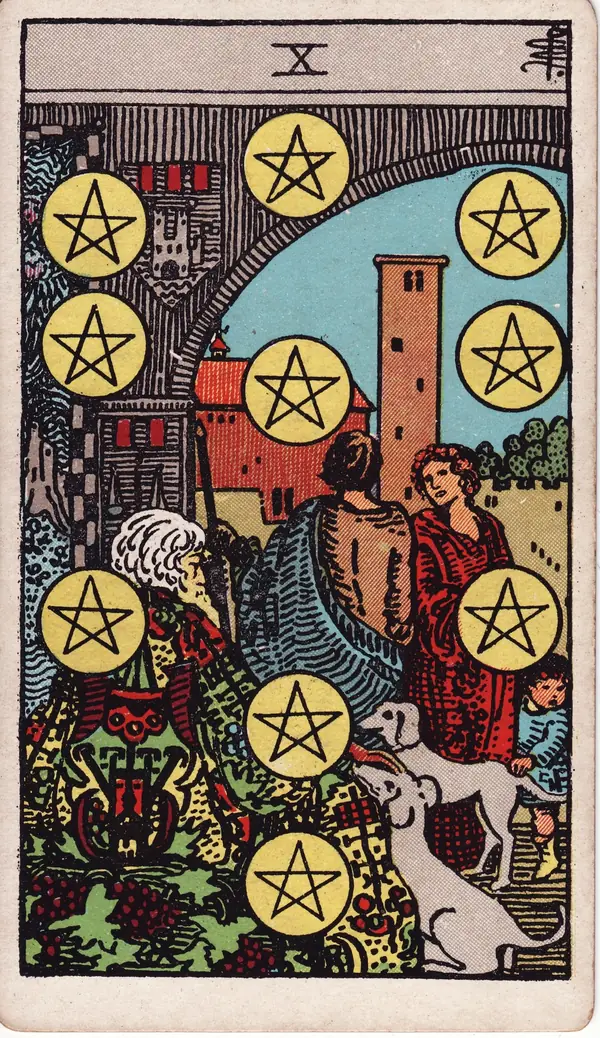
The Ten of Pentacles is the last numbered card in the Pentacles suit of the Classic Tarot, sometimes called the Ten of Coins. It belongs to earth and carries the number ten. You will also see it written as “10 of Pentacles.” The familiar image shows an elder seated beneath a stone arch, a younger couple and a child nearby, a dog at their feet, and ten coins arranged in the pattern of the Tree of Life. Beyond them is a town, a home, a whole world with a door that stays open.
Its core line is simple: generations gathered, the household secure. This is not just a card of money. It is a card of belonging, inheritance, and the quiet power of a life that has somewhere solid to return to.
Ten closes a cycle, and 1 + 0 returns to one, so completion also contains a fresh beginning. In the Kabbalistic Tree of Life, ten corresponds to Malkuth, the sphere of Kingdom, where intention finally becomes something you can touch. That is why the card so often appears around property, family businesses, savings, care for elders, and the practical shape of a shared future. When it appears upside down, the same themes remain, but the cracks in the foundation become the story.
Ten of Pentacles Kabbalah and Tree of Life
In the Classic Tarot, the Ten of Pentacles is a Minor Arcana card, so its place on the Tree of Life comes from its number and suit, not a path number or a Hebrew letter. Ten belongs to Malkuth (the Kingdom), the lowest sphere, and Pentacles corresponds to Assiah, the material world among the four worlds. Malkuth points to visible reality, the body, and the settling of matters; it sits on the central pillar. Assiah turns earth into touchable daily life. Together they say the energy gathered through the first nine cards must become a home, a meal, and something you can hand over—not a wish. The sphere speaks of grounding and completion; the world places it in physical reality.
This is why the Ten often appears with houses, land, ledgers, and family ties. In love, two people are not just discussing affection. They are deciding where to live, how money will be held, and who will care for each set of parents. Those unromantic arrangements are exactly what a promise at the Kingdom level looks like. At work, a proposal, client, or title has to end in a contract, a budget, and a process someone else can inherit; otherwise a good idea stays stuck one level up. In personal growth, the card asks you to turn what you learn into routines, savings, and care for your body, so change leaves a mark.
Another way to read it: a result needs a carrier. Earth cannot promise a distant vision, but it can test whether something has truly taken shape. The Kingdom is the lowest point of the tree, receiving all the energy above it and handing it to daily life. The usual astrological match is Mercury in Virgo—Mercury stresses communication and organization, Virgo stresses detail and service. That suits the work of managing resources and settling family affairs. Ask yourself whether what you own has been placed inside a real structure that can keep working over time.
Ten of Pentacles Numerology
The Ten of Pentacles carries the number ten. In the Minor Arcana, ten marks a final result, an ending, or fullness. It is not another beginning but the settlement of the nine stages before it: what should be harvested is harvested, what should be fixed is fixed, and the full account must be faced. Ten reduces to one plus zero, or one. A new independence grows out of that completed cycle.
This “one” is like an upright pole: independent, self-directed, bold, and willing to decide for itself. Its Major Arcana counterpart, the Magician, turns resources into action and gives an idea an outlet. The Ten does not mean resting on results. After completion comes a fresh hold on the initiative: the family estate may be in your hands, but how it is used and changed is still your call. Upright, that initiative is steady. Reversed, do not let an old structure bind you; tidy up before you set out. Read ten only as an endpoint, and you miss its demand to take over, judge, and carry responsibility. A real new start often begins with settling old accounts. Fullness does not close the door; it passes resources to the next pair of hands so completion can continue.
For someone with a life path number of one, this card can mean “completion” meeting “taking the helm again.” You may be taking over, wrapping up, or arranging life independently, and it is a good time to inventory the resources you can truly control. This is only a reference, not a verdict; the same number behaves differently in different situations, and the card’s position and neighbors still matter.
Ten of Pentacles and the Element of Earth
The Pentacles suit belongs to earth: practical, grounded, and closely tied to money and material conditions. Earth does not rush out like fire or think everything through like air. It asks whether something can land—where things are kept, whether the accounts balance, whether daily life can continue. In the Ten, earth turns completion into a home, land, savings, and an order that can pass to the next generation. It does not guarantee romance, but it gives a relationship and a life a steady frame.
Only court cards need a separate reading of rank element and suit element; the Ten is a number card, so earth itself is the focus. Elements cooperate and clash: fire and air tend to feed each other, water and earth can receive each other, while fire and water often conflict. With Wands or Swords, action and thought push a practical structure to adjust faster. With Cups, feeling can smooth family business, but do not talk only about emotions and ignore the accounts. An earth-heavy spread usually points to practical and financial questions—budget, housing, job security, family duty—that must be handled one at a time, not through mood.
Here, earth makes inheritance more than a verbal promise. It becomes keys, contracts, joint accounts, and care arrangements. In love, it appears in whether two people will share living costs. At work, it is whether a process can be handed over and resources can build up. In personal growth, it means turning a plan into a fixed habit. Too much earth can seem conservative and stubborn, so leave room for change. Financially, the card favors long-term organization and risk management; it promises no riches and gives no specific investment advice. See your income, expenses, and duties clearly before the next step.
What does Ten of Pentacles mean upright?
Upright, the Ten of Pentacles speaks of family, legacy, and long-term wealth. Picture an older relative handing over a set of keys and a worn ledger, or a couple putting a down payment, renovation costs, and childcare on the same spreadsheet. It can describe a family business that has survived several seasons, a home that has held several generations, or a professional network that functions like kin. The card says the foundation is real, and the fruits of patience are ready to be shared.
This is not necessarily inherited money. It can be a chosen family, a community, or a body of work built slowly enough to support other people. Unlike the Nine of Pentacles, which celebrates independent self-sufficiency, the Ten emphasizes stewardship. What you have is meant to be maintained, passed on, and used well. The shadow is complacency: tradition is only valuable when it serves the living. Ask whether your structure supports growth or merely protects appearances.
Ten of Pentacles reversed meaning
Reversed, the Ten of Pentacles points to family disputes and financial risk. The arch in the image develops a crack. A will has no clear executor. Siblings disagree about who pays for an aging parent’s care. One partner quietly covers a relative’s debt and calls it a temporary favor. A family firm gives important roles to relatives who have not earned them, while capable employees leave. Trust leaks through vague promises and uneven contributions.
This is not automatically a prediction of ruin. Reversed often means the structure needs inspection. Someone may be hiding a bill, a loan, or a family obligation to avoid an uncomfortable conversation. Another person may use money as leverage, offering support while expecting control. Before you make a large decision, gather the documents, ask direct questions, and separate facts from loyalty. The card asks you to find the loose brick before the next storm, not to abandon the house.
Ten of Pentacles in love: single, in a relationship, reconciliation
In love, the Ten of Pentacles is about the practical shape of togetherness. It asks whether two people can build a life that includes rent, relatives, rest, and long-term plans without losing warmth. This is not a less romantic card than the Cups suit; it simply locates romance inside daily life. The question becomes whether affection can survive logistics, and whether both people are willing to share responsibility rather than only good moods.
Ten of Pentacles upright love
Upright, love is heading toward shared routines and visible commitment. You may meet each other’s families, discuss a lease, save for a home, or plan who will help an aging parent. Affection shows up through reliability: someone remembers the appointment, makes room in their schedule, or offers to handle a difficult phone call. This phase may not be the most spontaneous, but steadiness has its own intimacy. Keep a little space for play, or the relationship can start to feel like a well-run household with no music in it.
Ten of Pentacles reversed love
Reversed, safety wobbles before affection does. In-law opinions, unequal financial contributions, secrecy about debt, or resentment over caregiving can turn into a quiet power struggle. One person may manage all the money while the other feels like a guest in their own life. Repair begins with transparency: what is owed, who decides, and what each person needs. If relatives are interfering, agree on a united boundary. This card does not declare the relationship over. It asks whether the two of you can rebuild the structure together.
Ten of Pentacles love for singles
For singles, the Ten acts as a long-term filter. You are less interested in a thrilling stranger than in someone who can sustain a life. Introductions may come through family, old friends, work, or community ties. You might be drawn to a person who is established, loyal, and close to their relatives, though you should notice whether that closeness leaves room for a partner. The card can also reflect a season when you are caring for family or building security, and romance has been postponed. Prepare your own foundation first. A good match should feel like partnership, not an audit.
Ten of Pentacles in a relationship
If you are already coupled, this is often a building phase. Budgets, housing, parenting, and elder care come into focus. The card favors commitments that require patience and paperwork, and it rewards couples who plan without becoming cold. Watch the division of labor. One person should not become the family administrator by default. Protect time that has nothing to do with logistics, even if it is only a walk after dinner. When the practical details are shared, the relationship can become a genuine refuge rather than another job.
Ten of Pentacles and getting back with an ex
A reunion is possible when the original obstacle was practical and both people have changed their behavior, not just their promises. If you separated over relocation, debt, family pressure, or different timelines, the card asks for a concrete plan. If the break came from betrayal or a fundamental values gap, it may only show familiarity and comfort. A healthy return needs new rules: financial transparency, clear family boundaries, and a shared understanding of caregiving. Let the reunion feel like a new agreement, not a rerun of an old argument.
Ten of Pentacles as feelings: how they feel about you
As a card of private thoughts, the Ten of Pentacles shows someone thinking about permanence, responsibility, and whether you fit into their world. This is often less about infatuation than about placement: where would you sit at the family table, how would your schedules combine, what would a shared budget look like? Someone may not say much, yet their actions keep moving in your direction. Read the behavior, but do not expect it to replace a conversation.
Ten of Pentacles upright as feelings
Upright, they think of you as someone worth building around. They may imagine introducing you to relatives, sharing a home, or combining ordinary routines. Their care is protective and consistent, and they are willing to take on responsibility for a shared future. Sometimes this type of person assumes you already know how they feel because their actions are steady. If you need words, ask for them directly. Quiet commitment is real, but it should not leave you guessing indefinitely.
Ten of Pentacles reversed as feelings
Reversed, their thoughts are more guarded. They may associate you with pressure: family expectations, financial strain, or a future they are not ready to promise. They might withhold a detail about debt or a relative’s needs, not from malice but from fear of losing you. They could also feel they cannot offer the stability you deserve. The useful move is to ask what they are protecting, rather than demand reassurance. Honesty about the obstacle is more valuable than a polished answer that avoids it.
Ten of Pentacles as how someone sees you
They likely see you as grounded, capable, and family-oriented. You may come across as someone who can handle a budget, remember a birthday, and keep a household running without drama. That can make you a serious prospect rather than a passing interest. In a reversed context, they may see you as tied to family duty or caught in a complicated financial situation. Their view is shaped by what you show them, so if you want to be seen as more playful or spontaneous, make room for that part of yourself.
Ten of Pentacles as intentions
Their intentions are usually serious. They may want to introduce you to relatives, discuss living arrangements, or save toward a shared goal. Upright, this is a wish to build something visible and durable. Reversed, the intention may be cautious or stalled: they want the relationship but avoid merging families or finances. That does not automatically mean dishonesty. Ask what they are ready to commit to now and what needs more time. A real intention comes with a timeline, not only warm language.
Ten of Pentacles career and work (upright & reversed)
At work, this card is about foundations, institutions, property, resources, and succession. It favors roles where experience accumulates and where reliability matters more than a flashy entrance. It can describe the moment a project becomes part of the company’s permanent operations, or the season when a senior colleague begins to hand over responsibilities. The card rewards people who understand the long game, but it also asks them to check whether the organization’s structure is fair.
Ten of Pentacles upright career
Upright, career matters lean toward stable organizations and fields connected to real assets: real estate, construction, finance, agriculture, hospitality, manufacturing, public institutions, and family enterprises. A referral from a relative or senior colleague may open a door. You could take over an important account, manage a long project, or be trusted with resources because you have proven dependable. If you are job hunting, look at benefits, training, job security, and the path ahead, not salary alone. When a role offers stability, negotiate scope and credit as well.
Ten of Pentacles reversed career
Reversed, watch for unclear books, family favoritism, unequal workloads, and vague promises about ownership. You might be asked to cover for a relative’s mistake or accept a title without the authority to do the job. Before joining a company, research its finances and review the contract, benefits, and reporting lines. Inside a family firm, separate employment terms from inheritance expectations. If a project is underfunded, document the risks in writing. This card does not predict failure; it asks for due diligence and boundaries before you invest your time.
Ten of Pentacles for money and finances
The financial theme here is accumulation and distribution, not sudden windfall. The Ten favors savings that grow quietly, property that is maintained, family support that is genuinely available, and resources that can be passed on. It can appear when an inheritance is settled, a long-term account matures, or a household finally has a working budget. A useful check-in is to ask not only how much you have, but who has access to it, who depends on it, and what would happen if circumstances changed.
Upright, the financial base looks sturdy enough to plan from. That might mean building an emergency fund, separating shared and personal accounts, or reviewing a mortgage, lease, or insurance policy. If you are considering a large purchase, the card suggests the foundation is there, but it does not excuse you from reading the fine print. Keep records. Discuss expectations with anyone who shares expenses. A good card is not a substitute for a contract, a receipt, or a realiztic monthly budget.
Reversed, expenses may rise, relatives may ask for loans, or an inheritance and property division may become contentious. Hidden costs are the main risk: the repair that was “almost done,” the debt someone forgot to mention, the family contribution that quietly stopped. Put large transfers in writing and keep receipts. Review shared spending on a regular schedule. Avoid borrowing under emotional pressure, and do not trust anyone who promises a guaranteed return. If debt already exists, organize it by interest rate and due date before making new commitments.
Ten of Pentacles for health
Health-wise, the Ten of Pentacles is less about a specific condition and more about the structure of daily life. Earth cards often mirror routines, sleep, food, movement, and the body’s need for regularity. This is a good card for asking whether your current schedule is sustainable. It can also highlight family health patterns and the practical side of care: who drives someone to appointments, who cooks, who remembers the prescriptions, and who never gets a day off.
Upright, the overall picture tends to be steady. Your routines may be supporting you, even if they are not perfect. If an older relative is part of your household, pay attention to shared habits and make sure their care does not erase your own rest. Schedule movement, meals, and checkups the way you schedule work. Do not skip your own appointment because someone else needs you. If something feels off, get it checked rather than reassuring yourself that the card looks positive.
Reversed, strain often comes from caregiving, money worry, or a family conflict that follows you to bed. You may sleep poorly, carry tension in your shoulders, or lose your appetite. Reversed asks you to share the load instead of treating endurance as a virtue. Ask for help, divide responsibilities, and take real breaks. Persistent pain, unusual fatigue, or low mood deserves medical attention. The cards can point to stress, but they cannot diagnose. For any pregnancy-related concern, speak with a qualified clinician.
Ten of Pentacles as advice
The advice of this card is to think in decades without forgetting today. Put the important things into a structure: a budget, a will, a care plan, a lease, a business agreement. The Ten is not asking you to become rigid. It is asking you to make your good intentions durable. That can mean a family meeting, a written schedule, or a savings account with a clear purpose. The point is to stop relying on memory and goodwill alone.
Ten of Pentacles upright as advice
Write it down. Make the plan visible. Choose paths that compound: skills, relationships, savings, and reputation. Honor your family without becoming its emergency fund. If you are in a position to share resources, be generous and clear at the same time. Enjoy what has already been built, too. A legacy is meant to be lived in, not preserved under glass. Let the next generation participate, and let yourself rest in the security you helped create.
Ten of Pentacles reversed as advice
Find the loose brick. Audit shared accounts, ask about the loan, clarify who pays for what, and set a boundary with the relative who treats your home as an extension of theirs. Replace vague promises with dates and documents. If a conflict is entrenched, bring in a neutral professional rather than another family mediator with a favorite side. Reversed does not ask you to burn down the house. It asks you to repair the foundation before the next storm, and to do it with your eyes open.
Ten of Pentacles as a person
As a person, the Ten of Pentacles describes someone grounded, dependable, and often a little traditional. They may be the family anchor, the one who knows where the documents are and who remembers which cousin is not speaking to whom. They value history, property, and practical care, and they often show love by providing. They may be older than their years, or simply mature in the way they handle responsibility. Their shadow side is rigidity, status awareness, or the belief that money should buy obedience.
Ten of Pentacles reversed as a person
In reversal, this person may be carrying too much, secretive about money, or controlling through resources. They could be the adult child managing an aging parent’s finances without transparency, or a partner who says “we’ll handle it” and never shows the numbers. They might also be someone whose identity is so tied to family that they struggle to make an independent commitment. None of this makes them a villain. It makes them someone who needs clear boundaries and honest questions. Approach with curiosity, but do not hand over your keys too quickly.
How to place it in a reading
Position changes the tone. In the past, the Ten can point to family background, early resources, or a long accumulation that shaped your present options. In the present, it describes the state of your household, assets, and support system. In the future, it leans toward stability taking form, but the surrounding cards will show whether that stability is nourishing or merely comfortable. A surrounding Ten of Cups can suggest emotional warmth alongside material security. Swords cards may point to contracts, communication, or a decision that must be made in writing. A nearby Nine of Pentacles can raise the question of independence versus family duty. The card is best read as a question about how resources are managed, not as a simple label of good or bad.
Our take
The Ten is about the long term, and our advice is straightforward: put important money matters in writing. This is a fortunate card, but good fortune still needs systems. Strong family bonds need boundaries. A stable income needs a budget. A sincere promise needs a record. Upright, appreciate the support you have and use it well. Reversed, do not reject everything in sight; find the loose part and repair it. Treat this card as an invitation to take stock of your household, your resources, and your responsibilities. That is more useful than asking whether it will make you rich.

FAQ
These are the questions readers ask most often about the Ten of Pentacles. The answers follow the site’s usual grading and practical approach, with attention to both orientations and the position in a spread.
Is Ten of Pentacles a yes or no card?
It leans yes. The card supports steady progress, especially when the question involves family, property, or long-term security. In this site’s grading, the Ten is a soft yes rather than an enthusiastic yes. It favors situations that already have a foundation and rewards patience. If you are asking about a practical commitment, a property matter, or a long-term plan, the card is generally encouraging. A reversed Ten still carries that leaning, but it adds conditions. Expect a slower process, family involvement, or a need to clarify money and responsibilities. The answer is not a clean yes until the loose details are addressed.
What does Ten of Pentacles reversed mean in a yes or no reading?
It still leans yes, but with conditions. Expect delays, family input, or paperwork before the answer feels clean. The reversal does not flip the site’s grading to no. It shows that the outcome may arrive through negotiation rather than smooth momentum. Someone may need to produce a document, a relative may need to be consulted, or a budget may need revision. Read the surrounding cards for the nature of the delay. If swords or fiery cards dominate, communication may be tense. If cups or temperate cards soften the spread, the delay is more likely to be administrative than emotional.
What does Ten of Pentacles mean if you have a secret crush?
It points to long-term potential, not instant romance. Someone may be quietly deciding whether you fit into their everyday life. This is not usually a card of sudden confession. It shows a person thinking about practical fit: schedules, families, money, and the kind of future that can be sustained. They may be watching how you handle ordinary responsibilities more than they are watching for a grand gesture. Give the connection time to become visible in daily life. Notice whether they include you in plans, introduce you to friends, or make room for you in their routine. If they keep you separate from everything that matters to them, the card’s promise is mostly theoretical.
What does Ten of Pentacles mean for marriage?
It leans yes. The card suggests a stable, family-centered commitment, provided money and boundaries are discussed openly. Traditionally, this is one of the more supportive cards for a lasting union. It often appears around meeting families, planning a shared home, or blending two practical worlds. The emphasis is on durability rather than spectacle. The caution is that relatives and finances must not be allowed to run the relationship by default. Talk about expectations, debts, housing, and care for older family members before the celebration. A strong structure can hold a great deal of love, but only if both people help maintain it.
What does Ten of Pentacles mean as an outcome?
A stable outcome that builds over time. It favors security, family support, and lasting structures more than sudden luck. As an outcome, the card suggests that the situation will settle into something durable. It may not arrive quickly, and it may require practical work, but the result has weight. For a project, this can mean it becomes part of the long-term plan. For a relationship, it can mean a shared life rather than a temporary arrangement. Check the surrounding cards for the quality of that stability. Stability can be warm and generous, or it can be rigid and controlling. The Ten tells you that structure is the theme; the other cards tell you what kind of structure it is.
What timing does Ten of Pentacles suggest?
Slow. Think in months or seasons, not days, and watch for practical milestones such as savings, paperwork, or family conversations. The card belongs to earth, so its pace is deliberate. It rarely describes a sudden turn. Instead, it describes a process that becomes real through decisions, signatures, and accumulated effort. A date on a contract may matter more than a feeling of urgency. Use real-world markers to read the timing: when the lease is signed, when the debt is paid, when the family meeting happens. If the question needs an immediate answer, this card is a reminder that the foundation is not yet complete.
Does Ten of Pentacles mean pregnancy?
No. The card does not reliably indicate pregnancy; it speaks about family structures, not a medical test. Readers sometimes associate the Ten with family expansion because of the child in the image, but that is not a dependable meaning. It can describe a household growing, a family adding a member through marriage or adoption, or a concern about fertility, without confirming anything about a pregnancy. For any pregnancy question, use a medical test and consult a qualified clinician. The cards are not a diagnostic tool, and a warm family card should never be treated as a substitute for medical advice.
What zodiac sign is Ten of Pentacles?
Mercury in Virgo is the common traditional correspondence. It matches the card’s practical, detailed, family-centered tone. Virgo is an earth sign associated with routine, service, and careful management, while Mercury adds communication and analysis. Together they describe the kind of intelligence that keeps a household running and notices the discrepancy in a ledger. This is not glamorous energy, but it is extremely useful. The correspondence also explains why the card often points to documents, schedules, and the small decisions that hold a family together. It favors clear language and precise arrangements over vague assurances.
Is Ten of Pentacles a good or bad card?
Generally good. It points to stability, support, and long-term security, though the reversal asks you to repair weak spots. The upright card is a welcome sight when the question concerns family, property, or a long-term plan. Its goodness is not dramatic; it is the goodness of a roof that holds, a savings account that exists, and people who show up when they say they will. The reversed card is not a curse. It reveals family disputes, financial risk, or hidden pressure so that you can respond. Judge the card by what you do with the information. A difficult reading can still lead to a much healthier structure.
Related cards
- Nine of Pentacles: the previous card celebrates independent security and personal enjoyment, while the Ten shifts the focus toward shared family resources.
- Ten of Cups: another card of completion, but it emphasizes emotional belonging and domestic warmth rather than material security.
- Six of Pentacles: a card of giving and receiving, useful for questions about loans, support, and the balance of power in a household.
- Wheel of Fortune: both cards involve cycles, though the Ten grounds the turning point in property, family, and long-term obligations.
- Temperance: a reminder to balance family duty, money, and personal rest when the Ten feels heavy.
- Page of Pentacles: the beginner’s card of the suit, pointing back to the basic skills that make a lasting legacy possible.