Justice Tarot Card Meaning: Reversed, Love, as Feelings, Yes or No

Draw a Classic Tarot spread →Free, no sign-up. Think of your question, then draw.
In one line: Put both sides on the scale; the result follows the facts.
| Keywords | |
|---|---|
| Upright | fairness, cause and effect, decisions |
| Reversed | bias, dodging consequences, unfairness |
| Type | Major Arcana 11 |
| Yes/no (our grading) | depends on the other cards |
Quick answers: yes/no · love · career
- Yes/No: Under our grading, Justice depends on the other cards. Yes/no is the least reliable use of tarot—prefer “how should I approach this?”.
- Love: A bond that needs balance in give and take; reversed, one side short-changed or not honest.
- Career: Contracts, disputes and reviews go by the rules; reversed, get documents and evidence in order.
*FateClear Editorial Team*
Want to draw a Classic Tarot spread? Draw cards.
Justice is card 11 of the Major Arcana in the Classic Tarot, and it marks the moment a situation stops being vague and starts asking for a verdict. Traditionally it is tied to the air element and to Libra, the sign that weighs, compares, and looks for the fair middle. Air keeps the thinking clear; Libra keeps the human cost in view.
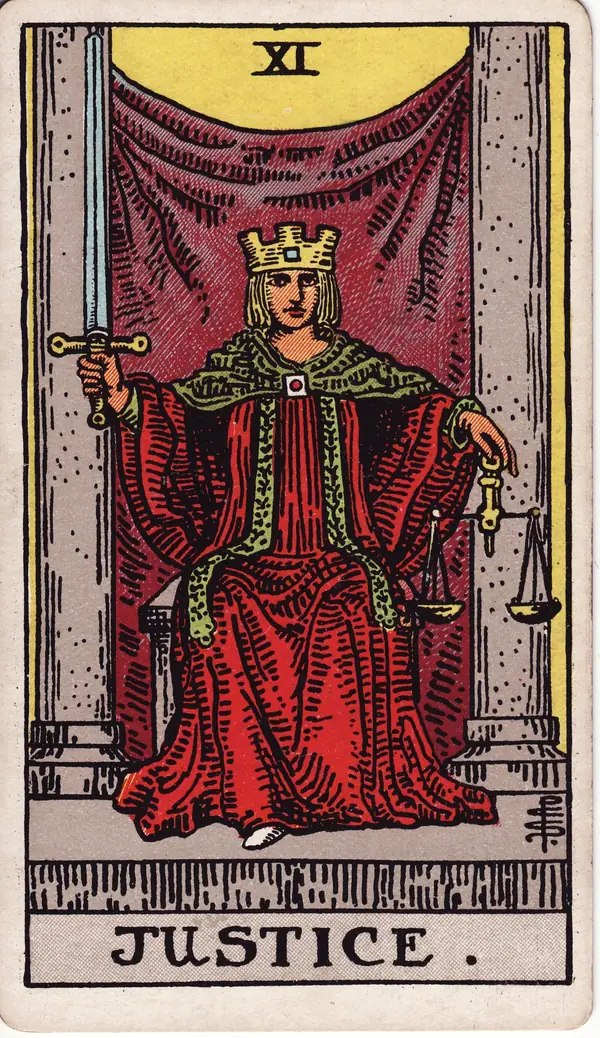
The image is easy to hold: a seated figure, upright and calm, holding scales in one hand and a straight sword in the other. The scales measure what was given and what was taken. The sword cuts through excuses and delay. Nothing here is settled by mood. The card's one-line core is this: put both sides on the scale; the result follows the facts.
Eleven deserves a pause too. Two ones stand side by side, like two people, two positions, two sets of effort in one room. Number study often reads that pairing as balance between differences, which is why Justice speaks about rules and relationships at once. In the older symbolic map of the Tree of Life, it sits on the twenty-second path, linked with the Hebrew letter Lamed, between severity and beauty. A fair ruling has to cut and mend at the same time. Arrive upside down, and that call to honesty is simply harder to hear.
Justice Symbolism: What Each Detail on the Card Means
The seated figure: In the Classic Tarot, the figure sits with a straight back, facing the viewer directly, shoulders level, and gaze even—neither looking away nor trying to stare anyone down. The posture suggests a decision placed on stable ground, not a passing emotional reaction. Upright, the card shows a willingness to face the situation and accept responsibility. Reversed, the posture seems to slacken and the gaze to drift, a sign that self-interest or outside pressure has pulled the position off-center. The calm face keeps emotion in check and asks you to set your first reaction aside.
The scales: One hand holds the scales, and the two pans hang level, not yet tipped. They weigh visible contributions and visible costs, while also reminding you that some parts of the story have not been spoken. Upright, the scales stand for facts you can check and terms you can compare. Reversed, they look as if a hand is pressing one pan down, pointing to double standards, hidden information, or a distribution that favors one side.
The sword: The other hand holds a sword with the point raised, aimed at no one. The blade is not there to wound; it is there to cut through vagueness and make a boundary clear. Upright, the card leans toward judgment by stated rules and plain speech. Reversed, the words may be too sharp or the verdict too quick, or a relationship that should have been cut is still being dragged along, causing more harm the longer it lasts.
Weigh first, cut second: The scales and sword sit on opposite sides, creating an order: measure first, rule second. Scales without a sword can understand every side and still never reach a conclusion. A sword without scales can strike from temper alone. Upright, the two tools work together. Reversed, the order often breaks down—someone delivers a verdict before the facts are clear, or sees the truth plainly and still will not act on it.
The red robe: In the familiar image, the robe is mostly red. Red brings passion and active energy, and it signals that this matter is not a set of cold clauses. Someone genuinely cares about what happens. The color gives justice more than paper rules; it adds the warmth of wanting fairness to be real. Reversed, that red can turn into temper, and the wish for fairness can shrink into a fight to prove a point.
The crown and square jewel: The crown carries a square shape rather than a soft, rounded ornament. A square feels stable and easy to follow, as if a decision has been set inside an upright frame. Upright, the card points to standards that are clear and consistent from one case to the next. Reversed, the frame itself may be crooked, so the rule works only for one side and quietly fails the other.
The two pillars and purple veil: The figure sits between two pillars, with a veil hanging behind and closing off the space beyond. The pillars resemble two opposing positions. Purple adds mystery and dignity, and it warns that what you can see is not the whole story. Upright, the card favors looking for a middle line between the two sides. Reversed, someone may be holding back a key fact, or using “neutrality” as a shield against taking a stand.
The numeral and the blank background: A Roman numeral usually appears on the card, matching its place as number 11. There are no animals, plants, distant hills, or even clouds; the background is nearly empty. That emptiness pulls attention back to the person and the two objects in their hands. It also says the turning point will not come from outside; it depends on someone stating cause and effect clearly. Upright, the card dares to judge inside that blank space. Reversed, it avoids the judgment and lets the empty space become delay.
Justice Kabbalah and Tree of Life
In the Classic Tarot tradition, the twenty-second path is tied to the Hebrew letter Lamed. The letter began as a picture of an ox-goad, the stick used to drive cattle, and English usually gives the term as ox-goad. The path joins Geburah (Severity), the fifth sephirah on the left pillar, to Tiphareth (Beauty), the sixth sephirah on the middle pillar. Geburah governs strength, cutting, conflict, and correction. Tiphareth governs balance, harmony, and the self. The path ties those temperaments together: first comes the courage to cut, then the calm return to center. Severity without a return to center hardens into harshness. Harmony that refuses to cut anything turns into muddling through.
Direction matters as well. The path runs from the left pillar toward the middle, so force loosens into release and sharp judgment is placed back inside a larger order. It also runs downward, which means a ruling has to land in real human affairs; it cannot stay at the level of talk. In a love reading, Justice often marks the point where two people begin to discuss terms. One end is the sharp “I have had enough,” the other is the repairing question “can we still live together well?” The path says to cut the unequal practice, not the whole person.
At work, when responsibility or performance is in dispute, Geburah gives you the nerve to name the problem. Tiphareth asks you to fit the correction back into the team as a whole, so you do not win the argument and lose the cooperation. In personal growth, the path works like a rule you set for yourself: refuse what should be refused, admit what should be admitted, then return to the rhythm of daily life instead of sentencing yourself as a bad person. In astrology, Justice is often linked with Libra, the sign of weight and relationship. That echoes the path’s balance from the middle pillar and gives the card its underlying note: after the ruling, people still have to live together.
Justice Numerology
Justice is number 11, which reduces to 2 in numerology (1 + 1), the number of the High Priestess. The eleven is built from two ones, like two separate straight lines. “I” and “you” each have to stand on their own before comparison and cooperation become possible. Once the number reduces to 2, the question shifts from “who is stronger” to “how can both exist.” That is the logic underneath Justice: neither side gets erased, and both weights are allowed to show.
The energy of 2 is cooperative and attentive. It picks up other people’s moods easily and notices small details in someone’s behavior. Inside Justice, it explains two sides of the card. Upright, you can see the other person’s difficulty, so you want rules everyone can accept. Reversed, you care so much about their reaction that you give away your own share, or you turn “I have been accommodating all along” into a debt you expect them to pay. The card does not ask you to stop noticing others; it asks you to include your own side in the count.
The High Priestess answers Justice from the inside while Justice works on the outside. The High Priestess sits before the veil and deals with the feminine and masculine within oneself. Justice sits between two pillars and deals with right and wrong in the outer world. Both cards ask a person to steady themselves before making a judgment; only the stage is different. People with life path number 2 are often described as quiet observers with something of the High Priestess about them, and they tend to be especially alert to equality when Justice appears. That is a mirror for reflection, not a verdict. You can use it to check whether you have taken on extra work again, but you do not have to treat a personality label as fate.
What does Justice mean upright?
Upright, Justice is not a promise that you win. It puts fairness, cause and effect, and decision-making back at the center of the table. What you contributed, what you agreed to, and what you are willing to own all get weighed on the same scale. This card often appears around signing papers, setting terms, dividing resources, or ending a long stretch of ambiguity. If your standards are consistent and your evidence is in order, you do not have to charm anyone to hold your place. Say what needs saying, carry what is yours, and let the facts move things forward.
Justice reversed meaning
Reversed, Justice usually points to bias, dodged consequences, or plain unfairness. Maybe you gave a great deal and received little in return. Maybe the rules themselves lean toward one side. Maybe you are using "there was nothing I could do" to cover a choice you did make. The reversed card makes people feel wronged, and it also makes them keep score. Before you set out to prove someone is bad, find the exact standard that got bent. That is the only place where the situation can become negotiable again.
Justice in love: single, in a relationship, reconciliation
In love, Justice upright tends to bring equality to the front: are both people contributing, can both speak plainly, will both stand behind their choices? It does not turn affection into a transaction. It asks whether the relationship can stand up straight over time. The sections below look at singles, people already in a relationship, and the question of returning to an ex.
Justice upright love
Upright in a love reading, Justice asks whether the give and take actually balances. That can sound cold, but it is often a relief: you are allowed to name what you need instead of quietly absorbing the cost. Notice who initiates, who apologizes, who adjusts their schedule, who pays, who remembers. None of these alone decides the relationship, but together they show its shape. The card favors clear agreements over hopeful guessing, and it rewards the two people who can discuss fairness without turning it into an accusation.
Justice reversed love
Reversed, love readings often show a ledger that no longer adds up. One person keeps overgiving and calls it devotion; another enjoys the benefits and calls the arrangement normal. Sometimes the imbalance is practical, involving money, chores, or time. Sometimes it is emotional, with one person's feelings treated as facts and the other's as complaints. The card does not say the relationship is over. It says the current terms are not fair, and that quietly enduring them will not fix anything. Name the imbalance before resentment writes the ending for you.
Justice love for singles
For a single person, Justice is less about a new face and more about a clear standard. What will you accept? What will you not? How much time and trust are you willing to offer before someone has earned them? This card often appears when you stop shrinking yourself in order to be chosen. When you meet someone, watch for consistency: do their words match their schedule, their promises match their follow-through? Mutual respect is a better signal than a rush of excitement. Date like someone who expects to be treated fairly, not like someone hoping to be picked.
Justice in a relationship
In an established relationship, Justice pushes the unglamorous subjects forward: household labor, shared money, promises made in passing, boundaries with family, and what happens when you disagree. This is not a sign that love is fading. It is a sign that the relationship needs terms both people can live with. Pick a calm hour, not the middle of a fight, and get specific. Who handles what? What counts as overstepping? How do you repair after a disagreement? Fairness discussed in daylight is far kinder than fairness enforced through silent resentment.
Justice and getting back with an ex
With an ex, Justice does not hand down a simple answer about reunion. It asks whether the relationship can be renegotiated. If both people can admit the old problem, take their share of responsibility, and do something different this time, there is a real basis for trying again. If the plan is simply to return to something familiar while the same imbalance stays untouched, the old argument will come back stronger. Reconciliation here is not about who apologizes hardest. It is about whether the terms, boundaries, and costs can be laid out honestly before anyone moves back in.
Justice as feelings: how they feel about you
When Justice appears in a feelings position, the other person is rarely lost in pure emotion. They are measuring. That does not mean they feel nothing. It means they are weighing what the connection costs, what it offers, and whether they can be fair to you and to themselves. A card cannot read minds, so treat this as a map of their focus rather than a report on their private thoughts.
Justice upright as feelings
Upright, their feelings come with a scale attached. They notice how much you reach out, how consistently you show up, whether your words and actions agree. They may admire your sense of proportion and feel safe with someone who has clear edges. What you experience as distance is often their version of care: they do not want to promise more than they can deliver. If they are slow to move, it may not be lack of interest. They may be waiting to see whether the connection is balanced enough to deserve a clear answer.
Justice reversed as feelings
Reversed, their feelings are tangled with defensiveness. They may believe they have been treated unfairly, or they may know they acted poorly and would rather not look at it. Some people in this position keep saying how difficult everything is and hand the responsibility to circumstances. Others quietly compare and decide you ask for too much. Their behavior can swing between warm and remote because their internal scale is tilted. Pay attention to what they do across a few weeks, not to the explanation they offer in one conversation.
Justice as how someone sees you
They see you as principled, composed, and hard to fool. You come across as someone with standards, someone who notices when a deal is uneven, and someone who will not pretend a problem is small just to keep the peace. That can be attractive and slightly intimidating at once. They may assume you are more detached than you are, or that you need less reassurance than you do. If you want warmth to register, say it plainly; otherwise they may read your calm as a closed door.
Justice as intentions
As intentions, Justice says they want things defined. They would rather agree on what this is than drift through ambiguity, and they are thinking about consequences before they act. That can look unromantic, but it is a form of respect: they do not want to make promises they cannot keep or take more than they can return. If they are asking practical questions about timing, exclusivity, money, or plans, take those questions seriously. They are not trying to kill the mood. They are trying to build something they can stand behind.
Justice career and work (upright & reversed)
At work, Justice is a practical card. It favors clear processes, transparent criteria, and decisions that can survive a second look. It cares less about office politics than about whether the same rules apply to everyone. Upright, it supports you in asking for what your work is worth. Reversed, it warns that the field is not level and that you need evidence before you need outrage.
Justice upright career
In a job search, this card points toward roles with clear expectations, structured interviews, and criteria you can prepare for. Your record will be read on its merits, so make it easy to read: tidy your resume, gather references, and explain gaps without apology. At work, it asks you to clarify duties, performance measures, pay, and boundaries instead of hoping good effort will be noticed. When considering an offer, compare salary, commute, growth, and risk in writing. Justice does not guarantee promotion, but it supports a fair case argued calmly.
Justice reversed career
Reversed at work, Justice often describes a tilted field: standards that shift with the person, credit that goes elsewhere, blame that lands on the wrong desk, or policies that quietly favor a select group. Do not meet this with pure emotion. Keep records, check the written rule, and use the proper channel. A dated paper trail is worth more than a passionate speech in the hallway. If the environment refuses to correct itself over time, weigh the real cost of staying against the risk of leaving. The card supports fair play, not a dramatic resignation meant to prove a point.
Justice for money and finances
With money, Justice is about balance rather than windfall. It asks whether income and spending match, whether contracts are clear, and whether shared costs are divided in a way everyone understands. This is a good card for reviewing accounts, reading the fine print on a lease or loan, and settling debts with a written record. It also warns against avoiding money conversations to keep the peace, since unclear arrangements tend to become resentments with interest. Nothing here promises wealth or recommends a particular investment. Treat it as a prompt to verify terms, keep receipts, and make agreements you could explain to a neutral third party.
Justice for health
In a health context, Justice is a card of balance and honest signals, not diagnosis. It asks whether your routine is sustainable: are you working through fatigue, skipping rest, eating at random hours, carrying stress in your shoulders because there is no room to set it down? The body tends to present its own evidence. Notice sleep, tension, appetite, and energy without arguing with them. The card supports regular habits and asking for help when the load is too heavy. It cannot name an illness or replace a doctor. If discomfort, pain, or sleep problems persist, seek proper medical advice.
Justice as advice
The advice of Justice comes in two steps: separate fact from feeling, then decide whether and how to talk. Upright, it is about applying fairness in practice. Reversed, it is about correcting a tilt that has already happened. Settling accounts is not the same as being cold; the point is to protect something that has to last.
Justice upright as advice
Write it down. What happened, what each person promised, what was actually delivered, and where the gap sits. Then propose something specific and doable rather than a general complaint. Make the decision without dragging it out, and do not use "let us wait and see" as a hiding place. If you are on solid ground, be polite and unmovable. If part of this is yours, admit it first, then discuss repair. Fairness is not about making everyone happy. It is about building an outcome that still looks reasonable when you review it later.
Justice reversed as advice
Start with the place where you feel wronged, but do not camp there. Ask three questions: Which rule was broken? Did I quietly allow it? What specifically would I like to change? Turn accusations into requests, and replace "you always" with "this time, when this happened." If you have raised the issue several times and nothing moves, set a boundary and mean it. Leaving an unfair arrangement is not the same as defeating the other person. It is refusing to keep paying a price that no one else has agreed to share.
Justice as a person
As a person, Justice describes someone fair-minded, principled, and usually the one friends ask to settle a dispute. They keep their word, read the contract, and dislike double standards. They can seem reserved because they process before they react, and because they would rather be accurate than charming. In relationships they notice reciprocity and expect it. Their strength is reliability; their blind spot is assuming everyone is as reasonable as they are. If this card represents you, remember that fairness without warmth can feel like a courtroom, and that naming your feelings is not a loss of objectivity.
Justice reversed as a person
Reversed, this figure can be rigid, self-serving, or quietly evasive. Sometimes it is someone who applies one standard to themselves and another to everyone else, who keeps a private tally of favors, or who avoids responsibility with a smooth explanation. It can also describe a person who has been treated unfairly so long that they now judge every situation through that wound. Either way, the test is in the details: do they accept accountability, do they correct mistakes, do they respect your boundaries? Charm is easy. A consistent pattern of fair behavior is the evidence you want.
How to place it in a reading
Position changes how Justice speaks. In a present position, it usually means the matter has reached the stage of terms, evidence, and consequences. In an advice position, it tells you to handle things by the rule and the record rather than by mood. In an outcome position, it suggests the result will match the conditions: what is properly documented and agreed tends to hold, while what was left vague tends to be decided by someone else. The surrounding cards show the arena. Near swords, the fight is about facts and words; near cups, about emotional reciprocity; near pentacles, about money and resources. Paired with the Hanged Man, it often means pause, count the cost, then return to fairness.
Our take
In a spread, Justice looks first at the direction of cause and effect, not at simple good or bad luck. The cards to its left usually show the cause: the conditions, the choices, and who broke the rule first. The cards to its right show the effect: the price after the ruling and the way the relationship gets rearranged. If a tense sword card sits on the left and a pentacle or cup card appears on the right, the dispute will often end in money, resources, or emotional compensation. If a sword card or the Tower lands on the right, prepare for an outcome that is not gentle.
In a dispute or contract spread, position matters more than the card’s general meaning. Justice on the querent’s side suggests the querent holds the clearer facts or terms; the task is to organize the evidence. On the other person’s side, it warns that the other party has the stronger footing in the rules, so the querent should gather documents first instead of relying on a sense of grievance. In the middle, the core question is “which standard applies.” Settle the standard before arguing over who wins. A written clause can outweigh the loudest complaint.
It is easy to confuse Justice with Judgment and the Two of Swords. Judgment leans toward re-evaluation and rebirth; its focus is “am I willing to face the past?” The Two of Swords leans toward a stalled decision, with two options locked in place and a refusal to look for now. Justice leans toward a fair ruling: known facts go on the scale, and the conclusion has to be something that can be carried out. In short, Judgment starts again, the Two of Swords stops, and Justice weighs.
A past–present–future spread works well. Justice in the present means the matter has entered a stage of terms and conditions. In the future, it means the result will be settled according to what was done earlier. In a two-option spread, the side it sits closer to is the side with more rules and clearer consequences, not necessarily the easier side. Its Libra link can help too: notice which side feels hotter and more urgent, and which feels cooler and steadier. That can show where the scale is sinking, but facts still come first.
Justice in Different Positions: Past, Present, Advice, Obstacle
Past: When Justice falls in the past position, it usually points to a ruling or an imbalance that has already happened. You may have signed a contract without reading it closely, or spent a long stretch in a relationship giving more than you received. The position asks what shaped the present situation, and Justice answers that an old rule, promise, or judgment is still in force. Upright, the way it was handled mostly holds up. Reversed, the tilt began back then and you are still settling the bill now.
Present: The present position asks what is happening right now. Justice here puts you at a threshold where a judgment is required: should you talk, sign, or say the thing plainly? Upright, the conditions are becoming clear and it is time to move through the proper steps. Reversed, the scale is already tipped. Do not rush to a verdict; first find out who is changing the rules and why. The card favors a clear procedure over a dramatic confrontation.
Future: In the future position, the question is where things are heading. Justice here often means the matter will enter a settling period, with the result tied to what came before. Upright, it leans toward the facts being honored. Reversed, it warns that the result may still be disputed, or that you will pay for earlier vagueness. The card is not predicting a winner. It is saying that cause and effect will come to the surface, and the account will be reviewed.
Advice: The advice position asks what to do. With Justice here, write three columns: what happened, how you feel about it, and what you want the other person to do. Upright, the answer is to talk firmly and politely, with the facts in front of you. Reversed, the first task is to stop shortchanging yourself. Do not keep using patience to buy a surface peace that leaves the real imbalance untouched. Put the request in plain language and give it a clear limit.
Obstacle: The obstacle position asks what is stuck. When Justice lands here, the block is often an inconsistent standard: one side argues from emotion, the other from logic, or everyone talks about fairness while nobody will admit their own share. Upright, the obstacle is that a decision has to be made. Reversed, the obstacle is someone refusing to let the scale return to zero. The matter stays suspended because a ruling keeps being postponed.
Outcome or clarifier: In an outcome position, Justice leans toward an ending produced by the rules, one that can be explained afterward. It may not satisfy everyone, but the accounts will be clear. As a clarifier, it reminds you that the real thing to protect is consistency, not pride. A reversed outcome often means “half the benefit”: even a win costs relationships and energy. A positive card in reverse is seldom all bad; the fairness is discounted and you have to add the missing enforcement and boundaries.
Reversed is not automatically the villain. It usually shows the upright energy in excess or out of balance right now. The wish to be fair can harden into scorekeeping, and the wish to stay neutral can turn into avoidance. Look at which end has gone too far before you decide whether to pull back or push forward. The card asks for adjustment, not a verdict on your character.
Justice Three-Card Example (Fictional Example)
Fictional example: The people and events below are invented and serve only to show how the reading can work.
Question: A querent has been renting an apartment for two years. At move-out, the landlord wants to keep most of the deposit because of “stains on the walls and scratches on the floor.” The querent accepts that normal use left marks but believes this is ordinary wear, and the two sides cannot agree on the amount. The querent wants to know whether to fight hard, give in, or go to mediation.
Spread: My position, the other person’s position, and the outcome. The three cards are: first, “my position,” Queen of Pentacles upright; second, “the other person’s position,” Seven of Swords upright; third, “outcome,” Justice upright.
First card, my position: Queen of Pentacles upright. This card says the querent is not being unreasonable. The querent is practical, takes care of daily life, and pays attention to real losses. The Queen of Pentacles can count the cost, but she will not inflate a claim just to win a point; she cares about what repairs actually cost and which part belongs to her. In this position, the card shows usable material already in the querent’s hands: move-in photos, cleaning records, and screenshots of the conversation. The material has not been organized yet. The weak spot is that the querent puts “I do not want trouble” first and may give away too much at the start.
Second card, the other person’s position: Seven of Swords upright. The Seven of Swords often carries the idea of holding something back and avoiding a direct approach. In the other person’s position, this does not mean calling the landlord evil. It points to a negotiating style that picks the most favorable version: mentioning damage but not the age of the apartment, giving a verbal estimate but no repair receipts, or counting normal aging as damage. The card also suggests the other side may not want a large fight; it may prefer to use an information gap to push the number down quickly. The querent’s defense is not a louder voice but a clear account.
Third card, outcome: Justice upright. A major card in the outcome position says the matter will not be settled only by whoever argues best. It returns to evidence and standards. Upright, Justice leans toward the lease, the actual wear, and an amount that can be checked. It does not promise the full deposit, but it supports having the reasonable part recognized. It also suggests a more formal process: written communication, repair quotes, and if needed, a third-party mediator. More phone calls in which each side repeats its own version will not move the case forward.
Putting the three together: Only one card is a major, so the matter has a real principle at stake but is not completely out of control. By element, the Queen of Pentacles is earth, the Seven of Swords is air, and Justice is often linked with air. The overall tone is cool and rational, with little fire or water to push it along. Neither side is likely to create an emotional showdown. The opening lies in making the account solid, not in proving who feels more wronged. The Queen supplies a practical base, the Seven warns that the other side will dodge the weak points, and Justice pulls the ending back to the rules. On the warm–cool contrast, the querent’s side is warmer and more willing to carry a share; the other side is cooler and more calculating. A neutral standard has to close the gap.
Advice for the querent: Do not begin by convicting the landlord in your own mind. Put the evidence in date order: move-in photos, move-out photos, lease clauses, repair quotes, and chat records. Make two lists: “reasonable wear I will accept” and “excessive deductions I reject.” Send both lists in writing with a clear deadline. When you talk, stay on items and amounts. Do not bring up old grievances or attack the person. If the other side will only give verbal numbers, propose a joint third-party assessment or mediation. The goal is to recover the part that is owed, not to burn the relationship to the ground.
Common Misreadings of Justice
Misreading one: Justice means you are sure to win. The card is about handling a matter by a standard, not about handing one side a victory. If the evidence is thin or the terms work against you, it will settle the account just as honestly. Look at the cards beside it and at whose position it occupies. Do not hear “fairness” and assume it means “favors me.”
Misreading two: Justice is cold and heartless. It asks you to slow your emotions down, not to have none. The red robe and the scales both show that human weight matters. Reading the card as “whoever shows feeling loses” can push a querent to swallow real needs. The better approach is to name the feeling, then turn the request into terms that can be discussed. If cup cards sit nearby, read the emotion and the conditions together.
Misreading three: reversed always means the other person is bad and unfair. Reversed Justice is more often about imbalance or excess. You may be keeping too close a score, or you may have given in for too long. The rules may lean to one side, or you may know you are wrong and still put off the reckoning. Sort out which pattern is present before you decide whether to fight, repair, or walk away.
Misreading four: Justice means payback, so you should wait for the other person to fall. The card does not take revenge on your behalf. It lays cause and effect on the table. A spectator’s attitude can make you miss the part you still need to correct. If Justice appears with Judgment, keep the two distinct: Judgment is about facing the past and beginning again, not about cursing someone.
Misreading five: one card can settle right and wrong or decide a marriage. A single card carries limited information, especially in questions about contracts, marriage, or law. You need the position, the neighboring cards, and the real documents. Treating Justice as the only answer can turn “we need to talk this through” into “the matter is already decided.” That leap is where readings go wrong.
Misreading six: upright is always good and reversed is always bad. A positive card in reverse often means the benefit is cut in half, not that everything is ruined. Upright Justice can also mean you have to carry the pressure of making the call. Ask where the card sits and what surrounds it before you talk about good or bad fortune. The position often changes the tone more than the direction does.

FAQ
These questions come up often. The short answer is meant to be direct, but a card still has to be read inside its spread and inside your actual situation. For health, legal, or major financial matters, use a qualified professional.
Is Justice a yes or no card?
Its answer depends on the other cards. On its own, it leans toward a conditional yes: fair terms and solid facts first. Justice is conditional by nature. It asks what the agreement actually says before giving a green light, so a clean yes requires evidence, clear terms, and honest dealing. If those are missing, the card is less a refusal than a request to fix the conditions. Read it alongside the rest of the spread. Supportive cards around it tilt the answer positive; conflict, secrecy, or reversal tilts it cautious. If you pulled only this card, treat it as approval with a condition attached, not an unconditional green light.
What does Justice reversed mean in a yes or no reading?
Usually a cautious no, or a not yet. Something in the situation is unbalanced, and the answer waits until that is addressed. Reversed Justice rarely delivers a clean outcome because the conditions are compromised: someone is hiding a cost, a standard is being applied unevenly, or a consequence is being avoided. The card asks you to find the specific distortion instead of accepting a vague answer. If the surrounding cards are constructive, this can mean approval after the correction. If they are defensive or evasive, treat it as a no for now. Either way, the useful move is the same: get the facts straight before you act.
What does Justice mean if you have a secret crush?
It suggests weighing the connection honestly, not a guarantee that your crush feels the same. Watch for reciprocity, not hope. With a secret crush, Justice cools the fantasy and asks what is actually known. Does this person seek you out? Do they keep plans? Are they available in a real sense, or only charming in passing? The card favors a grounded read over imagined signals. It can also turn the mirror on you: are you hoping to be chosen by someone you have never really shown yourself to? A straightforward, low-pressure conversation usually tells you more than weeks of analysis. Being fair to yourself matters as much as being fair to them.
What does Justice mean for marriage?
It points to a serious review of commitment and shared responsibility. It is neutral about the outcome. Marriage questions bring Justice to the practical core of partnership: household duties, money, family obligations, and the promises each person believes they made. The card often appears when an imbalance has become too obvious to ignore, or when a formal decision is approaching. It does not predict divorce or guarantee a wedding. It asks whether the terms are mutual and whether both people are willing to put them in plain language. A fair conversation now can strengthen the bond; avoidance tends to let resentment do the negotiating.
What does Justice mean as an outcome?
The outcome follows the evidence. Fair terms tend to hold; vague arrangements tend to be settled by someone else. As an outcome, Justice is less about luck than about correspondence between cause and result. If you have kept records, honored commitments, and stated your case clearly, the card suggests the conclusion will reflect that. If the matter was handled carelessly, the outcome may simply reveal the cost. It is worth checking what fairness means in this specific situation. Sometimes the fair result is not the one you wanted. The card asks you to accept a decision that can be defended, rather than chase a victory that only feels good in the moment.
What timing does Justice suggest?
No fixed timeline. It moves at the speed of paperwork, procedures, and clear decisions rather than sudden events. Justice is not a card of instant shifts. It suggests a period of review, negotiation, or waiting for an official answer. Things may feel slow because the situation requires accuracy rather than speed. Use the wait to prepare: gather documents, clarify what you are asking for, and decide your bottom line. When movement comes, it often arrives through a formal channel — a response, a signed agreement, a scheduled conversation. The card favors readiness over rushing.
Does Justice mean pregnancy?
No. Justice is not a pregnancy card and cannot answer that question. Nothing in the symbolism of scales and a sword points to conception, and tarot is not a reliable way to determine pregnancy. If you are wondering about pregnancy, a test and a doctor are the appropriate sources. In a broader reading, this card may speak about responsibility, timing, or a decision that affects a family. Those themes are worth discussing honestly, but they should not be confused with a medical answer.
What zodiac sign is Justice?
Libra. In traditional correspondence, Justice is linked with the sign of the scales. Libra fits the card's focus on balance, comparison, and fair dealing. It also brings in the social dimension: Justice is not only about private ethics but about how people treat one another inside a shared arrangement. Some readers also connect the card with the air element, which supports clear thinking and careful language. You do not need astrology to read Justice well, but the Libra link is a useful reminder that fairness is relational, not abstract.
Is Justice a good or bad card?
Neither. It is neutral, showing fairness and consequence; its tone depends on how honestly the situation is handled. When people have been straightforward, Justice often feels supportive, even relieving. It confirms that effort and evidence matter. When someone has been avoiding a cost or bending the rules, the same card feels severe. That is why good or bad is a less useful question than what is true here. Justice holds up a mirror. If you like what you see, the card is encouraging. If you do not, it is still giving you something valuable: a chance to correct the account before it is corrected for you.
Related cards
Several cards share Justice's concern with weight, cause, and rules. Read them by position and by the question, not as fixed pairs.
- The Hanged Man: pause before you argue for fairness, and look at what the delay is costing.
- Two of Swords: also weighs options, but it tends to stall, while Justice asks for a decision.
- Judgment: both deal with reckoning, though Judgment leans toward awakening and a fresh start.
- Six of Pentacles: adds the practical detail of giving, receiving, and who holds the power to distribute.
- The Emperor: shares the theme of order, with more emphasis on authority than on whether the rule is just.
- Ten of Wands: shows what happens when one person carries an unfair share for too long.