The Hanged Man Tarot Card Meaning: Reversed, Love, as Feelings, Yes or No

Draw a Classic Tarot spread →Free, no sign-up. Think of your question, then draw.
In one line: When stuck, turn the picture upside down—it may make sense.
| Keywords | |
|---|---|
| Upright | pause, new perspective, letting go |
| Reversed | pointless sacrifice, stalling, tunnel vision |
| Type | Major Arcana 12 |
| Yes/no (our grading) | leans no |
Quick answers: yes/no · love · career
- Yes/No: Under our grading, The Hanged Man leans no. Yes/no is the least reliable use of tarot—prefer “how should I approach this?”.
- Love: Things stand still; someone needs to see the other side; reversed, unseen sacrifice or endless limbo.
- Career: A pause can be useful for re-evaluating; reversed, you've waited too long.
*FateClear Editorial Team*
Want to draw a Classic Tarot spread? Draw cards.
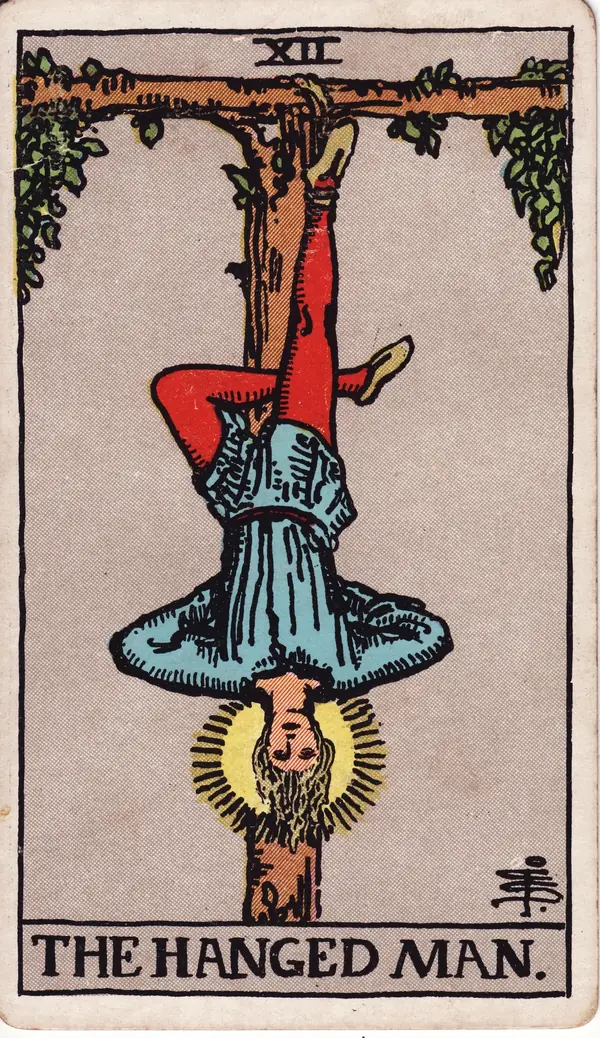
The Hanged Man is Major Arcana 12. In the Classic Tarot, a figure hangs by one ankle from a rough T-shaped tree. The free leg bends comfortably, the hands rest behind the back, and a soft halo glows around the head. Nothing in the posture looks like panic. The body is restrained; the expression suggests someone who has stopped struggling long enough to notice something new.
The Classic Tarot tradition connects the card with water, and many modern lists pair that water with Neptune. Water moves around obstacles instead of breaking them, which fits the card's mood. On the Tree of Life, it is linked with the twenty-third path and the Hebrew letter Mem, joining Severity to Splendor. Mem is deep water: it blurs sharp either-or thinking and lets a wider view surface.
The card's short meaning is simple: when stuck, turn the picture upside down—it may make sense. That does not mean contradicting people for sport. It means setting down your usual speed, position, and need to control the result for a while. The image makes that reversal visible, and that is the point. A pause can be wise, but only if you know why you are pausing. Much of this page is about telling a chosen pause from one that has turned into drift.
The Hanged Man Symbolism: What Each Detail on the Card Means
The upside-down body: In the familiar image, one foot is tied and the whole body hangs head down, so the figure sees the world from the opposite direction of everyone standing. The picture reverses up and down first, then quietly rearranges rank and priority. Upright, the inversion is intentional: the person leaves their usual height for a while to look at what was hidden. Reversed, only the posture may remain. There is no new sight, and the person hangs in place without being able to say what they are waiting for.
The calm face: There is no struggle in the face. The eyes are open and the mouth is relaxed. A restrained body with a settled expression suggests that endurance can be a clear-eyed choice rather than a punishment from fate. Upright, the card leans toward a voluntary pause. Reversed, the same calm can turn into numbness: the outside says everything is fine while the inside is worn down, or “I can see past it” covers a problem the person is afraid to touch.
The light around the head: A yellow halo circles the head and pulls attention toward awareness rather than the rope. Yellow sits close to clarity and wakefulness, with a little warmth, so the insight does not feel cold. Upright, the card stresses what can be understood during a stop. Reversed, it warns that the light is blocked. Someone may explain themselves over and over without ever seeing the blind spot.
The tied ankle: The rope wraps only one ankle. The restriction has a specific location, which means it has an edge; the whole body is not bound. It symbolizes accepting a limit in exchange for a larger freedom. Upright, the message is “I know what is tying me down.” Reversed, the knot has lost its meaning. The person could untie it but keeps hanging there out of habit, guilt, or fear.
The crossed legs: The free leg bends and passes behind the tied leg, forming an angle close to the number 4. Four often speaks of structure, order, and grounding, which suggests the pause is not falling apart but has a shape. Upright, there is method inside the waiting. Reversed, that shape can harden into a frame: the rule remains, but no one asks whether it still fits.
The hands behind the back: Neither hand reaches forward or shields the body. Both are hidden behind the back and hold nothing. The gesture looks like giving up an immediate counterattack, or handing over the initiative for a while. Upright, it means not rushing to answer and not working so hard to prove a point, letting the situation reveal itself. Reversed, the tucked hands can become suppression: words go unsaid, boundaries go unguarded, and powerlessness gets mistaken for poise.
The blue shirt: The shirt is blue, a color tied to reason, calm, and the feel of water. It pulls the card’s center of gravity inward: emotion moves, judgment slows, and a person can hear themselves more clearly. Upright, the blue supports the idea of sinking down to see. Reversed, watch for blue turning cold: isolation, overthinking, or using rationality to wrap around an emotion that does not want to be faced.
The red pants: The lower half is red, bringing heat, desire, and vitality. It reminds us that hanging upside down does not make anyone desireless. The wants are still there; they simply cannot move in the old way for now. Upright, this is not passive resignation but a gathering of energy. Reversed, the opposite can appear: the body looks still while the mind races, and heat turns into irritation and resentment.
The T-shaped wooden frame and green leaves: The frame that holds him looks like a tree that is still alive, with green leaves on its branches rather than dead wood built for torture. Wood stands for the body and the structures of real life; green stands for growth and hope. The stay is still connected to life. Upright, read it as “something can grow in this resting place.” Reversed, someone may see only the hardness of the wood and forget the living leaves, concluding that everything has stopped for good.
The blank background and sky: Almost no scenery surrounds the figure, only a pale sky, and the ground is indistinct. The empty space removes distractions so the posture itself is all we see. It symbolizes detachment, clearing out, and having no answer yet. Upright, the emptiness makes room for a new angle. Reversed, the emptiness can feel like having no foothold at all, as if the person is suspended between an old position they cannot return to and a landing they have not found.
The Hanged Man Kabbalah and Tree of Life
On the Tree of Life, this card belongs to the twenty-third path, and its Hebrew letter is Mem, whose shape and root meaning both point to water. The path links the fifth sphere, Geburah (Severity)—strength, cutting, conflict, and correction—with the eighth, Hod (Splendor)—reason, language, and analysis. Both spheres sit on the left pillar of Severity, so the entire path runs along that side. In the Classic Tarot tradition, direction matters: right to left tends to tighten, left to right tends to open, and downward movement stresses extension and grounding. Because both ends share the same pillar here, the main reading is downward seepage: carrying discrimination and thought from above into concrete life.
Mem’s water is not a soft decoration. Water goes around hard stone and slowly wears a shape into it. Paired with Severity’s cutting, it asks a person to delete the excuses used for self-comfort. Paired with Splendor’s analysis, it asks them to turn muddled emotion into clear sentences. Together, the two ends describe the Hanged Man’s “go under first, then reorganize what you understand.” The shared qualities of the path make the card more than passive waiting; it is observation with discrimination.
In love, this structure can break “what does he really think” into checkable behavior and speech: what the other person has said, what they have done, and which parts were filled in by the querent’s own mind. Water keeps warmth in the reading, Severity removes fantasy, and Splendor helps state a need plainly. At work, when a project is stuck, analyze the process first, then cut the actions that produce no result instead of using overtime to hide a wrong direction. In self-growth, it asks whether the sentence repeating in your head is a fact or an old habit’s explanation. Astrologically, water is the common link, and modern lists often add Neptune, which echoes Mem’s seepage and dissolving quality. The path’s downward direction also reminds the person to turn insight into ordinary choices.
The Hanged Man Numerology
The Hanged Man is numbered 12. Split 12 into 1 and 2, add them, and you get 3, which numerology connects with the Empress. Twelve is also a full circuit: twelve months in a year, a clock face that returns to its starting point. It is not a clean finish but the seam where an old cycle has closed and a new one has not fully opened. The Hanged Man waits in that seam, so its pause carries a sense of gestation rather than blankness.
Three is creative, inspired, diffuse, and sociable, close to the Empress’s abundance, nourishment, and talent for letting things grow on their own. The Hanged Man inherits this tone and helps explain why the card often coincides with “a sudden idea after a change of angle”: once a person stops forcing, feelings and material can recombine. The Empress grows a seed into fruit; the Hanged Man turns an old idea upside down to see whether it can grow a new branch.
People with a life-path 3 are often described as full of ideas, eager to express themselves, and easily drawn to whatever is interesting. This card can serve as a prompt: when ideas multiply and direction scatters, a short pause and a narrower focus help more than another novelty. It is not a fixed verdict. Reversed, it warns that diffusion has gone too far. Someone may change their mind repeatedly or use “I’m still thinking” to hold off a choice that is already due.
What does The Hanged Man mean upright?
Upright, The Hanged Man usually describes a pause you choose. You are capable of acting, but you sense that pushing now would cost more than it gains. So you step out of the contest for a moment, listen to a different opinion, and let someone else be right about a small thing. This is not weakness; it takes steadiness to resist the urge to force an answer. In daily life it can look like revising a plan, accepting an unfinished question, or trading the need to win for the need to understand. It is a practiced letting go of the need to steer every outcome, and the reward is a new perspective rather than a guarantee that the problem disappears.
The Hanged Man reversed meaning
Reversed, the pause loses its edges. Someone may have stepped back so long ago that no one remembers the reason, yet keeps retreating. Another person says they are letting things unfold while growing more anxious by the day. Advice arrives from every side, and the more they hear, the less they can locate their own preference. Work or love may be plainly stalled, but "a little more time" keeps the decision at arm's length. That is stalling, not surrender. The useful question is not whether you have been patient enough. It is whether this particular wait still serves you.
The Hanged Man in love: single, in a relationship, reconciliation
Love readings with The Hanged Man tend to move slowly. The card is less interested in grand declarations than in the space between two people: who adjusts, who waits, and who is honest about what they need. It can describe tenderness, but it can also describe avoidance dressed as patience. Read the surrounding cards for tone, and keep one eye on real behavior.
The Hanged Man upright love
In a love reading, the upright card often means one person needs room to think. They may not be ready to name the relationship, but they are not necessarily indifferent. Patience and empathy help here, especially if the bond is already stable; a quiet week is not automatically a crisis. If the connection is vague, however, the same card can describe a long lookout with no promised arrival. Respect the space, but ask yourself whether care is flowing both ways.
The Hanged Man reversed love
Reversed in love, the card points to an imbalance that has been tolerated too long. One partner keeps rearranging their life around the other, then feels unseen when the sacrifice goes unacknowledged. Another couple avoids the real subject by calling every delay "bad timing." Outside voices can make this worse: friends, parents, and coworkers each offer a different verdict until the couple cannot hear itself. The way forward starts with plain language about who is carrying what, and what each person is actually willing to change.
The Hanged Man love for singles
For a single person, the upright card often reflects a genuinely quiet season. You may enjoy your own company, spend weekends on a project, or feel no urgency to meet anyone. That is not a failure, and it is not proof that love has passed you by. When someone does appear, the connection may take several meetings to make sense. The trap is using "going with the flow" to hide fear of being direct. Solitude is healthy; using it as a hiding place is not.
The Hanged Man in a relationship
In an established relationship, this card emphasizes breathing room. A couple may be busy in separate seasons, with fewer messages and more logistics. Married partners might need to rethink chores, money, or care for an older relative, and the best move is to imagine the other person's day before defending their own. Upright, it rarely means separation. It asks you to stop equating closeness with constant contact. If you feel ignored, check whether the distance is temporary and explained, or has quietly become the normal.
The Hanged Man and getting back with an ex
With an ex, the upright card says look before you leap back. One or both of you may still be processing the breakup, and time apart can reveal something you could not see while arguing. That is valuable, but it is not a promise of reunion. Watch for changed behavior rather than nostalgic messages. If only one person keeps bending, the relationship is not being rebuilt; it is being reentered on the same uneven terms. A real second chance needs two people willing to name the old pattern.
The Hanged Man as feelings: how they feel about you
When The Hanged Man stands for someone's feelings, it describes their inner stance more than a verdict about you. They may be thoughtful, conflicted, or simply not ready to act. The same outward silence can come from care, fear, or habit, so the card asks you to read patterns over a stretch of time. Words matter, but repeated choices matter more.
The Hanged Man upright as feelings
Upright as feelings, the card suggests someone is weighing the connection rather than dismissing it. They may be quieter than you expect because they are trying to see the situation from more than one side. They could also be protecting themselves, waiting to learn whether you will respect their pace. If they still answer, show up, and keep small promises, the slowness is probably reflection. If weeks pass with no real contact, do not call that deep feeling just because the card sounds spiritual.
The Hanged Man reversed as feelings
Reversed as feelings, the inner picture is messier. They may want you near one day and feel crowded the next. Guilt, old hurt, or pressure from other people can keep them circling without landing. Sometimes loneliness gets mistaken for love: they miss having someone, not necessarily you. Mixed signals can be sincere and still be unusable. What matters is whether they can make a decision and stand by it. Confusion is not the same as commitment, and repetition is not the same as depth.
The Hanged Man as how someone sees you
In the position of how someone sees you, The Hanged Man often says they find you unusual in a way that makes them pause. You may seem perceptive, self-contained, or hard to read, and that can be attractive and unsettling at once. They might think you are the person who notices what everyone else misses. They could also see you as unavailable, especially if you have been guarding your time. The card does not tell you which version is true. Their behavior will show whether curiosity turns into effort.
The Hanged Man as intentions
As intentions, the upright card points to caution rather than pursuit. This person wants to understand the situation before making a move, and they may test the ground with small gestures instead of a clear invitation. That can be respectful, but it can also become a way to keep one foot outside the door. Ask what their actions are building toward. A thoughtful intention should eventually produce a plan, a question, or a boundary—not only more observation.
The Hanged Man career and work (upright & reversed)
At work, The Hanged Man is less about promotion and more about method. It appears when effort alone is not solving the problem and a change of position would help. That may mean research, a slower launch, or listening to someone with a different view of the project. It rewards strategy, not visible busyness. The card also asks whether the wait is yours to choose.
The Hanged Man upright career
Upright in a job search, the card favors a focused approach over sending applications everywhere. Rework your portfolio, study what the role really requires, and ask a trusted person where your story is unclear. Offers may arrive slowly, but they can fit your strengths better. At work, the card suits research, planning, writing, design, and behind-the-scenes support; your value may show through an idea that gets adopted rather than a loud presentation. If you are considering a change, diagnose first: is the direction wrong, or are you simply tired? A pause is fine when it has a deadline.
The Hanged Man reversed career
Reversed at work, the card often shows endurance that has lost its purpose. You may be covering tasks outside your role while someone else receives the credit, or revising the same project because no one will make a decision. Conflicting advice can leave you ready to quit on Monday and resigned to stay by Friday, with no plan either way. Watch for pointless sacrifice and tunnel vision. If the job keeps asking you to lower your standards without growth or fair pay, update your resume, ask direct questions about conditions, and build a little financial room before you move.
The Hanged Man for money and finances
The Hanged Man is not a wealth card. It cares about how value is recognized, not about a sudden jump in your bank balance. Upright, money may come through creative work, planning, writing, research, or a contribution made behind the scenes. Payment can be delayed, so keep a simple budget and separate unpaid favors from real collaboration. Reversed, check for leakage: treating people out of obligation, advancing money in a vague partnership, or failing to send an invoice because you feel awkward. Write down amounts, dates, and responsibilities. This card offers no investment tip and no promise of a windfall; it asks you to protect your resources while a longer value develops.
The Hanged Man for health
Read The Hanged Man as a prompt about stress and routine, never as a diagnosis. It often appears when energy is low, sleep is irregular, or the body is sending small signals you have been ignoring. Upright, the message is to slow down: eat at regular times, protect a quiet hour, and stop treating rest as a reward you must earn. Water associations may remind you to drink enough and let feelings move instead of holding them in. Reversed, the tension may be more chronic—headaches, stomach upset, tight shoulders, or shallow sleep. Make rest part of the schedule, reduce overcommitment, and see a doctor about anything persistent. Do not use a card to explain away symptoms.
The Hanged Man as advice
Advice from The Hanged Man is about changing position, not increasing speed. Before you decide what to do, answer one question honestly: am I choosing this wait, or have I stopped believing I can move? The first calls for a purpose and an end point. The second calls for a small return of agency. Neither is served by vague optimism.
The Hanged Man upright as advice
Upright, choose the pause deliberately. Name what you are waiting for, how long you will wait, and what would tell you the situation has changed. Then look at the problem from three chairs: your own, the other person's, and a neutral observer's. Try a small experiment instead of betting everything on one outcome. Make room for compromise, but keep a boundary around it; understanding someone else's position does not mean adopting it as your own. If no answer is available today, care for your daily life so the waiting does not empty it.
The Hanged Man reversed as advice
Reversed, bring your attention back from the crowd. Stop asking five people for five opinions and give yourself one quiet hour to notice what you already know. Practice a clear no where you have been overextending, and set a date for a decision you have postponed. You do not have to prove sincerity by sacrificing more. Start with the smallest honest step: decline one unreasonable request, send one direct question, or write one paragraph of the choice you are avoiding. Clarity tends to return through action, not through another round of waiting.
The Hanged Man as a person
As a person, The Hanged Man describes someone who watches before joining in. They may be quiet, original, and comfortable alone, with a habit of seeing the angle nobody else noticed. They are not necessarily lazy; often they are conserving effort for something they consider meaningful. They can also be in the middle of a transition and unwilling to explain themselves yet. Do not confuse mystery with maturity. A thoughtful person still keeps commitments, answers honestly, and takes responsibility for the effect of their silence.
The Hanged Man reversed as a person
Reversed as a person, the card can describe someone who has turned indecision into a lifestyle. They may say yes to everything, then quietly resent everyone. Or they avoid conflict so completely that important truths never get spoken. Sometimes they frame inactivity as spiritual wisdom, when it is really fear of being judged. Their company can feel heavy because they expect others to read their mind. The difference between the upright and reversed versions is not silence itself, but whether the person remains accountable. A martyr who keeps score is not the calm figure in the tree.
How to place it in a reading
Where the card falls changes its tone. In the past, it can show a period of waiting that shaped your present view. In the present, it says you are inside a pause; pushing harder may blur the picture. In the future, it suggests a process of observation and adjustment rather than an instant verdict. As an obstacle, it can be over-accommodation or delay. As advice, it asks you to step back before proving a point. Nearby cards add detail: Swords Four deepens the need for rest, Cups bring feelings and relationships into focus, and fast-moving cards warn that waiting now has a cost. Water and Neptune are common links, but let the whole spread speak.
Our take
In a spread, the most useful question is not “Will it happen?” but “What is this pause doing?” In a three-card triangle spread, if the Hanged Man lands in the middle, the matter is often entering an observation phase. Read the card to its right first. If the next card is the Star or Six of Cups, warming cards like these suggest the wait probably has a repairing tone: a relationship is slowly warming, an old person or old matter brings understanding, or hope returns after a low stretch. The pause is not wasted, but give it a checkpoint. Look back in a month, for example, to see whether the other person has actually moved closer or new information has arrived.
If the next card is the Eight of Swords or Four of Pentacles, the tone changes. The Eight of Swords suggests being trapped by your own thoughts; the Four of Pentacles suggests gripping what you already have and refusing to loosen your hold. With the Hanged Man between them, the warning is not to let a pause grow into a cage. You may be afraid to move because you fear loss, or you may treat endurance as the only safe option. Ask whether you are protecting a bottom line or only avoiding change.
In an advice position, the card does not say keep waiting. It says change the angle. Suppose the current situation and obstacle already name the block; if the Hanged Man appears as advice, reframe the question from “How do I get them to come back?” to “What kind of relationship do I need?” or from “How do I get promoted right away?” to “Which visible ability am I still missing?” As an obstacle, it often means the delay has gone on too long; as advice, it asks for an active shift of sight. Water and Neptune can serve as atmosphere notes in a spread: notice where boundaries go blurry and where imagination is being treated as fact. Do not turn that into a hard rule.
The Hanged Man in Different Positions: Past, Present, Advice, Obstacle
Past: The past position asks what shaped the present situation. The Hanged Man here often points to a stretch of waiting, yielding, or being forced to stop that changed the height from which you see things. You may have learned endurance, or you may have learned to put yourself second. Reversed in the past, the aftermath is still active: you say it is behind you, yet in a similar scene you retreat first. The past position turns the card into memory and influence, not a command for the present.
Present: The present position asks what is happening at this moment. Upright, you are in a pause, whether chosen or imposed. Progress is slow, but there is still room to watch. Reversed, the pause has lost its balance: you have waited too long, retreated too much, or you are forcing yourself to bounce back when you actually need to slow down. Reversed is not a simple opposite. It is the upright energy in excess, or the present state knocked off center. Decide which before you follow any advice.
Future: The future position asks where things are headed. The Hanged Man usually means the matter will go through a period of observation, adjustment, and further understanding. It will not settle immediately. This is a process card, not a final verdict. Reversed, watch for the same loop stretching out: without a deadline now, the future may keep delaying the decision with “a little more time.” When a favorable card reverses, its benefits are often halved. A turning point remains, but the cost is more visible.
Advice: The advice position asks what to do. Upright, choose the pause and give it a purpose: change your vantage point, gather missing facts, see the price. It is not permission to lie flat. Reversed, stop sacrificing without limits. Bring your attention back to yourself and restore your judgment. The position changes the meaning because it describes an action, not a condition. The same card moves from state to method, and its tone becomes more active.
Obstacle: The obstacle position asks what is blocking the road. The Hanged Man here often means over-accommodation, delayed honesty, or treating sacrifice as a virtue. It can also be the habit of dodging a choice with “let me think about it.” Reversed as an obstacle, it can be stubborn refusal to change the angle, or the opposite: an inability to stop and a demand for an immediate solution. A pause is neutral. Put it at the wrong time and it turns into avoidance.
Outcome or hint: The outcome position asks where it lands. The Hanged Man rarely gives a clean success or failure. It is more like a note that the ending will come through a shift in perspective, and that forcing it tends to repeat the cycle. Upright, it points to new understanding after a wait. Things may not improve at once, but the direction becomes clearer. Reversed, it warns that delay may stretch on, or that an old pattern of sacrifice may return. Treat it as a hint rather than a final answer.
The Hanged Man Three-Card Example (Fictional Example)
Fictional example: The people and events below are invented and serve only to demonstrate how to read the cards.
Question: A querent’s promotion request has been on hold for six months. His supervisor keeps saying “let’s see,” and he is both unwilling to let it go and afraid to push. He wants to know how to view the situation.
Spread: Current situation · The angle that needs to change · Advice.
Cards and positions: Card 1, Current situation: The Hanged Man (upright). Card 2, The angle that needs to change: Four of Cups (upright). Card 3, Advice: Page of Wands (upright).
Card 1, Current situation: The Hanged Man (upright): This card confirms the situation first: the matter really is suspended, and he cannot move it alone. The upright position says the six months have not been completely empty. He has probably been waiting for a clear answer and quietly weighing whether to press or leave. But the Hanged Man’s pause needs a purpose; if he is only hanging there, the waiting will drain his confidence. In the current position, the card answers “What is the state now?” not “Will the promotion happen in the end?”
Card 2, The angle that needs to change: Four of Cups (upright): The Four of Cups often shows a person guarding the cups in front of him while ignoring a cup offered at his side. In this position, it suggests the querent has put all his attention on the shelved job and is missing other exits: another project, an internal rotation, a mentor willing to sponsor him, or a development path that fits his strengths better. This is not a command to give up on the promotion. It asks him to see the options he closed because he was disappointed.
Card 3, Advice: Page of Wands (upright): The Page of Wands brings fire’s curiosity and drive. The advice is a small, reversible experiment rather than another lap around the waiting room. He could ask his supervisor for one short meeting with one specific question: “Which skill is still missing?” He could volunteer for a small project that puts his results in front of people. He could also update his resume and test the outside market without quitting on impulse. The Page is young, probing, and learning; the point is not to bet everything at once.
All three together: Only one Major card appears, so the core lesson really sits with the Hanged Man: the task is to change how he views the wait, not to chase a fast answer. The two Minors show that daily life still offers room to act. The elements are water, water, and fire. The first two are cool, with a lot of emotion and disappointment; the last brings a little warmth of action. Overall, the spread does not say “promotion soon” or “no chance.” It says “change the angle, then run a small experiment.”
Advice for the querent: First, set a clear deadline for the wait, six weeks for example, and stop guessing the supervisor’s thoughts every day. Second, change the question from “Why haven’t I been promoted?” to “Which specific gap keeps me from being chosen?” and request one brief conversation. Third, do one small thing that leaves evidence: add a skill, take a cross-department assignment, or put together a list of results. Fourth, if there is still no substantive response after six weeks, start the backup plan, whether an internal transfer or outside applications. Do not quit to prove a point, and do not keep waiting in exchange for a vague promise.
Common Misreadings of The Hanged Man
Misreading 1: The Hanged Man means bad luck or punishment. The image is bound and upside down, but the face is calm and there is light around the head. The point is not suffering; it is a pause that is chosen. Read the card as pure misfortune and the querent hears only “It’s over,” missing the adjustments still available. Check the position: in the advice slot, it is closer to a method than a sentence.
Misreading 2: If the Hanged Man appears, you should keep waiting. Waiting works only when it has a purpose and a deadline. If nearby cards show opportunity draining away, or the querent has lost the ability to judge, more waiting turns a pause into procrastination. Ask what you are waiting for, how long you will wait, and what it costs. Then decide whether to extend it.
Misreading 3: Reversed means the opposite, so you must act at once. Reversed usually shows the upright energy in excess or the present state out of balance, not a simple reversal. It can be the agitation that follows a long wait, or a forced awakening when the person actually needs to stop. When a favorable card reverses, its benefits are often halved. Resources remain, but the state needs recalibration before any acceleration.
Misreading 4: The more you sacrifice, the more love or loyalty you prove. The Hanged Man does include surrender and letting go, but sacrifice without boundaries becomes resentment and a hidden bargain. Constantly giving way in love, or covering for everyone at work, does not automatically earn understanding. Look at whether the other person carries their share and whether reality returns anything. Do not dress self-consumption up as devotion.
Misreading 5: Drawing this card proves the other person does not love you. It describes the other person’s present state: observing, hesitating, pulling back, or being occupied by something else. That is not enough to settle whether love exists. Watch whether actions stay consistent and boundaries are respected. If there are only verbal explanations and no approach, “he needs time” cannot extend forever.
Misreading 6: The Hanged Man means enlightenment, so you do nothing. A change of perspective does not happen by itself. It takes reflection, information, and grounding. Hanging motionless can simply mean being stuck. Turn the insight into one small action: a conversation, a refusal, a revised plan. The card gives a direction; it is not a charm that replaces effort.

FAQ
These questions come up often after The Hanged Man appears, and the honest answer usually depends on context. The card describes a position, not a fixed fate. In each case, separate a deliberate pause from a stall, then look at what the people involved are actually doing. A single card cannot replace a conversation, a doctor's advice, or your own judgment.
Is The Hanged Man a yes or no card?
It leans no. Upright, it suggests waiting; reversed, it warns against forcing a decision. In a yes-or-no spread, this card is not an enthusiastic green light. It points to conditions that are not ready, information that is missing, or a person who has not committed to a course of action. Upright, read it as "pause before you decide." Reversed, read it as "stop pushing yourself toward an answer that has not formed." If the matter is urgent, use practical advice and professional guidance alongside the cards.
What does The Hanged Man reversed mean in a yes or no reading?
It also leans no, with a stronger warning that the wait has stopped serving you. The reversed card often appears when someone keeps postponing a choice and calls it patience. The result is usually frustration, resentment, or a decision made for you by default. In a yes-or-no question, take this as a signal to examine the cost of further delay. It does not forbid a positive outcome forever, but it does not support action based on hope alone.
What does The Hanged Man mean if you have a secret crush?
It suggests quiet observation rather than clear action, so do not assume mutual interest yet. With a secret crush, the card often reflects someone who is curious but not ready to reveal it, or a connection that lives mostly in one person's imagination. Be kind to yourself about the dreaming; just do not mistake it for evidence. Watch whether they make time, ask real questions, and respect your boundaries. If nothing concrete grows, let the fantasy shrink before it takes over your week.
What does The Hanged Man mean for marriage?
It suggests slowing down and discussing expectations before making a firm commitment. Marriage questions with this card usually point to different assumptions about timing, family duties, money, or living arrangements. Upright, there is room for patient negotiation. Reversed, the risk is that one person keeps yielding while the other avoids the conversation. The card does not decide whether a marriage will happen. Put the practical hopes and fears on the table and see whether both people can carry them together.
What does The Hanged Man mean as an outcome?
It points to delay, adjustment, or a changed viewpoint before a final result appears. As an outcome, The Hanged Man rarely describes a sudden event. It suggests a phase in which plans are reconsidered and priorities shift. The eventual result may be better than the original plan, but it may also be a clear signal that the present route is not working. Judge the outcome by whether you emerge with more understanding, not by how fast the situation resolves.
What timing does The Hanged Man suggest?
It gives no fixed date; it describes a waiting season whose length depends on the choices around it. Timing with this card is intentionally vague. It belongs to a moment when schedules are unclear and people are still deciding. Look to nearby cards and real-world deadlines for practical timing. If you need a decision by a certain date, state that deadline plainly rather than waiting for the cards to supply one.
Does The Hanged Man mean pregnancy?
It does not answer pregnancy questions. Read it as a call to rest and get proper medical confirmation. A tarot card cannot detect pregnancy or predict fertility, and treating it as a yes or no would be unfair to you. The Hanged Man may reflect waiting, uncertainty, or a need to care for your body, but those feelings are not medical information. Take a test, consult a qualified professional, and do not let a reading delay care. If you are pregnant or trying to conceive, follow medical advice rather than symbolic clues.
What zodiac sign is The Hanged Man?
Water, often Neptune in modern lists. The card has no settled zodiac sign in older lists. Traditional astrological links to The Hanged Man are loose. Many contemporary readers associate it with water and Neptune because both suggest sensitivity, imagination, and softened boundaries. The card's deeper theme is surrender and changed perspective, which fits that watery mood. You can use the correspondence as a prompt for reflection, not as a rule that limits the card's meaning.
Is The Hanged Man a good or bad card?
Neither. It is a pause card, and context decides whether the pause helps or harms. It can be good when it prevents a rushed decision and offers a wider view. It can be difficult when it becomes chronic delay, self-sacrifice, or avoidance of a necessary conversation. The card itself does not carry a moral grade. Ask what the pause is protecting and what it is costing. That answer will tell you more than the label "good" or "bad."
Related cards
Placed beside other cards, The Hanged Man becomes easier to read. The contrasts show whether you are resting, reflecting, or simply stuck. Use these pairings as questions to explore, not fixed formulas. The surrounding cards describe the reason for the pause and the likely cost of staying in it. Notice whether they support patience or push toward movement.
- The Fool: both face the unknown, but The Fool steps forward while The Hanged Man stops to change the angle.
- The Hermit: both value solitude, though The Hermit seeks an inner answer and The Hanged Man seeks a different position.
- Wheel of Fortune: one card emphasizes cycles in motion, the other a deliberate suspension, and together they show that waiting can be part of a larger turn.
- Temperance: both work with balance, but Temperance adjusts through exchange while The Hanged Man adjusts by suspending action.
- Four of Swords: both suggest rest, with Four of Swords focused on recovery and The Hanged Man on a shift in viewpoint.