Seven of Swords (7 of Swords) Meaning: Reversed, Love, as Feelings, Yes or No

Draw a Classic Tarot spread →Free, no sign-up. Think of your question, then draw.
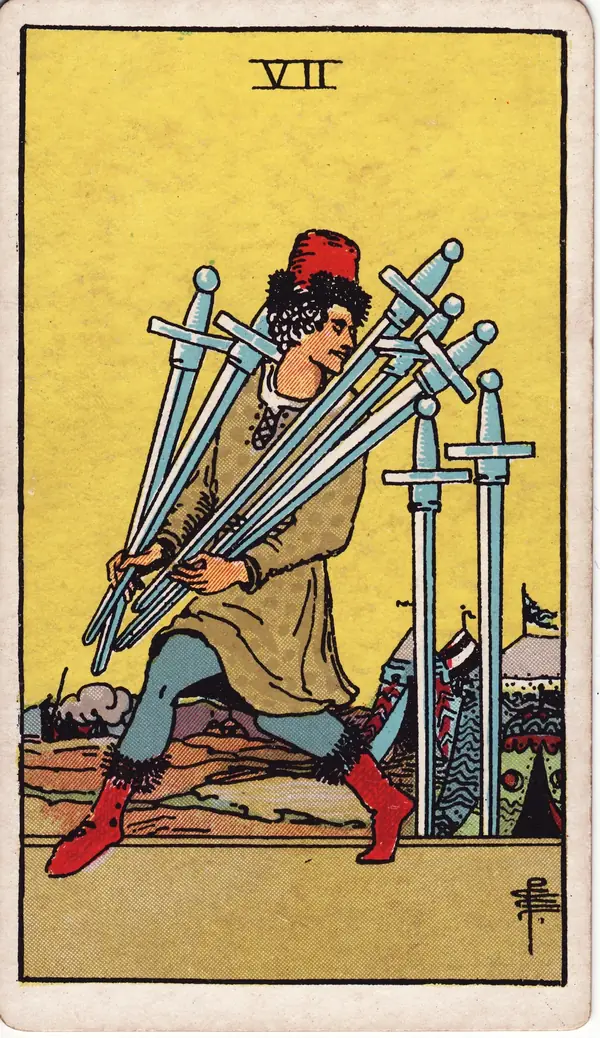
In one line: Quietly carrying swords out of the camp.
| Keywords | |
|---|---|
| Upright | strategy, stealth, cutting corners |
| Reversed | getting caught, guilty conscience, confession |
| Type | Swords · air |
| Yes/no (our grading) | leans no |
Quick answers: yes/no · love · career
- Yes/No: Under our grading, Seven of Swords leans no. Yes/no is the least reliable use of tarot—prefer “how should I approach this?”.
- Love: Secrets or private calculations; reversed, exposed or deciding to confess.
- Career: Clever workarounds, or someone acting behind your back; reversed, the scheme fails.
*FateClear Editorial Team*
Want to draw a Classic Tarot spread? Draw cards.
In the Classic Tarot, the Seven of Swords is the seventh card in the suit of Swords, tied to the element of air and the world of thoughts, words, and decisions. The image shows a figure slipping away from a camp with several swords in their arms, glancing back at the tents left behind. Its one-line meaning is quiet and pointed: quietly carrying swords out of the camp. You will also see it written as 7 of Swords.
The number seven asks for assessment: do you stay and fight, or find another route? Upright, the card speaks to strategy, stealth, and cutting corners. In reverse, the focus shifts toward getting caught, a guilty conscience, and confession. None of this is a simple verdict on character. The real question is whether a private move protects you or quietly shifts the cost onto someone else.
That tension is why the Seven can feel uneasy even when nothing dramatic is happening. Someone is holding information close, buying time, or preparing an exit. Sometimes that is wise. Sometimes it is the first step into a mess. The cards around it and its place in the spread tell you which way the story leans.
Seven of Swords Kabbalah and Tree of Life
In Classic Tarot, the Seven of Swords is a minor card, and its meaning turns less on a path number or Hebrew letter than on where the number and suit sit on the Tree of Life. Seven belongs to Netzach (Victory), the seventh sephirah on the right-hand pillar of Mercy, whose themes are feeling, desire, and persistence. The suit is air, and its world is Yetzirah, the world of Formation, one of the four worlds. A useful shorthand is this: the sephirah describes the kind of step being taken, while the world describes the level on which it happens. Fire is will and action, water is emotion, air is thought, and earth is physical reality. That is why the Seven of Swords begins not with an outcome but with the way ideas, information, and communication move.
This correspondence is most helpful when it separates “sneaking” into motive and level. Victory carries the drive to want something and keep striving for it; Yetzirah puts the contest in the realm of ideas and information. The card’s scheming is therefore rarely cool and detached. Some desire is pushing it: a wish to protect autonomy, dodge conflict, or keep a way out. No concrete harm may have occurred yet, but an information gap has already opened at the level of perception.
In love, one person may say everything is fine while privately weighing whether to leave. What they are defending is their own space; how they defend it is by saying little, testing the water, and keeping a fallback. At work, the same pattern can look like quietly preparing a transfer or holding on to key documents—wanting change without facing a direct showdown. In personal growth, ask: What exactly am I holding on to, and why can this commitment survive only through concealment? Once the desire is clear, a hidden strategy can become a choice you are able to explain.
The usual astrological link is the Moon in Aquarius: feelings that need distance and judgment that prizes independence, as if desire has found a side channel in the mind. Classic Tarot uses this correspondence not to convict anyone, but to ask a sharper question: are you hiding information, or are you hiding even your own motive from yourself?
Seven of Swords Numerology
In numerology, the Seven of Swords carries the number 7, which already reduces to 7, so there is no further digit to fold it into. Minor-card numbers often mark a stage in a situation. Seven holds both conflict and a look ahead. It is not an ending. The old approach has hit a wall, and the person is beginning to look for another route. The conflict may never be spoken aloud; it can be the private recognition that business as usual will not work. The forward look shows up as quiet testing, alternative arrangements, or a door left open for oneself.
Seven’s character is analytical and investigative. Faced with a doubt, it keeps digging like a detective and is not satisfied with the surface story. It can take information apart and compare costs and benefits, though too much thinking can make it seem reserved. The Chariot offers a useful contrast among the majors: both cards have momentum, but the Chariot puts its force into a clear direction and an act of will, while the Seven of Swords more often hides its force in observation, detours, and control of information. One asks, “How do I push through?” The other asks, “How do I get past without being stopped?”
Unlike plain deceit, the Seven includes hesitation. The person is calculating and also weighing the price. In a reading, treat seven as a fork in the road, not a verdict.
For someone with life path 7, this card can work as a mirror. You are a natural analyst and prefer to understand the board before you move. The caution is that inquiry can turn into distrust and cleverness into a refusal to explain. This is a reference point, not a fixed judgment. If you are caught in a conflict, turn the detective’s eye on yourself first: identify what you are really trying to protect, then decide whether the plan can be put on the table.
Seven of Swords and the Element of Air
The suit of Swords belongs to air, which governs thoughts, language, judgment, and the exchange of information. Its strengths are speed, perspective, and the ability to see a structure clearly. Its weak side is mistaking a thought for a fact and letting analysis turn into endless rehearsal. People with strong air often seem rational and direct, yet may carry constant internal pressure; their words can wound themselves or others, and they can be nostalgic, attached, and in need of being understood. The Seven of Swords directs this airy quality toward controlling information. Observe first, calculate first, find an exit first—and both cleverness and defensiveness grow larger.
Elements also cooperate and pull against one another. Fire and air tend to work together, since an idea can ignite action. Water and earth support each other more readily, bringing feeling down into daily life. Fire and water clash; without a buffer, enthusiasm and emotion can push forward and pull back at the same time. In a Seven of Swords spread, fire can mean a private plan actually becomes action. Water asks you not to analyze the other person only, but to look at what both people feel. Earth asks you to replace speculation with facts and consequences you can check.
With court cards, the same approach must account for how rank and suit elements stack. The rank element works like a style of expression; the suit element supplies the subject. Air meeting fire becomes more impatient to turn thought into movement. Air meeting earth has to anchor a plan in evidence, procedure, and a timetable. Because this is a number card, read air as the main axis first, then ask whether the surrounding elements help it land or let it drift further into theory.
A spread heavy with Swords usually points to overthinking, too much information, and considerable pressure. The person may hold meeting after meeting in their head and still not act, while speech turns defensive. In concrete terms: in love, they may keep decoding the meaning of a single reply instead of asking directly; at work, they may collect material and prepare escape routes while postponing the conversation that matters; in personal growth, they may replay dialogue at bedtime. At that point, reducing the noise and clarifying the one thing that most needs confirmation is more useful than another round of analysis.
What does Seven of Swords mean upright?
Upright, the Seven of Swords is less about villainy than about choosing a side door. You may research a job before telling anyone, protect an idea until it is ready, or step away from an argument that will only drain you. The figure in the card is not celebrating; they are tense, calculating, and aware of the risk. In daily life this can look like a quiet plan or a strategic retreat. It can also point to a literal change of place, such as moving house or shifting offices. The healthy version protects your boundaries. The unhealthy version pushes risk onto people who never agreed to carry it.
Seven of Swords reversed meaning
Reversed, the Seven of Swords shows the moment the quiet move stops being quiet. A detail slips, a story stops matching, or your own conscience starts making noise. The keywords are getting caught, guilty conscience, and confession. This is not always a scandal; sometimes it is the relief of finally saying, “I have been avoiding this.” Plans to relocate or transfer may stall while paperwork, timing, or other people’s schedules refuse to cooperate. You may feel stuck halfway out the door. The useful question is no longer how to cover the tracks, but what needs to be repaired now that they are visible.
Seven of Swords in love: single, in a relationship, reconciliation
Love readings rarely turn on one dramatic clue. The Seven of Swords tends to appear when two people are working with different amounts of information. One person is guessing; the other is editing. That does not automatically mean betrayal, but it does mean the relationship is running on incomplete honesty. Look at patterns over time, not one suspicious moment. The card is asking where transparency is missing.
Seven of Swords upright love
Upright in love, the card often describes indirect movement. Someone watches, tests, or keeps a little distance while deciding how much to reveal. Texts may be warm one day and vague the next; plans may stay flexible in a way that protects one person’s options. It can also describe you holding back your real needs to avoid a difficult talk. The card does not prove cheating. It asks whether the amount of mystery in the dynamic is mutual. If only one person gets to keep secrets, that imbalance deserves a name.
Seven of Swords reversed love
Reversed in love, hidden material tends to come forward. A conversation that was avoided finally happens; a receipt, message, or changed plan creates a confrontation. Sometimes the truth arrives through someone else, and sometimes it arrives through a sudden burst of guilt. What follows matters more than the reveal. A confession can open the door to repair, but repair needs consistent access, clear answers, and a willingness to deal with the old issue instead of only apologizing for getting caught. If the response is defensiveness, that is information too.
Seven of Swords love for singles
For singles, the Seven of Swords often appears in the gray zone between interest and availability. Someone texts late at night but never plans a real date; they enjoy your attention while keeping their social world closed. Or you may be the one keeping several conversations alive without being clear about what you want. The card asks you to stop treating mixed signals as a puzzle to solve. State your expectation once, plainly, and watch what happens. Interest that only exists when it is convenient is not the same as interest that makes room for you.
Seven of Swords in a relationship
In an established relationship, this card can show a season of avoided conversations. One person gives short answers about money, work, or family; phones stay face down; overtime becomes a convenient shield. There may be a real need for space underneath it, or a private problem someone is embarrassed to name. Do not turn one card into an accusation. Describe the specific behavior that leaves you uneasy and ask for a direct response. If the answer is another wall of vagueness, you have learned something important about how this partner handles pressure.
Seven of Swords and getting back with an ex
When you ask about getting back with an ex, the Seven of Swords suggests indirect contact: a liked post, a message through a friend, a sudden appearance with no clear request. Someone may be testing the temperature without accepting the risk of a real conversation. Reconnection is not impossible, but it should move slowly and out loud. Ask what has changed, not just what feels familiar. If the two of you slide back into old routines without addressing the reason for the split, the same exit will likely appear again. Strategy without sincerity is just a longer goodbye.
Seven of Swords as feelings: how they feel about you
When the Seven of Swords appears in a feelings position, it is tempting to treat it as mind-reading. It is not. It describes a style of handling emotion: guarded, observant, and careful about exposure. The card may reflect what someone feels, but it also reflects how they behave while feeling it. Pay attention to the gap between what is said and what is scheduled, shared, or avoided.
Seven of Swords upright as feelings
Upright as feelings, there is affection or curiosity here, but it comes wrapped in self-protection. They may be weighing the risks of showing interest, calculating how much to reveal, or keeping an exit in view. That does not mean they feel nothing. It means their first instinct is to manage the situation rather than surrender to it. You might notice warmth in private and distance in public, or playful attention that never turns into a clear plan. The feeling is real enough to watch; the question is whether it is brave enough to act.
Seven of Swords reversed as feelings
Reversed as feelings, the internal pressure rises. They may be worried about being found out, ashamed of something they have withheld, or tired of maintaining a version of themselves that does not quite fit. Some people become more honest here; others become more defensive, deflecting questions or turning the focus back on you. Silence can mean indifference, but it can also mean they do not know how to clean up the mess. Give them one clear opening to tell the truth, then notice whether they use it.
Seven of Swords as how someone sees you
In the position of how someone sees you, the Seven of Swords often casts you as clever, private, and a little hard to read. They may admire your independence, or they may suspect that you always have one foot out the door. If trust has been damaged, ordinary privacy can look like secrecy. If the relationship is healthy, the same quality can look like good judgment. Ask what evidence they are actually responding to. You do not have to reveal everything to be honest, but you may need to be clearer about your intentions.
Seven of Swords as intentions
As intentions, the Seven of Swords points toward self-protection and time-buying. The person may want to avoid a confrontation, keep their options open, or handle a problem privately before anyone else knows. They may not set out to harm you, but they are willing to withhold information to stay in control. That is the detail to weigh. Good intentions that never become transparent behavior are still hard to build on. Look for follow-through: a real plan, a direct answer, a choice that costs them something. Intentions become credible when they show up in the calendar.
Seven of Swords career and work (upright & reversed)
At work, the Seven of Swords is the card of the clever route: the referral instead of the cold application, the quiet preparation before a big announcement, the diplomatic sidestep around a pointless conflict. It can be useful. It can also become the shortcut that creates more work later. The difference is usually whether the move can survive being explained to the people affected.
Seven of Swords upright career
Upright in career, you may be researching a new role, protecting a project until it is ready, or preparing to move teams or cities. Job hunting through your network, building a portfolio before an interview, and keeping your plans private until an offer is firm are all reasonable versions of this card. The caution is not to oversell your experience or leave colleagues carrying your unfinished work. If you are leaving, hand things over cleanly. Strategy is strongest when it does not depend on someone else being caught off guard.
Seven of Swords reversed career
Reversed in career, check the places where a shortcut is starting to show. An exaggerated resume claim, a borrowed idea, a skipped approval, or an error pushed onto a teammate can become unstable now. This is also a card of delayed moves: the transfer stalls, the relocation paperwork snags, the new role takes longer to confirm. Instead of patching the story, bring the problem into the open. Correct the record, ask for the permission you need, and put agreements in writing. It may be uncomfortable for a week, but it prevents a larger cleanup later.
Seven of Swords for money and finances
Money is where the Seven of Swords asks for clean information. The card is not about sudden wealth, and it is not a signal to take a financial gamble. Upright, it can describe sensible privacy: comparing prices, building an emergency fund, or keeping a side project quiet until it is stable. That kind of discretion is fine. Problems begin when secrecy enters shared money. If you split rent, run a household budget, or share a business, the key figures need to be visible to the people who depend on them. “I’ll handle it” is not a budget plan.
Reversed, hidden expenses, unpaid balances, or a purchase someone did not mention tend to surface. A bill does not match, or a partner discovers a subscription that was never discussed. Start with the facts: income, debt, fixed costs, and what each person believed was true. If a contract is involved, get the terms in writing. This card does not promise a windfall and does not tell you what to invest in. Its instruction is simpler: do not let money live in the dark.
Seven of Swords for health
Health readings with the Seven of Swords usually point to mental load rather than a specific medical condition. The image is someone sneaking away with too much in their arms, and that is often how stress feels: you are carrying more than you admit and trying not to drop any of it in front of others. Upright, watch for a mind that will not stop. You may lie down but keep replaying a conversation, or say you are resting while still answering messages. Shoulders, jaw, and sleep are common places where this tension shows up. Protect a regular bedtime, eat something real, and schedule rest that does not involve a screen.
Reversed, the accumulated strain may be harder to ignore. You wake up tired, lose track of details, or feel irritable over small things. This is not a diagnosis, and the card cannot tell you what is wrong. If symptoms persist or worry you, see a doctor. If you are already being treated for a condition, follow the care plan you have been given. A tarot reading can remind you to pay attention; it cannot replace an examination.
Seven of Swords as advice
The advice of the Seven of Swords is not “never be strategic.” Strategy is part of a mature life. The advice is to keep strategy from becoming a hiding place. A private plan can buy you time, but it should not require you to lie about what you are doing. The upright and reversed positions ask slightly different questions. Read the tone of the whole spread before you decide which one applies.
Seven of Swords upright as advice
Upright, use the clever route, but keep it clean. You can prepare quietly, avoid an unnecessary fight, or move before announcing every detail. Just make sure the cost is not being passed to someone who has no say. If you are planning a change, sort out the timing, the money, and the responsibilities you are leaving behind. Ask yourself: if this plan were described out loud, would it still make sense? If yes, proceed. If not, adjust the plan before you take another step. Rest is allowed; disappearing is not the same thing.
Seven of Swords reversed as advice
Reversed, stop adding new secrets. Take stock of what is already exposed or nearly exposed, and deal with that first. Apologize where an apology is owed, correct the record where you can, and ask for help if the mess is bigger than you can manage alone. If a relationship or job has become a contest of who can hide more, consider a clean exit rather than another round of concealment. Confession will not guarantee forgiveness. It does give you back your own timing. The longer you wait to stop the cover-up, the more expensive the cleanup usually becomes.
Seven of Swords as a person
As a person, the Seven of Swords describes someone quick, observant, and privately resourceful. They notice the exits in a room. They can read a situation and adjust before others have caught up. That makes them good in a crisis and sometimes difficult to know. They may keep their plans close, share selectively, and prefer to solve problems alone. None of that makes them a villain. The question is how they handle accountability. A mature version of this personality is discreet without being deceptive; an immature version treats every relationship as a game of information. Watch what happens when they are asked a direct question.
Seven of Swords reversed as a person
Reversed as a person, the Seven of Swords can show someone under pressure to keep a story straight. They may be defensive, overexplaining, or suddenly eager to confess. Sometimes this is the moment a private person becomes honest; sometimes it is someone trying to control the damage. Look for behavior that changes after the words are spoken. Do they give you access to the truth, or only a better-sounding version of it? Do they take responsibility without turning themselves into the victim? The reversed card is not a permanent label. It is a snapshot of someone whose hidden life has become heavier than expected.
How to place it in a reading
In a spread, start with the position. In the past, the Seven can mark an old secret, a quiet departure, or a decision made without full disclosure. In the present, it describes the strategy you or someone else is using right now. In the future, it warns that information may stay incomplete for a while, or that a concealed move will eventually need to be explained. In an outcome position, it is not a final verdict; it shows the atmosphere the situation is heading toward. Read the neighbors. The Six of Swords adds transition and leaving, but with more open movement. The Four of Swords calls for real rest rather than a temporary hideout. The Moon deepens confusion and suspicion. The Page of Swords adds curiosity and questions. If several secretive cards cluster together, slow down and ask where the missing information actually lives.
Our take
Our take: there are two sides to the Seven. Smart strategy is fine, as long as it can bear being seen. Quiet preparation, a private job search, a low-key move, or a diplomatic retreat can all be wise. Secrecy becomes a problem when it depends on someone else’s ignorance or puts them at risk. The card does not demand that you reveal every thought to every person. It asks whether your hidden move would survive a calm explanation. If it would, proceed with confidence. If it would not, the issue is not the strategy; it is the lack of honesty underneath it.

FAQ
The questions below come up most often with this card. Each answer begins with a short conclusion, then explains the reasoning. Your own reading still depends on the question you asked, the position in the spread, and the cards around it. Use the card as a prompt for a real-world conversation, not as a substitute for professional advice.
Is Seven of Swords a yes or no card?
It leans no. The Seven of Swords suggests missing information or a private agenda, so a confident yes is rarely supported. Upright, the card points to a situation where not everyone is working from the same facts. Someone may be keeping options open, and a quick yes could rest on a version of events that later changes. Reversed, the same caution holds: hidden material is more likely to surface, and plans may be delayed. That does not make every outcome bad, but it does make a clean, immediate yes unlikely. Wait for clarity before you commit.
What does Seven of Swords reversed mean in a yes or no reading?
Still leans no. Reversed, the card points to exposure, delay, or a confession that changes the terms of the question. When the card is reversed, the issue is no longer whether the secret can stay hidden. It is what happens when it comes out. That can be a relief in the long run, but it rarely produces a simple green light in the moment. A plan may stall, a person may have to answer for something, or a relationship may need a difficult reset. If you are asking whether to move forward right now, wait until the facts are on the table.
What does Seven of Swords mean if you have a secret crush?
There is curiosity and probably some attraction, but not enough openness to call it clear mutual interest. The Seven of Swords often shows someone watching you without showing their hand. They may enjoy the attention, test your reactions, or keep the connection private while they decide what they want. That can feel exciting, but it is not the same as someone making room for you. You are allowed to make one direct move and see how they respond. If the response is another round of vague signals, stop filling in the blanks for them.
What does Seven of Swords mean for marriage?
Slow down. The card asks you to verify honesty and shared plans before making a bigger commitment. Marriage questions often bring up practical topics: money, family boundaries, housing, and the division of daily responsibilities. The Seven of Swords suggests that at least one of these conversations has been avoided or only partially had. That does not mean the relationship is doomed. It means the next step should be a clear conversation, not a bigger gesture. If one person keeps deflecting, the timing of the commitment matters. A wedding can be beautiful and still be premature.
What does Seven of Swords mean as an outcome?
Mixed to unfavorable unless the hidden part is brought into the open. The result depends on how honestly people respond now. As an outcome, the Seven of Swords rarely gives a clean, sunny resolution. It suggests a situation that continues to be shaped by what is not being said. If the people involved choose transparency, the outcome can improve; the card still leaves room for repair. If they choose another layer of concealment, the problem tends to resurface in a more complicated form. Read the surrounding cards for tone. Clear, supportive cards soften the prediction; confusion or conflict cards make the warning stronger.
What timing does Seven of Swords suggest?
No fixed date. It suggests a short, uneven window, often around a disclosure, a departure, or a delayed plan. Timing with this card is rarely smooth. Things may move quickly in private and then slow down when they need to be explained. You might see progress in days, followed by a pause while someone avoids a conversation. Rather than waiting for a precise date, watch for the moment information changes hands. That is usually when the situation shifts. If you need a practical deadline, set one for yourself and decide what you will do if the answer has not arrived.
Does Seven of Swords mean pregnancy?
The card does not answer pregnancy questions. Use a reliable test and speak with a doctor for anything health-related. No tarot card can confirm or rule out pregnancy. The Seven of Swords may reflect anxiety, secrecy, or a desire to keep news private, but those are emotional themes, not medical evidence. If you are wondering about pregnancy, take a test at the appropriate time and consult a healthcare professional. If you are already pregnant or trying to conceive, follow the guidance of your care team. A reading can help you name your feelings, but it cannot replace medical information.
What zodiac sign is Seven of Swords?
Its traditional correspondence is the Moon in Aquarius, a combination of emotional detachment and independent thinking. The Moon brings sensitivity, instinct, and a need for emotional safety. Aquarius adds perspective, independence, and a willingness to step outside the group. Together they describe the Seven’s particular mood: someone who wants distance in order to think clearly, and who may keep real feelings behind a calm or unconventional surface. This is a traditional correspondence, not a rule about who the card will describe. Use it as a lens, not a label.
Is Seven of Swords a good or bad card?
Neither. It is a neutral card with a sharp edge; the outcome depends on whether the strategy can survive scrutiny. In a protective context, the Seven can be smart and necessary. It can help you leave a harmful situation, protect private information, or avoid a conflict that would cost more than it solves. In a deceptive context, it can signal shortcuts, hidden agendas, and consequences that arrive later. The card itself does not decide which version you are living. Your choices do. Ask whether the people affected would understand your move if they saw it clearly.
Related cards
The Seven of Swords changes tone depending on its neighbors. These are the most common pairings:
- Six of Swords: Both involve leaving, but the Six is open and gradual while the Seven is private and strategic.
- Four of Swords: Both suggest a pause; the Four is genuine rest, while the Seven may be a temporary hideout.
- Page of Swords: Both emphasize observation and information; the Page is curious, while the Seven may already be acting.
- The Moon: Both deal with what is hidden; the Moon brings anxiety and imagination, while the Seven suggests deliberate withholding.
- The Fool: Both can mark a departure; the Fool is spontaneous, while the Seven has counted the risks.