Ten of Swords (10 of Swords) Meaning: Reversed, Love, as Feelings, Yes or No

Draw a Classic Tarot spread →Free, no sign-up. Think of your question, then draw.
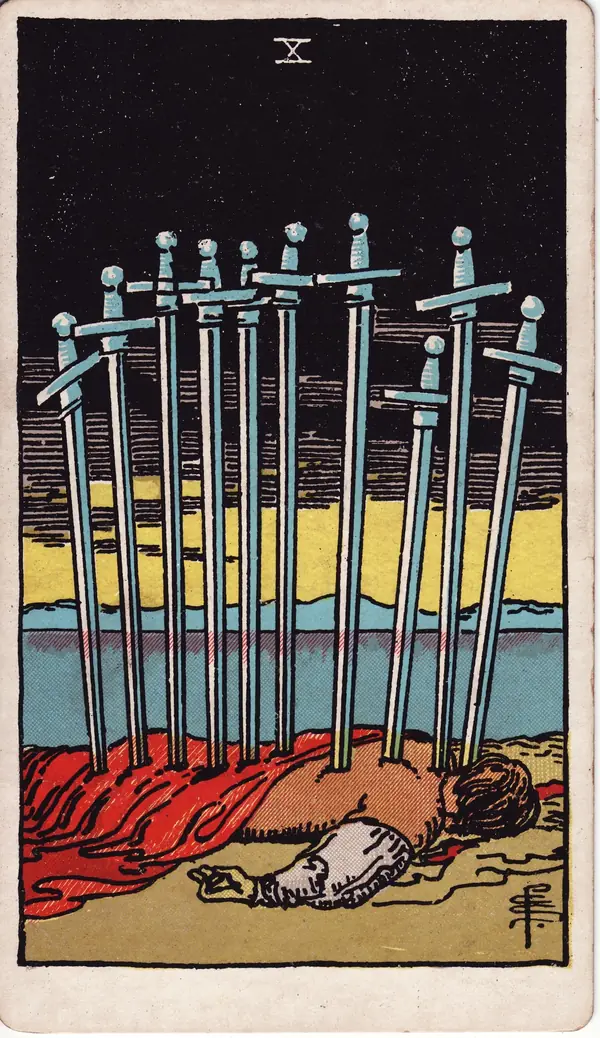
In one line: Ten swords in the back, yet dawn breaks on the horizon.
| Keywords | |
|---|---|
| Upright | rock bottom, final ending, worst is over |
| Reversed | slow recovery, lingering pain |
| Type | Swords · air |
| Yes/no (our grading) | leans no |
Quick answers: yes/no · love · career
- Yes/No: Under our grading, Ten of Swords leans no. Yes/no is the least reliable use of tarot—prefer “how should I approach this?”.
- Love: A relationship fully over; reversed, climbing out of the low.
- Career: Total failure, starting over; reversed, the hardest part is past.
*FateClear Editorial Team*
Want to draw a Classic Tarot spread? Draw cards.
The Ten of Swords closes the numbered cycle of the Swords suit in the Classic Tarot. Swords is the air suit: thought, language, truth, and the stories that keep us awake at night. Ten is completion, the moment a pattern has spent all its energy. In the Tree of Life, the tens settle into Malkuth, the Kingdom, where an idea finally meets the ground and shows its consequences. The image is blunt. A figure lies face down with ten blades in the back, a red cloak still around the body, a black sky overhead, and a thin gold dawn at the horizon. The card is also written 10 of Swords.
Its one-line meaning is “Ten swords in the back, yet dawn breaks on the horizon.” Both halves matter. The upright keywords are rock bottom, final ending, and worst is over; the reversed keywords are slow recovery and lingering pain. This is not a gentle card, but it is not a pointless one. It marks the place where resistance runs out and something true can finally be named.
Read it as a snapshot of a moment, not a life sentence. The Ten can describe a breakup, a job loss, a public failure, a private collapse, or the quiet instant when you realize you cannot keep going in the same way. When it appears in reverse, the emphasis shifts from the blow itself to the long work of getting up.
Ten of Swords Kabbalah and Tree of Life
In the Classic Tarot, the Ten of Swords is a minor card. It has no Major Arcana path number or Hebrew letter; its meaning comes from the meeting of number and suit. Ten belongs to Malkuth (the Kingdom), the lowest sephira at the base of the Middle Pillar. That is the ground of physical life, the body, and results, not high ideals. Swords is air, and the suit belongs to Yetzirah, the world of formation, where thought, speech, and judgment take shape. Together they make the card's nature plain: a storm forms in the mind and lands in the body and in daily life.
In love, this explains why the pain can outlast a clear ending. Yetzirah sends the mind back through conversations, second-guessing every tone and filling in what was left unsaid; the ten blades feel like one thought after another. Malkuth turns them into insomnia, cold silence, packed bags, and practical arrangements that must be faced. If you only ask about the other person's thoughts, you remain upstairs, circling. Move your attention to the Kingdom and the question changes: What did the relationship actually leave, and what concrete task is in front of you today? The ending then stops being only an angry remark and becomes a fact you can place.
Work follows the same pattern. On the Yetzirah side are repeated meetings, information overload, and plans that grow messier with each revision—people spinning in words. On the Malkuth side are a stopped project, a spent budget, and a handover that still must be completed. See the difference and you will not mistake "I feel finished" for "this is finished," nor will you drown in feeling while loose ends remain. Confirm the loss at the level of results first; then order your thoughts. Judgment comes easier after that.
For self-growth, Malkuth returns you to the body. The Middle Pillar speaks of balance, and its lowest point is the most grounded: sleep, food, tension in the shoulders and neck, whether you can rise each day. This is where the card lives. Yetzirah adds the pressure of "I should have figured this out by now." Recovery is not another explanation; it is turning a thought into one small action you can perform. The usual astrological link is the Sun in Gemini. Gemini stresses language and double vision, while the Sun brings visibility—an echo of Yetzirah's circling thought and Malkuth's first light.
Fictional example: After a breakup, one person keeps rereading old messages late at night, then spends the next morning packing shared belongings and deciding who will keep the apartment.
Ten of Swords Numerology
Ten reduces to one in numerology. The numbered minors run from one to ten, tracing a matter from its opening to its close; ten is the final result, the end, or the point of fullness. So this card does not first announce a new beginning. It says a stage has genuinely finished. Yet ten did not appear from nowhere. It accumulated from one, and it reduces back to one, so the ending contains a more basic starting point.
The character of one is independent, self-directed, and bold—a pole that stands upright without support. It corresponds to the Magician, who turns will into action with every tool at hand. The "one" inside the Ten of Swords has no such tools, only a speck of light on the horizon and one plain choice: whether to get up. The link is not "start over immediately" but "take back a little agency." Only after you decide not to add anything more to the old story can a new start mean something.
So the number gives two messages. Ten confirms the finality; one keeps an ember alive. The card does not promise that things will improve on their own, and it does not demand instant cheer. It says the old loop has hit bottom, and the next step, however small, is yours. Read ten only as ruin and you miss the one. Treat one as an immediate fresh start and you rush the process. Accept the ending, then reclaim a measure of control: that is the steadiest reading of this pair.
For someone with Life Path number 1, the Ten of Swords can be read this way: you are used to carrying things alone, but this time independence is better spent accepting the ending, asking for help, and rearranging your life rather than forcing yourself to keep going. Treat this as a perspective, not a verdict.
Ten of Swords and the Element of Air
The Ten of Swords belongs to air. Air rules thought, language, judgment, and information. Its temperament is rational and direct; the mind moves fast, and words can turn sharp. Unlike fire, which acts first, or water, which feels first, air analyzes and looks for explanations. Under pressure, analysis becomes rumination, and the same sentence loops through the mind again and again. The Ten pushes this tendency to its limit: the problem is not too little thinking but too much, until thought and body lock together. This is a minor card, so no court rank is involved; with Swords court cards, you would combine rank and air.
Elements cooperate and collide. Fire and air get along: air feeds fire, and fire gives air direction. In a spread, that can mean ideas move action forward, though impulse may also grow. Water and earth are also friendly: feeling finds ground, and reality can hold emotion. Fire and water clash, so action and emotion pull against each other. As air, the Ten meets many Wands cards by turning thought into decision; with many Cups cards, it may use logic to suppress feeling, analyzing its way farther from the actual grief.
When Swords dominate a spread, the theme tends toward overthinking, stress, hurtful words, and replaying. A person may function by day and lie awake at night; a finished matter may be reopened through several versions of the story. The task is not to produce a perfect answer but to cut down new input, stop the review, and return attention to what can be done now.
In the Ten's own territory, this often looks like dissecting chat logs after a separation or relitigating blame after a project ends. The body signals overload through tight muscles and poor sleep. Air needs to be understood, not amplified. Give it an outlet—write it down, say it plainly, set a stopping line—rather than holding court in your head.
What does Ten of Swords mean upright?
In the upright position, the Ten of Swords means the bottom has been reached. A problem that was postponed, minimized, or carried alone has become impossible to ignore. It may look sudden, but the pressure usually built for a long time. The ten blades are all in the back, none ahead: the harm is real, yet no eleventh sword is waiting in the dark. That detail matters. The worst is over, even if the body and mind have not caught up.
Expect exhaustion, foggy thinking, disrupted sleep, and a strong urge to withdraw. Relief may arrive oddly, mixed with grief. Do not rush to call this a fresh start. First, let the ending be an ending.
Ten of Swords reversed meaning
Reversed, the Ten of Swords points to slow recovery and lingering pain. The blades have not vanished; you are beginning to move around them. Some days bring improvement, and the next brings a sentence, a memory, or a silence that puts you back on the floor. That is not failure. It is what aftermath feels like when the crisis has passed but the nervous system has not.
The trap is replaying the story. You may no longer want the person or the job, yet still argue with the past in your head. Recovery asks for fewer visits to the wound: less checking, less explaining, less trying to win an old argument. Dawn arrives at the speed of a body, not a decision.
Ten of Swords in love: single, in a relationship, reconciliation
Love readings are where this card is most often reduced to one verdict. The Ten rarely says love never existed. It says the pressure inside the connection has become unsustainable. The real question is not whether there were good days, but whether the current pattern can continue without more damage. Swords adds overthinking, harsh words, and the exhaustion that comes from trying to reason your way through a feeling.
Ten of Swords upright love
Upright, the card describes a relationship that has hit its limit. A long-running conflict, a broken promise, or an imbalance of effort has finally emptied the tank. One more conversation may not fix it. The final ending can be literal, or it can be the end of a role: the endless fixer, the patient partner, the person who absorbs every blow. If the truth is finally out, that is painful and useful at once.
Ten of Swords reversed love
Reversed, love is caught in the space after the break. Someone may still share an apartment, text late at night, or go through the motions of a partnership that ended emotionally months ago. The connection is not peaceful; it is tender the way a bruise is tender. The lingering pain asks for honesty about whether this is recovery or a refusal to let the ending finish.
Ten of Swords love for singles
For singles, the Ten of Swords often arrives after a long stretch of one-sided effort. You kept the conversation alive, explained yourself, waited for a clearer sign, and slowly wore yourself down. The card does not say you were foolish. It says the investment became lopsided. The healthiest move is to stop auditioning for someone’s attention and let the silence tell you what it has been saying. Solitude after that kind of exhaustion can feel like a clean room.
Ten of Swords in a relationship
In a relationship, the card points to accumulated strain rather than one bad week. Work schedules, money worry, caregiving, jealousy, or years of avoided conflict can push a couple to the edge. A crisis may force the truth into the open. From there, two paths exist: a real renegotiation of needs and boundaries, or an honest ending. What will not work is pretending the collapse never happened and returning to the same script.
Ten of Swords and getting back with an ex
Getting back with an ex under the Ten of Swords is possible, but rarely quick. The card asks what actually ended. Was it a single fight, or a pattern of disrespect? Was it distance and timing, or a fundamental mismatch? If the same problem remains untouched, reconciliation is just a return trip to the same wound. A slower approach is wiser: observe changed behavior, not nostalgic words. Let time show whether the dawn is real or only a trick of light.
Ten of Swords as feelings: how they feel about you
When the Ten appears in a feelings position, it describes an inner climate, not a verdict. The person may care and still be utterly depleted. Swords feelings are mental before they are romantic: they replay conversations, scan for danger, and struggle to relax. Read the card as exhaustion with the situation, not necessarily a lack of love. A heavy heart can coexist with a clear decision.
Ten of Swords upright as feelings
Upright as feelings, they feel finished. Not mildly annoyed, not waiting to be persuaded—finished. Something in them has stopped bracing for a better outcome. They may still feel sadness, guilt, or affection, but those feelings sit beneath a heavier certainty that the connection costs too much. Their silence is protective. If they speak bluntly, it is because they have already had the argument many times in their head.
Ten of Swords reversed as feelings
Reversed as feelings, they have not made a clean exit. They may miss you, check your profile, or draft a message and delete it. Yet missing someone is not the same as being ready to build with them. The reversed Ten carries doubt, leftover anger, and a fear of reopening the same injury. Their mixed signals are real, but they are not a promise. Watch whether they bring clarity and repair, not just another wave of feeling.
Ten of Swords as how someone sees you
As how someone sees you, the Ten can mean they see you as someone who has been through too much, or as part of a situation that has drained them. It can also mean they perceive you as the one who ended things, even if you were simply the first to say it aloud. The card does not flatter either side. It asks you to separate their projection from your own truth.
Ten of Swords as intentions
As intentions, the Ten is not usually a card of pursuit. It suggests the person intends to stop, withdraw, or put down a burden. They may want closure more than contact. If they do reach out, the intention could be to explain, apologize, or finally say the thing they avoided. Do not assume a grand romantic plan. The energy moves toward ending the strain, not adding more intensity.
Ten of Swords career and work (upright & reversed)
Work readings often make the Ten more concrete than love readings. A job can end, a project can fail, a team can dissolve, and a person can discover that a career path is no longer survivable. The card does not measure your worth. It describes a structure that has reached its limit. The useful question is what must stop, what must be completed, and what can wait until you have rested.
Ten of Swords upright career
Upright in a career reading, the Ten points to rock bottom at work: a layoff, a shutdown, a rejected application after months of trying, or a role that has become unbearable. Sometimes it is a public mistake or a conflict that cannot be smoothed over. The final ending may be frightening, but it also clears the fog. You can stop pretending the situation is workable. Before making a dramatic move, check your practical runway: savings, notice periods, benefits, and the people who can help. Then let the old arrangement end.
Ten of Swords reversed career
Reversed, work is in the aftermath. The worst meeting may be over, but the workload, the gossip, or the self-doubt remains. You may be recovering from burnout while still answering emails, or job hunting while replaying an old rejection. Progress will feel uneven. Protect your energy, document what happened, and avoid making a permanent decision in a temporary surge of pain. If you stay, set boundaries and a deadline for change. If you leave, leave with a plan rather than a reaction.
Ten of Swords for money and finances
Money readings call for steadiness. The Ten of Swords suggests strain that has been building: lost income, a failed venture, or mounting debt. Upright, face the numbers without shame. List what is coming in, what is going out, and what can be paused. Tell the necessary people the truth. Stop feeding a plan that has proved unworkable.
Reversed, the acute phase may ease, but the aftermath needs care. A repayment plan or a difficult conversation may be part of the climb. Do not use a new high-risk move to erase an old loss. Recovery is unglamorous: lower fixed costs, ask for help, keep records, and set a realiztic timeline. No sudden wealth is promised—only a way to stop the bleeding.
Ten of Swords for health
Health readings belong to care, not prediction. The Ten of Swords speaks to stress, overload, poor sleep, and a body sending signals. It may describe deep fatigue, tension headaches, back tightness, or low mood. These are not a diagnosis. They are reasons to rest, reduce demands, and pay attention. If symptoms are severe or persistent, see a doctor.
Reversed, recovery comes with setbacks. You may sleep better, then crash after a busy day. Rest is not a failure of will. Build back slowly, keep meals and bedtime regular, and ask for help. Pregnancy cannot be confirmed or ruled out by this card; use a test and medical advice. The Ten can support a conversation about exhaustion, not replace professional care.
Ten of Swords as advice
Advice from the Ten of Swords is blunt but kind: stop adding to the wound. You cannot undo what happened by thinking harder, loving more, or working longer. What you can do is stop the old pattern from taking more from you. Upright advice leans toward acceptance and closure. Reversed advice leans toward patient repair. Both ask for honesty about what is actually over.
Ten of Swords upright as advice
Upright, accept the ending. Say the true thing, close the account, return the key, or admit that the plan no longer works. Closure does not require the other person’s agreement. Then rest in a way that restores you: sleep, food, quiet, and fewer explanations. Ask for support from friends, family, or a qualified professional if the weight is too much. The dawn is not a reward for pretending to be fine. It appears after you stop forcing the night to continue.
Ten of Swords reversed as advice
Reversed, stop reopening the wound. Limit the late-night checking, the rereading of old messages, and the imaginary conversations. Give yourself a period of observation before you reconnect, return, or recommit. Look for changed behavior, not just emotional weather. Recovery can be slow and still real. Choose one small stabilizing action today, then another tomorrow. The goal is not to feel perfect. It is to stop losing ground to the same old story.
Ten of Swords as a person
Upright as a person, the Ten of Swords describes someone who has been carrying too much for too long. They may look composed, even capable, while running on empty. Their humor can turn dry or dark; their patience can vanish without warning. They are not trying to be cold. They are trying to survive a nervous system that has been on alert for months. Approach them with less advice and more space. A practical offer of help often lands better than a speech about resilience.
Ten of Swords reversed as a person
Reversed as a person, this is someone in the messy middle of recovery. They may be sensitive to noise, quick to retreat, and prone to canceling plans. One day they seem ready to reengage; the next they disappear. They are not necessarily unreliable. They are learning how much they can carry without collapsing again. Respect their limits, but do not let their inconsistency become your whole life. Compassion and boundaries can share the same room.
How to place it in a reading
Position changes the story. In the past, the Ten often marks the root of current trouble: a collapse, a betrayal, burnout, or an ending that still shapes how you trust. In the present, it says the ending is happening now, or you are in its immediate aftermath. In the future, it warns that a strained situation will reach its limit.
In an advice position, the Ten asks you to stop pushing. In an outcome position, it points to a conclusion, often a hard one, followed by relief. Nearby cards refine the tone. The Star or the Sun can make recovery more visible; the Tower can make the ending more abrupt; the Nine of Swords can show how much anxiety is feeding the story. Read the Ten as a turning point, not a permanent identity.
Our take
Our take is simple: the Ten means bottom—and the dawn on the horizon is on the card too. We do not soften the pain. A real ending deserves grief, not a slogan. But the image also refuses despair. The red cloak remains, the sky is already changing, and the swords are behind the figure rather than ahead. That is the card’s honest hope. You do not have to feel hopeful to turn toward the light. You only have to stop crawling in the same direction.

FAQ
These are the questions readers bring most often. Each answer gives the short version first, then the context that keeps the card from becoming a slogan. A single card is a perspective, not a substitute for medical, legal, or financial advice. Use it to ask better questions, not to hand over your judgment. The Ten can be blunt, so read it with care.
Is Ten of Swords a yes or no card?
It leans no. Upright, the card is about an ending, so it rarely supports “yes, continue as before.” If the question is “should I let this end?” the Ten supports the ending. Reversed, the answer is still negative, but it often describes a delayed decision, a lingering attachment, or relief that has not arrived yet. Treat it as a firm nudge away from the old pattern, not a guarantee about every detail.
What does Ten of Swords reversed mean in a yes or no reading?
Still leans no, though the answer arrives slowly and with mixed signals. In a reversed yes or no reading, the card suggests the situation is not moving toward a healthy yes. You may get contact, mixed signals, or a temporary thaw, yet the underlying problem remains. The answer leans no because the pattern has not changed. If you are asking whether to wait, put a limit on waiting and watch for action, not hope.
What does Ten of Swords mean if you have a secret crush?
It points to one-sided exhaustion, not a signal to keep pursuing. With a secret crush, the Ten often reflects the cost of waiting, guessing, and reading too much into small signs. You may have reached the end of your capacity to keep the feeling hidden or the hope alive. That does not make the other person cruel. It means this private investment is draining you. Reclaim your attention and let the situation become honest, either through a straightforward conversation or through distance.
What does Ten of Swords mean for marriage?
It warns that pressure has reached a breaking point and needs honest attention. In a marriage reading, the Ten points to accumulated strain: repeated arguments, silence, broken trust, or the feeling that one more conversation will change nothing. It can mark the end of a phase or the end of the union itself. Do not make a permanent decision in a single raw moment. Name the real problem, seek support if needed, and be honest about whether both people are willing to repair.
What does Ten of Swords mean as an outcome?
It points to a hard conclusion, followed by relief once the worst has passed. As an outcome, the Ten of Swords does not predict disaster in every area of life. It says the matter at hand reaches its limit. The ending may hurt, but it also stops the suspense. Afterward, energy can return slowly. If surrounding cards are gentle, the emphasis falls on recovery; if they are harsh, the ending may be more abrupt. Either way, the old chapter closes.
What timing does Ten of Swords suggest?
There is no fixed date; it usually marks the end of a cycle. Timing with the Ten is less about a calendar and more about sequence. It suggests that something must finish before the next phase can begin. Swords can move quickly, so a decision or break may arrive suddenly, but the emotional aftermath takes longer. Watch for a clear ending—a conversation, a resignation, a final payment, a closed door. The dawn comes after that, not before.
Does Ten of Swords mean pregnancy?
It cannot answer that. This card neither confirms nor rules out pregnancy. Pregnancy is a medical question, and the Ten of Swords does not answer it. The card may reflect stress, fear, or exhaustion around the subject, but it is not a test and should not be treated as one. If pregnancy is possible, use a reliable test and speak with a doctor. Do not let a difficult card create fear or false certainty.
What zodiac sign is Ten of Swords?
Traditionally, the Sun in Gemini. This correspondence links the Ten to curiosity, rapid thought, and the mind’s ability to argue both sides of an ending. Gemini can describe information overload: too many messages, too many versions of the story, too many what-ifs. The Sun adds visibility. In the card’s imagery, that visibility is the dawn—the moment the darkness stops being the whole view.
Is Ten of Swords a good or bad card?
Neither simple. It is a painful ending that carries the first light of recovery. The Ten is bad in the sense that it describes real loss, exhaustion, and closure. It is not purely bad because the image includes a new day and a body still wrapped in warmth. Calling it “good” too quickly can dismiss genuine grief. Calling it “cursed” ignores the turn already underway. Read it as a severe but honest threshold: the old way is over, and care is now the priority.
Related cards
The Ten rarely stands alone. Neighboring cards can sharpen what kind of ending it is, how long the aftermath may feel, and where the first sign of recovery appears. A hard card beside a gentle one tells a different story than a hard card beside another hard one. Compare the suits and numbers, not just the mood of a single card.
- Nine of Swords: The Nine is sleepless worry and mental spiraling; the Ten is the point where that strain finally breaks.
- Eight of Swords: The Eight describes feeling trapped; beside the Ten, it shows how much exhaustion comes from believing there is no way out.
- Death: Death marks a clean transition; with the Ten, it emphasizes that a chapter must be grieved before it can truly close.
- The Star: The Star offers hope after collapse; with the Ten, it suggests recovery becomes visible once you stop reopening the wound.
- The Sun: The Sun brings clarity and vitality; with the Ten, it enlarges the dawn and points toward a more open future.