Ace of Cups (1 of Cups) Meaning: Reversed, Love, as Feelings, Yes or No

Draw a Classic Tarot spread →Free, no sign-up. Think of your question, then draw.
In one line: A cup overflowing: a new feeling is beginning.
| Keywords | |
|---|---|
| Upright | new feelings, overflowing heart, openness |
| Reversed | blocked emotions, unreturned care |
| Type | Cups · water |
| Yes/no (our grading) | leans yes |
Quick answers: yes/no · love · career
- Yes/No: Under our grading, Ace of Cups leans yes. Yes/no is the least reliable use of tarot—prefer “how should I approach this?”.
- Love: A new romance or deeper feelings; reversed, nowhere for feelings to go.
- Career: Renewed passion for work; reversed, unhappy at work.
*FateClear Editorial Team*
Want to draw a Classic Tarot spread? Draw cards.
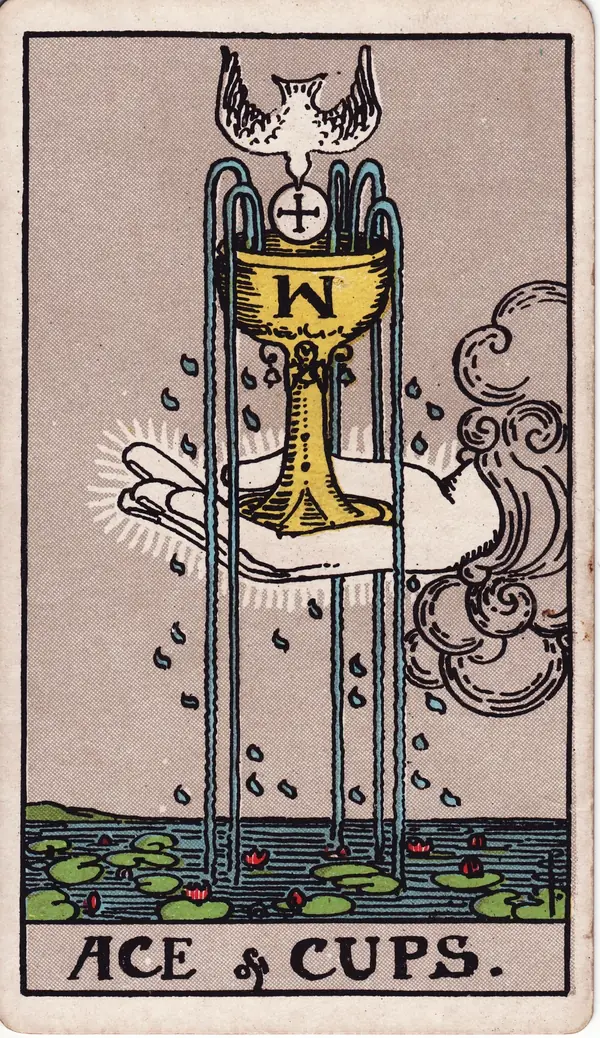
The Ace of Cups opens the suit of Cups in the Classic Tarot. It is also written 1 of Cups, and both labels point to the same card: the first stirring of water, before a feeling has a name. A single cup rests in a hand beneath a cloud, filled to the rim, with five streams spilling over. Lilies and rippling water suggest tenderness and emotional movement. The suit belongs to water, and the number one is a seed, not a finished story.
Its one-line meaning is *A cup overflowing: a new feeling is beginning.* That feeling may be love, friendship, compassion, creative excitement, or the relief of admitting what matters. The Ace does not promise the feeling will be returned or that the situation will last. It describes the arrival of water, not the whole river.
The number one carries the quality of a beginning. In the Tree of Life, this card is often linked with Keter, the crown, where feeling exists before language separates it into categories. When the card appears upside down, or in reverse, the cup is still full, but its direction changes. The water collects, presses against the rim, or spills where no one can catch it. Reading it well means asking not only what you feel, but whether that feeling has a clean place to go.
Ace of Cups Kabbalah and Tree of Life
In the Classic Tarot, each minor card's number points to a station on the Tree of Life, and its suit points to one of the four worlds. The Ace of Cups carries the number one and sits at Kether (the Crown), the top of the Middle Pillar. At this height there is no left or right, no yin or yang, no separate you and me. Everything is still at the source, energy before it takes a form. Cups belong to water and to Briah (Creation). Put those two markers together and the card's character comes clear: emotion stirring at its source, genuine and pure, with no name yet.
That framework explains the Ace's famous vagueness. Kether says this is a beginning, still undivided. Briah says the beginning is emotional, not practical or physical. What arrives is therefore a feeling just barely felt, not a deal already negotiated. The Middle Pillar adds balance. The card does not push you to confess today, nor does it tell you to shut the feeling down. It asks you to hold your ground and admit that the water is rising.
Concrete situations make this easier. In love, you may suddenly want to move closer to someone and have no explanation ready; it is too early to define the relationship. The Crown's undivided quality fits that order of events: feeling first, language later. There is no need to slap on a label. At work, a new project may light you up while roles and budget remain unsettled. Water in Briah says the first thing that exists is resonance and enthusiasm; terms must be negotiated on their own track. In personal growth, you might finally admit, "I have always wanted this." That sentence is awareness at the source level. It is not a plan, yet it will change the choices that follow.
A note on astrology: the Ace is often treated as the root of water, covering Cancer, Scorpio, and Pisces. "Root" echoes the Crown, both pointing to the moment before division. When you draw this card, start with two questions: Where did this feeling come from, and where does it want to flow? Those answers usually arrive before any answer to "What will happen?"
Ace of Cups Numerology
The Ace of Cups is numbered one. In numerology, the minor cards from one through ten read as ten stages of a single matter, and one is the start: nothing formed, nothing accumulated, but a direction has appeared. That is why this card so often describes something "just beginning." It does not say a relationship is stable or an opportunity is already secured. It says something has been switched on.
The character of one is independent, self-directed, and willing to move first, like a pole standing on its own without anyone holding it up. That energy matches The Magician among the majors: tools laid out on the table, will clear, ready to speak and ready to act. The two cards make a useful pair. The Magician says, "I can begin." The Ace of Cups says, "I am willing to feel." One sends energy outward; the other takes feeling in first. Both mark a starting point, but one leans toward action and the other toward receptivity.
There is another layer: one is a single point, not yet a pair. The Ace therefore tends to show up while the situation is still at the "I" stage rather than the "we" stage. Real exchange waits for the Two of Cups. If you draw it in a question about progress, read it as early days, not as arrival.
For someone with a life path number of one, the card can serve as a reminder. You are used to carrying things yourself and making your own calls, but this time you might let yourself be moved before you prove anything through action. Take that as a prompt, not a verdict. The card describes a present state, not the whole of a person.
Ace of Cups and the Element of Water
The element of the Ace of Cups is water. Among the four elements, water governs feeling, mood, and human connection. Its temperament is sensitive and empathetic, and it often keeps words bottled up: much thinking, little doing, with satisfaction arriving through emotional value—being understood, being needed. On this card the water is undiluted. A feeling lands directly: a glance that catches your heart, a lyric that hits out of nowhere, someone's tone of voice that lets your shoulders drop.
One structural point is worth making. Only court cards ask you to combine a rank element with a suit element; the Page of Cups is water of earth, and the Knight of Cups is water of fire. The Ace is a numbered card, so it carries the suit element alone. Its water is the purest in the suit, and the most likely to overflow.
The elements cooperate and clash. Water and earth get along: when a feeling receives concrete care, a plan, or a budget, it does not have to stay locked inside. Water and air often work together too: turning an emotion into a sentence keeps water from growing stagnant. Fire and water oppose each other; enthusiasm meeting emotion can turn into one-sided heat, or the two can evaporate each other and leave only fatigue. In a spread, a heavy Cup presence usually puts the theme in emotion and relationships, with a tendency to think more than act. Add some earth (specific steps) and air (plain speech), and the water has a channel. If Wands are also numerous, watch for impulse and feeling pulling against each other.
In daily life: with too much water in a love reading, you may feel so much for the other person that you forget to ask whether you are comfortable. At work, the atmosphere and relationships often affect your state more than pay does. In self-care, emotion needs an outlet before a steady routine can follow. Water itself is not the problem. Water needs banks.
What does Ace of Cups mean upright?
Upright, the Ace of Cups brings new feelings, an overflowing heart, and openness. Something reaches you: a kind word, a piece of music, a person who listens without rushing. You may notice a softening before you can explain it. The card favors receiving, not performing—let a compliment land, accept help, enjoy a small pleasure. A full cup has to pour somewhere. If you seal emotion behind good manners, the gift becomes pressure. Let the first drop move.
Ace of Cups reversed meaning
Reversed, the Ace of Cups often means blocked emotions and unreturned care. The feeling is present, but it may hide behind politeness, wait for a perfect moment, or go to someone who cannot hold it. You might wait for a sign that never comes, or give until you feel empty. This is not proof that love is absent. Check the channel: Are you speaking clearly? Can the other person respond? Repair the flow before you demand a result.
Ace of Cups in love: single, in a relationship, reconciliation
Love readings depend on context, but the Ace of Cups enters the emotional layer first. It speaks of attraction, tenderness, returning hope, or the wish to be close. It does not automatically mean commitment, a proposal, or a reunion. The card describes what is alive more reliably than what will be built. Read it with the surrounding cards and the other person's consistent behavior. A full cup is a beginning, not a guarantee. The sections below separate the common situations.
Ace of Cups upright love
In an upright love reading, the Ace points to a fresh emotional current. You may be more willing to be seen, or the other person may become gentler. Conversation feels easier, and small gestures carry weight. If the relationship has been dry, this card can mark a thaw: someone remembers a detail, reaches out first, says the thing that needed saying. Enjoy the warmth without turning it into a contract. Consistency turns one bright moment into trust.
Ace of Cups reversed love
Reversed in love, the Ace often shows a mismatch between the care you give and the care you receive. You may be attached to the idea of a person while feeling lonely in their presence. Or you hide your needs to keep the peace, then resent the silence. Sometimes a connection flares quickly and cools just as fast. Do not force a verdict. Name what you need plainly, then see whether the other person can meet it without being pushed.
Ace of Cups love for singles
For a single person, the Ace of Cups can signal a reopening. You might meet someone who makes you curious, or recover the sense that you are able to want again. That second version matters more than it sounds. The card invites you to be approachable without performing. Accept a low-pressure coffee, answer honestly, enjoy the first stages. It does not promise that every new face is the one. Its gift is emotional availability—the cup is not sealed.
Ace of Cups in a relationship
In an existing relationship, the Ace asks about the water between you. Upright, it favors a fresh gesture: a real conversation, a meal without phones, a sincere apology. Reversed, it warns that daily life may have squeezed out tenderness until you feel more like coworkers than partners. The card is not asking for a grand production. It is asking whether care still travels both ways. Offer one small thing and name one small need, without keeping score.
Ace of Cups and getting back with an ex
With an ex, the Ace of Cups can be hopeful and misleading at once. Feeling something does not mean the old problems have changed. You may remember warmth and forget why the relationship ended. A soft message can reopen the door, but the real question is whether both people can speak differently now. If you reconnect, go slowly and name the pattern you do not want to repeat. If the other person wants comfort without responsibility, the cup will spill again.
Ace of Cups as feelings: how they feel about you
When a reading asks what someone thinks or feels about you, the Ace of Cups points to the heart before the plan. You have made an impression, perhaps a tender one. The person may see you as someone who brings ease, beauty, or relief. This does not automatically become action. Some people feel deeply and still hesitate; others enjoy the feeling without intending to build anything. Keep the card in the realm of inner life. Look elsewhere for behavior, timing, and commitment.
Ace of Cups upright as feelings
Upright, what they feel is often warm and unguarded. They may think of you with affection, soften around you, or wish to care for you in small ways. If you have been distant, your absence may register more than you expect. The feeling can be romantic, friendly, protective, or creative—a spark rather than a declaration. The important detail is movement: something opens when your name comes up. They may not have language for it yet. Let it become behavior before you decide what it means.
Ace of Cups reversed as feelings
Reversed, the feeling is likely present but guarded. They may care and still pull back, or want to respond and then talk themselves out of it. Fear of rejection, old disappointment, or a crowded life can keep the cup covered. You may experience inconsistency: warmth one day, distance the next. It is tempting to call that indifference, but the card suggests a blocked channel, not an empty one. Look for repeated small actions. If they never move toward you, that hesitation is still information.
Ace of Cups as how someone sees you
As a picture of how someone sees you, the Ace of Cups often casts you as gentle, receptive, or emotionally refreshing. They may find it easy to talk to you, or feel that you notice what others miss. There is a slightly idealized quality here: they see your warmth but not yet your limits. That is flattering, not the whole story. If the connection grows, let them meet the parts of you that are complicated, tired, or direct. Being seen accurately is what makes intimacy durable.
Ace of Cups as intentions
When the question is about intentions, the Ace of Cups suggests a desire to connect, comfort, or create something meaningful. The intention is usually sincere at the feeling level, but it may lack a concrete plan. Someone may want to know you better without being ready for a relationship, or want to help without knowing how. Read the card as a direction, not a contract. Ask whether their actions match the tenderness they show. Intention becomes trustworthy when it is repeated, specific, and open to your answer.
Ace of Cups career and work (upright & reversed)
At work, the Ace of Cups is less about status and more about emotional investment. It can describe a role that makes you feel useful, a team where kindness exists, or a project that reminds you why you chose your field. It may also appear when a creative idea needs protection before it is shown. The card does not promise a promotion or a raise. It asks whether the work has a pulse for you. Practical details still need a clear-eyed look.
Ace of Cups upright career
Upright, a work reading may bring a fresh opportunity: a supportive colleague, a project that fits your interests, or an interview where conversation flows. You may feel seen for what you enjoy doing, not just what you produce. This is a good moment to accept a small collaboration, ask for mentorship, or share an idea you have been nursing. Keep enthusiasm grounded. Before accepting, ask what the role involves day to day, who decides, and how success is measured. Warmth opens the door; clarity keeps it from becoming a trap.
Ace of Cups reversed career
Reversed, the Ace of Cups at work often points to effort that is not being received. You may care deeply about a project while others treat it as a number. Or a role that sounded meaningful turns out to be draining, with little room for your strengths. Do not mistake disappointment for proof that you are bad at the job. Separate the environment from your ability. Record what exhausts you, what feedback is specific, and what you need to thrive. If the culture consistently ignores care, leaving may be wiser.
Ace of Cups for money and finances
Money questions sit awkwardly with the Ace of Cups. Cups speak the language of connection, mood, and meaning, not budgets or returns. The card is still useful because it shows how emotion and spending meet. You may give generously, celebrate an occasion, or buy something that promises a feeling rather than a function. None of that is automatically wrong. The caution is to know which need you are funding. Are you buying an experience, or relief from loneliness, guilt, or fear? No investment decision should rest on this card.
Ace of Cups for health
On health, the Ace of Cups is gentle, not medical. It invites you to notice the link between emotional load and physical rhythm. When feelings are held in too long, sleep may become shallow, appetite may shift, or tension may settle in the shoulders. When you rest and receive support, energy often returns in small ways. Use the card as a prompt to drink water, keep a steadier bedtime, and tell someone you are tired. It cannot diagnose anything. If a symptom persists or worries you, see a doctor. Pregnancy questions need professional guidance.
Ace of Cups as advice
The advice of the Ace of Cups is to honor the first feeling without letting it make every decision. An emotion can be true and still need time, context, or a boundary. The card asks you to receive before you perform: notice what moves you, say it plainly, and let the other person respond. It also asks you to protect the cup. Openness is not unlimited access. You can be warm and still keep your schedule, standards, and privacy.
Ace of Cups upright as advice
Upright, the advice is to say the warm thing while it is alive in you. Send the message, offer the invitation, start the sketch, make the call. Do not wait until you feel perfectly ready; readiness often arrives after the first step. At the same time, do not treat the feeling as a blank check. State what you want without demanding a result, and leave room for an honest answer. Acting from sincerity is a cleaner place to stand, whatever comes back.
Ace of Cups reversed as advice
Reversed, the advice is to stop pouring and check the vessel. Are you giving because you want to, or because you fear what silence would mean? Are you waiting for someone to guess a need you never named? Choose one honest sentence and one boundary. For example: “I care about you, and I need a reply when we make plans.” Then watch what happens. If the pattern stays one-sided, believe it. Stop offering your heart to a place that keeps dropping it.
Ace of Cups as a person
As a person, the Ace of Cups often describes someone with a soft antenna for atmosphere. They notice the tiredness behind a smile, remember a small detail you mentioned weeks ago, and can make a room feel less sharp. They may be creative, romantic, or drawn to caregiving. The shadow side is overidentification: they can absorb another person's mood and call it love, or give until they lose track of their own preferences. Look for warmth that is genuine but sometimes poorly bounded.
Ace of Cups reversed as a person
Reversed as a person, the Ace of Cups can point to someone whose care is blocked, inconsistent, or performed. They may want closeness but fear being known, so they offer just enough warmth to keep you interested without risking real exposure. Or they may be overwhelmed and unable to hold much beyond their own survival. The difference shows in accountability. A blocked person can listen when you name the impact. A performative person deflects, blames, or makes you feel unreasonable for asking. Do not diagnose them from one card.
How to place it in a reading
Position changes the Ace of Cups. In the past, it can mark the moment a feeling first entered: a meeting, a kindness, a creative awakening that still shapes you. In the present, water is rising now—something asks for attention. In the future, a new emotional beginning is forming, though not necessarily in the form you imagine. Nearby Cups intensify the theme; Wands add momentum, Swords add analysis, and Pentacles ask how the feeling will be supported. A Major Arcana card beside it gives the matter more weight.
Our take
Our take is close to the card's simplest message: The Ace says the feeling is real; acknowledge it first, then decide what to do. We would not rush from “I feel something” to “therefore this must become a relationship or a permanent choice.” The Ace is an opening, and openings deserve curiosity more than pressure. Name the feeling. Ask what it requests of you. Then check the facts: how the other person behaves, what the job requires, whether your body has room. The card is a beginning, not a verdict.

FAQ
These are common questions readers bring to this card. A short answer comes first, followed by context that keeps it honest. One card can highlight a theme, but it cannot see every detail of a relationship, a job, or a health situation. Use it as a prompt for reflection, not a substitute for professional advice. Where a question touches money, health, or a major commitment, bring in real information and, when needed, a qualified professional.
Is Ace of Cups a yes or no card?
Yes, it leans yes. The Ace of Cups suggests an opening, an honest feeling, or a chance worth meeting, though the final answer still depends on the full spread. The card's yes is warm rather than absolute. The emotional door is not locked, and something sincere can move through it. For reaching out, starting a creative project, or accepting a kind invitation, that is usually supportive. Still, “yes” does not mean “guaranteed.” If the question involves a promise, a large purchase, or serious consequences, let the other cards and facts carry equal weight. The Ace gives permission to try, not a promise about the result.
What does Ace of Cups reversed mean in a yes or no reading?
Reversed, it still leans yes, but with a condition: move slowly and check whether the feeling has a safe place to go. The reversed Ace does not flip the answer to no. It points to blocked emotion, uneven care, or a signal that is not received clearly. The opening exists, but the channel needs attention. Ask what is being avoided and whether the other person can respond consistently. Treat this as a qualified yes. For a commitment, wait for clearer behavior. For a conversation, have it, but keep expectations realiztic. A yes with boundaries is stronger than enthusiasm that ignores the evidence.
What does Ace of Cups mean if you have a secret crush?
A secret crush can be reflected here as a real emotional stirring, but the card does not prove that the other person feels the same. The Ace often appears when attraction has become noticeable to you, even if you have not said anything. You may be alert to small signs: a longer conversation, a repeated joke, a glance that feels deliberate. Enjoy the aliveness without turning every signal into a verdict. If you want clarity, choose one low-pressure step. Ask a casual question, suggest a group activity, or be a little more open. Watch how they respond over time. Their behavior will tell you more than one card.
What does Ace of Cups mean for marriage?
The Ace of Cups can point to tenderness and a new emotional chapter, but it does not confirm a proposal, a wedding date, or a successful marriage. In a marriage question, read the card as a question about emotional renewal. Is warmth still moving between you? Are you both willing to say what you need? A marriage can be legally secure and emotionally dry, or modest in form and deeply alive. The Ace cares about the latter. If you are waiting for a proposal, look for consistency, shared planning, and conversations about the future. If you are already married, consider what small ritual would bring fresh water back. The card supports honest connection, not a timeline.
What does Ace of Cups mean as an outcome?
As an outcome, the Ace of Cups suggests a new emotional beginning rather than a finished result. Expect a shift in how you feel or what you will try. The outcome may be an honest conversation, a creative spark, a deepening friendship, or the relief of admitting what you want. It is less likely to describe a neatly wrapped conclusion. The card's energy is first-chapter energy: something is opening. Read it with the other cards for scale. Beside positive cards, it can mark a genuine fresh start. Beside difficult cards, it may describe tenderness arriving in a complicated situation. Either way, the outcome is not passive. Your response to the opening shapes what comes next.
What timing does Ace of Cups suggest?
The Ace of Cups does not give a reliable calendar date. It suggests a beginning close to the surface, often felt before it becomes visible. Timing is notoriously slippery with tarot, and this card is no exception. Cups are associated with water, emotion, and the inner world, none of which moves on a tidy schedule. You may feel the shift before an event confirms it. Instead of forcing a date, watch for signs of movement: someone initiates contact, a creative idea keeps returning, or you feel ready to speak. If you need a deadline, set one for your own action rather than another person's response. The card favors readiness, not prediction.
Does Ace of Cups mean pregnancy?
The Ace of Cups can symbolize new life, creativity, or a fresh chapter, but it cannot confirm pregnancy. Only a medical test and a doctor can answer that. People often connect this card with fertility because of its image of water, fullness, and beginning. That association is poetic, not diagnostic. The card may reflect a wish for a child, a creative project, or a surge of nurturing energy. It may appear when someone is thinking about family without any pregnancy being involved. If you are trying to conceive, or worried about a possible pregnancy, rely on medical guidance rather than symbolism. If you are not trying, do not treat the card as reassurance. It cannot tell you what is happening in your body.
What zodiac sign is Ace of Cups?
The Ace of Cups is linked with water as a whole and is often associated with Cancer, Scorpio, and Pisces rather than a single sign. In the traditional correspondence, it represents the root of water, the source from which the three water signs flow. Cancer brings belonging and care. Scorpio brings depth, intimacy, and emotional truth. Pisces brings empathy, imagination, and dissolving boundaries. The Ace holds all three in potential before they separate into distinct expressions. You do not need to memorize this. It is a reminder that water moves differently: protective, intense, or dreamlike. When the Ace appears, ask which kind is present. Is the feeling asking for safety, depth, or spaciousness? That question is more useful than forcing the card into one box.
Is Ace of Cups a good or bad card?
It leans good, because it speaks of emotional openness and new beginnings. It is not a guarantee of ease, and its reversed side can feel tender. The card's goodness is about aliveness, not convenience. Feeling something can be inconvenient. It can complicate a neat plan or reveal a need you have been ignoring. Still, genuine emotion is usually a sign that something in you is available to life. Do not use the label “good” to pressure yourself into optimism, or “bad” to frighten yourself. Ask what the feeling needs and whether the situation can hold it. A good card in a difficult spread may mean care is still possible. A difficult card in a good spread may mean care needs better boundaries.
Related cards
These neighboring cards show how the Ace's first drop becomes a stream, a shared cup, or a lesson in loss. They are useful when you want to know what happens after the opening, or when you need to compare an honest beginning with a complicated situation.
- Two of Cups: the feeling becomes a shared exchange, with mutual response and balance.
- Three of Cups: water moves into community, celebration, and friendship.
- Ten of Cups: the long-term emotional environment of family and belonging comes into view.
- Page of Cups: a smaller, more tentative emotional signal appears, often curious or awkward.
- Four of Cups: an offered cup is overlooked or taken for granted.
- Five of Cups: the focus turns to what spilled while asking you to notice what remains.