Knight of Wands Tarot Card Meaning: Reversed, Love, as Feelings, Yes or No

Draw a Classic Tarot spread →Free, no sign-up. Think of your question, then draw.
In one line: Galloping ahead—go first, think later.
| Keywords | |
|---|---|
| Upright | action, adventure, moving |
| Reversed | impulsiveness, quitting halfway, hot temper |
| Type | Wands · fire |
| Yes/no (our grading) | depends on the other cards |
Quick answers: yes/no · love · career
- Yes/No: Under our grading, Knight of Wands depends on the other cards. Yes/no is the least reliable use of tarot—prefer “how should I approach this?”.
- Love: Passionate pursuit that arrives fast; reversed, unstable or quick to leave.
- Career: Good for pioneering, sales, relocating; reversed, charging ahead without finishing.
*FateClear Editorial Team*
Want to draw a Classic Tarot spread? Draw cards.
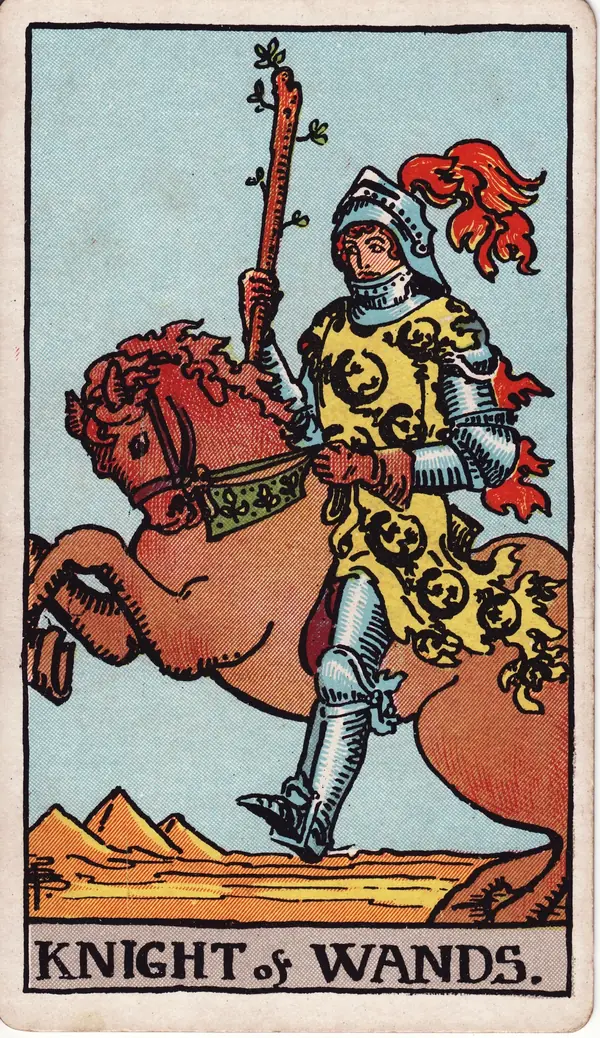
The Knight of Wands is one of the court cards in the Minor Arcana of the Classic Tarot. He belongs to the suit of Wands, the fire suit, and carries the element's heat, speed, and urge to move outward. A knight adds departure and momentum: this is not a figure who stays seated and plans forever.
Classic imagery shows him on a charging horse, cloak lifted by wind, wand held like a marker pointing forward, the landscape dry and open. The core meaning is simple: gallop ahead, go first, think later. He is action, adventure, and moving—sometimes before the route is fully clear.
Because court cards describe people, moods, and modes of action, the Knight can appear as an event, a personality, or an inner impulse. When the card arrives upside down, the fire does not vanish; it changes direction. The sections below separate upright and reversed meanings across love, thoughts, work, money, health, advice, and card positions.
Knight of Wands Kabbalah and Tree of Life
In Classic Tarot, court cards do not take one of the numbered paths assigned to the Major Arcana. They are read through two layers at once: the element of their rank and the world governed by their suit. The Knight's rank element is air. Air moves people through travel, conversation, testing, and quick reactions. Wands belong to fire in the archetypal world, where attention goes to will, passion, and the urge to begin. Put the layers together and you get air inside fire: a fire that wants to burn forward, expressed through a gust of motion—charge first, find the bearing on the way.
The card is often placed at Tiphareth (Beauty), the sixth sephirah. Sitting at the center of the Tree, Tiphareth speaks of balance and harmony, and of how a person gathers the forces above into a self that others can recognize. So the Knight of Wands is not merely reckless. He also has to bring his speed back to that center and know why he set out. The rank element tells you how he acts; the suit element tells you what he cares about. Air finds the route, carries the message, and tests what is possible. Fire supplies nerve, direction, and the staying desire to keep going. Take away air and the fire smothers. Take away fire and the air just circles.
A few scenes make this easier to see. In love, he cares about moving the relationship to its next step. He sends the first message, proposes a meeting, suggests a short trip. Air makes him quick to speak and full of ideas, though he may switch topics before the other person has caught up. At work, he cares about opening new ground. He will take on new clients or enter new markets. Air helps him ask around fast and coordinate on the spot, but he often leaves the cleanup details to someone else. In personal growth, the combination often shows up as the courage to leave a familiar setting—to move to another city, change social circles, or learn a new skill. The lesson is to return to center after every dash and ask whether the action made life more integrated or just kept him busy.
Astrology often connects the Knight of Wands with the Leo area. Leo is fixed fire: confident, expressive, visible. That fits the air-inside-fire structure well. Fire provides the presence he brings into a room; air provides the quick way he appears there. Traditions do not all assign court-card astrology the same way, so treat this as a helpful lens, not a fixed answer. What matters in a reading is still how air finds an outlet for fire, and whether fire carries air somewhere worth arriving.
Knight of Wands Numerology
The Knight of Wands is a court card, so it has no ace-to-ten pip number. You cannot read it by treating its face as a numeral. A more reliable starting point is its place on the Tree of Life: Tiphareth (Beauty), the sixth sephirah. Take six as the number of that station, and the themes are giving, care, the wish for perfection and harmony, and a high value on relationships and family. Its Major Arcana partner is the Lovers. Both cards involve choice and union: one asks whom you give your heart to, the other asks who this drive serves and why you are using it.
For the Knight, six adds a motive of “running for the relationship.” He may not be in love with freedom for its own sake. He may be trying to prove he is reliable through action—planning a partner's trip, taking the team's field assignments, handling trouble at home. The risk is that six's giving, with no boundaries, turns into overcommitment. He believes he is caring for people; they may feel pushed. Six wants harmony, but harmony is not one person finishing every task. It is everyone having a part.
Numerology also sees court cards as stages of maturity. The Knight is in the active period between youth and adulthood, and six reminds him that action is not only self-proof. He must also learn the balance of the relationship. If someone's life-path number is six, this card can work as a mirror: you tend to charge ahead for others, so check whether you have admitted you are tired. That is not a final judgment—just one angle. The real reading still comes from the whole spread and the person's situation.
In short, six gives the Knight's speed a caring motive, and gives his urgency a blind spot: the idea that more doing means more love. Keep both giving and boundaries in view, and the number actually helps the reading.
Knight of Wands and the Element of Fire
Wands belong to fire. Fire moves outward and upward, bringing action, responsibility, and a desire to control the direction of events. It makes a person act before explaining, burn physical energy freely, speak little, and move fast. The Knight's rank adds air, which rules thought, language, information, and travel. So the Knight of Wands is not a smoldering fire but air inside fire: fire gives the urge to charge, air gives the route, the words, and the reflex. In balance he is a torch fanned by wind, able to light up a room at once. Out of balance, wind scatters the flame into impatience, empty talk, or constant changes of direction.
The elements both cooperate and clash. Fire and air usually assist each other: air feeds fire oxygen, fire gives air a destination. Water and earth also pair well, one moistening and one carrying. Fire and water tend to fight, since one wants speed and outward expression while the other wants slowness and inward feeling. For this Knight, many Cups can cool his heat with emotion or worry, or show him burning a relationship because he misreads the other person's feelings. Many Swords add air to air: words come faster and judgment sharper, but he is more likely to decide before hearing the whole story.
A fire-heavy spread magnifies action, competition, travel, and physical effort. Events move quickly, yet the cards also warn against filling every hour; rest belongs in the plan. An air-heavy spread raises thinking, communication, stress, and friction, and a person may think and rush at once. With the Knight of Wands in such a spread, the scene is often concrete: at work, a sudden trip, a new project, or coordination across several locations; in love, someone pushing to define the relationship or talking the other person into a decision; in personal growth, the urge to leave an old environment right away. Ask whether this fire is clearing a road or rushing someone down it.
What does Knight of Wands mean upright?
The upright Knight of Wands says the decision has moved from mind to body. You may book the ticket, send the application, knock on the door, or finally move the desk that has blocked your workflow. His strengths are action, adventure, and moving: he gets stalled situations rolling and gives other people permission to try. At work this can look like a fast approval, a new client, or someone volunteering to lead. In love it is warm and direct, though his attention often follows his own mission. On the Tree of Life, knights are often linked with the sephirah of Beauty, where force takes shape. That is the useful reminder: heat needs a form, or it is only passing fire. Upright does not mean mature—it means the energy has started.
Knight of Wands reversed meaning
Reversed, the Knight of Wands keeps the fire but loses the clean outlet. The classic keywords are impulsiveness, quitting halfway, and hot temper. Someone promises quickly and then misses the follow-up; a project begins with noise and stalls once the interesting part ends; a conversation turns sharp because patience runs out. Sometimes the block is external—approval, budget, a slow partner—and sometimes it is internal, with too many starts and no finish. Do not rush to label laziness or bad faith. Ask whether the person cannot start, will not commit, or is simply stuck. The answer decides whether you need a method, a boundary, or a more realiztic pace.
Knight of Wands in love: single, in a relationship, reconciliation
In love, the Knight of Wands brings speed and initiative. He can push a relationship forward, but he may choose the direction without asking. This is a card of pursuit, invitations, travel, and spontaneous plans. It can feel exciting and a little uneven. The question is not whether the spark is real; it is whether the spark has somewhere to land. Read the surrounding cards for steadiness.
Knight of Wands upright love
Upright, love feels lively. Someone suggests a weekend trip, a concert, a drive, or a bold first date. Affection is shown through movement rather than long speeches: picking you up, making a plan, introducing you to friends. This can be refreshing, especially if the connection has been stuck. Still, notice whether enthusiasm includes listening. Does he ask about your schedule before booking? Does he remember that you need a quiet evening? The Knight's warmth is real, but it is self-propelled. Enjoy the momentum and keep your own pace. A good match here is not someone who dampens the fire; it is someone who helps it burn steadily.
Knight of Wands reversed love
Reversed, the same heat becomes uneven. Plans are made and canceled; messages arrive late at night and disappear by morning; apologies come quickly but the behavior repeats. There may be a hot temper in the mix, or a habit of leaving when a conversation gets difficult. This does not automatically mean the person is cruel. It may mean they are overwhelmed, immature in conflict, or chasing intensity rather than intimacy. What matters is the pattern over time. One busy week is life; months of broken plans is information. Say what you need in plain language, then watch whether words turn into a calendar entry.
Knight of Wands love for singles
For a single person, the Knight often appears as a sudden opportunity to move: a trip, a sports group, a friend's party, or an app match who wants to meet without a long text exchange. You may also feel a surge of courage to make the first move. That is worth using. The caution is to separate attraction from reliability. A fast beginning can be fun, but it does not prove that someone will stay. Notice whether the next meeting gets a date, whether small promises are kept, and whether you feel like a destination or a stop along the way. Let action, not intensity, earn your trust.
Knight of Wands in a relationship
In an established relationship, this Knight usually shows up as the one who wants to change the routine. He may propose a move, a renovation, a trip, or a new shared project. That energy can revive a couple that has been coasting. It can also leave one partner managing the home while the other chases the next adventure. If you are the steadier one, say plainly what support you need rather than waiting to feel resentful. If you are the restless one, build the plan with your partner instead of presenting it as a done deal. Put the next two weeks on a shared calendar, including rest.
Knight of Wands and getting back with an ex
With an ex, the upright Knight often brings a sudden message or a direct request to meet. He may want to clear the air, apologize, or simply see whether the spark is still there. Speed is not the same as repair. If the breakup involved broken promises or mismatched rhythms, ask what has changed in practical terms. A single intense conversation can reopen the door, but it cannot rebuild trust alone. Suggest a short, sober meeting, then agree on a contact rhythm and a check-in point. Let consistency, not urgency, decide whether a reunion deserves another chapter.
Knight of Wands as feelings: how they feel about you
When the Knight of Wands describes what someone feels, it usually carries heat, curiosity, and a desire to act. The feeling is often real in the moment, but it may be tied to pursuit rather than long-term commitment. Read the upright and reversed versions differently, and always compare them with the rest of the spread.
Knight of Wands upright as feelings
Upright, they feel drawn to you with momentum. They want to see you, talk to you, or take you somewhere. Their thoughts run toward the next meeting rather than a distant future, and their interest may show as playful teasing, quick replies, or an invitation made on the spot. This can be sincere and exciting. It can also be a little self-focused, because the pleasure of the chase is part of the charge. If you want more clarity, ask a concrete question about timing. Their answer, and whether they follow through, will tell you more than the temperature of their enthusiasm.
Knight of Wands reversed as feelings
Reversed, their feelings are tangled with hesitation. They may want you near but fear being tied down, or they may enjoy the attention without wanting the responsibility that comes with it. You might experience bursts of warmth followed by distance. Sometimes the cause is external stress; sometimes it is a habit of leaving before anyone can ask for more. Do not fill the silence with a story that flatters them. Give them room to state their position, then watch their actions for two or three weeks. Interest that cannot survive a simple plan is not a stable foundation.
Knight of Wands as how someone sees you
They may see you as bright, attractive, and hard to ignore—someone who brings motion into their life. You might seem adventurous, direct, or a little unpredictable. That can be flattering, but it can also turn you into a symbol of escape rather than a whole person. If they only praise your spontaneity and never ask about your responsibilities, your worries, or your ordinary days, they may be responding to a mood rather than to you. Let them meet the parts of you that are not performing. The right person will find both the fire and the quiet interesting.
Knight of Wands as intentions
Their intention is usually to move things forward, at least in the short term. They may want a date, a trip, a physical connection, or a chance to see whether the chemistry works in person. Upright, the intention is more likely to be stated openly. Reversed, it may be vague, inconsistent, or focused on convenience. Ask yourself whether the intention includes your needs or only their curiosity. A clear intention does not have to be a lifetime promise, but it should be honest about what is available now. Listen for specifics: when, where, and what happens next.
Knight of Wands career and work (upright & reversed)
At work, the Knight of Wands is a starter. He is useful when something needs a push, a launch, or a visible champion. He is less useful for audits, handovers, and slow consensus. The upright and reversed positions show whether that drive is being received well or leaking into chaos. Read the card alongside the rest of the spread before you decide which version is active.
Knight of Wands upright career
Upright, projects move. A decision lands, a client responds, a team member volunteers to lead, or a stuck process finally gets a temporary workaround. This is a good moment to pitch an idea, apply for a role, attend an industry event, or ask for a stretch assignment. Jobs that involve travel, field work, sales, emergency response, or quick troubleshooting may suit the energy. The risk is celebrating speed before the details are secure. Before you charge ahead, write down the deliverable, the owner, and the date. Then go. One page of clarity can save a week of rework.
Knight of Wands reversed career
Reversed, progress stalls or scatters. Meetings repeat without decisions, a plan is revised endlessly, or someone keeps announcing a launch without a launch date. The cause may be your own scattered attention, a slow approval chain, or a colleague who promises more than they deliver. Avoid solving everything with extra effort. Find the actual bottleneck and name it. If the block is yours, shrink the next step until it is easy to begin. If it is someone else's, confirm deadlines in writing and set a review point. Changing jobs may bring relief, but it will not fix a habit of leaving before the hard part.
Knight of Wands for money and finances
With money, the Knight of Wands emphasizes flow and initiative rather than sudden windfall. Upright, extra income may come from a new project, a move, a trip, or a channel you have been meaning to test. The same motion can bring costs: travel, equipment, deposits, or a change of workplace. The healthy approach is to let activity create options while protecting a buffer. Decide what portion of any new income is spoken for before it arrives.
Reversed, watch impulse spending, paying for appearances, and plans that assume money will arrive on time. A partner's slow payment or a delayed reimbursement can tighten the month. This is not a card for guaranteed profit or specific investment choices; it is a prompt to check the rhythm between what comes in and what leaves. If a purchase depends on future money, wait until the money is visible.
Knight of Wands for health
The Knight of Wands relates to energy, movement, and the tendency to override fatigue. In a health context, keep the reading practical: this card can highlight stress, sleep, and activity levels, not diagnose a condition. Upright, energy may be good, and regular movement—walking, cycling, a sport, stretching between tasks—can help discharge the fire. The caution is overdoing it after a busy stretch. Warm up, hydrate, and protect a full night's sleep.
Reversed, the pace may be erratic: late nights, too much caffeine, long sedentary days followed by intense exercise. If discomfort, palpitations, or unusual exhaustion persists, see a doctor. Pregnancy questions need medical advice, not a card reading. Use this card as a reminder to notice your body's signals early, not as a substitute for professional care.
Knight of Wands as advice
The Knight's advice depends on whether the fire is moving cleanly. Upright, use the momentum before it cools. Reversed, slow down enough to check what you have promised. In both cases, the goal is not to become cautious; it is to give action a landing place. A useful rule is to move at the speed of your follow-through.
Knight of Wands upright as advice
Pick the smallest real action and do it today. Send the email, book the call, pack the bag, ask the question. Then attach a checkpoint: three days to review, one week to decide whether to add resources. Because this Knight is better at starting than finishing, borrow a finisher. Pair with someone who loves details, or use a simple list that shows what "done" looks like. Tell people your timeline instead of saying "soon." Heat is precious; do not let it evaporate in a group chat. Move, but leave a marker for your return.
Knight of Wands reversed as advice
Before you promise more, check your capacity. Replace "I will handle it" with a date and a specific next step. If you cannot deliver, say so early; that is more trustworthy than a dramatic apology later. Close a few open loops before opening new ones. If someone else is blocking you, move the conversation from feeling to facts: what is needed, who owns it, and when it will be reviewed. If you are tired, rest is part of the plan, not a failure of drive. Finally, look at the neighboring cards to see whether the delay is temporary or the direction itself is wrong.
Knight of Wands as a person
As a person, the Knight of Wands is outgoing, kinetic, and easy to notice. He speaks directly, moves quickly, and often has a project, a trip, or a training plan in motion. He may be drawn to outdoor work, travel, sales, performance, or any role with variety. He is generous with enthusiasm and can make an ordinary afternoon feel like an event. The shadow side is impatience: he may finish your sentence, forget a follow-up, or treat a shared plan as his solo schedule. He is not necessarily uncaring; his attention simply runs ahead of him. Good friends appreciate his spark and remind him to slow down.
Knight of Wands reversed as a person
Reversed, this figure can be all talk and little follow-through. He may promise to help, then vanish when the work begins; start strong, then quit when the novelty fades; or turn irritation into a sharp remark. Sometimes the reversal shows someone whose confidence is louder than his competence. At other times it shows a person who is exhausted and scattered rather than dishonest. The distinction matters. Ask what has actually been completed, not what has been announced. Keep boundaries around your time, and do not mistake intensity for reliability. He can still be warm and fun; just do not build your plans on his unconfirmed words.
How to place it in a reading
Start with the position. In the past, the Knight can show a departure, a rapid decision, or a period of restless movement. In the present, it suggests that events are already in motion and a response is needed. In the future, it points to a fast-moving development or an invitation that arrives with a short window. In an advice position, it asks for initiative. In an obstacle position, it warns that speed or temper is getting in the way.
Then read the neighbors. Other Wands increase heat, competition, and visible action. Swords add quick thinking and sharp speech; the combination can become argumentative if no one pauses. Cups soften the tone but may reveal a gap between excitement and emotional presence. Pentacles ask for a budget, a schedule, or a physical anchor. Major Arcana cards raise the stakes and suggest that the movement is part of a larger transition. Look for repeated suits and repeated numbers, because they show where the energy gathers.
Our take
The Knight of Wands has valuable heat. We would not try to cool it down; we would pair it with someone who finishes things. That is the idea behind our take: the card is at its best when its impulse is met by follow-through, whether that comes from a teammate, a partner, or a habit you build yourself. If you are the Knight, find a person or routine that helps you close loops. If you love a Knight, receive the enthusiasm first, then make the plan concrete. Fire is not the problem. Fire without a container is.

FAQ
These short answers follow the site's usual approach: read the card in context and keep the yes/no grade flexible. The first paragraph gives the direct response, and the notes below explain when the answer may shift. A court card rarely acts alone, so let the full spread guide you.
Is Knight of Wands a yes or no card?
It depends on the other cards. The Knight of Wands is not a fixed yes or no on its own. Upright, he often leans yes for questions about action, travel, launching, or making contact, because the card shows movement and initiative. For questions about stability, long-term commitment, or careful planning, his yes is less dependable. Reversed, the answer usually becomes "not yet" or "only if the follow-through improves." Check whether supportive cards supply patience and structure. If the rest of the spread is slow and steady, his speed may be an asset. If it is chaotic, his speed may be the problem.
What does Knight of Wands reversed mean in a yes or no reading?
Usually not yet, or a soft no, because follow-through is weak. Let the other cards refine it. A reversed Knight can mean the request is premature, the person is unreliable, or the energy is scattered. If you are asking whether someone will act, look for evidence that they have already acted. If you are asking whether to proceed, check your own capacity and the practical details. A strong Pentacle or a steady Major card can offset some of the instability, but it does not turn an empty promise into a plan. Treat this as a prompt to verify, not a final verdict.
What does Knight of Wands mean if you have a secret crush?
It suggests quick attraction and a possible bold move, but not necessarily lasting intent. There may be glances, teasing, sudden messages, or an invitation that seems to come out of nowhere. The person could be drawn to your energy and want to see what happens. That can be exciting, especially if you have been waiting for a sign. The caution is projection. A secret crush often magnifies a small signal into a full story. Watch whether their interest survives an ordinary Tuesday: do they make a real plan, remember your plans, and stay consistent after the exciting first step? If yes, respond. If not, enjoy the spark without handing it your whole week.
What does Knight of Wands mean for marriage?
It shows momentum, not a ready-made commitment. Watch whether plans become real. This card may appear when a couple is discussing a move, a family event, a shared home, or a practical next step. It can signal that one person wants to push forward. It does not promise a proposal or guarantee that both people are ready. Reversed, pay attention to broken promises, rushed decisions, or one partner avoiding the serious conversation. A wedding is a sequence of choices, not a single burst of enthusiasm. Look for steady follow-through and shared responsibility in the surrounding cards.
What does Knight of Wands mean as an outcome?
A fast-moving outcome with a burst of energy; whether it lasts depends on follow-through. Upright, expect news, movement, or a situation that develops quickly. The result may be exciting and may require you to respond before you feel fully prepared. Reversed, the outcome may be delayed, unfinished, or marked by frustration and scattered effort. The Knight is not a card of quiet permanence. If the question is about a long-term result, read the other cards for staying power. If it is about a short trip, a launch, or a first step, the card is more straightforward.
What timing does Knight of Wands suggest?
Often soon—days to a few weeks—especially when other fast cards appear. Fire cards tend to move quickly, and a knight adds speed. A simple three-card spread may point to the next few weeks; a larger spread can stretch the window. Still, timing is not fixed. The Knight can also describe a season of high activity rather than a precise date. Use the card as a sense of pace, not a countdown. If the surrounding cards are slow, such as Pentacles or quiet Major Arcana, the event may take longer than the Knight's first impression suggests.
Does Knight of Wands mean pregnancy?
No. This card cannot confirm pregnancy; take a test and consult a doctor. The Knight of Wands speaks to energy and movement, not to medical facts. No tarot card can reliably answer a pregnancy question, and this one certainly should not be treated as a diagnosis. If you are trying to conceive or worried about a possible pregnancy, use a home test and seek professional medical advice. The card may reflect excitement, anxiety, or a desire to move forward in life, but those feelings are not evidence about your body. Keep health decisions with qualified care.
What zodiac sign is Knight of Wands?
Leo is the common correspondence, often with the neighboring sign; court card traditions differ. In many traditional lists, the Knight of Wands is tied to Leo and sometimes to the adjacent sign, which fits the card's fire, pride, and dramatic forward motion. Other systems assign court cards by element and modality, so you may see a different sign in a different lineage. The safest reading is symbolic: the Knight carries fire's courage and heat. Use the zodiac link as a useful lens, not a fixed rule about a person's birthday or character.
Is Knight of Wands a good or bad card?
Neither by itself. It is a strong, fast card whose value depends on how its fire is used. Upright, it can be excellent for starting, traveling, competing, and breaking inertia. It can be difficult for patience, commitment, and careful follow-through. Reversed, it can point to impulsiveness, unfinished projects, or a short temper, but it can also show that energy is blocked and needs a better outlet. The card is morally neutral. Ask what the fire is serving, and whether there is anyone or anything to help it land.
Related cards
- Page of Wands: also fire and eager, but the Page explores while the Knight has already set out.
- Queen of Wands: turns the Knight's charge into sustained confidence and self-command.
- King of Wands: a mature fire leader who knows where to aim and how to carry responsibility.
- The Chariot: another fast card, but it adds willpower and direction to the Knight's raw momentum.
- Knight of Swords: equally quick, though the speed lives in thought and speech rather than physical action.
- Temperance: offers a useful counterweight, reminding the Knight to balance exertion with rest.